
Featured Electric Heating Tubes & Resistance Alloys (Top Selection)
Direct factory wholesale supply from China’s premier metallurgical manufacturer. Engineered for extreme operating temperatures up to 1425°C, high power density, and prolonged service longevity.


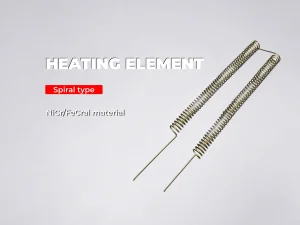
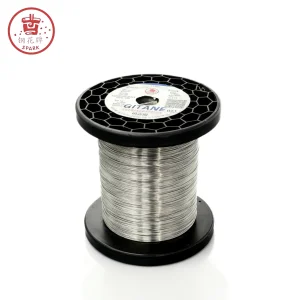
Technical Whitepaper: Advanced Material Physics & Sheath Mechanics of Electric Heating Tubes
An authoritative deep dive into resistance alloy formulation, high-temperature oxidation kinetics, structural sheathing options, and surface load calculations for B2B procurement teams and thermal engineers.
1. Metallurgy Formulation & Oxide Scale Protection
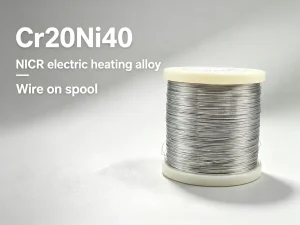
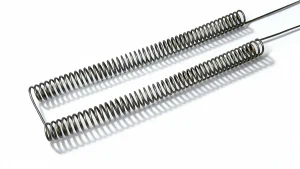
High-performance electric heating tubes operate in demanding thermal environments where structural integrity, electrical insulation, and resistance to thermal degradation are paramount. The inner core of a premium heating tube consists of a precisely drawn resistance element—typically either a Iron-Chromium-Aluminum (FeCrAl) alloy or a Nickel-Chromium (NiCr) matrix.
At temperatures above 1000°C, FeCrAl alloys form a dense, adherent layer of alpha-alumina ($\alpha-Al_2O_3$). This ceramic-grade oxide oxide film acts as a thermodynamic barrier against atmospheric oxygen, sulfur vapor, and carbon ingress. In contrast, NiCr alloys generate a protective chromia ($\text{Cr}_2\text{O}_3$) oxide layer, offering superior mechanical ductility at elevated temperatures and exceptional structural stability during rapid thermal cycling.
2. Powder Metallurgy (PM) Microstructure Breakthroughs
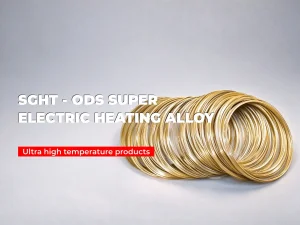
Traditional ingot-melting alloys suffer from grain growth and creep deformation at temperatures exceeding 1300°C. To solve this engineering limit, Beijing Shougang Gitane New Materials developed the SGHT powder metallurgy process. By consolidating fine alloy powders via hot isostatic pressing (HIP), SGHT exhibits exceptional grain refinement and dispersion hardening.
This advanced metallurgical process eliminates micro-segregation, dramatically lowers the thermal expansion coefficient, and prevents sagging in vertically or horizontally suspended radiant heating tubes—yielding up to a 300% extension in continuous operating lifespan under severe heat-treatment conditions.
Information Gain Engineering Note: When evaluating wholesale heating tube quotes, never select elements based on resistance value alone. Watt density ($W/\text{cm}^2$), sheath wall thickness, compaction density of the Magnesium Oxide ($\text{MgO}$) dielectric buffer, and thermal conductivity differentials are the critical parameters determining Total Cost of Ownership (TCO).
| Alloy Grade / Sheath Material | Composition Class | Max Temp (°C) | Resistivity ($\mu\Omega\cdot\text{m}$, 20°C) | Key Industrial Applications |
|---|---|---|---|---|
| SPARK SGHT | FeCrAl (Powder Metallurgy) | 1425°C | 1.45 ± 0.05 | Semiconductor diffusion, ceramic sintering, solar PV cell furnaces |
| SPARK SGHYZ / HRE | FeCrAl + Rare Earth (RE) | 1350°C - 1400°C | 1.42 ± 0.04 | Heavy industrial heat treatment, carburizing & annealing kilns |
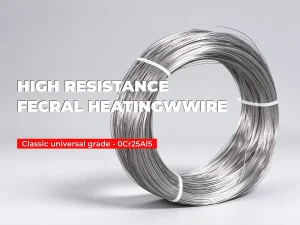
| 0Cr25Al5 | Standard FeCrAl | 1250°C | 1.42 | Industrial tempering ovens, immersion heaters, radiant heating tubes |
| Cr20Ni80 (Nichrome) | 80Ni-20Cr Alloy | 1200°C | 1.09 | High-vibration equipment, medical sterilization, precise laboratory heaters |
| Incoloy 800H Sheath | Ni-Fe-Cr Superalloy | 1100°C (Sheath) | N/A (Sheathing Material) | Corrosive fluid immersion, chemical processing, high-pressure steam boilers |
Technology Roadmap & Future Outlook (2025–2035)
How next-generation electric heating elements are evolving to meet Industry 5.0 efficiency standards, carbon-neutral manufacturing mandates, and smart thermal management architectures.
Embedded Sensor Integration & AI-Driven Predictive Maintenance
The future of high-performance electric heating tubes lies in cyber-physical smart elements. Next-generation heating tubes incorporate thin-film thermocouple micro-sensors and fiber-optic Bragg gratings directly within the compacted $\text{MgO}$ dielectric core.
This allows real-time telemetry of internal resistance wire temperature, localized thermal hotspots, and dielectrical insulation decay. Integrated AI algorithms analyze impedance shifts to predict material failure weeks before burnout occurs, completely eliminating unscheduled line stoppages in automated assembly plants.
Hydrogen-Compatible & Clean Atmosphere Heating
As global manufacturing transitions to green hydrogen ($\text{H}_2$) as a reducing agent in green steelmaking and chemical synthesis, conventional resistance alloys face severe embrittlement and oxide scale loss. Shougang Gitane’s R&D roadmap emphasizes rare-earth doped Fe-Cr-Al formulations optimized for $100\%\ \text{H}_2$ and water-vapor-rich cracked ammonia atmospheres.
Our advanced pre-oxidation treatment protocols generate zero-porosity alumina protective layers that completely isolate the underlying metallic matrix from hydrogen atom penetration.
Additive Manufacturing & Gradient Porous Sheathing
Leveraging selective laser melting (SLM) 3D printing technologies, Gitane is pioneering custom tubular heating elements featuring variable cross-section heating coils and internally finned metallic sheaths. This geometric optimization boosts convective surface area by up to $400\%$.
Gradient density MgO filling combined with 3D-printed ceramic insulators allows ultra-fast dynamic thermal response ($>150^\circ\text{C/sec}$) without inducing thermal shock cracking in the tube envelope.
Macro Industry Solutions & System Integration
Tailored electrical heating architecture engineered for harsh operating environments, ultra-clean manufacturing requirements, and energy-efficient industrial processing.
Semiconductor Wafer Epitaxial Growth & Diffusion
In silicon and silicon carbide (SiC) semiconductor fabrication, thermal uniformity across 300mm wafers must be held within $\pm 0.5^\circ\text{C}$. Gitane provides high-purity quartz sheath electric heating tubes fitted with SGHT powder-metallurgy resistance spirals. Zero particle shedding, ultra-low ionic contamination, and multi-zone precise thermal gradient control guarantee maximum wafer yield in oxidation, annealing, and LPCVD processes.
Lithium EV Battery Cathode/Anode Calcination
Continuous roller hearth kilns for LFP and NCM battery material synthesis require radiant heating tubes capable of withstanding corrosive lithium dust and high alkaline vapor emissions. Our high-nickel Incoloy-sheathed heating elements equipped with heavy-gauge FeCrAl elements prevent shell swelling, resist chemical pitting, and deliver exceptional energy utilization during continuous $24/7$ calcination schedules.
Photovoltaic Silicon Ingot Pulling & Solar Glass Annealing
Monocrystalline Czochralski (CZ) growers and solar glass tempering lines rely on robust high-power immersion and radiant tubular heaters. Gitane’s heavy-duty 0Cr25Al5 and SGHYZ spiral heating tubes offer high watt density capabilities ($>8\ \text{W/cm}^2$), minimizing thermal inertia during pull ramp-up while reducing power consumption by up to $18\%$ compared to legacy carbon heaters.
China Factory 4.0: Supply Chain Resilience & Shougang Gitane Heritage
Backed by Shougang Group’s state-owned metallurgical infrastructure, Beijing Shougang Gitane New Materials Co., Ltd. operates an 88,000m² vertically integrated facility delivering unmatched cost-efficiency, quality control, and global dispatch stability.
Vertically Integrated Metallurgical Value Chain
Unlike secondary assemblers who purchase third-party wire, Shougang Gitane controls every step of production: from vacuum induction melting (VIM) and electroslag remelting (ESR) to hot rolling, precision cold drawing, hydrogen annealing, and final tube assembly.
This complete vertical integration guarantees $100\%$ raw material traceability, consistent electrical resistivity batch-to-batch, and significant wholesale cost economies passed directly to global B2B buyers.
Automated Quality Control & Testing Rigor
Our Changping production base incorporates automated ultrasonic wall-thickness scanning, X-ray weld inspection, real-time laser wire micrometer checks, and high-voltage dielectric insulation testing ($>2500\text{V/1s}$ zero breakdown).
Every shipment leaves our factory accompanied by certified mill test reports (MTRs) compliant with EN 10204 3.1 / 3.2, verifying chemical composition, tensile yield strength, and electrical resistance accuracy.
Global Enterprise Procurement & Engineering Selection Framework
Key technical criteria for specifying electric heating tubes and evaluating OEM supplier quotes.
1. Surface Watt Density Calculation
Calculating the safe maximum watt density ($p$, in $\text{W/cm}^2$) is critical to prevent premature oxidation failure. Formula:
$p = \frac{P}{\pi \cdot d \cdot L_h}$
where $P$ is total power (Watts), $d$ is element diameter ($\text{cm}$), and $L_h$ is active heated length ($\text{cm}$). Forced air systems can handle $4–6\ \text{W/cm}^2$, while radiant tube furnaces require conservative limits ($1.5–3.0\ \text{W/cm}^2$).
2. Dielectric MgO Purity & Compaction
The electrical insulation between the internal resistance wire coil and the outer protective metal sheath depends on compacted Magnesium Oxide ($\text{MgO}$) powder. Gitane utilizes high-purity fused electrical-grade $\text{MgO}$ ($>99.5\%\ \text{MgO}$, low iron content $<0.05\%$) compacted via multi-stage swaging to achieve densities above $3.1\ \text{g/cm}^3$ for maximum thermal conductivity and zero leakage current.
3. Cold Leg Ratio & Terminal Design
To protect terminal connection boxes and electrical wiring from thermal degradation, electric heating tubes must feature calibrated unheated "cold zones". We engineer custom cold-leg ratios utilizing oversized terminal pins or dual-strand low-resistance lead wires securely welded via automated TIG/laser systems.
Localization Support, Compliance & Regulatory Assurance
Seamless integration with international engineering standards and global logistics channels.
International Regulatory Compliance
All heating alloys and fabricated tubular heaters produced by Beijing Shougang Gitane comply strictly with GB/T 1234-2012, ASTM B603, DIN 17470, and JIS C2520 standards. Furthermore, our raw materials conform to EU RoHS directives, REACH chemical safety frameworks, and carry CE and UL certification eligibility for seamless export to North American, European, and Asian markets.
Customs, Logistics & OEM White-Labeling
We provide end-to-end support for international buyers, including DDP/FOB/CIF shipping terms, custom wooden-crate export packaging, custom laser branding/part marking, and dedicated technical multilingual support. Engineering drawings submitted via CAD/STEP files are processed by our engineering team within 24 hours.
Supplementary High Performance Electric Heating Alloys & Tubes (Bottom Selection)
Explore our extended industrial catalog of heating elements, specialized FeCrAl/NiCr resistance wires, and custom assembly components direct from the manufacturer.
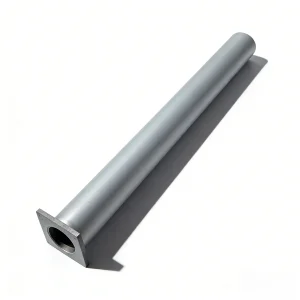
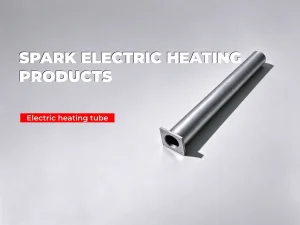
Technical & Procurement FAQ (Frequently Asked Questions)
Detailed answers to crucial thermal engineering, material selection, and ordering questions encountered by B2B buyers and process designers.
What is the fundamental engineering difference between FeCrAl and NiCr heating tube elements?
NiCr (Nickel-Chromium) elements (such as Cr20Ni80 and Cr30Ni70) operate at slightly lower maximum temperatures (up to 1200°C), but maintain high ductility and mechanical strength after prolonged heating cycles. NiCr forms a tough chromia scale that resists flaking during rapid, frequent thermal cycling and performs exceptionally well in humid or nitrogen-containing atmospheres.
How does Powder Metallurgy (SGHT) improve electric heating tube performance at 1400°C+?
This yields a fine, uniform grain structure resistant to high-temperature thermal creep. SGHT maintains structural stiffness, prevents sagging in horizontal or suspended radiant heating tubes, and develops a self-healing alpha-alumina oxide skin that dramatically extends element life in severe continuous service up to 1425°C.
How do I calculate the optimal watt density for wholesale electric heating tubes?
$$\text{Watt Density } (W/\text{cm}^2) = \frac{\text{Total Element Power (Watts)}}{\pi \times \text{Sheath Outer Diameter (cm)} \times \text{Heated Length (cm)}}$$
Recommended limits:
- Forced Air Heating: $4.0 - 7.0\ \text{W/cm}^2$
- Water / Immersion Boilers: $6.0 - 10.0\ \text{W/cm}^2$
- Heavy Viscosity Oil / Chemical Solutions: $1.5 - 3.0\ \text{W/cm}^2$
- High-Temperature Radiant Tube Furnaces: $1.5 - 2.5\ \text{W/cm}^2$
Which sheath material should I select for corrosive or liquid immersion heating applications?
- Stainless Steel 304/316L: Suitable for clean water heating, low-temperature air ovens, and mild alkaline solutions up to 400°C.
- Stainless Steel 310S: High-chromium steel ideal for high-temperature air heaters and oxidation environments up to 800°C.
- Incoloy 800H / 840: Superalloy featuring high nickel-chromium content. Resistant to stress corrosion cracking, carburization, and chemical attack in industrial immersion and high-pressure boilers up to 1050°C.
- Quartz / Ceramic Sheathing: Mandatory for highly acidic solutions, semiconductor processing, and high-purity environments requiring zero metallic ion contamination.
What quality certifications and mill documentation accompany Shougang Gitane orders?
Every shipment is provided with formal EN 10204 3.1 Mill Test Reports (MTRs), specifying chemical composition analysis, cold resistance values ($\Omega/\text{m}$), tensile strength, elongation percentages, and high-voltage insulation test results.
What is the typical lead time and MOQ for OEM custom wholesale orders?
Minimum order quantities (MOQs) are flexible depending on alloy weight and custom tooling requirements. Contact our technical export sales division for rapid RFQ feedback within 24 hours.