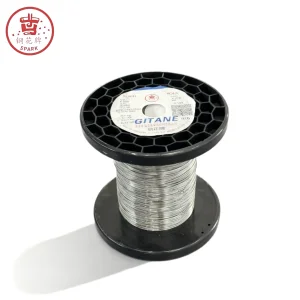
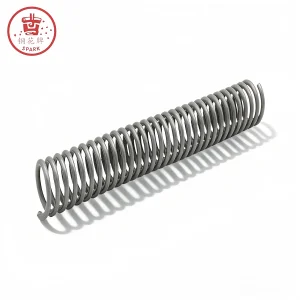
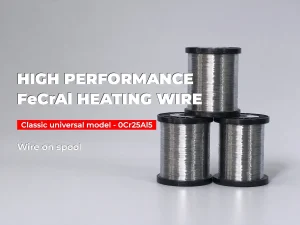
High Resistance FeCrAl & Heating Alloy Products (Part I)
Direct supply from leading Chinese metallurgical facilities, featuring optimized iron-chromium-aluminum alloys, precision spiral coils, and high-temperature elements.
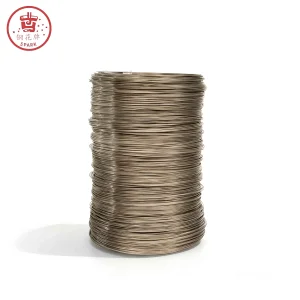
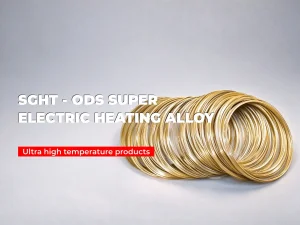

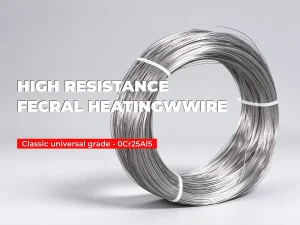



Metallurgical Science of High Resistance FeCrAl Alloys
Understanding the microstructural mechanics, oxidation mechanisms, and thermodynamics that give Iron-Chromium-Aluminum alloys their outstanding high-temperature superiority.
The $\alpha-\text{Al}_2\text{O}_3$ Oxide Passivation Barrier
High Resistance FeCrAl alloys are ferritic iron-chromium-aluminum materials engineered specifically for thermal resistance applications up to 1425°C. Unlike traditional Nickel-Chromium (NiCr) alloys which rely on a chromia ($\text{Cr}_2\text{O}_3$) protective scale, high-grade FeCrAl forms an intensely adherent, non-porous layer of alpha-alumina ($\alpha-\text{Al}_2\text{O}_3$) when heated above 1000°C.
This aluminum-oxide film possesses extremely high electrical resistivity, excellent thermodynamic stability, and low oxygen permeability. In the event of surface abrasion or thermal cycling, the underlying aluminum dopes within the bulk matrix migrate rapidly to the surface, continuously repairing the passivation barrier. This self-healing characteristic prevents progressive oxidation and catastrophically slow degradation of the internal wire core.
Chemical Micro-Alloying & Reactive Elements
Modern industrial FeCrAl alloys—such as 0Cr25Al5, 0Cr21Al6Nb, HRE, SGHYZ, and powder metallurgy SGHT—incorporate trace additions of Reactive Elements (RE) including Yttrium (Y), Zirconium (Zr), Hafnium (Hf), and Rare Earth Metals (REM).
These micro-alloying additives perform critical metallurgical functions:
- Grain Boundary Locking: Prevents rapid ferritic grain coarsening at elevated temperatures.
- Sulfur Pegging: Traps trace sulfur impurities to preserve scale adhesion.
- Creep & SAG Resistance: Enhances high-temperature structural rigidity during continuous horizontal heating operations.
Physical & Electrical Property Matrix: FeCrAl vs. Alternative Heating Materials
| Alloy Grade / Family | Max Service Temp (°C) | Electrical Resistivity (μΩ·m, 20°C) | Density (g/cm³) | Thermal Expansion (10⁻⁶/K) | Primary Atmosphere Suitability |
|---|---|---|---|---|---|
| 0Cr23Al5 (FeCrAl) | 1250°C | 1.35 ± 0.05 | 7.25 | 14.0 (20–1000°C) | Oxidizing, Air, Carburizing with pre-ox |
| 0Cr25Al5 (Standard Industrial) | 1300°C | 1.42 ± 0.05 | 7.10 | 14.7 (20–1000°C) | Air, Dry Hydrogen, Inert gases |
| SGHYZ 1400°C (Rare Earth Enriched) | 1400°C | 1.45 ± 0.05 | 7.10 | 15.0 (20–1000°C) | High-temp Kilns, Oxidizing, Sulfur-rich |
| SGHT (Powder Metallurgy ODS) | 1425°C | 1.45 ± 0.05 | 7.10 | 15.2 (20–1000°C) | Ultra-high-temp continuous furnaces |
| Cr20Ni80 (Nichrome Benchmark) | 1200°C | 1.09 ± 0.05 | 8.40 | 17.0 (20–1000°C) | Reducing, Ammonia, Wet Nitrogen |
High Resistance FeCrAl Alloy Pricelist & Cost Factors Matrix
Commercial pricing guide for B2B procurement officers, engineering managers, and furnace OEMs. Understand factory-direct cost drivers and price benchmarks.
Raw Material Metallurgical Purity
FeCrAl prices are heavily anchored to high-purity electrolytic iron, low-carbon ferrochrome, and pure aluminum ingots. Micro-alloying premiums for Yttrium, Zirconium, and Niobium add specialized technical value for extreme heat applications.
Wire Diameter & Dimensional Tolerance
Fine wires (< 0.20 mm) require repetitive multi-pass diamond die drawing and specialized intermediate bright hydrogen annealing, raising labor and processing costs per kilogram compared to heavy rod stocks (> 5.0 mm).
Powder Metallurgy Synthesis (PM)
Advanced grades like SGHT 1425°C utilize Gas Atomization and Hot Isostatic Pressing (HIP) followed by extrusion. This powder metallurgy route commands a premium over conventional ingot melting due to unmatched thermal life.
Global Wholesale Price Benchmarks (EXW Factory China Basis)
*Note: Prices vary according to international metal exchange fluctuations, order volume, wire gauge specifications, and custom annealing treatments. Contact our engineering desk for live, binding quotes.
| Grade / Specification | Diameter Range (mm) / Form | Est. Price Benchmark (USD/kg) | Min. Order Quantity (MOQ) | Typical Lead Time |
|---|---|---|---|---|
| 0Cr23Al5 Standard Wire | 1.0 mm – 6.0 mm (Coil/Spool) | $6.50 – $9.80 / kg | 100 kg | 5 - 10 Days |
| 0Cr25Al5 Industrial Grade Wire | 0.5 mm – 3.0 mm (Spool) | $8.20 – $12.50 / kg | 100 kg | 7 - 12 Days |
| 0Cr21Al6Nb High-Temp Wire | 0.8 mm – 5.0 mm (Coil) | $11.50 – $16.00 / kg | 200 kg | 10 - 15 Days |
| SGHYZ 1400°C Ultra-Alloy Wire | 1.5 mm – 8.0 mm (Heavy Coil) | $18.00 – $26.00 / kg | 100 kg | 12 - 18 Days |
| SGHT Powder Metallurgy Wire | 2.0 mm – 7.0 mm (Precision Rod/Wire) | $32.00 – $48.00 / kg | 50 kg | 15 - 25 Days |
| FeCrAl Precision Ribbon / Strip | Thickness 0.1 - 2.0mm, Width 5-100mm | $10.50 – $18.50 / kg | 150 kg | 10 - 15 Days |
Total Cost of Ownership (TCO): FeCrAl vs. NiCr ROI Advantage
While initial procurement price per kilogram is a vital metric, smart engineering buyers evaluate the Total Cost of Ownership across the entire furnace lifecycle:
Material Weight Reduction (Density Factor)
FeCrAl has a density of ~7.10 g/cm³ versus NiCr's ~8.40 g/cm³. Purchasing 100 kg of FeCrAl provides ~15% more total meters of resistance element than 100 kg of NiCr wire of identical gauge, yielding direct unit cost savings.
Extended Operational Lifespan in Oxidizing Duty
Due to the non-scaling alpha-alumina oxide film, premium FeCrAl alloys outlast NiCr by up to 200% at temperatures exceeding 1100°C, drastically minimizing line shutdown hours, coil element replacement labor, and lost heat-treatment production throughput.
Why Source FeCrAl Alloys From China Manufacturers (SPARK Advantage)
China has emerged as the global epicenter for advanced electrometallurgical materials, combining complete upstream mining integration with world-class secondary refining technology.
Fully Integrated Production Ecosystem
Chinese manufacturers manage every phase: Vacuum Induction Melting (VIM), Electroslag Remelting (ESR), Hot Rod Rolling, Cold Drawing, and Automated Continuous Annealing under one roof.
Strict Quality Verification (GB/T 1234 Standard)
China's GB/T 1234-2012 electrothermal alloy standard enforces rigorous resistivity uniformity tolerance, cold-bend ductility testing, and accelerated life testing under cycling thermal loads.
Powder Metallurgy R&D Breakthroughs
Leading Chinese state-level enterprises have perfected Oxide Dispersion Strengthened (ODS) FeCrAl alloys (such as SGHT), closing the gap with European specialty manufacturers at lower capital expenditures.
Agile OEM Customization & Delivery
Custom ribbon cross-sections, pre-formed wave shape elements, pickled or oxidized surface finishes, and rapid air-freight packing allow swift integration into international furnace builds.
Macro-Industry Solutions & Localized Use Cases
Deploying High Resistance FeCrAl Alloys across mission-critical heating infrastructure in modern manufacturing, energy transition, and advanced tech sectors.
Lithium Battery Cathode Sintering Kilns
Continuous Roller Hearth Kilns (RHK) synthesizing LFP and NCM cathode powders require precise heating zone uniformity (1000°C–1200°C). FeCrAl elements resist chemical attack from lithium vapor outgassing while maintaining tight physical stability.
Diffusion & Oxidation Quartz Tube Heating
Semiconductor wafer processing and solar cell photovoltaic silicon ingot diffusion furnaces utilize high-purity SGHT powder metallurgy FeCrAl. These alloys withstand continuous 1350°C–1400°C thermal cycles without sagging or contaminating cleanroom environments.
Automotive & Steel Heat Treatment
Carburizing, nitriding, annealing, and hardening furnaces demand robust heating coils. High resistance FeCrAl strip and wire elements deliver high surface watt loading ($W/\text{cm}^2$) for rapid thermal recovery during heavy charge loading.
Diesel Particulate Filters & VOC Catalysts
FeCrAl foils synthesized into corrugated honeycomb metal substrates serve as catalyst carriers for exhaust gas purification, VOC incineration, and automotive catalytic converters due to their thermal shock immunity.
Commercial HVAC & Domestic Heating
From commercial hand dryers and industrial convection duct heaters to residential cooktops and quartz tube heaters, fine FeCrAl wire delivers instant thermal radiation, compact footprint, and high electrical safety margin.
Sintering & Technical Glass Melting
Kilns for technical ceramics (Alumina, Zirconia) and glass annealing require heating elements capable of operating near 1400°C in air without volatile oxide emissions that could discolor delicate ceramic glazes.
Element Design Formulae & Surface Watt Loading Guidelines
Engineering framework for calculating element wire gauge, total resistance, and maximum permissible surface watt density to maximize lifespan.
1. Surface Watt Density Formula
The thermal life of a FeCrAl resistance heating wire depends directly on its surface loading $p$ ($\text{W/cm}^2$). Exceeding maximum watt limits causes localized overheating and oxide scale breakdown.
Where:
p = Surface Watt Loading (W/cm²)
P = Element Power Rating (Watts)
d = Wire Diameter (cm)
L = Total Stretched Length of Wire (cm)
2. Temperature-Resistance Factor ($C_t$)
FeCrAl alloys exhibit a positive resistance variation as operating temperature increases. Electrical resistance at working temperature ($R_t$) must be calculated using the resistance correction factor $C_t$:
Example (0Cr25Al5):
At 20°C: C_t = 1.00 | At 800°C: C_t = 1.04
At 1000°C: C_t = 1.05 | At 1200°C: C_t = 1.06
Recommended Max Surface Loading ($W/\text{cm}^2$) by Atmosphere
| Furnace Working Temp (°C) | Air / Oxidizing Atmosphere | Dry Nitrogen ($N_2$) | Carburizing Atmosphere (Pre-ox) |
|---|---|---|---|
| 800°C – 1000°C | 2.5 – 4.0 W/cm² | 1.8 – 2.5 W/cm² | 1.5 – 2.0 W/cm² |
| 1000°C – 1200°C | 1.5 – 2.5 W/cm² | 1.2 – 1.8 W/cm² | 1.0 – 1.4 W/cm² |
| 1200°C – 1350°C | 0.8 – 1.4 W/cm² | 0.5 – 0.9 W/cm² | Not Recommended |
| > 1350°C (SGHT/SGHYZ) | 0.5 – 1.0 W/cm² | Specialist Review | Not Recommended |
Engineering Best Practice Tip:
Always specify pre-oxidation treatment (1050°C for 8 hours in clean air) before exposing new FeCrAl elements to carbon-bearing or reducing gas atmospheres. This pre-built $\alpha-\text{Al}_2\text{O}_3$ layer acts as an essential shield against green rot and carbon soot pickup.
Future Roadmap: Electrification of Industrial Thermal Processing
How high resistance alloys are replacing fossil fuel combustion burners in global net-zero industrial transformations.
Zero-Carbon Industrial Heating
As steelmakers, glass producers, and chemical plants shift away from natural gas and fuel oil firing to fulfill Scope 1 emissions reduction goals, high-capacity electrical resistance elements are being scaled to multi-megawatt systems.
Ultra-Fine Grain Engineering
Nanometer-scale oxide dispersion strengthened (ODS) research is pushing the operational envelope of ferritic FeCrAl toward 1450°C, approaching the physical limits of metallic heating elements and bridging the gap with fragile ceramic heating rods.
Intelligent Thermal Management
Modern electric furnaces combine thyristor (SCR) power controllers with precise FeCrAl element resistance monitoring, allowing real-time predictive tracking of wire degradation and automated preventive maintenance scheduling.
Technical Procurement Q&A (FAQ)
Expert answers addressing real-world engineering queries, grade comparisons, failure analysis, and international logistics.
What is the difference between standard FeCrAl (0Cr25Al5) and Powder Metallurgy FeCrAl (SGHT)?
Why choose FeCrAl resistance wire over Nichrome (NiCr) wire for industrial furnaces?
How does furnace atmosphere affect the lifespan of FeCrAl elements?
What delivery forms and dimensions are available for export?
What quality certifications and mill reports accompany B2B shipments?
What causes premature burn-out of FeCrAl heating elements and how can it be prevented?
High Resistance FeCrAl & Heating Alloy Products (Part II)
Explore specialized industrial steel tubes, SGHYZ ultra-high-temperature wires, NiCr/FeCrAl composite elements, and precision alloy stock.