
Precision Fe-Cr-Al & High-Temp Resistance Alloys (Part I)
Explore our flagship electrothermal materials engineered for extreme thermal environments, exceptional creep strength, and extended service life across industrial heating applications.



Executive Engineering Report: Fundamentals of Iron-Chromium-Aluminum Metallurgy
An authoritative technical analysis of Fe-Cr-Al alloy microstructures, passivation mechanisms, thermal longevity, and material selection criteria for global furnace design engineers.
Phase Stability & Oxidation Dynamics
Iron-Chromium-Aluminum (Fe-Cr-Al) alloys represent a premier class of ferritic resistance heating materials. The operational advantage of Fe-Cr-Al resides in its thermodynamic ability to form a highly adherent, continuous, and self-healing alpha-Alumina (α-Al₂O₃) surface scale when exposed to oxygen at temperatures exceeding 900°C.
Unlike Nickel-Chromium (Ni-Cr) alloys, which form a chromia (Cr₂O₃) protective oxide layer susceptible to volatilization above 1100°C, the α-Al₂O₃ oxide layer exhibits extraordinary thermodynamic stability up to 1425°C. This impermeable scale acts as a barrier against further metallic oxidation, carburization, and sulfur contamination, drastically extending element lifecycle in continuous industrial kilns.
Micro-Alloying with Reactive Elements (RE)
A core technological benchmark in high-end Fe-Cr-Al manufacturing—such as Shougang Gitane's proprietary SPARK alloy formulations—is the precise doping of rare-earth elements including Yttrium (Y), Cerium (Ce), Zirconium (Zr), and Hafnium (Hf).
Reactive Element additions segregate to the grain boundaries of both the metallic alloy matrix and the growing alumina scale. This eliminates voids at the oxide-metal interface, suppresses the outward diffusion of iron/chromium cations, and dramatically improves thermal cycling spallation resistance, enabling elements to withstand repeated fast thermal cycling without premature dielectric breakdown or hotspot formation.
Comprehensive Engineering Comparison: Fe-Cr-Al vs Ni-Cr Alloys
Quantitative analysis evaluating thermal limits, electrical resistivity, mechanical properties, and economic efficiency across major industrial heating alloy families.
| Performance Parameter | Fe-Cr-Al Alloys (e.g., 0Cr25Al5, HRE, SGHT) | Ni-Cr Alloys (e.g., Cr20Ni80, Cr30Ni70) | Engineering Impact / Sourcing Advantage |
|---|---|---|---|
| Max Atmosphere Temp (°C) | Up to 1425°C | Up to 1200°C | FeCrAl delivers +225°C thermal headroom for high-temp ceramic & powder metallurgy sintering. |
| Resistivity at 20°C (μΩ·m) | 1.25 – 1.45 | 1.03 – 1.18 | Higher electrical resistance enables larger conductor cross-sections, prolonging element life. |
| Density (g/cm³) | 7.10 – 7.25 | 8.30 – 8.40 | FeCrAl requires ~15% less weight by mass for identical electrical heating surface area. |
| Protective Oxide Scale | α-Al₂O₃ (Alpha-Alumina) | Cr₂O₃ (Chromium Oxide) | Alumina scale prevents volatility loss at high temperatures; resistant to sulfurous gases. |
| Hot Strength & Creep Resistance | Lower (Ferritic matrix requires ceramic support) | Higher (Austenitic matrix) | FeCrAl elements require engineered supports or advanced PM grain stabilization (SGHT). |
| Ductility Post-Service | Becomes brittle after high-temp exposure | Remains ductile | FeCrAl must be heated prior to major physical re-coiling or structural alteration. |
| Sulfur & Carburization Tolerance | Excellent | Moderate to Poor | FeCrAl performs superiorly in raw atmosphere furnace designs with sulfur/carbon presence. |
Master Grade Analysis: Fe-Cr-Al Alloy Spectrum
Detailed mechanical, chemical, and thermal characterization of standard, super, and powder-metallurgy iron-chromium-aluminum alloys manufactured by China's leading mills.
0Cr25Al5 & 0Cr23Al5
Chemical Composition: 23-26% Cr, 4.5-5.5% Al, Fe Balance.
Max Temperature: 1250°C.
Resistivity: 1.42 μΩ·m.
Widely deployed in general industrial heat-treatment furnaces, radiant tube heaters, commercial cooking equipment, and domestic heating units. Offers optimal balance between economic raw material cost and reliable resistance performance.
0Cr21Al6Nb & 0Cr27Al7Mo2
Chemical Composition: High Cr/Al with Niobium (Nb) or Molybdenum (Mo) alloying additions.
Max Temperature: 1350°C – 1400°C.
Resistivity: 1.45 μΩ·m.
Niobium carbide and Molybdenum additions drastically increase high-temperature creep strength, suppressing sagging and thermal deformation in heavy ribbon and large-diameter rod elements.
HRE, SGHYZ & SGHT
Chemical Composition: Ultra-pure Fe-Cr-Al with Dispersion Strengthened Rare Earths (Y/Zr/Ce).
Max Temperature: 1350°C to 1425°C.
Produced via specialized Powder Metallurgy (PM) routes. Eliminates macro-segregation, enhances grain size stability at high thermal soaking, and achieves unmatched thermal endurance for semiconductor crystal growth and ceramic kilns.
The China Manufacturing Eco-System Advantage
Why top global furnace builders and OEM procurement groups partner with premier Chinese Fe-Cr-Al alloy factories for high-precision electrothermal materials.
Vertical Metallurgical Integration & Melting Control
Leading Chinese manufacturers like Shougang Gitane operate completely integrated manufacturing lines. From ultra-clean melting using Vacuum Induction Melting (VIM) and Electroslag Remelting (ESR) to hot rolling, precision cold drawing, and continuous hydrogen atmosphere bright annealing, every step is strictly controlled.
This vertical control guarantees chemical composition tolerances within narrow bands (e.g., Al content within ±0.3%), virtually eliminating batch-to-batch resistivity variance and ensuring uniform hot-to-cold resistance ratios ($R_T/R_{20}$).
Scale, Customization & Quality Assurance
With facilities spanning tens of thousands of square meters, state-of-the-art wire drawing equipment, and ribbon rolling mills, Chinese production hubs accommodate everything from ultra-fine wire (Ø 0.05mm) for precision electronics to heavy hot-rolled rod (Ø 12mm) and wide strip for heavy industrial furnaces.
Fully accredited with ISO 9001 and ISO 14001 quality standards, every production heat is validated with full trace chemical analysis, Eddy current flaw detection, mechanical tensile testing, and accelerated high-temperature life tests prior to export dispatch.
Macro Solutions & Specialized Application Sectors
Deploying Fe-Cr-Al alloy technology across diverse thermal engineering domains to solve critical energy efficiency and material degradation challenges.
Industrial Furnace Engineering
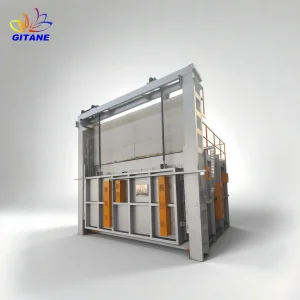
Used in continuous mesh-belt furnaces, bogie hearth heat treatment kilns, and carburizing furnaces. Fe-Cr-Al elements offer low weight, reduced structural load on refractory walls, and extreme energy conversion efficiency.
Powder Metallurgy & Ceramics
High-purity HRE and SGHYZ grades maintain stable element profile and uniform thermal output inside zirconia, alumina, and technical ceramic sintering kilns operating continuously above 1300°C.
Semiconductor & Solar Photovoltaics
SGHT powder-metallurgy Fe-Cr-Al alloys provide particle-free heating solutions for quartz tube diffusion furnaces, ingot wafer growth chambers, and solar cell manufacturing equipment.
Automotive Catalyst Substrates
Ultra-thin Fe-Cr-Al foil (0.03mm – 0.05mm) forms metallic honeycomb carriers for vehicle exhaust catalytic converters, providing high thermal shock resistance and rapid catalytic light-off.
Global Procurement Architecture & OEM Buyer Guidance
How international procurement directors and OEM engineers can streamline lead times, lower Total Cost of Ownership (TCO), and secure reliable alloy supply lines.
Total Cost of Ownership (TCO) Optimization
When specifying resistance heating alloys, comparing material price per kilogram alone is misleading. Because Fe-Cr-Al has a lower density (~7.10 g/cm³) than Ni-Cr (~8.40 g/cm³), selecting Fe-Cr-Al yields approximately 15% more linear element length per kilogram of wire.
Combined with higher electrical resistivity (enabling smaller cross-sections for equivalent power ratings), procurement teams achieve significant raw material weight reductions and direct freight cost savings on overseas shipments.
Compliance, Mill Certification & Custom Formats
All export orders are delivered with certified EN 10204 3.1 Mill Test Reports detailing exact ladle chemistry, room-temperature tensile strength, elongation percentages, $20^\circ\text{C}$ resistance per meter, and thermal coefficient factors.
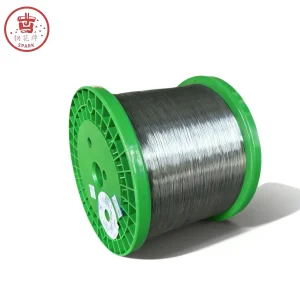
Available delivery formats include DIN/BS standard plastic spools for fine wire, heavy coil bundles for wire rod, precision slit coils for strip/ribbon, and custom pre-formed spiral elements ready for immediate furnace installation.
Future Industry Trends in Resistance Heating Metallurgy
Key innovation vectors shaping the next decade of ultra-high-temperature electrothermal engineering and environmental material design.
Powder Metallurgy & Oxide Dispersion Strengthening (ODS)
Traditional ingot-melting FeCrAl faces physical creep limits near 1300°C. Future alloy generations heavily leverage PM and ODS techniques (incorporating Y₂O₃ nanoparticles) to lock grain boundaries, raising structural stability and creep resistance up to 1450°C.
Decarbonization & Green Hydrogen Processing
As industrial heating transitions away from fossil fuel burners to green electric heating, demand for ultra-durable, fast-response Fe-Cr-Al resistance elements in hydrogen-atmosphere bright annealing and green steel processing furnaces is accelerating globally.
Nanoscale Surface Engineering & Pre-Oxidation
Advanced factory pre-oxidation treatments create a pre-formed, uniform alpha-alumina film prior to customer installation. This eliminates early-stage oxidation outgassing and ensures maximum dielectric lifespan from the very first heat cycle.
Frequently Asked Questions (Q&A) for Engineers & Procurement
Expert answers addressing element calculation, atmosphere compatibility, structural installation, and alloy grade selection.
Precision Fe-Cr-Al & High-Temp Resistance Alloys (Part II)
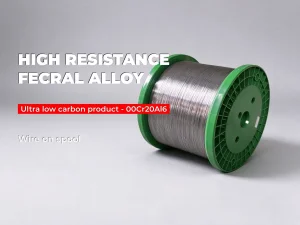
Browse our full range of resistance alloys, ultra-low carbon formulations, high-temperature tubes, and specialized electric heating wire products.



Partner with China's Premier Fe-Cr-Al Alloy Manufacturers
Request instant factory quotes, custom technical consultations, or mill test samples for your specific industrial furnace requirements.