High-Precision Heating Alloys & Elements (Part 1)
Browse our premier lineup of precision-drawn FeCrAl and NiCr heating elements certified to strict resistance and dimensional tolerances.






Metallurgical Precision & Electrical Uniformity Engineering
Why achieve a tight ±3% tolerance across dimensional and electrical parameters transforms industrial furnace performance and longevity.
±3% Precision Dimensional Control
Utilizing high-speed optical laser micrometers and diamond drawing dies, wire cross-sections maintain ultra-strict geometric stability. Eliminating localized necking directly prevents hot-spot creation.
Homogeneous Resistivity Distribution
Advanced vacuum induction melting (VIM) ensures precise chemical element dispersion. Resistivity variance ($\Delta \rho$) is held under tight control, guaranteeing consistent wattage density along every meter.
Coherent Thermal Profile
Uniform resistance translates directly to even power dissipation ($P = I^2 R$). Radiative heat flux across the element length remains balanced, avoiding micro-cracking and premature creep deformation.
Information Gain Metric: The Physics of Thermal Hot-Spot Prevention
In thermal engineering, localized electrical resistance spikes result in non-linear localized thermal dissipation. According to the Stefan-Boltzmann radiation law ($P = \epsilon \sigma A T^4$), a localized resistance deviation of $+5\%$ raises the local temperature exponentially under constant current, rapidly exceeding the critical grain-coarsening threshold ($T_{crit} \approx 1150^\circ\text{C}$ for standard FeCrAl alloys). By enforcing a manufacturing tolerance of $\pm3\%$, local temperature variations remain strictly within $\pm 8^\circ\text{C}$, extending overall element lifetime by up to 300%.
Global Enterprise Procurement Dynamics & Operational Economics
Why global Fortune 500 thermal process operators prioritize high-precision resistance alloy specifications during wholesale procurement.
In high-throughput industrial manufacturing—such as semiconductor wafer processing, lithium-ion battery cathode calcination, and aerospace vacuum heat treatment—thermal process stability dictates final product yield. Procuring commercial heating alloys with wide resistance tolerances ($\pm 8\%$ to $\pm 10\%$) introduces unacceptable operational liabilities:
1. Accelerated Thermal Fatigue & Burnout
Uneven resistance causes localized electrical bottlenecks. These "hot-spots" experience localized accelerated oxidation, forming brittle phase transformation zones that break during cyclic thermal expansion.
2. Excessive Operational Downtime Costs
Unplanned shutdowns in continuous tunnel kilns or roller hearth furnaces cost tens of thousands of dollars per hour. Tight tolerance elements reduce emergency maintenance frequency by over 65%.
3. Batch Material Scrapping
In ceramic sintering and crystal growth, temperature deviations exceeding $\pm 3^\circ\text{C}$ across the furnace chamber cause uneven phase formation, resulting in massive scrap rates of high-value raw materials.
Comparative Technical Impact Analysis
| Performance Parameter | Standard Commercial Wire (±8% to ±10%) | SPARK High-Precision Wire (±3%) | Operational Advantage |
|---|---|---|---|
| Cross-Section Diameter Tolerance | ±0.03 mm to ±0.05 mm | ±0.008 mm to ±0.012 mm | Eliminates micro-constrictions & current crowding |
| Resistivity Uniformity ($\rho$) | Significant batch-to-batch variation | Strict chemical homogenicity (<1% variance) | Predictable power input across multi-zone controls |
| Thermal Zone Deviation | ±15°C to ±25°C variance | Controlled within ±3°C to ±5°C | Guarantees homogeneous end-product crystal structure |
| Mean Time Between Failure (MTBF) | ~ 3,000 to 5,000 Operating Hours | > 12,000 Operating Hours | Substantially lowers Total Cost of Ownership (TCO) |
Macro Industry Solutions & Specialized Thermal Applications
Tailored heating alloy configurations engineered to solve demanding process challenges across critical global supply chains.
Lithium Battery Cathode Sintering
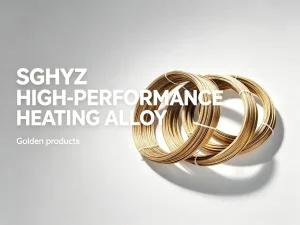
For LFP and NCM synthesis in rotary and pusher kilns. SPARK FeCrAl alloys ($0Cr25Al5$ & $SGHYZ$) provide dense protective $\alpha-\text{Al}_2\text{O}_3$ scales resistant to aggressive lithium vapor corrosion.
Semiconductor Wafer Epitaxy
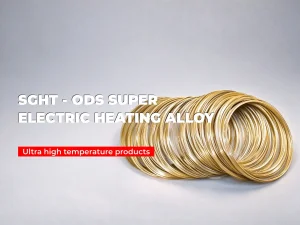
In diffusion and oxidation furnaces operating up to 1350°C, high-purity powder-metallurgy alloy grades ($SGHT$) prevent trace metallic contamination while delivering crisp $\pm 1^\circ\text{C}$ thermal uniformity.
Aerospace Superalloy Processing
For vacuum brazing and stress-relieving of turbine components. Precision NiCr alloys ($Cr20Ni80$) deliver robust mechanical strength and hot ductility under repeated, high-vacuum thermal cycling.
Advanced Metallurgy Roadmap: Achieving ±3% Consistency
A look into our end-to-end quality assurance matrix, from virgin raw material melt selection to continuous laser-monitored wire drawing.
VIM & ESR Vacuum Refining
Selection of ultra-pure iron, chromium, and nickel ingots. Double vacuum melting eliminates dissolved gases ($O_2, N_2, H_2$) and harmful tramp elements ($S, P < 0.005\%$), securing pristine ingot purity.
Rare-Earth Micro-Doping
Controlled addition of Yttrium (Y), Zirconium (Zr), and Rare Earth elements ($RE$). Micro-alloying pins grain boundaries, preventing rapid grain growth and enhancing oxide scale adhesion at elevated temperatures.
Multi-Pass Cold Drawing
Utilizing single-crystal diamond dies with specialized synthetic lubricants. Multi-stage precision cold drawing achieves strict outer diameter stability with non-contact dual-axis laser feedback control.
Hydrogen Atmosphere Annealing
Continuous bright annealing in $100\%$ pure dry hydrogen atmosphere. Removes internal draw stresses, ensures absolute surface cleanliness, and normalizes grain structure for uniform resistivity.
Next-Generation Heating Alloys & Technological Horizon
How advance materials technology is driving energy efficiency and decarbonization across global thermal processing sectors.
As heavy industry shifts toward electrification and carbon neutrality, electric heating elements are replacing gas burner systems across steel manufacturing, glass processing, and chemical production. This transition demands alloys capable of higher surface loads ($W/\text{cm}^2$) and extreme temperature durability:
Powder Metallurgy (PM) Dispersion Strengthening
Future resistance materials leverage Oxide Dispersion Strengthened (ODS) alloys. By distributing nano-scale yttria ($Y_2O_3$) particles throughout the metallic matrix, creep resistance increases threefold at 1400°C+.
Smart Thermal Sensor Integration
Embedding high-precision alloy ribbons directly into ceramic fiber modules equipped with integrated real-time resistance feedback sensors to predict element wear before catastrophic failure occurs.
Zero-Carbon Alloy Production
Utilizing green hydrogen reduction metallurgy and 100% renewable energy grid powering for vacuum melting plants, lowering the embodied carbon footprint of high-temperature electrical resistance alloys.
Global Compliance, Quality Documentation & Supply Chain Integrity
Fully certified manufacturing processes aligned with international metallurgical standards and regulatory frameworks.
Regulatory & Quality Certification
All SPARK alloys strictly conform to ISO 9001:2015 quality management systems, GB/T 1234-2012 standards, ASTM B603 (FeCrAl), and ASTM B344 (NiCr). Products are fully RoHS and REACH compliant.
Comprehensive Mill Test Certificates (MTC)
Every wholesale shipment is accompanied by EN 10204 3.1 Mill Test Reports detailing actual heat numbers, spectral chemical composition analysis, room-temperature tensile properties, and certified electrical resistance measurements.
Export Packaging & Logistics Support
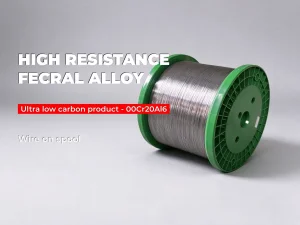
Wire is supplied on spools (DIN 200, DIN 250, K350) or in coils wrapped in waterproof VCI anti-corrosion film, secured inside reinforced wooden crates to ensure zero physical damage or oxidation during ocean transport.
Frequently Asked Questions (FAQ)
Expert insights addressing common engineering, procurement, and technical queries regarding high-precision resistance wire.
Why is a ±3% resistance tolerance crucial compared to standard commercial wire tolerances?
How does SPARK guarantee uniform resistance distribution along the entire wire length?
What are the main operational differences between FeCrAl and NiCr heating alloys?
Which alloy grade is recommended for ultra-high temperature operations above 1350°C?
What delivery forms and dimensions are available for factory quotes?
What documentation accompanies wholesale factory orders?
High-Precision Heating Alloys & Elements (Part 2)
Explore our specialized high-temperature resistance materials and custom components for heavy industrial heating applications.