
High-Precision Resistance Heating Alloys in Modern Industrial Thermal Systems
A rigorous metallurgical evaluation of FeCrAl and NiCr electrothermal alloys engineered for extreme thermal environments up to 1425°C.
In the rapidly evolving landscape of advanced industrial thermal processing, precision electrical heating materials represent the fundamental cornerstone of modern manufacturing efficiency. From continuous semiconductor crystal growth and lithium-ion battery cathode calcination to high-vacuum aerospace sintering, thermal processing systems require resistance materials capable of maintaining strict resistance tolerances, resisting mechanical creep, and preventing destructive oxidation under severe thermal shock cycles. As global industries accelerate decarbonization strategies by shifting from fossil fuel-fired furnaces to ultra-efficient electric thermal systems, the strategic procurement of optimized resistance heating alloys has become a primary operational lever for enterprise procurement teams worldwide.
Chinese metallurgical manufacturers, led by industry pioneers such as Beijing Shougang Gitane New Materials Co., Ltd. (SPARK), have spent over six decades advancing the science of vacuum induction melting, controlled wire drawing, and specialized rare-earth element doping. Today, precision heating wire, ribbon, and strip manufactured in China meet or exceed stringent global standards, including GB/T 1234-2012, ASTM B603, and DIN 17470. This guide provides industrial engineers, furnace architects, and supply chain directors with an exhaustive white paper detailing the material selection, metallurgical performance, macro application frameworks, and commercial pricing dynamics of China-sourced precision heating materials.
Precision Resistance Heating Wires & High-Temperature Alloys
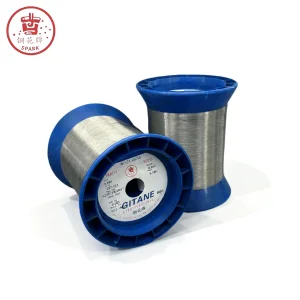
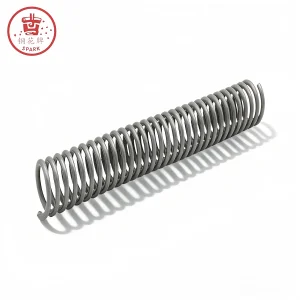
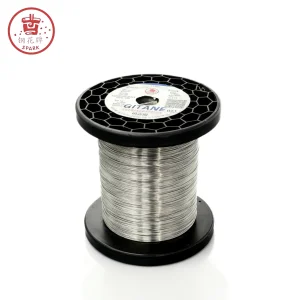
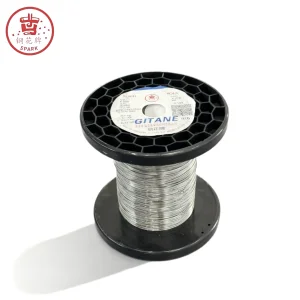
Explore directly engineered FeCrAl and NiCr heating elements and wires designed for industrial furnace builders and precision heating OEMs.


Global Enterprise Sourcing Demands & Total Cost of Ownership (TCO)
Evaluating purchasing triggers, key technical specifications, and risk mitigation strategies in high-volume heating alloy procurement.
When enterprise procurement directors, metallurgy specialists, and OEM furnace builders evaluate precision heating material suppliers from China, their intent extends far beyond basic cost-per-kilogram price points. High-temperature resistance alloys operate as critical single-point-of-failure components in capital-intensive heating assets. Component failure results in catastrophic downtime, batch contamination, and severe revenue loss. Therefore, modern purchasing frameworks prioritize five essential vectors of value creation:
Batch-to-Batch Uniformity
Strict controls on cross-sectional diameter tolerances (down to ±0.01 mm) and electrical resistivity ($\mu\Omega\cdot m$) to ensure uniform power distribution across multi-zone industrial furnaces.
Thermal Creep Stability
Resistance to high-temperature sag, elongation, and structural deformation under continuous thermal loading at working temperatures exceeding 1200°C.
Oxidation Layer Adhesion
Self-healing, dense protective scale formation ($\alpha-Al_2O_3$ on FeCrAl or $Cr_2O_3$ on NiCr) preventing rapid oxide spallation and thermal burnout.
Atmosphere Compatibility
Proven service longevity across protective and reactive gas atmospheres including Hydrogen ($H_2$), Dissociated Ammonia, Nitrogen ($N_2$), Argon, and vacuum regimes.
From a Total Cost of Ownership (TCO) standpoint, buying precision heating wire involves analyzing the dollar-per-operating-hour metric rather than initial purchase price alone. Premium Chinese alloys such as SGHYZ (1400°C rating) and 0Cr21Al6Nb integrate precise concentrations of Rare Earth Elements (REE) like Yttrium (Y), Zirconium (Zr), and Niobium (Nb). These micro-alloying additives refine grain boundaries, dramatically retard oxide scale growth rates, and extend element lifespan by up to 150% compared to standard non-REE modified grades, directly slashing maintenance overheads for global operators.
Macro Industry Solutions: Where Precision Heating Powers Innovation
Custom metallurgical configurations tailored to demanding global manufacturing sectors.
Semiconductor & Photovoltaics
MOCVD epitaxial reactors, silicon ingot growth furnaces, and solar wafer diffusion tubes require zero-outgassing heating elements. Ultra-pure FeCrAl alloys like SGHT withstand continuous 1350°C–1425°C thermal stress without metallic vapor contamination.
Lithium Battery Energy Storage
Roller hearth kilns (RHK) calcining LFP and NCM cathode active materials demand strict temperature uniformity across multi-zone tunnels. High-resistance 0Cr25Al5 and 0Cr23Al5 strips provide steady heat output and corrosion resistance against alkaline vapors.
Aerospace Thermal Processing
High-vacuum heat treatment, titanium alloy stress relief, and carbon-carbon composite sintering rely on precision NiCr (Cr20Ni80) and rare-earth enhanced FeCrAl coils for stable radiation heating up to vacuum thresholds of $10^{-5}$ Torr.
Medical & Analytical Instrumentation
Micro-diameter precision heating wires (down to 0.05 mm) engineered from Cr15Ni60 and Cr20Ni80 enable tight-tolerance thermal elements inside medical sterilizers, mass spectrometers, and laboratory fluid analyzers.
FeCrAl vs. NiCr Alloy Roadmap: Comprehensive Technical Comparison
Understanding the microstructural differences, physical properties, and design limits of premier resistance heating alloys.
In electrical thermal design, choosing between Iron-Chromium-Aluminum (FeCrAl) and Nickel-Chromium (NiCr) alloys requires evaluating operating temperature, atmospheric chemistry, mechanical ductility, and electrical resistivity requirements. FeCrAl alloys are characterized by higher electrical resistivity and lower specific density, providing a substantial weight and material cost saving in industrial furnace installations. Furthermore, FeCrAl forms a protective surface layer of pure, white alumina ($\alpha-Al_2O_3$) at temperatures above 1000°C, providing superior oxidation protection up to 1425°C.
Conversely, NiCr alloys form a tough, green chromia oxide layer ($Cr_2O_3$). While NiCr exhibits lower maximum temperature ratings (up to 1200°C–1250°C), it preserves exceptional hot strength, high ductility after prolonged thermal exposure, and superior tolerance to frequent rapid heating/cooling cycles without becoming brittle. This makes NiCr the gold standard for domestic appliance elements, industrial air heaters, and applications subject to severe vibration or mechanical impact.
| Alloy Grade | Alloy Family | Max Temp (°C) | Resistivity at 20°C (μΩ·m) | Density (g/cm³) | Key Features & Applications |
|---|---|---|---|---|---|
| SGHT | Powder Metallurgy FeCrAl | 1425°C | 1.45 | 7.10 | Ultra-high creep strength, powder metallurgy process, semiconductor & ceramic sintering. |
| SGHYZ / HRE | Rare-Earth Enhanced FeCrAl | 1350°C–1400°C | 1.42–1.45 | 7.10 | High temperature stability, REE grain modification, continuous industrial kilns. |
| 0Cr25Al5 | Standard Industrial FeCrAl | 1250°C | 1.42 | 7.10 | High resistivity, cost-effective workhorse for heat treatment and ceramic kilns. |
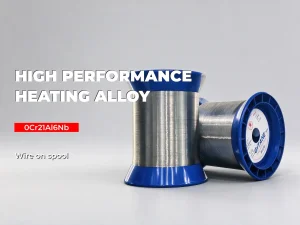
| 0Cr21Al6Nb | Niobium Doped FeCrAl | 1350°C | 1.45 | 7.10 | Nb additions retard thermal growth and improve hot strength; heavy-duty furnace coils. |
| Cr20Ni80 | Premium NiCr Nichrome | 1200°C | 1.09 | 8.40 | Exceptional hot ductility, non-magnetic, cycling resistance; precision appliances & equipment. |
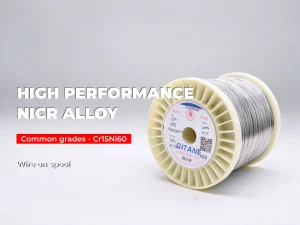
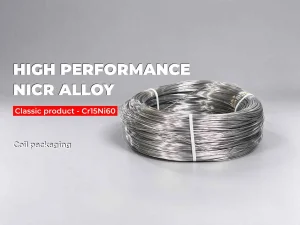
| Cr15Ni60 | NiCrFe Resistance Wire | 1150°C | 1.11 | 8.20 | Excellent corrosion resistance, bright spool wire for fine electronics and heating elements. |
| Cr30Ni70 | High-Cr Nickel Alloy | 1250°C | 1.18 | 8.10 | Superior oxidation life in sulfur-free atmospheres, high thermal shock capability. |
Surface Load Calculations & Thermal Lifespan Engineering
A primary failure mode in resistance element design is improper surface load design ($W/cm^2$). The surface load represents the electrical power dissipated per unit surface area of the wire or ribbon. Operating above the recommended surface load accelerates thermal fatigue, increases core wire temperature dramatically, and causes oxide layer breakdown. Chinese engineering guidelines dictate maximum surface loads based on wire diameter and furnace operating temperatures:
- Industrial Furnaces (1100°C–1300°C): Recommended FeCrAl surface load: $1.2 - 2.5 \, W/cm^2$.
- Domestic Appliance Elements (600°C–900°C): Recommended NiCr surface load: $3.0 - 6.5 \, W/cm^2$.
- High-Speed Air Heaters: Recommended surface load: Up to $8.0 - 10.0 \, W/cm^2$ under high forced convection.
China Precision Heating Material Quotations & Global Market Dynamics
Demystifying raw material surcharges, pricing structures, and supply chain strategies for international procurement managers.
Understanding price formation mechanisms for precision heating materials manufactured in China is essential for establishing cost-effective contract negotiations and strategic purchasing buffers. Unlike standardized carbon steel products, high-temperature resistance alloys are high-precision specialty products directly indexed to global non-ferrous metal exchanges, notably the London Metal Exchange (LME) and Shanghai Futures Exchange (SHFE).
Primary Drivers of Resistance Wire Quotes:
1. Raw Material Metal Index
NiCr quotes correlate heavily with global Nickel and Chromium spot prices. FeCrAl pricing is substantially more stable, as Iron and Aluminum experience less extreme volatility than Nickel.
2. Micro-Alloying & Purity
Additions of Rare Earth Elements (Yttrium, Hf, Zirconium) and specialized powder metallurgy synthesis (SGHT) carry processing premiums reflective of enhanced performance capabilities.
3. Wire Gauge & Tolerance
Fine wires ($d < 0.10 \, mm$) require multiple cold-drawing passes, diamond dies, and intermediate bright annealing stages, increasing labor and transformation costs relative to heavy rod ($d > 5.0 \, mm$).
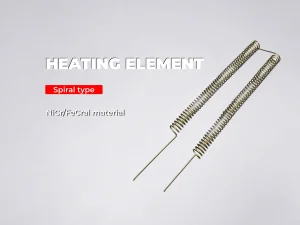
When requesting quotes from China manufacturers, procurement officers should specify: (a) Exact alloy chemistry grade or operating temperature; (b) Wire diameter or strip cross-section dimensions with acceptable tolerances; (c) Delivery form (bright spool, annealed coil, pre-wound spiral element); (d) Packaging compliance (vacuum sealed, export wooden crate); and (e) Required certification standards (ISO, MTR with chemical breakdown and electrical resistance tests).
International Standards, Testing Protocols & Global Logistics Support
How leading Chinese manufacturers guarantee strict quality control from raw melt to destination port.
To meet the demanding quality governance frameworks of tier-1 European, North American, and Asian industrial clients, premier Chinese heating alloy factories operate rigorous, multi-tier inspection protocols. Quality control is embedded across every manufacturing step:
Spectrographic Melt Analysis
Direct-reading optical emission spectrometers analyze every heat from the vacuum induction furnace to verify strict compliance with chemical composition bounds before pouring.
Continuous Resistance Testing
Inline digital resistance bridges measure linear resistance ($\Omega/m$) continuously during cold drawing to guarantee wire-to-wire consistency within ±1% to ±3% thresholds.
Accelerated High-Temp Life Tests
Per GB/T 1234 guidelines, samples undergo accelerated life testing under continuous thermal cycling to confirm oxidation film stability and hours-to-failure benchmarks.
Environmental Compliance
All finished products fully conform to EU RoHS 2.0 and REACH environmental directives, prohibiting heavy metal contaminants and dangerous surface oil residues.
Comprehensive documentation accompanies all export shipments, including official EN 10204 3.1 Mill Test Certificates (MTRs), mechanical elongation reports, dimensional inspection sheets, and custom-bonded packaging designs that safeguard fine wires against ocean freight humidity and salt corrosion.
High-Performance Alloys, Heating Tubes & Specialized Finished Products
Explore customized industrial heating solutions, bright spools, and heavy-duty elements engineered in Beijing.



Frequently Asked Questions by Industrial Sourcing Specialists
Expert answers addressing material selection, custom fabrication, lead times, and technical specifications.