
High-Performance Alloy Wires & Industrial Heating Elements
Explore specialized resistance alloys manufactured to ISO9001 and GB/T 1234-2012 standards, engineered for continuous operation from 1100°C to 1425°C.
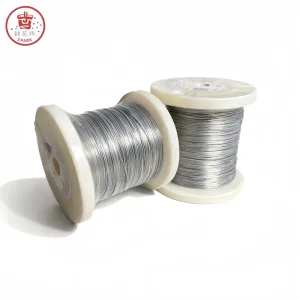
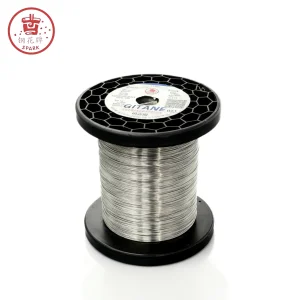
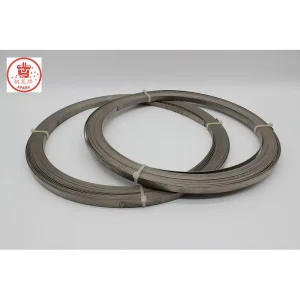
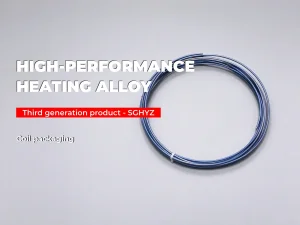

The Global Electrification Paradigm: Why High-Performance Electric Heating Wire is Redefining Industrial Thermal Processing
In the contemporary industrial ecosystem, thermal processing represents one of the most energy-intensive manufacturing operational stages. Driven by global decarbonization mandates, ESG (Environmental, Social, and Governance) requirements, and the aggressive shift from fossil-fuel combustion to zero-carbon electric heating, the demand for high-performance electric heating wires has reached unprecedented heights.
Industrial electric heating wire—specifically high-resistivity metallic alloys based on FeCrAl (Iron-Chromium-Aluminium) and NiCr (Nickel-Chromium) systems—serves as the primary energy conversion transducer in modern industrial furnaces, kilns, and high-temperature reactors. The ability of these alloys to maintain structural integrity, resist destructive high-temperature oxidation, prevent creep elongation, and maintain precise electrical resistivity over thousands of thermal cycles determines the efficiency, operational uptime, and profitability of global thermal manufacturing operations.
Decarbonization & Green Kiln Conversion
Global steelmakers, ceramic manufacturers, and glass producers are retrofitting legacy gas-fired combustion systems with clean electric heating element arrays, requiring alloys capable of handling extreme surface watt loadings ($W/cm^2$).
Advanced Battery & Semiconductor Growth
The explosive demand for lithium-ion battery cathode materials (LFP and NCM) and semiconductor wafer annealing demands precision temperature uniformity ($\pm 1^\circ C$) achieved only via high-purity, creep-resistant FeCrAl and NiCr heating elements.
Rare-Earth Micro-Alloying Breakthroughs
Innovations in reactive element addition (Yttrium, Zirconium, Cerium) pioneered by leading Chinese metallurgical complexes have drastically improved the adhesive quality of the protective oxide scale, doubling alloy operational lifespan at temperatures exceeding 1350°C.
Thermodynamic & Mechanical Comparison: FeCrAl vs. NiCr Resistance Alloys
Selecting the optimal electric heating alloy requires a deep understanding of solid-state thermodynamics, oxidation kinetics, and high-temperature mechanical properties under load.
| Alloy Grade / Family | Primary Composition | Max Temp (°C) | Resistivity at 20°C ($\mu\Omega\cdot m$) | Density ($g/cm^3$) | Protective Oxide Film | Primary Industrial Applications |
|---|---|---|---|---|---|---|
| SGHT (Powder Met) | Fe-Cr-Al + PM Rare Earth | 1425°C | 1.45 | 7.10 | Alpha-$\text{Al}_2\text{O}_3$ (Ultra-Dense) | Semiconductor diffusion, high-purity ceramic kilns |
| SGHYZ / HRE | Fe-25Cr-6Al + Y/Zr | 1400°C / 1350°C | 1.42 - 1.45 | 7.10 | Adherent $\text{Al}_2\text{O}_3$ Scale | Powder metallurgy sintering, heavy industrial kilns |
| 0Cr25Al5 | Fe-25Cr-5Al | 1250°C | 1.42 | 7.10 | $\text{Al}_2\text{O}_3$ Alumina Scale | Heat treatment furnaces, industrial radiant tubes |
| 0Cr23Al5 | Fe-23Cr-5Al | 1250°C | 1.35 | 7.25 | $\text{Al}_2\text{O}_3$ Alumina Scale | Industrial heating elements, tempering furnaces |
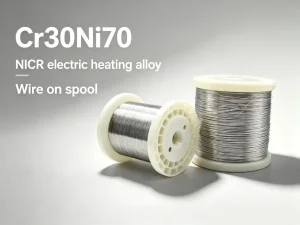
| Cr30Ni70 | 70Ni-30Cr | 1250°C | 1.18 | 8.10 | $\text{Cr}_2\text{O}_3$ Chromia Scale | High-temperature electric heating equipment, controlled atmosphere |
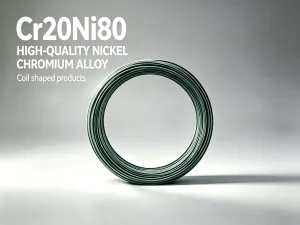
| Cr20Ni80 | 80Ni-20Cr | 1200°C | 1.09 | 8.40 | $\text{Cr}_2\text{O}_3$ Chromia Scale | Appliance heating, rapid-cycling industrial heaters, nitriding furnaces |
FeCrAl Alloys: High Temperature & Weight Efficiency
Iron-Chromium-Aluminium (FeCrAl) alloys represent the pinnacle of high-temperature electrical heating capability. When heated above 1000°C, FeCrAl forms a continuous, thermally stable, and electrically insulating Alpha-Alumina ($\alpha\text{-Al}_2\text{O}_3$) oxide layer on its surface.
- Higher Maximum Operating Temperature: Operates safely up to 1425°C compared to NiCr's typical 1200°C limit.
- Higher Electrical Resistivity: Provides higher resistance per unit cross-section, allowing thicker wire gauges and longer service life.
- Lower Material Density: FeCrAl density ($7.10\,g/cm^3$) is ~15% lower than NiCr ($8.40\,g/cm^3$), delivering significantly more wire meters per kilogram.
- Superior Sulfur Resistance: Highly resistant to sulfur-containing atmospheres and carbonaceous gas pickup.
NiCr Alloys: Ductility & Cyclic Thermal Resistance
Nickel-Chromium (NiCr) alloys, such as Cr20Ni80 and Cr30Ni70, feature an austenitic matrix that maintains exceptional structural strength, toughness, and mechanical ductility even after prolonged high-temperature exposure.
- Retained Post-Service Ductility: Unlike FeCrAl, which undergoes grain growth and becomes embrittled upon cooling, NiCr remains ductile, permitting easy coil repair or re-shaping.
- Superior Cyclic Thermal Endurance: The adherent Chromia ($\text{Cr}_2\text{O}_3$) oxide film does not spall off during rapid, frequent power cycling (ON/OFF duty cycles).
- Non-Magnetic Character: Austenitic NiCr alloys are completely non-magnetic at room temperature, making them ideal for specialized electronic heating applications.
- Green Rot Prevention: High-chromium variants like Cr30Ni70 offer enhanced resistance to carburization and "green rot" in reducing atmospheres.
The China Electric Heating Wire Factory Advantage: Sourcing Excellence
Why leading global furnace manufacturers, OEM heating element winders, and engineering conglomerates contract Chinese specialized alloy production factories.
1. Integrated Vacuum Melting (VIM/ESR)
China’s premier alloy facilities utilize Vacuum Induction Melting (VIM) followed by Electroslag Remelting (ESR). This double-vacuum purification process removes non-metallic inclusions, gases, and tramp impurities, ensuring exceptionally uniform wire electrical resistivity.
2. Precision Cold Drawing & Annealing
Equipped with multi-pass continuous diamond die wire drawing machines and hydrogen atmosphere bright annealing lines, Chinese factories deliver wire diameters from 0.05mm ultra-fine wire up to 10.0mm heavy industrial rods with bright, oxide-free surface finishes.
3. Comprehensive Supply Chain Economy
By integrating raw rare-earth refining, base metal smelting, hot rolling, cold drawing, and automated coil packaging within concentrated industrial zones, Chinese manufacturers provide an unbeatable price-to-performance ratio without compromising metallurgical purity.
High Performance Electric Heating Wire Pricelist Analysis & TCO Valuation
For international procurement directors and supply chain managers, evaluating electric heating wire cost goes beyond the raw factory quote per kilogram ($/kg). True commercial optimization requires calculating the Total Cost of Ownership (TCO) across the lifespan of the furnace.
Because FeCrAl alloys possess a density of ~7.10 g/cm³ compared to NiCr's ~8.40 g/cm³, purchasing 1,000 kg of FeCrAl wire yields approximately 18.3% more functional wire length than 1,000 kg of NiCr wire of identical gauge. Factoring in FeCrAl's higher electrical resistivity ($\mu\Omega\cdot m$), the net cost per meter of active heating coil can be up to 35% lower.
Factory Pricelist Drivers & Key Cost Modifiers
When requesting quotes and reviewing factory pricelists for China electric heating wires, the final unit cost is influenced by five critical variables:
- Raw Material Indexing: NiCr alloys (Cr20Ni80, Cr30Ni70) fluctuate dynamically with London Metal Exchange (LME) Nickel spot prices. FeCrAl alloys (0Cr25Al5, SGHYZ) are far more price-stable due to iron and aluminum base abundance.
- Alloy Grade & Rare Earth Additives: Specialized ultra-high temperature grades (SGHYZ, HRE, SGHT) incorporating rare-earth elements (Yttrium, Zirconium, Hafnium) command a premium due to high-purity melting processes.
- Wire Dimension & Gauge Tolerance: Fine wires ($\le 0.20\,mm$) incur significantly higher drawing pass labor costs than heavy industrial rod wire ($2.00\,mm - 8.00\,mm$).
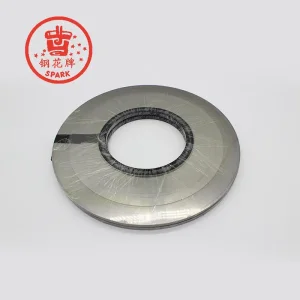
- Form Factor & Processing: Bare spooled wire vs. flat ribbon strip vs. pre-wound coiled elements vs. straightened cut lengths.
- Certification & Testing Protocols: Accelerated high-temperature life testing (e.g., 50-hour accelerated oxidation tests per GB/T 1234), metallographic grain size inspection, and custom 3.1 Mill Test Certificates.
Factory Price Reference Framework (Commercial Indications)
The following valuation matrix provides enterprise buyers with operational price structuring benchmarks for strategic bulk procurement planning:
| Product Classification | Standard Specifications | Pricing Structure Matrix | Primary Cost Driver | Recommended Order Unit |
|---|---|---|---|---|
| Standard FeCrAl (0Cr25Al5, 0Cr23Al5) | Wire $\varnothing 1.0mm - 6.0mm$, Strip $0.5-3.0mm$ | Base Commodity Index + Melt Processing | Low (High Economy) | 500 kg - 5,000 kg Bulk Drums/Spools |
| High-Temp FeCrAl (SGHYZ, HRE 1350°C) | Precision Drawn Wire $\varnothing 0.5mm - 8.0mm$ | Mid-Tier Premium (RE Micro-alloying) | Moderate Value Balance | 200 kg - 2,000 kg Custom Coils |
| Powder Metallurgy FeCrAl (SGHT 1425°C) | P/M Ingot Extruded Rod & Wire | High-End Technical Specialty | P/M Process & Purity control | 50 kg - 500 kg High-Precision Lots |
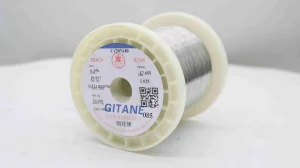
| Standard NiCr (Cr20Ni80, Cr20Ni40) | Wire $\varnothing 0.1mm - 5.0mm$, Flat Ribbon | LME Nickel Index + Fab Surcharge | High (Subject to LME Fluctuation) | 100 kg - 1,000 kg Plastic Spools |
| Specialty NiCr (Cr30Ni70 50h High-Life) | Vacuum Melted Fine & Medium Gauge Wire | High Nickel/Chromium Content + VIM/ESR | High Quality & Testing Standard | 100 kg - 500 kg Certified Batches |
Localized Industry Scenarios & Macro Heating Solutions
From micro-electronic devices to heavy industrial heat-treatment lines, explore how high-performance electric heating wires are deployed across core global industries.
Powder Metallurgy & Battery Kilns
Scenario: Continuous roller hearth kilns sintering lithium iron phosphate (LFP) cathode materials at 1100°C–1300°C.
Solution: High-temperature FeCrAl alloys (HRE, SGHYZ) coiled into meander elements or ceramic rod-supported wave coils to withstand corrosive lithium vapor off-gassing.
Semiconductor & Photovoltaics
Scenario: Quartz diffusion tubes and silicon ingot crystallization furnaces operating under stringent thermal drift tolerances.
Solution: SGHT powder metallurgy FeCrAl wire featuring low creep at 1400°C, zero sagging, and non-contaminating alpha-alumina surface insulation.
Steel Heat Treatment & Automotive
Scenario: Carburizing, nitriding, and annealing bell furnaces processing automotive gears, bearings, and structural tubing.
Solution: Heavy-gauge Cr20Ni80 ribbon or 0Cr25Al5 corrugated furnace elements configured inside metallic radiant tubes to insulate elements from carbon deposition.
Commercial & Domestic Appliances
Scenario: High-speed convection ovens, hand dryers, mica heaters, and water heating elements.
Solution: Fine to medium gauge Cr20Ni80 and Cr20Ni40 wire wound on mica or embedded in tubular ceramic sheaths, delivering instant heat thermal response.
Ceramics, Glass & Dental Sintering
Scenario: High-temperature muffle kilns firing technical ceramics, porcelain dental crowns, and glass tempering furnaces.
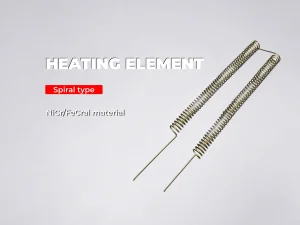
Solution: Pre-coiled spiral heating elements constructed from 0Cr25Al5 or SGHYZ wire installed on grooved refractory bricks or ceramic tubes.
Green Hydrogen & Chemical Catalysis
Scenario: High-temperature steam electrolysis (SOEC) reactors and chemical cracker pre-heaters operating at elevated pressures.
Solution: Oxidation-resistant Cr30Ni70 and SGHYZ heavy wire arrays optimized for extreme gas velocity and thermal shock stability.
How to Calculate Surface Watt Loading ($p$) and Element Sizing
A critical metric in thermal element engineering is the Surface Watt Loading ($p$, expressed in $W/cm^2$). Exceeding recommended surface load limits causes local overheating, accelerated scale spallation, premature wire burnout, and furnace refractory damage.
Surface Area ($A$): $A = \pi \cdot d \cdot L \quad (cm^2)$
Surface Load ($p$): $p = \frac{P}{A} = \frac{P}{\pi \cdot d \cdot L} \quad (W/cm^2)$
Where: $P = \text{Power (Watts)}$, $d = \text{Wire Diameter (cm)}$, $L = \text{Active Heating Length (cm)}$.
Recommended Maximum Surface Load Limits ($W/cm^2$)
The maximum permissible watt density decreases as the furnace operating temperature increases. Below are standard engineering guidelines for continuous industrial service:
| Furnace Temp (°C) | Element Temp (°C) | FeCrAl (SGHYZ / 0Cr25Al5) | NiCr (Cr20Ni80) | Recommended Mounting Form |
|---|---|---|---|---|
| 800°C | 900°C | $3.5 - 5.0 \, W/cm^2$ | $3.0 - 4.5 \, W/cm^2$ | Open spiral on ceramic tube / Grooved tile |
| 1000°C | 1100°C | $2.5 - 3.5 \, W/cm^2$ | $2.0 - 2.8 \, W/cm^2$ | Embedded coil or meander ribbon |
| 1200°C | 1280°C | $1.5 - 2.2 \, W/cm^2$ | $1.0 - 1.5 \, W/cm^2$ | Heavy gauge wave ribbon on ceramic hooks |
| 1350°C | 1400°C | $0.8 - 1.4 \, W/cm^2$ | Not Applicable (>Max Limit) | SGHYZ / SGHT thick rod on ceramic support |
High Temperature Alloy Wire & Custom Furnace Elements
Direct manufacturer supply of specialized resistance alloys, pre-wound spiral heaters, and industrial furnace wire solutions.


Frequently Asked Questions (FAQ) - Technical & Sourcing Insights
Comprehensive answers to key technical, metallurgical, and commercial inquiries submitted by global furnace builders and procurement teams.
What is the difference between standard FeCrAl (e.g., 0Cr25Al5) and ultra-high temp grades like SGHYZ or SGHT?
How does wire diameter affect the lifespan of an electric heating element?
Can FeCrAl electric heating wire be used in reducing or atmosphere-controlled furnaces?
What delivery forms and custom wire fabrications do Chinese factories supply?
How is product quality verified and tested before global shipment?
Why choose FeCrAl over NiCr to lower total furnace project costs?
Partner with China's Premier Electric Heating Wire Manufacturer
Obtain tailored metallurgical consultations, custom wire element engineering calculations, free sample coils for laboratory testing, and direct factory pricing quotes.