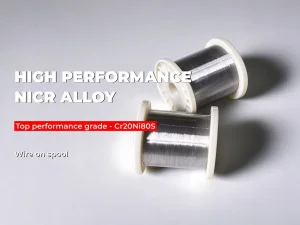
Featured Fe-Cr-Al Products for CDMX & Central Mexico

Metallurgical Engineering & Material Science of Fe-Cr-Al Alloys
Iron-Chromium-Aluminum (Fe-Cr-Al) electrical resistance alloys represent the benchmark material for extreme temperature electric heating up to 1425°C. Designed to meet the stringent demands of continuous industrial heat processing, Fe-Cr-Al alloys derive their outstanding heat resistance from a micro-alloyed ferritic matrix combined with a self-passivating surface layer of alpha-alumina ($\alpha\text{-Al}_2\text{O}_3$). Compared to traditional Nickel-Chromium (Ni-Cr) alloys, Fe-Cr-Al compounds deliver higher maximum service temperatures, elevated electrical resistivity ($1.25 - 1.45\,\mu\Omega\cdot\text{m}$), and a lower mass density ($7.10\,\text{g/cm}^3$ vs. $8.40\,\text{g/cm}^3$), yielding substantial weight savings and superior thermal efficiency in high-power furnace architectures.
Thermodynamic Scale Formation: The Alpha-Alumina Advantage
When subjected to temperatures above 900°C in oxygen-bearing atmospheres, aluminum atoms within the ferritic lattice diffuse rapidly to the alloy surface, reacting preferentially with oxygen to establish a dense, non-porous monolayer of adhesive $\alpha\text{-Al}_2\text{O}_3$. This protective oxide layer acts as an effective thermodynamic barrier against further gaseous diffusion, preventing catastrophic internal oxidation, carburization, and sulfur attack.
In advanced grades such as 0Cr21Al6Nb and powder metallurgy SGHT / SGHYZ, minute additions of reactive elements—such as Yttrium (Y), Zirconium (Zr), Hafnium (Hf), and Cerium (Ce)—are introduced via vacuum induction melting (VIM). These micro-alloying additions refine grain boundary growth, eliminate Kirkendall void formation at the scale-metal interface, and lock the alumina oxide layer mechanically onto the substrate, dramatically enhancing spallation resistance during rapid thermal cycling.
Because Fe-Cr-Al alloys feature approximately 15% lower density than Ni-Cr alloys, an equivalent weight of Fe-Cr-Al yields significantly more heating elements by linear length. Combined with a higher electrical resistivity, Fe-Cr-Al enables furnace designers to utilize larger wire cross-sections, directly extending element operating lifespan without increasing power density or transformer sizing.
| Alloy Grade | Chemical Composition (%) | Max Temp (°C) | Resistivity ($\mu\Omega\cdot\text{m}$) | Density ($\text{g/cm}^3$) | Primary Industrial Application |
|---|---|---|---|---|---|
| SGHT (Powder Met) | Fe-Rest, Cr 24-26, Al 6.5-7.5 + RE | 1425°C | 1.45 | 7.10 | Semiconductor, Advanced Ceramics, Solar Wafer Kilns |
| SGHYZ | Fe-Rest, Cr 23-26, Al 6.0-6.8 + Y/Zr | 1400°C | 1.42 | 7.10 | Continuous Mesh-Belt Furnaces, Powder Metallurgy |
| 0Cr21Al6Nb | Fe-Rest, Cr 21-23, Al 5.3-6.2, Nb 0.5 | 1350°C | 1.40 | 7.15 | Heavy Industrial Kilns, Automotive Heat Treatment |
| 0Cr25Al5 | Fe-Rest, Cr 23-26, Al 4.5-5.5 | 1250°C | 1.42 | 7.10 | General Industrial Furnaces, Radiant Heaters |
| 0Cr23Al5 | Fe-Rest, Cr 22-24, Al 4.2-5.1 | 1200°C | 1.35 | 7.15 | Commercial Appliances, Braking Resistor Banks |
Industrial Context: Fe-Cr-Al Alloys in the Mexico City Metropolitan Area (ZMVM)
The Greater Mexico City Metropolitan Area (Zona Metropolitana del Valle de México - ZMVM), alongside interconnecting industrial corridors in Toluca, Puebla, and Querétaro, constitutes the manufacturing heartland of Mexico. Driven by robust nearshoring trends under the USMCA (T-MEC) agreement, heavy industries across Central Mexico are modernizing thermal processing facilities, converting fossil-fuel burners to zero-carbon high-efficiency electric furnace systems.
Automotive & Precision Stamping
Supplying Tier 1 and Tier 2 automotive component manufacturers in Toluca and Cuautitlán Izcalli with high-grade FeCrAl wire and strip for carburizing, nitriding, and continuous steel annealing furnaces operating up to 1200°C.
Glass & Structural Ceramics
Extensive ceramic tile kilns, sanitaryware sintering facilities, and glass annealing lehrs in Vallejo and Puebla utilize 0Cr21Al6Nb and SGHYZ spiral elements to resist thermal shocks and chemical fumes.
Electronics & Electrical Appliances
CDMX industrial parks (Azcapotzalco, Naucalpan) manufacture consumer appliances and high-power industrial brake resistors using precision 0Cr25Al5 ribbon and foil engineered for long cycle reliability.
Engineered for Altitude & Local Grid Variables in Mexico City
Operating thermal processing equipment in the Valley of Mexico introduces unique technical constraints that must be accounted for during element design:
- High Altitude (~2,240 Meters Above Sea Level) Considerations: Reduced atmospheric barometric pressure (~77 kPa in CDMX vs. 101.3 kPa at sea level) impacts natural convection heat dissipation rates and lowers oxygen partial pressure. Shougang Gitane’s Fe-Cr-Al alloys feature optimized trace chemistry to establish a complete protective $\alpha\text{-Al}_2\text{O}_3$ scale even in oxygen-lean high-altitude ambient conditions.
- Electrical Grid Volatility & Voltage Fluctuations: Industrial power supply lines in heavily loaded zones like Tlalnepantla and Xalostoc frequently experience voltage surges and transient harmonics. The elevated resistivity temperature coefficient (TCR) stability of our FeCrAl alloys prevents destructive current spikes, protecting transformer equipment and elements alike.
Technical Roadmap & Future Outlook: Zero-Carbon Electric Heating
1. Green Hydrogen & Hybrid Atmospheres
As Mexican steel mills and glass plants transition toward $H_2$-rich fuels and electric hybrid furnaces, thermal elements must resist high-moisture high-temperature gas corrosion. SGHT powder metallurgy FeCrAl alloys maintain oxide integrity under high $H_2O/H_2$ partial pressures up to 1425°C.
2. Powder Metallurgy Grain-Boundary Stabilization
Standard wrought alloys suffer from rapid grain growth at extreme temperatures, causing sag and mechanical failure. Shougang Gitane’s proprietary PM process locks grain boundaries with oxide dispersion strengthening (ODS), yielding 4x higher creep strength at 1350°C+.
3. Micro-Foil & Ultra-Fine Wire Precision
Supporting Mexico's emerging medical device and micro-electronics manufacturing sectors with high-resistivity FeCrAl foils (down to 0.02mm thickness) and ultra-fine wires engineered for ultra-fast thermal response times.
Shougang Gitane Supply Chain Resilience & Manufacturing Capacity
Beijing Shougang Gitane New Materials Co., Ltd. is a specialized state-owned subsidiary of the world-renowned Shougang Group. Operating from an 88,000 m² facility in Shahe, Beijing—including 39,268 m² of advanced metallurgy workshops—Gitane integrates the entire manufacturing chain from virgin raw material melting to finished element assembly.
End-to-End Quality Control
In-house Vacuum Induction Melting (VIM), Electroslag Remelting (ESR), continuous hot rolling, multi-pass cold drawing, and hydrogen bright annealing ensure zero internal defects and tight dimensional tolerances ($\pm 0.01\,\text{mm}$).
Direct Maritime & Air Express to Mexico
Optimized freight routes from Tianjin/Qingdao ports direct to Manzanillo or Veracruz, complemented by air-freight express options to Mexico City International Airport (MEX) / Felipe Ángeles (NLU) for emergency maintenance requirements.
Full Compliance & Traceability
Certified under ISO 9001 and ISO 14001. Every shipment is delivered with EN 10204 3.1 Mill Test Certificates detailing exact chemical analysis, tensile strength, and batch electrical resistivity testing.
Frequently Asked Questions (FAQ) for Mexico City Procurement Engineers
Why choose Fe-Cr-Al alloys over Ni-Cr alloys for industrial furnaces in Mexico?
Fe-Cr-Al alloys provide higher maximum operating temperatures (up to 1425°C vs. 1200°C for Ni-Cr), higher resistivity (allowing thicker wire cross-sections for longer life), and approximately 15% lower density. This lower density means you receive more wire meters per kilogram, delivering significant material cost savings while extending element durability in sulfur-containing and oxidising atmospheres.
How does Mexico City's altitude (~2,240m) affect electric heating element design?
At 2,240 meters, barometric pressure drops to around 77 kPa, which lowers convective air cooling efficiency and reduces ambient oxygen partial pressure. For high-power density elements, furnace engineers should reduce surface load design (W/cm²) by roughly 5% to 10% to prevent localized hot-spot formation. Fe-Cr-Al alloys are ideal because their robust alpha-alumina scale forms reliably even under lower oxygen pressures.
What forms and sizes of Fe-Cr-Al alloys are available for import?
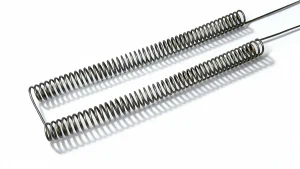
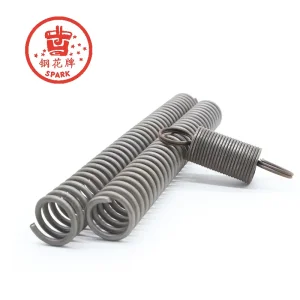
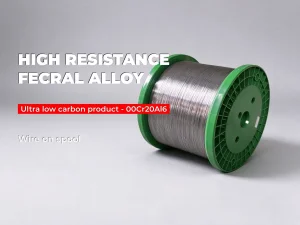
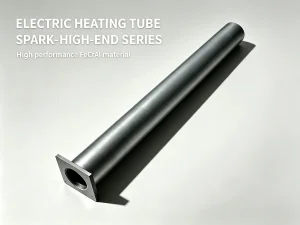
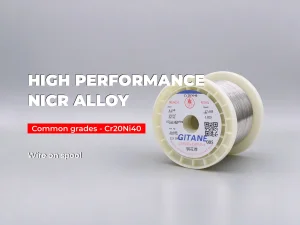
Shougang Gitane manufactures Fe-Cr-Al in round wire (0.05mm to 12.0mm diameter), flat ribbon, cold-rolled strip (width 5mm to 250mm, thickness 0.1mm to 4.0mm), pre-wound spiral elements, and radiant heating tubes ready for direct installation in industrial kilns.
What quality certificates are provided with shipments to Mexico?
All shipments include comprehensive EN 10204 3.1 Mill Test Certificates (MTC) detailing exact heat numbers, chemical spectral analysis, room temperature tensile properties, and cold electrical resistance testing per GB/T 1234-2012 / ASTM standards.
Full Catalog: Fe-Cr-Al & High-Temperature Resistance Alloys