
Featured Heating Alloys & Wire Solutions for Canadian Industry
Direct factory supply of certified electrothermal resistance wire, ribbons, and custom elements manufactured under strict ISO 9001 and ISO 14001 quality management systems.
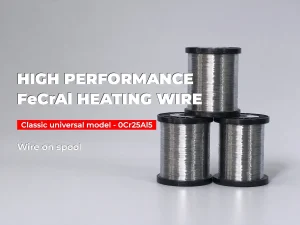

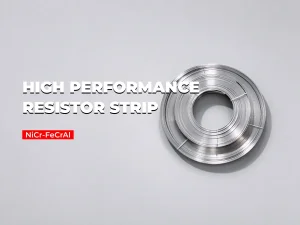
The Canadian Industrial Heating & Resistance Alloy Landscape
Understanding the unique thermal engineering demands of Canada's resource-rich economy, sub-zero climate challenges, and advanced clean-technology initiatives.
Canada represents one of the world's most demanding geographic markets for industrial thermal processing technology and electrothermal alloy engineering. From the deep-pit mining operations of Northern Ontario and Quebec to the vast oil sands processing infrastructure in Fort McMurray, Alberta, industrial heating systems operate in environments characterized by extreme thermal cycling, corrosive atmosphere exposure, and unyielding continuous-duty requirements. As a premier China NiCr Heating Wire Supplier & Factory for the Canada market, Shougang Gitane (SPARK Brand) brings over six decades of advanced metallurgical experience to solve complex thermal engineering challenges across Canadian provinces.
Mining & Ore Processing
Potash refinement in Saskatchewan and nickel-copper smelting in Sudbury require heavy-gauge Nichrome (Cr20Ni80) and FeCrAl furnace elements capable of resisting sulfurous gas attack and maintaining dimensional stability at temperatures up to 1250°C.
Oil Sands & Petrochemical
Heavy oil extraction requires trace heating cables, immersion heaters, and high-wattage ribbon elements engineered with superior hot-yield strength to prevent sagging and insulation breakdown during continuous bitumen viscosity control.
Sub-Zero HVAC & Infrastructure
Extreme Canadian winters require fast-responding, ductile NiCr alloy wire coils for commercial duct heaters, de-icing systems for transit networks, and defense aerospace freeze-prevention systems operating continuously below -40°C.
Canadian Compliance & Standards Context (E-E-A-T Focus)
All SPARK Nickel-Chromium resistance wires shipped to Canadian buyers comply strictly with ASTM B344 (Standard Specification for Drawn or Rolled Nickel-Chromium and Nickel-Chromium-Iron Alloys for Electrical Heating Elements) and align with CSA C22.2 safety standards for electrical heating equipment. Mill test reports (MTRs) detailing chemical composition via Inductively Coupled Plasma (ICP) spectroscopy and electrical resistivity in $\mu\Omega\cdot\text{m}$ accompany every shipment.
NiCr Resistance Alloys: Microstructural Engineering & Comparative Physics
Detailed technical analysis of Nickel-Chromium phase stability, oxide scale formation, and micro-alloying mechanisms that maximize component life in high-temperature furnaces.
Nickel-Chromium alloys—predominantly Cr20Ni80 (Nichrome V / Ni80Cr20) and Cr30Ni70—are the benchmark heating element materials for applications where mechanical strength at high temperatures and high ductility after prolonged oxidation are paramount. Unlike Iron-Chromium-Aluminum (FeCrAl) alloys which form an aluminum oxide ($\text{Al}_2\text{O}_3$) scale, NiCr alloys rely on a dense, self-healing chromium oxide ($\text{Cr}_2\text{O}_3$) protective layer that adheres exceptionally well under rapid thermal cycling.
| Alloy Grade | Nominal Composition (%) | Max Temp (°C) | Resistivity @20°C ($\mu\Omega\cdot\text{m}$) | Density ($\text{g/cm}^3$) | Microstructure & Thermal Characteristic |
|---|---|---|---|---|---|
| Cr20Ni80 (SPARK 80) | 80 Ni, 20 Cr | 1200°C | 1.09 ± 0.05 | 8.40 | Austenitic, high hot strength, non-magnetic, superior cycle life. |
| Cr30Ni70 (SPARK 70) | 70 Ni, 30 Cr | 1250°C | 1.18 ± 0.05 | 8.10 | Enhanced oxidation resistance in sulfur-free atmospheres. |
| Cr15Ni60 (SPARK 60) | 60 Ni, 16 Cr, Bal. Fe | 1150°C | 1.12 ± 0.05 | 8.20 | Cost-effective choice for lower-temperature appliances. |
| Cr20Ni35 (SPARK 35) | 35 Ni, 20 Cr, Bal. Fe | 1050°C | 1.04 ± 0.05 | 7.90 | Economical heating alloy for domestic heating elements. |
Why NiCr Alloys Outperform in Rapid Thermal Cycling Applications
When electric heating elements undergo frequent power modulation (e.g., PID controller pulse-width modulation), thermal expansion differential between the metallic core and surface oxide scale creates shear stress. FeCrAl alloys, while rated for higher static temperatures up to 1425°C, suffer from embrittlement at room temperature after heating due to grain growth. In contrast, NiCr (Cr20Ni80) maintains a fully austenitic structure across its entire operating range, ensuring:
- Permanent Ductility: Elements can be uncoiled, repaired, or reshaped even after hundreds of operating hours.
- Non-Magnetic Behavior: Critical for high-frequency induction furnaces, precision medical devices, and sensitive laboratory electronics in Canadian research facilities.
- Superior Hot Yield Strength: Prevents sagging, twisting, and element collapse in unsupported vertical furnace installations without requiring ceramic support pins every few centimeters.
Localized Engineering Solutions Across Canadian Industries
Custom wire drawing, ribbon rolling, and element fabrication tailored to key industrial sectors in Ontario, Quebec, Alberta, and British Columbia.
Aerospace Heat Treatment (Quebec Cluster)
Montreal's aerospace hub demands vacuum heat treating and solution annealing furnaces with ultra-precise temperature uniformity (AMS 2750 standard). SPARK Cr20Ni80 wire and strip supply extremely stable resistance values, minimizing heat gradients across large furnace zones treating titanium aircraft structural spars.
Nuclear & Clean Energy Auxiliary Systems (Ontario)
Ontario's nuclear sector (CANDU reactors and Small Modular Reactor development) utilizes SPARK high-purity NiCr ribbons in containment building freeze protection systems, steam generator preheaters, and heavy water processing units where chemical purity and high reliability are non-negotiable.
Green Hydrogen Electrolyzer Stack Pre-Heating
As Canada expands its green hydrogen infrastructure in Atlantic Canada and British Columbia, high-temperature solid oxide electrolyzer cells (SOEC) rely on custom SPARK NiCr high-density elements to bring cell stacks to 750°C–850°C operating temperatures efficiently.
Automotive Electrification (Ontario EV Corridor)
Battery enclosure manufacturing, aluminum casting degassing furnaces, and stator hair-pin insulation curing lines rely on SPARK heavy-duty open-coil heating elements and ribbon grids designed to withstand continuous 24/7 high-throughput production cycles.
Advanced Metallurgy & Next-Generation Resistance Alloys
How Shougang Gitane is advancing micro-alloying, rare-earth stabilization, and powder metallurgy processes to set new benchmarks in thermal longevity.
As industrial decarbonization accelerates worldwide, electric heating is replacing fossil-fuel burners in steel heat treating, ceramic kilns, and chemical synthesis. This macro shift demands electrothermal materials capable of handling higher power densities, aggressive gaseous atmospheres, and lower operational maintenance costs.
Rare-Earth Element (REE) Micro-Alloying
By precisely introducing trace quantities of Yttrium (Y), Cerium (Ce), and Zirconium (Zr) during vacuum melting, SPARK engineers pin grain boundaries, drastically slowing oxide spallation and increasing thermal cyclic life by up to 40% compared to conventional Nichrome alloys.
Ultra-Fine Wire Drawing Technology
Advancements in diamond wire-drawing dies and continuous hydrogen-atmosphere annealing allow production of medical-grade and aerospace-grade NiCr fine wire down to 0.018 mm diameter with ultra-tight tolerance of ±0.001 mm.
Powder Metallurgy (PM) Dispersion Strengthening
Next-gen PM processes synthesize nano-scale oxide dispersions within the metallic matrix, yielding alloys such as SPARK SGHT with exceptional creep resistance at temperatures approaching 1425°C.
Macro Industry Solutions: Surface Load & Element Design
Essential mathematical formulas and surface load recommendations for furnace builders and maintenance engineers operating in Canada.
Designing a reliable heating element requires balancing electrical power input, wire surface area, furnace operating temperature, and element surface load ($W/cm^2$). Exceeding maximum surface load leads to premature oxide burnout and rapid element failure.
Key Engineering Formula for Element Design
Surface Load ($p$): $p = \frac{P}{\pi \cdot d \cdot L} \quad (W/cm^2)$
Where: $P$ = Power per element (Watts), $d$ = Wire diameter ($cm$), $L$ = Stretched wire length ($cm$).
Cold Resistance ($R_{20}$): $R_{20} = \frac{R_T}{C_t}$
Where: $R_T$ = Hot resistance at operating temperature, $C_t$ = Temperature resistance factor for NiCr grade.
Recommended Maximum Surface Loads for Cr20Ni80 Wire ($W/cm^2$)
| Furnace Temperature (°C) | Spiral Element in Groove | Spiral on Support Tube | Heavy Ribbon Element | Radiant Tube Insert |
|---|---|---|---|---|
| 600°C | 4.5 – 5.5 W/cm² | 5.5 – 6.5 W/cm² | 6.0 – 7.5 W/cm² | 4.0 – 5.0 W/cm² |
| 800°C | 3.0 – 4.0 W/cm² | 4.0 – 4.8 W/cm² | 4.5 – 5.5 W/cm² | 3.0 – 3.8 W/cm² |
| 1000°C | 1.8 – 2.5 W/cm² | 2.4 – 3.0 W/cm² | 2.8 – 3.5 W/cm² | 1.8 – 2.4 W/cm² |
| 1150°C | 1.0 – 1.4 W/cm² | 1.3 – 1.7 W/cm² | 1.5 – 2.0 W/cm² | 1.0 – 1.3 W/cm² |
Full Range of Resistance Heating Alloys & Engineered Components
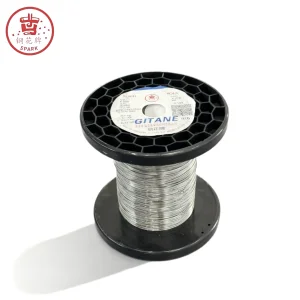
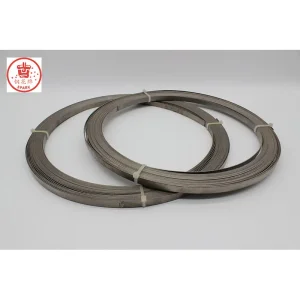
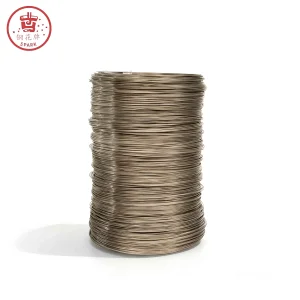
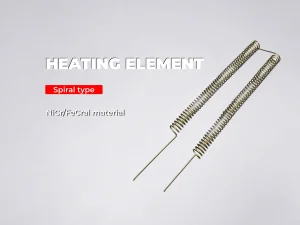
Explore our complete catalog of high-temperature FeCrAl, NiCr wire, strip, bare solid conductors, and pre-formed spiral elements ready for international logistics dispatch to Canada.



Frequently Asked Questions for Canadian Procurement & Engineering Teams
Expert answers regarding NiCr heating wire selection, international delivery to Canada, quality standards, and customized processing.
Every melt heat undergoes optical emission spectroscopy and ICP analytical testing. Our products strictly meet ASTM B344 and Chinese National Standard GB/T 1234-2012. We provide full Mill Test Certificates (MTC) EN 10204 3.1 detailing exact chemical composition, tensile strength, elongation, and electrical resistivity per batch shipped to Canadian ports (Vancouver, Montreal, Toronto).
Specify NiCr (Cr20Ni80) if your operating process involves frequent power cycling, rapid heating/cooling, reduction or humid atmospheres, or if the element requires reshaping/maintenance after prolonged use. Choose FeCrAl if you need maximum operating temperatures (up to 1425°C), higher electrical resistivity, or lower total material weight at high operating temperatures.
We supply round wire from Ø0.018 mm to Ø12.0 mm, cold-rolled strip and ribbon from thickness 0.05 mm to 4.0 mm (width 1.0 mm to 200 mm), as well as pre-coiled spiral elements, wave-shaped ribbons, and complete furnace grid assemblies tailored to OEM mechanical drawings.
Products are packed in plastic spools, coils wrapped in moisture-proof vacuum foil, and enclosed in ISPM-15 compliant wooden export crates to survive ocean transportation or express air freight via DHL/FedEx to Canadian destinations within 7 to 14 working days.
Partner with China's Premier Resistance Alloy Manufacturer
Looking for certified NiCr wire, strip, or customized furnace elements for your Canadian operations? Contact our engineering team today for technical consultation, material samples, and factory-direct pricing.
Send Inquiry Now