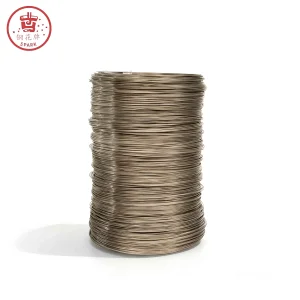
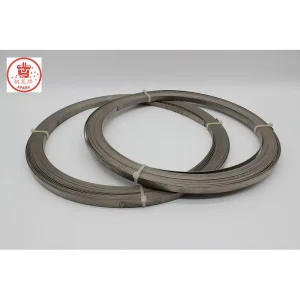
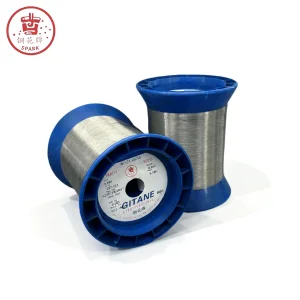
Precision Heating Alloys & Elements
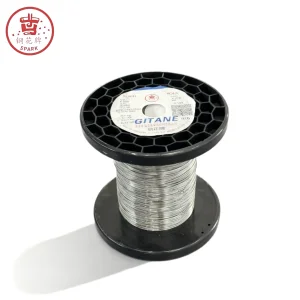
High-purity vacuum melted nickel-chromium and iron-chromium-aluminium alloys manufactured for demanding thermal environments.



Global Macro-Landscape of Advanced Thermal Alloys & Precision Heating
Analyzing the shift toward zero-carbon thermal processing, high-density household appliances, and ultra-precise industrial thermal management.
The global demand for high-precision electro-thermal resistance alloys has experienced a structural shift over the past decade. Driven by the rapid acceleration of electrification across household consumer appliances, semiconductor manufacturing, automotive thermal management, and industrial heat treatment, the requirement for alloy wires with strict physical and chemical tolerances has reached an unprecedented peak. At the core of this engineering evolution is the precise metallurgical manipulation of Nickel (Ni) and Chromium (Cr) matrix alloys, alongside advanced Iron-Chromium-Aluminium (FeCrAl) systems.
Modern thermal systems no longer accept broad tolerances in resistance per meter, non-uniform oxide scale growth, or micro-structural segregation. Household precision appliances—such as instant electric water heaters, smart induction-compatible radiant cooktops, high-wattage air fryers, and commercial espresso heating blocks—require instantaneous thermal response without undergoing fatigue deformation. Concurrently, heavy industrial thermal systems—such as semiconductor diffusion furnaces, lithium battery cathode calcination kilns, and aerospace vacuum tempering chambers—demand continuous operating capabilities at temperatures ranging from 1100°C to exceeding 1425°C.
Vacuum Induction Melting (VIM) & Micro-Calibrated Stoichiometry
Eliminating gaseous inclusion, refining grain boundaries, and balancing Ni-Cr phase diagrams for optimal thermal stability.
Vacuum Induction Melting (VIM)
By executing the primary melt within a high-vacuum chamber ($10^{-2}$ to $10^{-4}$ Torr), harmful dissolved gases such as Oxygen ($O_2$), Nitrogen ($N_2$), and Hydrogen ($H_2$) are thoroughly degassed. This prevents microscopic oxide inclusions that cause premature hot-spot electrical burnouts.
Strictly Calibrated Ni-Cr Ratio
Precision stoichiometry, such as Cr20Ni80 (80% Nickel, 20% Chromium) and Cr30Ni70, establishes a stable single-phase austenitic structure. This non-magnetic phase guarantees consistent resistivity across thermal cycling with zero order-disorder transformations.
Rare-Earth Doping (RE Micro-Alloying)
Intentionally introducing trace fractions of Yttrium (Y), Cerium (Ce), and Niobium (Nb) anchors the protective chromia ($Cr_2O_3$) or alumina ($Al_2O_3$) scale to the substrate wire, dramatically increasing resistance to thermal spallation during rapid cycling.
Precision Cold Drawing & Hydrogen Atmosphere Bright Annealing
Following ingot casting and hot rolling, the wire rod undergoes multi-pass cold drawing using single-crystal diamond dies. This process enforces sub-micron dimensional uniformity across thousands of continuous meters. Intermediate anneals are performed in pure dry Hydrogen ($H_2$) continuous strand furnaces. This bright annealing environment prevents surface oxidation, removes drawing lubricants, and recrystallizes the internal grain matrix to achieve uniform ductility, essential for high-speed automatic spiral coiling.
| Alloy Grade | Alloy System | Max Temp (°C) | Resistivity (μΩ·m, 20°C) | Density (g/cm³) | Primary Industrial / Appliance Application |
|---|---|---|---|---|---|
| Cr20Ni80 | Nickel-Chromium (Austenitic) | 1200°C | 1.09 ± 0.05 | 8.40 | High-end household appliances, coffee machine heaters, toaster spirals |
| Cr30Ni70 | Nickel-Chromium (High-Cr Austenitic) | 1250°C | 1.18 ± 0.05 | 8.10 | Industrial furnaces, highly corrosive atmospheres, heavy-duty heating elements |
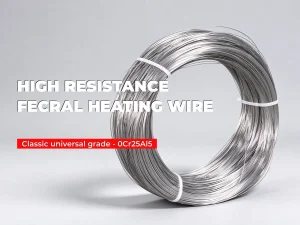
| 0Cr25Al5 | Iron-Chromium-Aluminium | 1250°C | 1.42 ± 0.07 | 7.10 | Industrial kilns, ceramic heaters, budget-friendly high-wattage home heating |
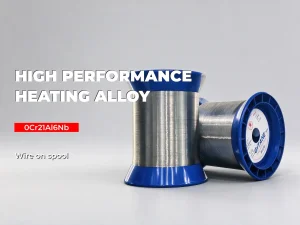
| 0Cr21Al6Nb | FeCrAl + Niobium Addition | 1350°C | 1.45 ± 0.07 | 7.10 | High-temperature industrial sintering, heat treatment furnaces |
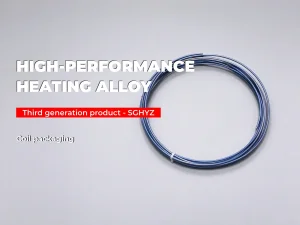
| SPARK SGHYZ | Advanced Powder Metallurgy FeCrAl | 1400°C | 1.48 ± 0.08 | 7.10 | Ultra-high-temperature kilns, semiconductor wafer processing |
Custom Thermal Systems & Household Appliance Solutions
Tailoring mechanical flexibility, watt density, and oxide scale characteristics to specialized commercial and domestic thermal equipment.
Precision Household Appliance Solutions
In high-density domestic appliances, element size constraints require high electrical resistivity combined with rapid dynamic heat transfer. Our vacuum-melted Cr20Ni80 Nichrome wire ensures:
- Zero Sagging at High Temperature: High hot yield strength prevents coil distortion and internal short circuits in enclosed mica or quartz sheathings.
- Rapid Duty Cycling Stability: Resists mechanical degradation caused by frequent expansion and contraction during thermostat-controlled ON/OFF switching.
- Food-Grade Clean Oxidation: Forms a non-flaking, non-toxic chromia surface layer suitable for convection ovens, air fryers, and beverage heating blocks.
Heavy Industrial & Custom Thermal Systems
For industrial plant engineering, thermal efficiency and low downtime dictate profitability. Our modified FeCrAl and SGHYZ alloys are deployed across continuous production lines:
- Tempering & Annealing Furnaces: Heavy-gauge spiral elements (SG140 grade) optimized for uniform heat dissipation across large hearth volumes.
- Semiconductor & Photovoltaic Furnaces: High-purity resistance elements capable of maintaining continuous 1350°C+ environments without vaporizing trace metallic contaminants.
- Corrosive & Carburizing Atmospheres: Special surface pre-oxidation treatments create an ultra-dense $Al_2O_3$ barrier resistant to carbon deposition and sulfur attack.
Technology Roadmap & Next-Generation Thermal Metallurgy
Pioneering powder metallurgy synthesis, micro-structural grain alignment, and zero-carbon emission furnace technologies.
Powder Metallurgy (PM) Synthesis
Moving beyond conventional liquid melting, Oxide Dispersion Strengthened (ODS) alloys synthesized via mechanical alloying and hot isostatic pressing (HIP) achieve creep resistance up to 1425°C, effectively doubling element operational lifespans.
Intelligent Surface Pre-Passivation
Engineered thermal oxidation cycles under controlled oxygen partial pressure pre-grow a self-healing nanostructured alumina layer prior to customer coil delivery, preventing initial burn-in degradation.
Sustainable Green Metallurgy
Transitioning primary melting energy sources to 100% green hydrogen reduction and electric arc systems, reducing the carbon footprint of raw material production to satisfy global Scope 1 and Scope 2 ESG compliance standards.
Technical Q&A / Frequently Asked Questions
Detailed answers to technical inquiries from thermal design engineers, procurement specialists, and furnace builders.
Industrial Heating Wires & Specialized Alloy Products
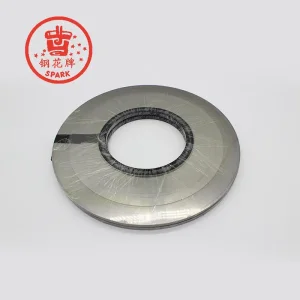
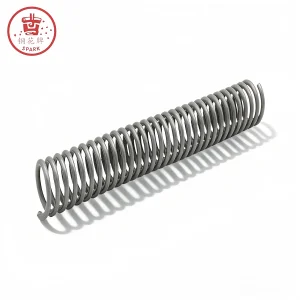
Explore our complete range of high-temperature resistance alloys, ribbon strip, and custom-formed heating spirals.