High-Temperature Resistance Alloys & Heating Tubes


Global Industry Trends: Why Complete Material Certificates (MTR) & Third-Party Lab Testing Define Modern Sourcing
In high-temperature thermal processing, microelectronics, and severe chemical manufacturing, the margin for alloy specification error is zero. As furnace temperatures push past 1400°C and operational lifecycles demand continuous run-times without element sagging, global engineering teams can no longer rely on unverified factory claims.
Strict Traceability Mandates
Global Tier-1 EPC contractors and industrial equipment OEMs now enforce mandatory raw material melt-to-shipment heat number tracking. Mill Test Reports (MTRs) detailing precise mass fraction percentages for Chromium, Aluminium, Nickel, and Rare Earth additions (e.g., Yttrium, Zirconium) are non-negotiable prerequisites for customs clearing and site auditing.
Third-Party ISO/IEC 17025 Labs
To eliminate conflict of interest, leading international enterprises require independent 3rd-party validation from recognized testing bodies (SGS, TÜV Rheinland, Intertek). Verification encompasses room-temperature mechanical tensile testing, high-temperature creep rates, electrical resistivity tolerance verification (within ±3%), and accelerated oxidation resistance testing.
Decarbonization & Green Steel
The global shift from fossil-fuel burners to zero-emission electric heating in steel reheating, glass tempering, and lithium battery cathode sintering has drastically increased electrical load demands. Uncertified alloys under extreme continuous thermal stress risk rapid degradation, oxidation spallation, and catastrophic electrical shorting.
Global Enterprise Procurement Requirements: What Sourcing Directors Must Demand
Procuring wholesale industrial heating wires (such as 0Cr25Al5, 0Cr21Al6Nb, HRE, SGHYZ, and Cr20Ni80) involves complex supply chain validation. Below is the mandatory compliance matrix required by fortune-500 industrial thermal processing manufacturers.
| Certification Parameter | Mill Test Report (MTR) Standard | Third-Party Lab Testing (SGS / TÜV) | Impact on Furnace Operations |
|---|---|---|---|
| Chemical Composition Analysis | ICP-OES Optical Emission Spectroscopy per GB/T 1234-2012 / ASTM A580 | Independent XRF & Wet Chemical Verification | Prevents element melting point drop and unwanted phase formation during thermal exposure. |
| Electrical Resistivity (20°C) | Precision Bridge Measurement (Tolerance ±3% to ±5%) | ISO/IEC 17025 Calibrated Resistance Testing | Guarantees exact power output matching furnace design specs; eliminates hot-spots and transformer overload. |
| High-Temp Accelerated Life Test | Continuous 50h–100h cyclic heating at 1200°C–1400°C | Microstructural grain growth & protective oxide layer adhesion check | Determines operational longevity, oxide scale spallation behavior, and element replacement cycle. |
| Tensile & Elongation Metrics | Yield strength, ultimate tensile strength, elongation % at break | Room-temperature vs. High-temperature mechanical testing | Ensures cold coilability during spiral production without micro-cracking or snapping. |
| Dimensional Tolerance & Roundness | Continuous laser micrometer scanning across entire coil length | Caliper & optical comparator audit | Eliminates localized wire thinning, preventing premature electrical burnouts. |
Macro-Industry Solutions: High-Performance FeCrAl & NiCr Heating Alloy Portfolio
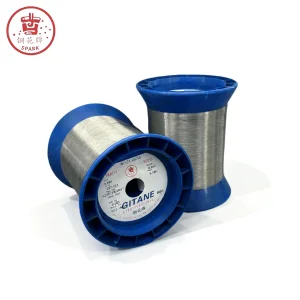
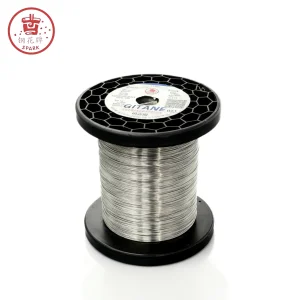
Beijing Shougang Gitane New Materials Co., Ltd. (SPARK) offers over 60 years of metallurgical refinement, delivering tailored electrical heating alloys backed by complete material test certificates for diverse extreme-temperature environments.
FeCrAl Series (Iron-Chromium-Aluminium)
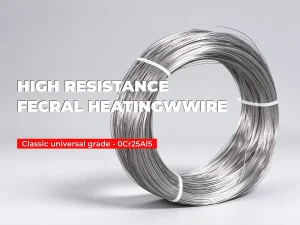
Including ultra-pure grades like 00Cr20Al6, 0Cr25Al5, 0Cr21Al6Nb, HRE (1350°C), and SGHYZ (1400°C). FeCrAl alloys form a dense, protective Alpha-Alumina (Al₂O₃) surface scale that acts as a superior electrical and thermal insulator. FeCrAl features higher resistivity (up to 1.45 μΩ·m) and roughly 15% lower density than NiCr, reducing total material weight and raw material purchasing costs for large industrial kilns.
NiCr Series (Nickel-Chromium)
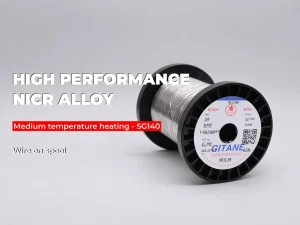
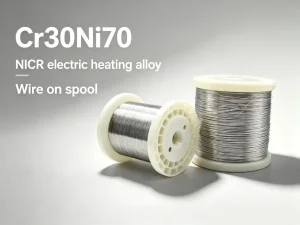
Including Cr20Ni80, Cr30Ni70, and Cr15Ni60. NiCr alloys offer superior hot strength, high ductility after prolonged high-temperature exposure, non-magnetic properties, and exceptional resistance to cyclic thermal fatigue. They do not embrittle over time, making them the preferred selection for medical equipment, domestic appliances, heat treatment furnaces with frequent cooling cycles, and protective atmosphere environments.
Powder Metallurgy (SGHT 1425°C)
Manufactured via advanced dispersion-strengthened powder metallurgy, SGHT represents the apex of resistance heating technology. By eliminating grain coarsening and thermal sag at extreme operating ranges up to 1425°C, SGHT provides unprecedented service life in semiconductor wafer diffusion furnaces, high-purity ceramic sintering, and heavy-duty industrial heat treat lines.
Localized Support, Regulatory Compliance, & Technical Quality Assurance
Partnering with an international manufacturer demands flawless compliance paperwork, rigorous customs documentation, and seamless local logistics support to guarantee uninterrupted production cycles.
EN 10204 3.1 & 3.2 Mill Certification
Every wholesale order shipped from our manufacturing plant includes an official EN 10204 3.1 Material Test Report signed by our chief metallurgical inspector. For critical infrastructure or government projects, we facilitate full EN 10204 3.2 co-certification with independent inspectors (SGS, Lloyd's Register, Bureau Veritas).
RoHS & REACH Chemical Safety Compliance
All SPARK resistance heating alloys fully comply with EU Directive 2011/65/EU (RoHS) and REACH Regulation (EC) No 1907/2006. Our products are guaranteed free from restricted heavy metal contaminants (Cadmium, Lead, Hexavalent Chromium, Mercury, PBBs, PBDEs), ensuring immediate acceptance into European and North American manufacturing lines.
Custom Export Packaging & Protection
To prevent oxidation or surface contamination during maritime transit, wires and strips are wound on high-rigidity plastic spools or packaged into fumigated wooden crates with VCI (Vapor Corrosion Inhibitor) plastic wrapping, desiccant packs, and waterproof stretch film, maintaining pristine mill condition upon arrival.
Technical Roadmap: Next-Generation Ultra-Low Carbon Alloys & AI Microstructure Control
As global industry transitions toward extreme-efficiency electric heating, Beijing Shougang Gitane is advancing the frontier of thermal alloy engineering through systematic technological innovations.
Ultra-Low Carbon Melting (00Cr20Al6)
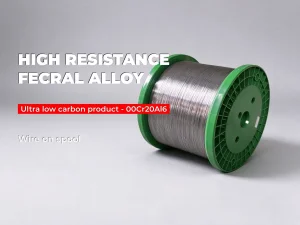
By utilizing vacuum induction melting (VIM) combined with electroslag remelting (ESR), carbon content is suppressed below 0.02%. This eliminates chromium carbide precipitation at grain boundaries, dramatically improving ductility during cold winding and preventing intergranular corrosion under high temperatures.
Rare Earth Element Nano-Doping
Precisely controlled micro-alloying with Yttrium (Y), Zirconium (Zr), Cerium (Ce), and Neodymium (Nd) optimizes the protective Al₂O₃ oxide layer. This chemical modification acts as a "peg" anchoring the oxide scale to the substrate metal, virtually eliminating scale peeling under violent thermal cycling.
Online Eddy Current & Laser Audit
Our state-of-the-art wire drawing lines integrate continuous non-destructive eddy-current flaw detection and high-speed multi-axis laser gauges. Internal inclusions, surface micro-fissures, and diameter variations exceeding 0.002 mm are flagged and isolated automatically in real-time.
Frequently Asked Questions: Technical & Procurement Clarifications
In-depth technical answers addressing material test reports, third-party lab testing, alloy selection, and wholesale ordering protocols.
What specific information is included in your factory Material Test Report (MTR / Mill Certificate)?
Can clients request third-party testing from independent laboratories like SGS or TÜV Rheinland?
How do I determine whether to specify FeCrAl (e.g., 0Cr25Al5, SGHYZ) or NiCr (e.g., Cr20Ni80) for my furnace?
• Choose FeCrAl if your operating temperature exceeds 1200°C (up to 1425°C with SGHT), or if you require maximum electrical resistivity and lower material weight at a cost-effective price point.
• Choose NiCr if your heating system experiences rapid, frequent on-off cycling, requires high ductility after extended service (allowing element repair/re-coiling), or operates in reducing/nitrogen atmospheres where alumina scales may degrade.
What delivery forms and dimension ranges are available for wholesale orders?
How does Beijing Shougang Gitane ensure batch-to-batch electrical resistivity consistency?
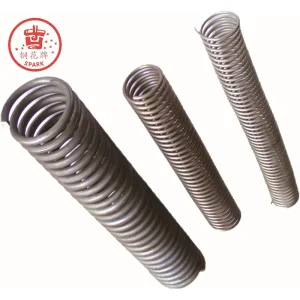
Specialized High-Temperature Alloys & Spiral Elements