
Industrial Heating Elements & High-Resistivity Alloys
Premium Grade DIN 17470 Compliant FeCrAl and NiCr Products Engineered for Precision Thermal Processing
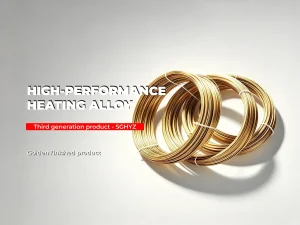
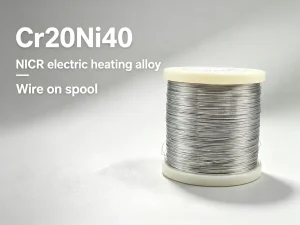
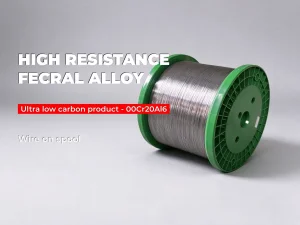



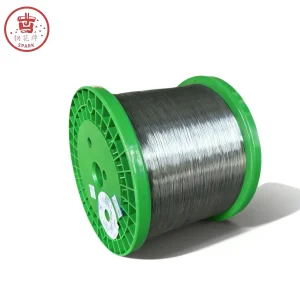
DIN 17470 Engineering Standards & High Resistivity FeCrAl Metallurgy
DIN 17470 defines the strict technical delivery conditions and physical properties for wrought electrical resistance alloys. Within this standard, Iron-Chromium-Aluminum (FeCrAl) high-resistivity strips represent the benchmark for thermal efficiency, high operating temperatures, and long-term service life in industrial heating equipment. Unlike conventional Nickel-Chromium (NiCr) alloys, FeCrAl strips form a self-healing, adherent alpha-alumina ($\alpha\text{-Al}_2\text{O}_3$) oxide layer upon exposure to elevated temperatures.
This protective surface layer acts as a chemical and electrical barrier, preventing further internal oxidation and permitting continuous operating temperatures of up to 1425°C. As global industries transition toward electrified high-temperature manufacturing, sourcing wholesale DIN 17470 FeCrAl heating strips from verified manufacturers provides an optimized balance between energy efficiency, thermal output, and lifecycle yield.
Key Physical & Thermodynamic Advantages
- Higher Specific Electrical Resistivity: Typically ranges from 1.35 to 1.45 $\mu\Omega\cdot\text{m}$, allowing compact coil designs with thicker cross-sections.
- Lower Material Density: Approximately 7.10 $g/cm^3$ vs. 8.40 $g/cm^3$ for NiCr, resulting in up to 15-20% weight savings per heating unit.
- Superior Oxidation Life: Formed $\alpha\text{-Al}_2\text{O}_3$ scale minimizes element scaling and furnace atmosphere contamination.
- Elevated Temperature Limit: Operates safely 100°C to 150°C higher than premium NiCr alloys.
Technical Insight for Procurement Directors: Choosing DIN 17470 compliant FeCrAl strips reduces element mass requirements. Due to higher resistivity and lower density, engineers can substitute NiCr elements with FeCrAl strips, yielding up to 30% cost efficiency per installed kilowatt of thermal capacity.
Global Market Dynamics & Industrial Landscape
Strategic Sourcing, Macroeconomic Drivers, and Supply Chain Realities for High-Resistivity Alloys
European & North American Re-Industrialization
Driven by the decarbonization of heavy industries, European and American thermal processing plants are aggressively replacing fossil-fuel-fired burners with electric radiant heating systems. DIN 17470 certified FeCrAl strips serve as the core conductor material for high-capacity industrial furnaces, semiconductor diffusion kilns, and green steel annealing lines.
Asia-Pacific Manufacturing Scale
Asia remains both the largest consumer and manufacturing hub for electric resistance alloys. Chinese factories, particularly Tier-1 integrated metallurgical facilities like Beijing Shougang Gitane, lead the global market in vacuum induction melting (VIM), continuous precision strip rolling, and micro-alloying control, establishing standard pricing and wholesale volume availability.
Raw Material Supply Chain Resilience
Volatilities in the global Nickel market have shifted industrial preferences toward Nickel-free FeCrAl resistance alloys. With Iron, Chromium, and Aluminum offering greater price stability, wholesale DIN 17470 FeCrAl strips safeguard original equipment manufacturers (OEMs) against sudden component cost inflation.
Metallurgical Innovations & Manufacturing Trends
Next-Generation Processing Techniques Driving FeCrAl Heating Strip Performance
1. Rare-Earth Element (RE) Micro-Alloying
Modern DIN 17470 FeCrAl formulations incorporate controlled additions of Reactive Elements (RE) such as Yttrium (Y), Zirconium (Zr), Hafnium (Hf), and Cerium (Ce). These micro-additions modify the oxide growth mechanism by pinning aluminum grain boundaries. This prevents the outward diffusion of iron and chromium cations, eliminating oxide scale spallation during rapid thermal cycling.
2. Powder Metallurgy (PM) & ODS Processing
To overcome high-temperature creep (sagging) traditional in conventional cast FeCrAl alloys, advanced manufacturers utilize Oxide Dispersion Strengthened (ODS) technology and powder metallurgy. By dispersing nanometer-scale Yttrium Oxide ($Y_2O_3$) particles throughout the metal matrix, PM FeCrAl heating strips maintain exceptional mechanical rigidity and tensile strength above 1200°C.
3. Precision Cold-Rolling & Tension Levelling
High-speed automated production lines now demand extreme dimensional tolerances for heating ribbon and strip. Modern cold-rolling mills deliver DIN 17470 strips with thickness tolerances within $\pm 0.01\text{ mm}$, smooth bright-annealed surface finishes, and zero edge burrs, ensuring uniform electrical resistance distribution and eliminating local hot spots.
4. Ultra-Low Carbon & Impurity Control
Utilizing Vacuum Induction Melting (VIM) combined with Argon Oxygen Decarburization (AOD), carbon levels in premium FeCrAl grades (e.g., 00Cr20Al6) are suppressed below 0.02%. Low carbon content suppresses intergranular carbide precipitation, dramatically improving ductility during cold forming into wave coils or meander-shaped heating elements.
Localized Application Scenarios & System Integration
From Heavy Industrial Furnaces to Precision Cleanroom Equipment
Industrial Heat Treatment
Used in car-bottom furnaces, roller hearth kilns, and pit furnaces for steel annealing, forging, and stress relieving. Meander-shaped FeCrAl strips suspended on ceramic tubes provide high surface power density ($W/cm^2$).
Semiconductor & PV
Diffusion furnaces and silicon ingot growth systems require non-contaminating, ultra-pure heating cassettes. FeCrAl strips produce zero volatile oxides, safeguarding cleanroom furnace integrity.
Exhaust Regeneration
Automotive and industrial diesel particulate filters (DPF/DOC) utilize corrugated DIN 17470 FeCrAl foil strips as electrically heated catalyst (EHC) substrates for rapid cold-start emission reduction.
High-Duty Appliance Heaters
Applied in commercial radiant hobs, hand dryers, space heaters, and industrial duct heaters requiring rapid thermal response and high mechanical rigidity during short-burst power cycling.
Technology Roadmap & Future Outlook (2025–2035)
The Strategic Evolution of Resistance Heating Materials in the Clean Energy Era
Grain-Boundary Engineered Alloys
Widespread commercial adoption of micro-alloyed FeCrAl RE strips with customized grain structures designed to mitigate room-temperature embrittlement post-service, simplifying element maintenance.
1450°C Continuous PM Strips
Scalable industrialization of oxide-dispersion strengthened powder metallurgy FeCrAl strips, enabling continuous operation in aggressive hydrogen and ceramic sintering atmospheres without sagging.
Zero-Emission Green Synthesis
Integration of 100% green hydrogen reduction and green electric melting in the production of DIN 17470 alloys, establishing fully carbon-neutral supply chains for high-temperature resistance materials.
Macro-Level Heating Solutions & System Calculations
Engineering Principles for Optimizing FeCrAl Heating Strip Life and Thermal Efficiency
1. Surface Load Density ($W/cm^2$) Optimization
The lifespan of a DIN 17470 FeCrAl strip element is directly dependent on its surface load—the ratio of power output to element surface area. Operating at excessive surface loads accelerates oxide layer degradation, causing localized hot spots and premature thermal burnout.
For industrial heat-treatment kilns operating in air at 1100°C, recommended surface load limits for meander heating strips range between 1.8 to 2.5 $W/cm^2$. Lowering surface loading by increasing strip width or thickness extends continuous service life exponentially.
2. Furnace Atmosphere Compatibility
FeCrAl strip performance varies drastically based on ambient atmospheric composition:
- Oxidizing Atmosphere (Air): Ideal environment. Promotes robust $\alpha\text{-Al}_2\text{O}_3$ scale growth.
- Nitrogen ($N_2$) Atmospheres: At temperatures above 1000°C, nitriding occurs, causing embrittlement. Pre-oxidizing the element in air at 1050°C prior to nitrogen exposure mitigates nitrogen penetration.
- Reducing/Carbonaceous Atmospheres: FeCrAl exhibits superior resistance to "Green Rot" and carburization compared to Nickel-Chromium alloys.
| DIN 17470 Grade | Werkstoff Nr. | Chemical Composition (%) | Max Temp (°C) | Resistivity at 20°C ($\mu\Omega\cdot\text{m}$) | Density ($g/cm^3$) |
|---|---|---|---|---|---|
| CrAl 25 5 (0Cr25Al5) | 1.4765 | Cr: 23.0-26.0 / Al: 4.5-5.5 / Fe: Bal. | 1250°C | 1.42 | 7.10 |
| CrAl 20 5 (0Cr21Al6) | 1.4725 | Cr: 19.0-22.0 / Al: 5.0-6.0 / Fe: Bal. | 1200°C | 1.35 | 7.16 |
| CrAl 20 6 (0Cr23Al5) | 1.4767 | Cr: 21.0-24.0 / Al: 5.0-6.0 / Fe: Bal. | 1250°C | 1.38 | 7.25 |
| SGHYZ Ultra 1400 | Proprietary RE | Cr: 24.0-27.0 / Al: 6.0-7.0 / RE: Added | 1400°C | 1.45 | 7.10 |
| NiCr 80 20 (Cr20Ni80) | 2.4869 | Ni: Bal. / Cr: 20.0-23.0 / Fe: <1.0 | 1200°C | 1.09 | 8.40 |
High-Temperature Alloys, Wires & Specialty Tubing
Wholesale Factory Solutions for Industrial Powder Metallurgy & Chemical Processing



Technical FAQ: Wholesale DIN 17470 FeCrAl Strip Engineering
Answers to Common Procurement and Metallurgical Design Queries
What is the primary difference between DIN 17470 FeCrAl strips and standard NiCr strips?
Why does FeCrAl become brittle after post-service cooling, and how is it managed?
What standard delivery tolerances apply to wholesale DIN 17470 heating strip orders?
How does rare-earth (RE) micro-alloying improve FeCrAl heating strip longevity?
Can DIN 17470 FeCrAl strips be used in vacuum furnaces?
What information is required to request an accurate wholesale factory quote?
Source Direct from Certified DIN 17470 Manufacturers
Beijing Shougang Gitane New Materials Co., Ltd. brings over 60 years of metallurgical excellence in manufacturing high-resistivity electric heating alloys. Contact our engineering sales office today for factory-direct pricing, mill test reports (MTR), and technical guidance.