Featured Wholesale Resistance Heating Alloys
Explore our factory-direct alloy selection engineered for severe high-temperature oxidation environments and precision electrical performance.
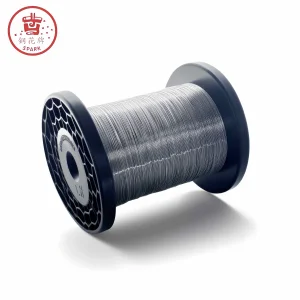
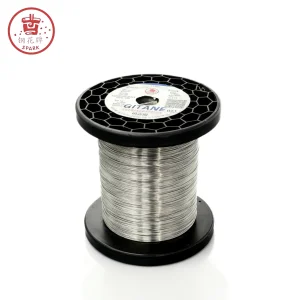
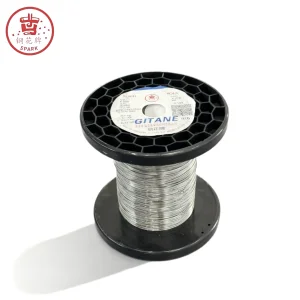
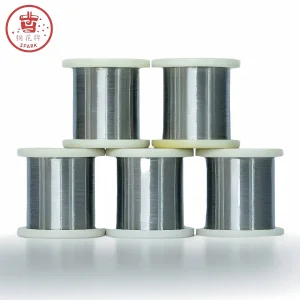
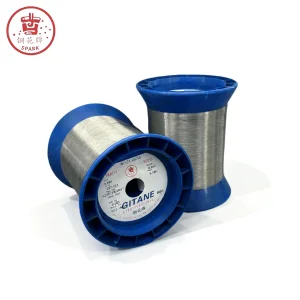
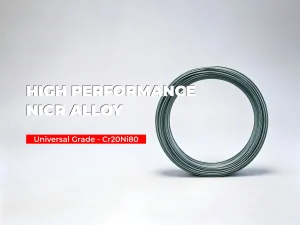
0.1mm–10mm Resistance Heating Wire: Metallurgical Foundations & Dimensional Engineering
In modern thermal processing, electrical resistance heating wire serves as the critical energy transducer across industrial, commercial, and laboratory applications. Selecting the optimal resistance alloy across the 0.1mm to 10mm diameter spectrum requires a rigorous synthesis of electrical resistivity, high-temperature oxidation kinetics, mechanical creep strength, and cross-sectional uniformity. From ultra-fine 0.1mm micro-wires used in medical sensors and miniature sealing elements to heavy 10mm industrial rods engineered for megawatt-scale heat-treatment furnaces, dimensional tolerance control directly dictates thermal reliability and operational lifespans.
Dimensional Classification & Functional Segmentation
The mechanical and thermal dynamics of electric heating alloys shift dramatically across size categories. Factory production lines utilize customized bright-annealing, cold-drawing, and multi-pass diamond die finishing tailored to specific gauge windows:
- Micro-Fine Wire Window (0.10mm – 0.80mm): Characterized by high surface-area-to-volume ratios. Used primarily in precision resistor networks, quartz tube elements, e-cigarette atomizers, medical sealing bars, and aerospace rapid-response sensors. Demands stringent microstructural homogeneity to prevent localized necking or hot-spot burnouts.
- Medium Commercial Gauge (0.90mm – 3.00mm): The workhorse range for domestic appliances (toasters, hairdryer coils, convection heaters) and commercial ovens. Requires balanced ductility for rapid automated coiling on CNC spring machines without micro-cracking the surface protective oxide layer.
- Heavy Industrial Rod & Gauge (3.20mm – 10.00mm): Engineered for high-temperature heavy industrial furnaces (car-bottom, pit furnaces, continuous mesh-belt lines). Designed to resist high-temperature sag, thermal shock, and structural sag. Heavy-gauge FeCrAl and NiCr elements provide structural self-support at elevated temperatures up to 1425°C.
FeCrAl vs. NiCr Metallurgical Comparison & Specification Table
The two primary families of electrothermal alloys—Iron-Chromium-Aluminum (FeCrAl) and Nickel-Chromium (NiCr)—offer distinct physical and chemical attributes. FeCrAl alloys form a protective, highly insulative alpha-alumina (α-Al₂O₃) surface scale, whereas NiCr alloys generate a tough, tenacious chromia (Cr₂O₃) oxide layer.
| Alloy Grade | Alloy System | Max Temp (°C) | Resistivity (μΩ·m at 20°C) | Density (g/cm³) | Primary Industrial Applications |
|---|---|---|---|---|---|
| SGHT / SGHYZ | FeCrAl (PM / Rare Earth) | 1400°C – 1425°C | 1.45 ± 0.05 | 7.10 | Semiconductor diffusion, ceramic sintering, powder metallurgy furnaces. |
| 0Cr25Al5 / HRE | FeCrAl High Temp | 1250°C – 1350°C | 1.42 ± 0.05 | 7.10 | Industrial heat treatment kilns, radiant heating tubes, kiln elements. |
| 0Cr23Al5 | FeCrAl Standard | 1250°C | 1.35 ± 0.05 | 7.25 | General industrial furnaces, domestic storage heaters, duct heaters. |
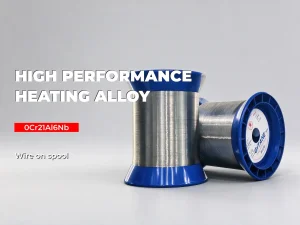
| 0Cr21Al6Nb | FeCrAl + Niobium | 1350°C | 1.45 ± 0.05 | 7.10 | High-temperature industrial furnaces requiring superior creep strength. |
| Cr20Ni80 (80/20 NiCr) | Ni-Cr Premium | 1200°C | 1.09 ± 0.05 | 8.40 | Precision lab furnaces, medical equipment, high-end appliances, heavy cycling. |
| Cr20Ni40 / Cr15Ni60 | Ni-Cr-Fe System | 1100°C – 1150°C | 1.04 – 1.11 | 8.20 | Off-road braking resistors, defrost heaters, medium-duty heat elements. |
FeCrAl alloys deliver higher resistivity (+30%) and lower density (-15%) compared to NiCr, translating to significant raw material weight savings (less kg required per total kW power output). However, NiCr alloys exhibit superior hot strength, non-magnetic properties, and superior ductility after prolonged thermal aging, making them ideal for applications subject to mechanical vibration or frequent thermal cycling.
Global Industry Trends Shaping Resistance Wire Manufacturing
The global resistance heating alloy market is undergoing a structural paradigm shift driven by industrial decarbonization, expansion of semiconductor fabrication infrastructure, and electrification of fossil-fueled industrial process heating. Key macro-trends include:
1. Industrial Decarbonization & Electrification
Heavy manufacturing sectors (steel processing, glass annealing, aluminum thermal processing) are aggressively replacing gas-fired burners with electric radiant heating systems. This transition requires heavy-gauge 6.0mm–10.0mm FeCrAl heating elements capable of continuous multi-megawatt power delivery with zero direct carbon emissions.
2. Powder Metallurgy (PM) Dispersion Strengthening
Standard ingot-melted alloys suffer from grain growth and thermal sag at temperatures above 1300°C. Advanced suppliers now utilize Powder Metallurgy (PM) process technology (e.g., SPARK SGHT grade). PM processing yields fine, uniform grain structures infused with oxide dispersions, raising max operating limits to 1425°C and increasing creep life by up to 300%.
3. Ultra-Precision Micro-Electronics Demand
The proliferation of advanced semiconductor processing tools, photovoltaic crystal pulling furnaces, and high-precision sensor arrays has driven demand for 0.1mm–0.5mm ultra-fine wires with extremely strict electrical resistance tolerances (down to ±1.5% resistance per meter) and defect-free mirror surface finishes.
Global Enterprise Sourcing & B2B Quote Engineering
For corporate buyers, OEM procurement directors, and furnace design engineers, securing wholesale resistance wire involves navigating complex technical parameters beyond basic per-kilogram pricing. High-volume procurement requires evaluating total cost of ownership (TCO), material yield metrics, and factory quality control protocols.
Crucial RFQ (Request for Quote) Specification Checklists
When requesting factory quotes for 0.1mm–10mm resistance heating wire, ensure your procurement documentation specifies the following five critical engineering criteria:
- Exact Chemical Grade & Grain Modification: Specify standard international designations (e.g., FeCrAl 0Cr25Al5, 0Cr21Al6Nb, or NiCr Cr20Ni80) and request micro-alloying details (addition of Yttrium, Zirconium, or Rare Earth elements for enhanced scale adhesion).
- Dimensional & Resistance Tolerances: Wire diameter tolerance (e.g., DIN 17470 or ASTM B603 standard precision grades) and electrical resistance per meter ($\Omega/\text{m}$) at 20°C.
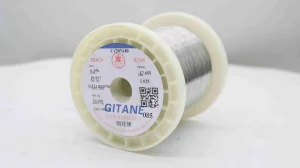
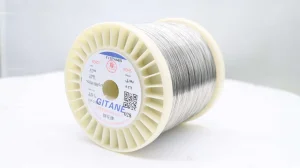
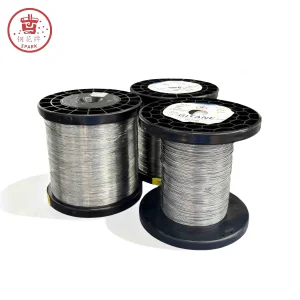
- Delivery Form Factor & Spooling: 0.1mm–0.8mm wire supplied on plastic spools (DIN 160, DIN 200, K250); 1.0mm–3.0mm supplied in standard coils or coreless carriers; 3.2mm–10.0mm supplied in heavy industrial coils or straight cut lengths.
- Heat Treatment State: Bright annealed (soft condition, ready for automatic coiling) vs. oxidized or hard-drawn states.
- Quality Compliance & Traceability: Insist on 3.1 Mill Test Certificates (MTC) matching molten heat numbers, detailing spectral chemical analysis, tensile strength, elongation, and room-temperature electrical resistivity.
Macro-Industry Heating Solutions & Systems Architecture
Industrial Heat Treatment & Metallurgy
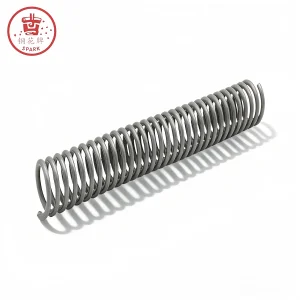
In car-bottom furnaces, nitriding lines, and pit furnaces, heavy-gauge 4.0mm–10.0mm 0Cr25Al5 or 0Cr21Al6Nb wire is formed into wave-shaped or spiral heating elements hung on refractory ceramic tubes. High oxidation resistance ensures multi-year campaign lives under continuous 1100°C–1250°C loading.
Ceramic Sintering & Glass Manufacturing
Glass tempering furnaces and technical ceramic kilns operate continuously between 1250°C and 1400°C. Utilizing ultra-high-temperature FeCrAl alloys (such as SGHYZ or PM-processed SGHT) prevents element sag, eliminating ceramic distortion and minimizing maintenance outages.
Appliance & Commercial Thermal OEM
Commercial food service equipment, industrial convection dryers, and mica-insulated heaters utilize 0.2mm–1.5mm Cr20Ni80 Nichrome wire. Nichrome’s high hot-strength prevents coil sagging during frequent rapid power cycling, delivering long product warranty periods.
Technical Roadmap & Metallurgical Innovations (2025–2030)
Next-generation thermal processing demands higher power densities, reduced energy consumption, and resistance to aggressive chemical atmospheres (including hydrogen reduction and carbonitriding). Metallurgical R&D at Shougang Gitane is focused on three primary breakthroughs:
- Nano-Scale Reactive Element Addition (RE Micro-Alloying): Precise doping of rare-earth additions (Yttrium, Hafnium, Cerium, Zirconium) at ppm-level concentrations. This promotes preferential growth of dense, slow-growing $\alpha\text{-Al}_2\text{O}_3$ scales while eliminating interfacial vacancy formation that causes oxide scale spallation.
- Advanced Surface Engineering & Pre-Oxidation: Factory-applied controlled thermal pre-oxidation treatments. Wires are shipped with a pre-formed, uniform dielectric alumina skin, reducing initial commissioning burnout risks for furnace builders.
- Zero-Defect Micro-Wire Drawing Technology: Ultrasonic drawing die technology combined with inline laser diffraction gauging. This guarantees continuous 0.1mm micro-wire production with diameter variations below ±0.001mm and surface defect depths under 0.5 microns.
Quality Control, Standards Compliance & Global Logistics
To maintain international market leadership, wholesale manufacturing operates under stringent ISO 9001:2015 quality management systems, complying fully with international standards including GB/T 1234-2012, ASTM B603, DIN 17470, and JIS C2520.
100% Resistance & Dimensional Auditing
Every master coil undergoes continuous inline electrical resistance measurement and non-contact laser optical profiling. Out-of-tolerance segments are automatically flagged and excised prior to spooling.
Comprehensive Laboratory Testing
Chemical composition verification via Direct Reading Spectrometers, mechanical tensile and elongation testing, accelerated high-temperature life testing (Basal life test according to GB standards), and metallographic grain structure verification.
Export Packaging & Compliance
All export shipments are packed with moisture-proof desiccant, vacuum-sealed plastic wrapping, and reinforced, IPPC-certified export wooden crates to prevent maritime corrosion and mechanical damage.
Frequently Asked Questions (FAQ) & Technical Solutions
What is the main difference between FeCrAl and NiCr heating wire for industrial furnaces?
FeCrAl alloys offer a higher maximum operating temperature (up to 1425°C vs 1200°C for NiCr), higher electrical resistivity (+30%), and lower density (-15%), making them more cost-effective for large industrial kilns. NiCr alloys, however, retain high mechanical ductility after prolonged thermal exposure, resist mechanical vibration better, and perform reliably under frequent rapid heating/cooling cycles.
How do I choose the correct wire diameter between 0.1mm and 10mm for my application?
Wire diameter selection is determined by required electrical resistance, surface power loading ($W/\text{cm}^2$), space constraints, and mechanical self-support requirements. Micro-fine wires (0.1mm–0.8mm) are selected when high electrical resistance is required within compact physical dimensions. Heavy wires (3.2mm–10mm) are specified for high-power industrial furnaces where structural stiffness and long oxidation life are critical.
Why is surface load (W/cm²) critical when designing resistance heating elements?
Surface load ($W/\text{cm}^2$) measures the thermal power dissipated per unit surface area of wire. If the surface load is too high, the wire temperature will exceed the ambient furnace temperature significantly, causing premature oxidation, localized melting, and element failure. Keeping surface loading within recommended design parameters guarantees multi-year continuous service.
What causes FeCrAl heating wire to become brittle after operating at high temperatures?
When FeCrAl alloys are held at temperatures exceeding 900°C for extended periods, rapid grain growth occurs within the ferritic matrix. Upon cooling to room temperature, this coarse grain structure makes the material brittle. Care must be taken during furnace maintenance to avoid physically flexing cold FeCrAl elements after they have been commissioned.
What quality documentation is provided with wholesale factory quotes?
All factory quotes include 3.1 Mill Test Certificates (MTC) matching heat lot numbers. Documentation includes chemical spectral analysis, room-temperature resistivity ($\mu\Omega\cdot\text{m}$), tensile strength ($N/\text{mm}^2$), elongation percentage, and dimensional tolerance inspection logs.
Can SPARK provide customized pre-coiled elements or straight-cut lengths?
Yes. In addition to master spools and coils, factory capabilities include CNC automatic winding of coiled heating elements, wave-shaped elements, ceramic-supported rack elements, and straight-cut, centerless-ground rods up to 10mm in diameter.
How does sulfur or carbon exposure impact resistance wire life?
Sulfur attacks NiCr alloys rapidly via nickel-sulfide eutectic formation, causing catastrophic green-rot corrosion. FeCrAl alloys offer far superior resistance to sulfurous atmospheres. Conversely, in heavy carburizing gas atmospheres, pre-oxidized FeCrAl or specialized PM grades must be used to prevent carbon ingress and embrittlement.
What is the minimum order quantity (MOQ) for factory direct quotes?
Standard stock grades (e.g., 0Cr25Al5, Cr20Ni80 in common diameters) have flexible MOQs starting from 10kg to 50kg. Custom alloy melts, non-standard ribbon dimensions, or specialized powder-metallurgy orders typically require MOQs of 100kg to 500kg depending on raw material casting sizes.
Explore Additional Resistance Alloy Products & Systems
Select your application specification to obtain instant mill pricing, lead times, and technical datasheets.