High-Precision Heating Alloys & Technical Solutions
Standard-setting electrothermal resistance alloys engineered for continuous ultra-high-temperature service, tight dimensional tolerances, and batch-to-batch electrical stability.


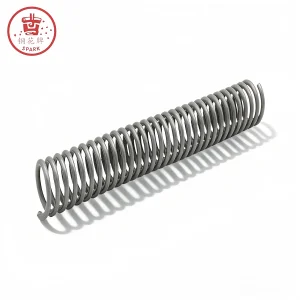
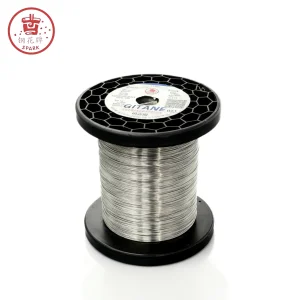
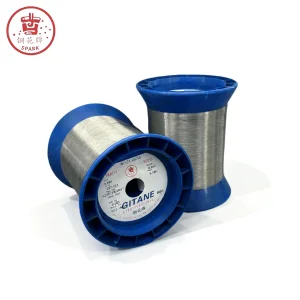
1. Metallurgical Science Behind Resistance Consistency in Precision Heating
Precision thermal engineering demands strict electrical resistance tolerances ($\pm 1.5\%$ to $\pm 3\%$) across long production runs. How advanced vacuum induction melting and cold-drawing technologies in China eliminate localized hot spots and premature thermal fatigue.
The Challenge of Electrical Drift ($\Delta R$)
In high-precision thermal systems—such as semiconductor diffusion chambers, medical laboratory analyzers, and defense component heat-treatment furnaces—temperature spatial uniformity must be maintained within tight windows (often $\le \pm 0.5^\circ\text{C}$). The electrical resistance ($R$) of a heating alloy wire directly dictates thermal power output ($P = V^2 / R$).
If wire diameter fluctuates along its length or chemical segregation occurs during ingot casting, local resistance increases. This causes non-uniform Joule heating, creating thermal gradients, accelerated localized oxidation, and eventual burn-out. Chinese precision alloy mills utilize Vacuum Induction Melting (VIM) coupled with Electro-Slag Remelting (ESR) to guarantee chemical homogeneity down to micro-ppm levels.
Precision Wire Drawing & Online Laser Micrometry
Resistance consistency is inextricably linked to cross-sectional dimensional tolerance ($\text{Resistance} \propto 1/d^2$, where $d$ is diameter). A deviation of just $2\%$ in diameter yields approximately a $4\%$ drift in electrical resistance.
Leading modern Chinese manufacturing facilities employ continuous multi-pass diamond-die wire drawing systems fitted with dual-axis laser micrometers. This automated setup enables real-time closed-loop feedback, guaranteeing wire diameter tolerances within $\pm 0.001\text{ mm}$ for fine wires and $\pm 0.005\text{ mm}$ for heavy industrial gauges.
Technical Datasheet: Standard Precision Electrothermal Alloys
| Alloy Grade | Nominal Chemical Composition (%) | Max Temp (°C) | Resistivity @ 20°C ($\mu\Omega\cdot\text{m}$) | Density ($\text{g/cm}^3$) | Thermal Expansion ($10^{-6}/\text{K}$) |
|---|---|---|---|---|---|
| Cr20Ni80 (Nichrome 80) | Ni 78.0-80.0, Cr 20.0-23.0, Si 1.0-1.5, Fe $\le 1.0$ | 1200 | $1.09 \pm 0.05$ | 8.40 | 18.0 |
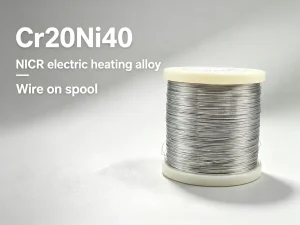
| Cr20Ni40 | Ni 34.0-37.0, Cr 18.0-21.0, Fe Bal. | 1100 | $1.04 \pm 0.05$ | 8.20 | 19.0 |
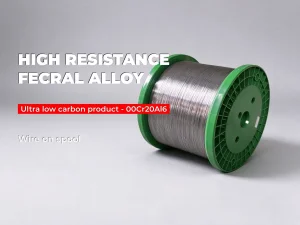
| 0Cr25Al5 (FeCrAl) | Cr 23.0-26.0, Al 4.5-6.5, Fe Bal. | 1250 | $1.42 \pm 0.07$ | 7.10 | 15.0 |
| 0Cr21Al6Nb (HRE Class) | Cr 21.0-23.0, Al 5.5-6.5, Nb 0.5-1.0, Fe Bal. | 1350 | $1.45 \pm 0.07$ | 7.10 | 14.7 |
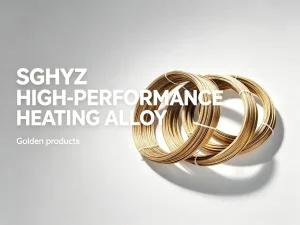
| SGHYZ Ultra-High Temp | Fe-Cr-Al Base + Rare Earth Additions (Y, Ce) | 1400 | $1.48 \pm 0.08$ | 7.05 | 14.5 |
2. Industrial Scale and Supply Chain Efficiency in China
How decades of metallurgical investment, vertically integrated supply chains, and advanced quality assurance have positioned Chinese factories as primary global providers of premium precision heating alloys.
Deep expertise in melting, hot rolling, cold drawing, and specialized bright annealing treatments.
Ultra-tight electrical resistance matching for high-spec medical and semiconductor equipment.
Advanced FeCrAl-RE alloys providing extended life in sintering and diffusion applications.
Full compliance with ISO 9001 and GB/T 1234-2012 standards with complete spectral analysis.
Cr20Ni80 Metallurgical Deep Dive: Features & Oxide Mechanics
Chromium-Nickel 80/20 (Cr20Ni80) remains the gold standard alloy for precision electrical heating under $1200^\circ\text{C}$. Unlike Iron-Chromium-Aluminum (FeCrAl) alloys, Cr20Ni80 possesses superior hot strength (preventing sagging or coil deformation over extended cycles) and maintains excellent ductility after long-term elevated thermal exposure.
- Adherent Protective Oxide Layer: Upon initial thermal activation, Cr20Ni80 forms a tenacious, non-spalling surface scale dominated by Chromium Oxide ($\text{Cr}_2\text{O}_3$). This protective oxide resists spallation during rapid thermal cycling, preventing progressive degradation of the wire core.
- Non-Magnetic Properties: Cr20Ni80 is fully non-magnetic in both annealed and heated states, eliminating stray magnetic field interference in delicate analytical instruments and medical thermal chambers.
- Low Temperature Coefficient of Resistance (TCR): With a low TCR, the electrical resistance changes minimally from ambient room temperature to maximum operating temperature, simplifying power supply control circuits.
3. Global & Localized Application Scenarios
From OEM equipment manufacturing to high-temperature industrial processing lines, precision heating wires are applied across diverse high-tech ecosystems.
Semiconductor & Photovoltaics
Used in quartz diffusion tube heaters, silicon ingot growing furnaces, and wafer baking elements where strict $\pm 0.5^\circ\text{C}$ temperature profiles across zones are mandatory.
Medical & Analytical Diagnostics
Integrated into precision blood analyzers, fluid warming devices, mass spectrometers, and laboratory sterilizers demanding fast thermal response and total resistance reliability.
Industrial Heat Treating & Kilns
Heavy-gauge coil elements in tempering furnaces, powder metallurgy sintering plants, ceramic firing kilns, and glass annealing lehrs operating up to $1400^\circ\text{C}$.
Precision Automotive Thermal Systems
Incorporated into electric vehicle battery thermal management modules, oxygen sensor heating elements, and exhaust gas treatment thermal devices.
4. Global Sourcing Strategy: Evaluating Mature Chinese Factories & Pricelists
Navigating alloy selection, total cost of ownership (TCO), quality verification, and pricing dynamics when direct-sourcing electrothermal alloys from premier Chinese suppliers.
Factory Evaluation Checklist for B2B Procurement
When selecting a supplier for precision electrothermal resistance alloys, relying solely on per-kilogram pricing often leads to high operational costs caused by premature element failure. Technical procurement managers should evaluate suppliers on four key pillars:
- Raw Material Purity: Insist on primary nickel/chromium virgin metal stock. Recycled scrap leads to trace element impurities (such as Lead, Sulfur, and Zinc) that severely degrade grain boundary cohesion at elevated temperatures.
- Continuous Annealing Capabilities: Hydrogen-atmosphere bright annealing is critical for oxide-free, uniform soft surface finishes, ensuring smooth coil winding on automated spring coiling machines.
- Resistance Deviation Testing: Verify that the factory conducts continuous online spool-to-spool resistance measurement rather than spot sampling.
- Mill Test Certification (MTC): Suppliers should provide EN 10204 3.1 compliant certificates detailing chemical compositions, mechanical tensile strength, elongation, and exact resistivity at 20°C.
Pricing Drivers & Pricelist Dynamics
Understanding the price structure of electrothermal alloy wires enables optimized strategic purchasing:
Cr20Ni80 prices correlate directly with the London Metal Exchange (LME) Nickel price index. FeCrAl alloys (e.g., 0Cr25Al5) present a significantly lower, highly stable cost profile because iron and aluminum form the main matrix.
2. Dimensional Gauges & Working TolerancesFine wires ($d < 0.10\text{ mm}$) carry higher processing premiums per kilogram due to multiple wire drawing passes and annealing steps. Custom flattened ribbons or special tight-tolerance profiles incur specialized die configuration charges.
3. Surface Treatments & PackagingOptions such as oxidized golden surfaces, pickling, or precision plastic spooling with vacuum seal bags protect stock against ambient humidity during ocean freight.
5. Future Trends in Electrothermal Alloy Engineering
How next-generation metallurgical innovations—including Powder Metallurgy (PM) alloys and rare earth micro-alloying—are shaping high-temperature industrial heating.
Powder Metallurgy (PM) FeCrAl
Traditional ingot-melted alloys face structural grain growth at temperatures above $1300^\circ\text{C}$. PM FeCrAl alloys synthesized via atomization and hot isostatic pressing exhibit ultra-fine grain microstructures, offering outstanding sag resistance and structural rigidity up to $1425^\circ\text{C}$.
Reactive Element Addition (RE)
Micro-alloying with rare earth elements such as Yttrium (Y), Zirconium (Zr), Hafnium (Hf), and Cerium (Ce) pins chromium and aluminum oxides at grain boundaries. This "reactive element effect" dramatically enhances oxide adhesion during intense rapid thermal cycling.
Decarbonization & Electrification
As global heavy industries shift from fossil gas-fired burners to zero-carbon electric heating, high-power-density industrial heating alloys are replacing gas combustion tubes in steel, glass, and chemical refining infrastructure worldwide.
6. Frequently Asked Questions (Technical & Procurement)
Expert answers to critical engineering queries regarding resistance consistency, alloy selection, and operational longevity.
FeCrAl Alloys: Lower density ($7.10\text{ g/cm}^3$), higher electrical resistivity ($1.42-1.48\mu\Omega\cdot\text{m}$), higher maximum temperature (up to $1400^\circ\text{C}$). However, FeCrAl alloys become brittle after heating and exhibit lower hot strength, requiring proper element ceramic support.
Explore Complete Resistance Wire & Element Catalog
Direct factory access to top-grade FeCrAl, NiCr, and specialized ultra-high-temperature heating wires engineered for global industry.