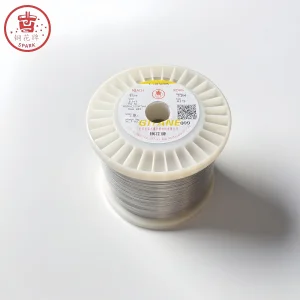
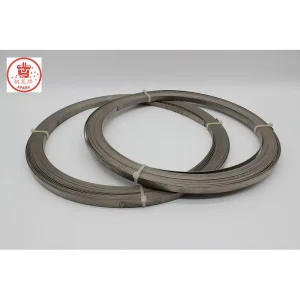
Featured Precision Heating Alloy Products
High-purity electric heating wire, resistance strip, and specialized elements manufactured under ISO9001 quality controls.



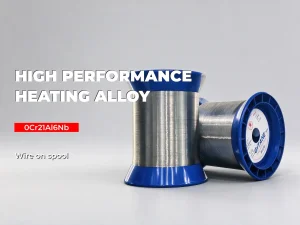

Precision Heating Wire Metallurgy in China: Technical Overview
An engineering analysis of high-temperature resistance materials, chemical homogeneity, phase stability, and oxide growth mechanisms.
Iron-Chromium-Aluminum (FeCrAl) Alloys
FeCrAl alloys (e.g., 0Cr25Al5, 0Cr21Al6Nb, HRE, SGHYZ) represent the pinnacle of high-temperature operational efficiency. Characterized by high electrical resistivity (up to 1.45 μΩ·m) and low density, these alloys form a self-healing, thermally grown alpha-alumina ($\alpha\text{-Al}_2\text{O}_3$) protective scale. This continuous scale drastically lowers oxygen diffusion rates, allowing continuous operation up to 1425°C in industrial ceramic kilns and semiconductor diffusion furnaces.
Nickel-Chromium (NiCr) Alloys
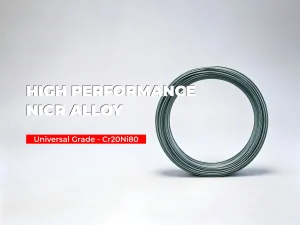
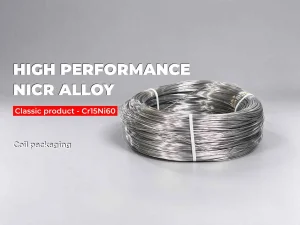
NiCr alloys (such as Cr20Ni80, Cr30Ni70, and Cr15Ni60) possess superior hot strength, high ductility after prolonged high-temperature exposure, and non-magnetic characteristics. Forming a dense chromia ($\text{Cr}_2\text{O}_3$) oxide layer, NiCr wire is resilient to thermal shock and mechanical vibration. It excels in frequent cycling environments, medical diagnostic instruments, aerospace thermal blanketing, and industrial heat treatment units up to 1200°C.
Powder Metallurgy (PM) Advancements
Leading Chinese manufacturers now deploy dispersion-strengthened powder metallurgy alloys (such as SGHT). By uniformly dispersing nano-scale oxide particles (Y2O3) throughout the metallic matrix, PM wire resists sag, thermal deformation, and grain coarsening far beyond traditional ingot-cast alloys, unlocking prolonged lifespans in critical cleanroom and photovoltaic manufacturing environments.
Why Global Procurement Centers Choose Chinese Suppliers
From upstream raw material synthesis to end-to-end quality assurance, examine the structural drivers behind China's market leadership in resistance alloys.
Fully Integrated Value Chains
Chinese manufacturing hubs integrate high-purity nickel cathode refining, electrolytic chromium sourcing, and rare-earth doping under localized industrial clusters. This reduces intermediate transport degradation, accelerates batch turnarounds, and guarantees stable chemical composition control per batch according to strict GB/T 1234-2012, ASTM B603, and DIN 17470 criteria.
Ultra-Fine Wire Drawing Expertise
Equipped with diamond dies and hydrogen atmosphere continuous bright annealing lines, top Chinese factories pull precision resistance wire down to 0.015 mm micro-gauge diameters. These fine wires maintain continuous electrical resistance consistency, defect-free mirror surface finishes, and zero micro-cracking—vital for medical coils, heating element spirals, and micro-sensors.
Rigorous Metrological Testing
Quality compliance extends beyond chemical composition. Modern China-based manufacturing plants conduct automated eddy-current flaw detection, continuous resistance variation mapping, elevated temperature accelerated life testing (50+ hours at 1200°C+), and scanning electron microscopy (SEM) for oxide scale adherence validation before issuing MTRs (Mill Test Reports).
Technical Specification & Engineering Comparison
Cross-examine physical, electrical, and thermal properties to select the optimal alloy grade for your thermal processing environment.
| Alloy Grade | Alloy Type | Max Element Temp (°C) | Resistivity at 20°C (μΩ·m) | Density (g/cm³) | Thermal Expansion Coefficient ($10^{-6}/\text{K}$) | Primary Industrial Applications |
|---|---|---|---|---|---|---|
| 0Cr25Al5 | FeCrAl | 1250°C | 1.42 | 7.10 | 14.7 | Industrial electric furnaces, domestic appliances, radiant heaters |
| 0Cr21Al6Nb | FeCrAl (Nb Doped) | 1350°C | 1.45 | 7.10 | 14.0 | Ceramic kilns, heat treatment furnaces, high-power boilers |
| HRE / SGHYZ | FeCrAl + RE | 1400°C | 1.45 | 7.10 | 12.5 | Powder metallurgy furnaces, diffusion heaters, crystal growth kilns |
| SGHT (PM) | Powder Metallurgy | 1425°C | 1.45 | 7.10 | 11.8 | Semiconductor processing, high-purity ceramic sintering |
| Cr20Ni80 | NiCr (80/20) | 1200°C | 1.09 | 8.40 | 18.0 | Medical electronics, heavy industrial elements, plastics sealing |
| Cr30Ni70 | NiCr (70/30) | 1250°C | 1.18 | 8.10 | 17.0 | Corrosive chemical vapor heaters, industrial air heating units |
| Cr15Ni60 | NiCrFe | 1150°C | 1.11 | 8.20 | 17.5 | Rheostats, braking resistors, low-temperature heating coils |
Global Industry Applications & Precision Heating Solutions
Tailored thermal solutions engineered to overcome operational challenges across high-tech, energy, and heavy manufacturing sectors.
Solar PV & Semiconductor Fabrication
In PV silicon ingot growth, cell diffusion furnaces, and semiconductor oxidation equipment, temperature uniformity within ±0.5°C is non-negotiable. Precision FeCrAl alloys (such as HRE and SGHT) spun into heavy-gauge spires or embedded in ceramic fiber modules prevent particulate contamination while sustaining uniform thermal field profiles over extended thermal runs.
Lithium Battery Cathode Sintering
Roller hearth kilns (RHK) producing battery active materials (LFP, NCM) operate continuously in corrosive atmosphere conditions. High-chromium FeCrAl strip and wire offer supreme resistance to alkali metal vapor attack and thermal fatigue, minimizing scheduled shutdown cycles for global battery material refiners.
Green Hydrogen & Petrochemical Units
Extreme ambient heat exchange units used in hydrogen reforming and high-pressure chemical fluid heating require robust, creep-resistant Cr30Ni70 or 0Cr21Al6Nb elements. These alloys maintain structural resistance against sulfurization, carbonization, and embrittlement in volatile gaseous streams.
Sourcing Best Practices for International Buyers
Key technical criteria, engineering formulas, and verification protocols for EPC contractors and OEM buyers when evaluating China suppliers.
1. Surface Load Rating ($W/\text{cm}^2$)
Never specify precision heating wire based purely on total power ($kW$). Evaluate allowable surface watt loading ($W/\text{cm}^2$) according to furnace atmosphere, element diameter, and support refractory geometry. Overloading leads to rapid hot-spot formation, oxide film rupture, and premature wire burnout.
2. Cold/Hot Resistance Ratio ($R_t/R_{20}$)
Verify temperature coefficient of resistance ($C_t$) curves. FeCrAl demonstrates small resistance variations across working temperature spans ($R_t/R_{20} \approx 1.02-1.06$), simplifying electrical power control. NiCr features higher variations, demanding calibrated SCR power controllers for transformer protection.
3. Packaging & Spooling Integrity
Precision thin wires must be spooled on high-impact plastic bobbins (DIN125, DIN160, DIN200) under constant tension control to prevent crossover overlay and kink defects. Heavy wire coils require protective VCI vapor-corrosion-inhibitor wrapping inside wooden crates for overseas sea freight resilience.
Emerging Trends Shaping Precision Wire Manufacturing
Next-generation innovations in alloy purity, green manufacturing, and smart thermal processing.
Carbon-Neutral Metallurgy
Leading Chinese producers are adopting electric arc furnaces powered by green hydrogen and renewable energy micro-grids. This lowers embedded Scope 1 and Scope 2 carbon emissions, helping global OEMs comply with European Carbon Border Adjustment Mechanism (CBAM) regulations.
AI-Powered Optical Die Inspection
Inline laser micrometer scanning continuously monitors wire roundness and dimensional tolerance along thousands of meters of drawn wire. Real-time AI feedback loops automatically adjust wire drawing speed and die tension, guaranteeing strict compliance with zero micro-flaw standards.
Advanced Pre-Oxidation Treatments
Factory-applied pre-oxidation processes form a pre-passivated, uniform $\alpha\text{-Al}_2\text{O}_3$ layer on FeCrAl wire prior to shipment. This eliminates client pre-heating downtime, speeds up on-site commissioning, and extends element life right from initial powering.
Frequently Asked Questions (FAQ)
Clear, authoritative technical answers regarding precision heating wire selection, furnace design, and operational troubleshooting.
High-Temperature Resistance Wire & Element Series
Explore specialized high-temperature alloy solutions manufactured for worldwide distribution.