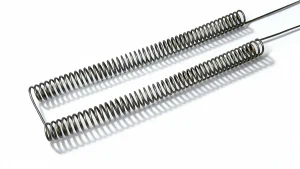
Featured Nickel Chromium & High-Temp Resistance Products
Factory-direct precision heating wire, FeCrAl alloys, and specialized industrial element solutions engineered for extreme thermal reliability up to 1425°C.
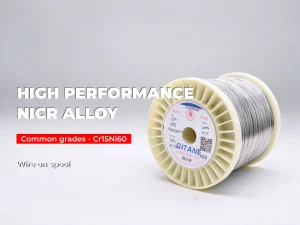
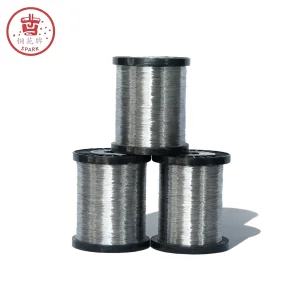
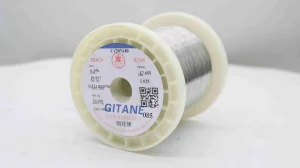
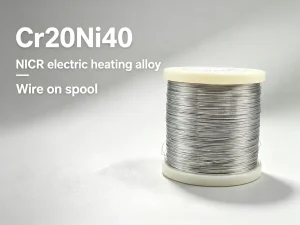
Executive Summary: Global Landscape of Nickel Chromium Heating Alloys
An authoritative analysis of industrial electrothermal processing, material transformation, and China's strategic role in high-temperature resistance alloy manufacturing.
The Evolution of Industrial Resistance Heating
Nickel-Chromium (Ni-Cr) resistance alloys represent the cornerstone of modern thermal engineering. Since the discovery of the solid-solution binary matrix, nickel-chromium heaters have provided the necessary high-resistivity, hot strength, and oxidation barrier essential for high-precision industrial applications. In the modern industrial era, demanding thermal environments—ranging from semiconductor wafer processing to aerospace vacuum sintering—require unmatched metallurgical purity and geometrical tolerance consistency.
As global industries shift toward complete process electrification to meet decarbonization goals, the demand for high-efficiency electric heating elements has accelerated exponentially. Fossil-fuel-fired combustion chambers are systematically being replaced by precision electric furnace systems powered by advanced NiCr and FeCrAl resistance wires.
China’s Supply Chain Dominance & Manufacturing Scale
China has emerged as the definitive global powerhouse for resistance heating alloy production. Through integrated vacuum induction melting (VIM), electro-slag remelting (ESR), continuous hot rolling, and precision micro-drawing, Chinese manufacturers deliver world-class alloy consistency. Leading domestic industrial entities, such as Beijing Shougang Gitane New Materials, leverage over six decades of metallurgical experience to supply high-purity NiCr wire, strip, and pre-formed heating elements worldwide.
Metallurgical Engineering: Oxide Layer Mechanics & Phase Stability
Technical comparison of solid-solution nickel-chromium matrices, oxidation kinetics, and temperature coefficients of resistance (TCR).
Oxidation Kinetics ($Cr_2O_3$ Film)
When nickel-chromium alloys are heated in oxidizing environments above 800°C, a dense, self-passivating chromia oxide scale ($Cr_2O_3$) forms on the surface. This protective layer impedes inward diffusion of oxygen and outward diffusion of metal ions. In premium grades like Ni80Cr20, rare-earth additions (such as Yttrium or Cerium) enhance scale adhesion, preventing spallation during rapid thermal cycling.
Hot Strength & Creep Resistance
Unlike Iron-Chromium-Aluminum (FeCrAl) alloys, which experience grain growth and structural softening at elevated temperatures, NiCr alloys maintain superior mechanical rigidity, plastic yield resistance, and creep strength. Elements engineered from Cr20Ni80 do not sag or deform under their own weight when mounted horizontally in furnace chambers.
Resistivity & TCR Stability
Nickel-chromium resistance alloys exhibit high electrical resistivity (typically $1.09$ to $1.18 \ \mu\Omega\cdot\text{m}$ at 20°C) combined with a low Temperature Coefficient of Resistance (TCR). This ensures near-constant electrical power draw across the entire heating envelope, preventing current surges during cold startup procedures.
| Alloy Grade | Nominal Composition | Max Temp (°C) | Resistivity @20°C ($\mu\Omega\cdot\text{m}$) | Density ($g/cm^3$) | Key Industrial Application |
|---|---|---|---|---|---|
| Cr20Ni80 (Nichrome 80) | 80% Ni, 20% Cr | 1200°C | 1.09 | 8.40 | Precision lab furnaces, heat treatment, appliances |
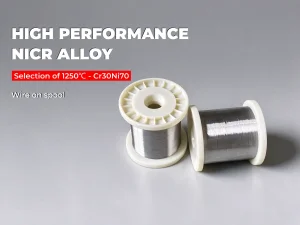
| Ni70Cr30 (Cr30Ni70) | 70% Ni, 30% Cr | 1250°C | 1.18 | 8.10 | Industrial furnaces, chemical gas heaters, steam reheaters |
| Cr15Ni60 (Ni60Cr15) | 60% Ni, 15% Cr, Bal. Fe | 1150°C | 1.11 | 8.20 | Medium-temp industrial heating, hot plates, duct heaters |
| Cr20Ni40 (Ni40Cr20) | 40% Ni, 20% Cr, Bal. Fe | 1100°C | 1.04 | 8.08 | Commercial immersion heaters, defrosting elements |
| SPARK SGHT (FeCrAl PM) | Fe-Cr-Al Powder Met. | 1425°C | 1.45 | 7.10 | Ultra-high-temp diffusion furnaces, semiconductor tools |
Global Enterprise Procurement Demand & Specification Criteria
Strategic decision matrices for procurement officers, plant engineers, and OEM original equipment designers.
Key Procurement Technical Benchmarks
When sourcing nickel chromium heating elements and wires from Chinese suppliers, enterprise buyers must evaluate strict metallurgical parameters to eliminate risk of premature thermal failure:
- Dimensional Tolerance Consistency: Diameter variations in fine wires (e.g., 0.05mm to 1.0mm) must stay within $\pm0.002\text{mm}$ to prevent localized resistance hot-spots.
- Surface Annealing Quality: Bright-annealed surfaces free of carbonaceous residues or drawing lubricants ensure clean oxidation during initial commissioning.
- ASTM B78 Accelerated Life Expectancy: Standardized test hours determining thermal stability under cyclic power loads.
- Spool Integrity & Tension Control: Precise spool winding without wire crossing or snapping during automated CNC coiling operations.
Total Cost of Ownership (TCO) Economics
While raw nickel market volatility impacts base alloy prices, calculating TCO reveals that element longevity far outweighs initial wire purchase costs. Premature heating element burnout results in costly furnace shutdown, batch contamination, and lost production yield.
Macro-Industry Solutions & Customized Heating Architectures
Deploying specialized nickel chromium and iron-chromium-aluminum resistance elements across high-stakes industrial sectors.
1. Semiconductor & Solar Wafer Manufacturing
Photovoltaic silicon crystal growth furnaces and semiconductor diffusion chambers demand clean thermal energy free of metallic particulate flaking. High-purity SGHT and Ni70Cr30 elements deliver razor-thin thermal profiling ($\pm0.5^\circ\text{C}$) inside quartz tube reactors without outgassing.
2. Petrochemical & Heavy Energy Processing
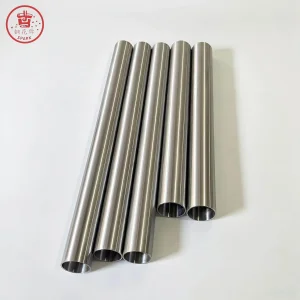
In hazardous refining and gas reforming pipelines, heavy-wall Nickel Chromium tubular elements provide explosion-proof indirect immersion heating. Resistant to sulfurous attacks and thermal shock, these elements safeguard continuous fluid viscosity control.
3. Industrial Metallurgical Heat Treatment
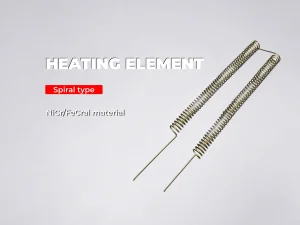
Continuous mesh belt furnaces for annealing, carburizing, and hardening require heavy-gauge wave-shaped or spiral heating elements. China's Cr20Ni80 wire and strip maintain structural shape under heavy mechanical loading and high-frequency thermal shock.
Metallurgical Technology Roadmap (2025–2035)
Next-generation innovations shaping the future of high-temperature electrical resistance materials.
Powder Metallurgy & Oxide Dispersion Strengthening (ODS)
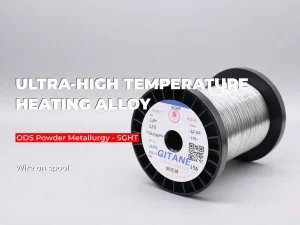
Traditional ingot metallurgy is reaching physical limits for maximum service temperature. The development of Powder Metallurgy (PM) processing—such as seen in modern SPARK SGHT grades—incorporates nano-scale yttria ($Y_2O_3$) particles uniformly throughout the alloy matrix. This ODS technique prevents grain boundary sliding, boosting operating temperature thresholds to 1425°C while maintaining exceptional creep resistance.
AI-Driven Thermal Element Modeling
Modern heater manufacturing is transitioning from static geometry design to AI-simulated thermal profiling. By utilizing finite element analysis (FEA) software, engineers optimize wire pitch, spiral coil expansion, and surface load watt density ($W/cm^2$) prior to physical drawing. This eliminates hot-spot burnout risk and ensures 100% heat dissipation uniform distribution.
Quality Standards, International Compliance & Field Support
Rigorous quality assurance standards ensuring seamless international cross-border deployment.
Global Standards Compliance
All nickel chromium and electrothermal alloys produced by certified Chinese manufacturers adhere strictly to global manufacturing standards including GB/T 1234-2012, ASTM B344 (Standard Specification for Drawn or Rolled Nickel-Chromium and Nickel-Chromium-Iron Alloys), and DIN 17470.
Testing Protocols
Every batch undergoes full spectrographic chemical analysis (ICP-OES), micro-structure grain size verification, tensile strength test, room-temperature resistivity measurement, and continuous optical surface flaw detection before export clearance.
Export Packaging & Logistics
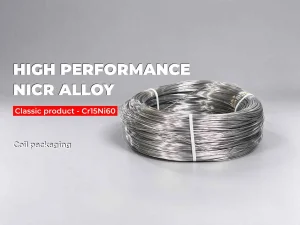
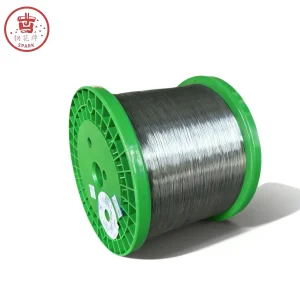
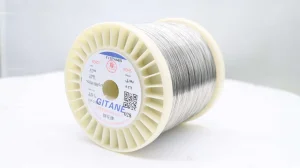
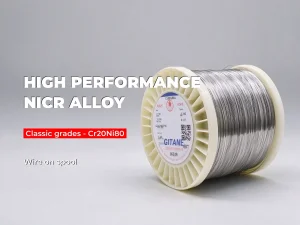
Micro-fine wires are packaged in precision plastic spools with desiccant protection inside sealed foil barriers. Heavy wires and coils are shipped on reinforced wooden pallets wrapped in anti-rust VCI film, ensuring zero atmospheric corrosion during ocean transit.
Frequently Asked Questions (Technical Sourcing Guide)
Expert technical answers addressing common engineering queries regarding Nickel Chromium and high-temperature heating alloys.
Complete Industrial Resistance Heating Product Catalog
Explore our full line of industrial heating alloys, bright resistance wires, and pre-formed furnace heating components.