
High-Precision Electric Resistance Product Portfolio
Direct factory supply from Beijing Shougang Gitane New Materials Co., Ltd. — Engineered to maintain structural integrity up to 1425°C.
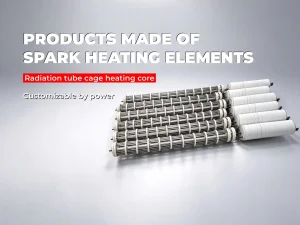
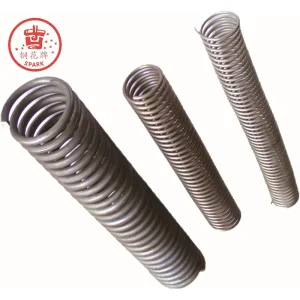
SPARK Ceramic Radiant Tube Heating Core | High-Precision Element
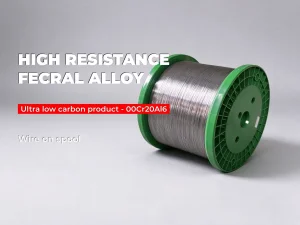
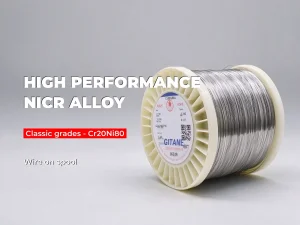




The Tri-Factor Equilibrium Paradigm: Solving the High-Temperature Alloy Dilemma
How Chinese metallurgical advances have unlocked the simultaneous optimization of electrical resistivity ($\rho$), parabolic oxidation rate constants ($K_p$), and creep-rupture resistance in thermal elements.
High Electrical Resistivity ($\rho$)
Elevated resistivity allows furnace engineers to utilize thicker wire cross-sections for a given resistance rating. Thicker elements dramatically extend operational service life by increasing the volume-to-surface ratio, delaying total aluminum depletion during high-temperature thermal cycling.
Self-Healing $\alpha$-$\text{Al}_2\text{O}_3$ Oxide Kinetics
By doping ultra-pure FeCrAl matrices with reactive elements (Y, Zr, Hf, Ce), our alloys form a highly adherent, non-spalling alpha-alumina oxide scale. This self-healing barrier impedes further oxygen diffusion, suppressing degradation up to 1425°C continuous atmosphere duty.
Grain Boundary & Structural Stability
Traditional FeCrAl alloys suffer from rapid grain growth at high temperatures, causing element sag and structural deformation. Our advanced powder metallurgy and vacuum induction melting (VIM) routes introduce oxide dispersion pinning, boosting high-temperature creep strength.
In thermal process engineering, the quest for an ideal resistance heating alloy has historically been constrained by a tri-way trade-off. Elevating chromium and aluminum contents increases electrical resistivity—allowing compact element design and efficient power density—yet it often embrittles the metallic matrix and accelerates grain coarsening at temperatures above 1100°C. Conversely, alloys designed purely for ductility and hot strength (such as standard nickel-chromium formulations) suffer from lower electrical resistivity and lower maximum operating temperature limits when exposed to harsh, oxidizing, or sulfur-bearing industrial atmospheres.
Beijing Shougang Gitane New Materials Co., Ltd. (SPARK) has achieved a breakthrough in resolving this multi-variable metallurgical challenge. By leveraging state-of-the-art Vacuum Induction Melting (VIM), Electroslag Remelting (ESR), and proprietary Powder Metallurgy (PM) processing, SPARK has engineered a portfolio of FeCrAl (Iron-Chromium-Aluminum) and NiCr (Nickel-Chromium) resistance alloys where high electrical resistivity, superior oxidation kinetics, and long-term structural stability are perfectly matched.
Comparative Performance Matrix of SPARK Electric Heating Alloys
Comprehensive metallurgical property baseline evaluated under GB/T 1234-2012, ASTM B603, and DIN 17470 testing protocols.
| Alloy Grade | Alloy System | Max Temp (°C) | Resistivity @20°C ($\mu\Omega\cdot\text{m}$) | Density ($\text{g/cm}^3$) | Thermal Expansion ($10^{-6}/\text{K}$) | Primary Oxide Layer Formed |
|---|---|---|---|---|---|---|
| SPARK SGHT | PM FeCrAl + RE ODS | 1425°C | 1.45 ± 0.05 | 7.10 | 14.7 (20–1000°C) | $\alpha$-$\text{Al}_2\text{O}_3$ (Ultra-Dense) |
| SPARK SGHYZ | Advanced FeCrAl + Rare Earth | 1400°C | 1.43 ± 0.04 | 7.15 | 15.0 (20–1000°C) | $\alpha$-$\text{Al}_2\text{O}_3$ (High Adhesion) |
| HRE / 0Cr27Al7Mo2 | FeCrAl High-Temp Grade | 1350°C | 1.42 ± 0.04 | 7.10 | 14.9 (20–1000°C) | $\alpha$-$\text{Al}_2\text{O}_3$ Protective Scale |
| 0Cr25Al5 / 0Cr23Al5 | Standard FeCrAl Workhorse | 1250°C | 1.35 – 1.42 | 7.25 | 15.1 (20–1000°C) | $\text{Al}_2\text{O}_3$ / $\text{Cr}_2\text{O}_3$ Mixed Film |
| Cr20Ni80 (Nichrome) | Austenitic Ni-Cr Alloy | 1200°C | 1.09 ± 0.03 | 8.40 | 17.0 (20–1000°C) | $\text{Cr}_2\text{O}_3$ Passivating Film |
| Cr30Ni70 | High-Cr Austenitic Ni-Cr | 1250°C | 1.18 ± 0.03 | 8.10 | 16.5 (20–1000°C) | $\text{Cr}_2\text{O}_3$ Spinel Structure |
Physical Mechanics of $\alpha$-Alumina Formation
Unlike lower-grade electrical heating alloys that form volatile chromium oxide ($\text{Cr}_2\text{O}_3$) which evaporates at temperatures exceeding 1100°C, SPARK FeCrAl alloys form a thermodynamic monolayer of pure $\alpha$-$\text{Al}_2\text{O}_3$. This scale exhibits extremely low parabolic oxidation constants ($K_p \approx 10^{-13} \text{g}^2\cdot\text{cm}^{-4}\cdot\text{s}^{-1}$ at 1200°C), preventing inward diffusion of oxygen and protecting the core conductor.
Creep Resistance via Micro-Alloying Pinning
Sagging of furnace wire coils leads to short circuits and localized hot spots. SPARK integrates trace Zirconium (Zr) and Carbon (C) control to form ultra-fine carbide and nitridic dispersions along grain boundaries. These secondary phase precipitates act as physical pinning sites, restricting grain boundary sliding during extended vertical operation in industrial kilns.
Macro Commercial Trends Driving Industrial Thermal Processing
The global pivot toward net-zero industrial heat, semiconductor expansion, and gigafactory battery production demands unmatched thermal durability.
Electrification of Heavy Industry
Global decarbonization mandates require steel, glass, and chemical plants to transition from gas-fired combustion to zero-emission electric resistance heating systems, dramatically increasing worldwide demand for high-reliability heating wire.
Solar PV & Semiconductor Growth
Polysilicon deposition, ingot growth, and semiconductor wafer annealing require precision thermal zones operating above 1300°C under ultra-clean conditions, where spalling oxide contamination cannot be tolerated.
Lithium Battery Cathode Sintering
Roller hearth kilns manufacturing LFP and NCM cathode powders run continuously for months. Heating elements must withstand aggressive chemical off-gassing and maintain mechanical stability without downtime.
Targeted Industrial Application Scenarios
Tailored alloy compositions optimized for distinct operating environments, furnace atmospheres, and geometry constraints.
1. Heavy Industrial Heat-Treating & Car-Bottom Furnaces
Challenge: Large heat-treating furnaces encounter heavy thermal shock, high mechanical vibrations, and continuous loading of forged steel components.
SPARK Solution: Utilizing SPARK 0Cr25Al5 & 0Cr21Al6Nb strip and heavy-gauge wire elements. The addition of Niobium (Nb) enhances high-temperature yield strength, preventing element sag when mounted on ceramic pegs across furnace side walls.
2. Photovoltaic Crystal Growing & Diffusion Tubing
Challenge: Ultra-precise thermal uniformity within $\pm 0.5^\circ\text{C}$ and absolute freedom from particulate micro-flaking inside quartz tube chambers.
SPARK Solution: Implementation of SPARK SGHYZ & SGHT PM Alloys. The non-spalling, mirror-smooth $\alpha$-alumina film ensures zero particulate shedding, safeguarding semiconductor wafers from metallic contamination.
3. Automotive Braking & Precision Fastener Brazing
Challenge: Continuous mesh-belt conveyor furnaces operating under reducing gas atmospheres (Dissociated Ammonia / $\text{H}_2+\text{N}_2$) cause rapid embrittlement in standard alloys.
SPARK Solution: SPARK Cr20Ni80 & Cr30Ni70 Nichrome alloys. The stable austenitic face-centered cubic (FCC) structure resists nitridation and remains completely ductile after cooling, allowing easy maintenance and element repair.
4. High-End Domestic & Commercial Heating Appliances
Challenge: Compact appliance designs demand rapid thermal response, tight bend radii without cracking, and high watt-density output.
SPARK Solution: Precision fine-drawn SPARK 00Cr20Al6 & Cr15Ni60 wire (diameters down to 0.05mm) featuring tight resistance tolerances of $\pm 2\%$, ensuring uniform power consumption across appliance production runs.
Quality Control, Testing Standards, and Supply Assurance
Beijing Shougang Gitane New Materials Co., Ltd. provides complete end-to-end traceabilities, international quality compliance, and regional engineering backup.
ISO 9001 & GB/T 1234 Certified
Manufacturing processes are rigorously audited under ISO 9001 quality management standards. Full chemical heat analysis, room-temperature tensile testing, and high-temperature life tests (per GB/T 1234-2012) are conducted for every master spool.
Advanced Metallurgical Inspection
Our 39,268 $\text{m}^2$ specialized plant houses scanning electron microscopes (SEM), energy-dispersive X-ray spectroscopy (EDS), and automated optical coil measurement systems to verify exact dimensional uniformity.
RoHS / REACH & Custom Spooling
All SPARK alloys comply with EU RoHS and REACH environmental guidelines. Products are packaged on heavy-duty plastic spools, wooden reels, or custom coil bundles to guarantee zero damage during international maritime transit.
Technology Roadmap: Next-Generation Thermal Materials
Shougang Gitane R&D is advancing future resistance heating solutions to push thermal limits beyond 1450°C.
Phase I: Nano-ODS Alloy Refinement
Integration of nano-scale Yttria ($\text{Y}_2\text{O}_3$) particles into FeCrAl matrices via mechanical alloying. This technology increases 1400°C creep-rupture strength by over 300%, eliminating sagging in horizontal element spans.
Phase II: Pre-Oxidized Functional Coatings
Developing factory-applied pre-oxidation protocols that form a stabilized $\alpha$-alumina film prior to customer installation, shortening conditioning cycles in industrial furnace commissioning.
Phase III: Zero-Carbon Alloy Melting
Transitioning primary smelting furnaces to green hydrogen reduction and renewable energy power, ensuring our high-temperature alloys carry minimal embedded carbon footprints for global OEMs.
Frequently Asked Questions by Thermal Engineers & Buyers
Detailed technical guidance on alloy selection, atmosphere compatibility, life expectancy, and element calculations.
Explore Additional SPARK Heating Alloy Products
Select high-performance alloys and specialized seamless tube heating assemblies ready for factory dispatch.





Optimize Your Industrial Thermal Systems with SPARK Alloys
Whether you are designing a high-temperature 1400°C atmosphere kiln, replacing worn furnace elements, or seeking custom-drawn wire with strict resistance tolerances, our metallurgical engineering team is ready to assist.