
Precision Resistance Heating Alloys & Components
Engineered high-resistivity FeCrAl and NiCr wire, strip, and heating elements manufactured under rigorous ISO 9001 quality management.



1. Metallurgical Foundations: High Resistivity Alloy Engineering
High resistivity electric heating alloys represent a vital class of functional metallic materials engineered to convert electrical energy directly into thermal energy via Joule heating ($P = I^2 R$). As industrial processes demand higher thermal efficiency, extended element service life, and rigorous thermal repeatability, the choice of resistance wire supplier becomes a paramount operational variable. Among global manufacturers, **China high resistivity heating alloy suppliers and factories**—led by state-backed technological powerhouses such as Beijing Shougang Gitane New Materials Co., Ltd. (SPARK Brand)—have reshaped the global competitive landscape through structural metallurgical innovations and vertically integrated manufacturing.
The performance of an electric heating alloy is governed by three foundational physical characteristics: **electrical resistivity ($\rho$)**, **high-temperature oxidation kinetics**, and **structural hot strength (creep resistance)**. Standard metallic conductors like copper or aluminum exhibit exceptionally low electrical resistivity, rendering them inefficient for heating. Conversely, high-resistance alloys rely on solid-solution strengthening and micro-alloying techniques to retard electron mobility, creating precise, stable electrical resistance across operational temperatures ranging from 100°C up to 1425°C.
Core Technical Information Gain: Standard FeCrAl alloys form a self-healing, thermodynamically stable Alpha-Alumina ($\alpha\text{-Al}_2\text{O}_3$) scale at high temperatures, whereas NiCr alloys generate a Chromia ($\text{Cr}_2\text{O}_3$) protective oxide layer. Understanding the phase transformation mechanisms of these protective films is essential for preventing localized hot-spotting, element embrittlement, and catastrophic dielectric breakdown in industrial kilns.
1.1 Iron-Chromium-Aluminum (FeCrAl) vs. Nickel-Chromium (NiCr) Systems
Industrial thermal engineers primarily select between two main families of resistance heating alloys: Ferritic Iron-Chromium-Aluminum (FeCrAl) alloys and Austenitic Nickel-Chromium (NiCr) alloys. Each alloy class exhibits distinct physical, chemical, and electrical attributes suited to specific thermal environments.
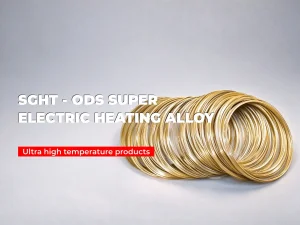
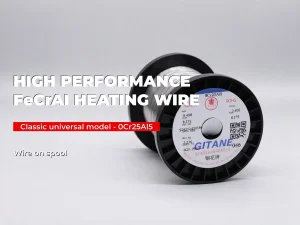
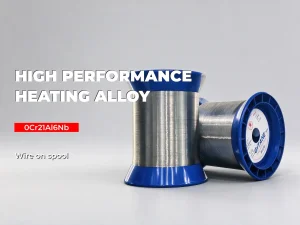
- FeCrAl Alloy System (e.g., 0Cr25Al5, 0Cr23Al5, 0Cr21Al6Nb, SGHT): Characterized by higher electrical resistivity ($1.35 - 1.45\,\mu\Omega\cdot\text{m}$), lower density ($6.8 - 7.1\,\text{g/cm}^3$), higher continuous service temperatures (up to 1425°C), and resistance to sulfur-bearing atmospheres. The primary mechanism of protection is the rapid formation of a non-porous, highly adherent $\alpha\text{-Al}_2\text{O}_3$ scale when exposed to oxygen at temperatures exceeding 900°C.
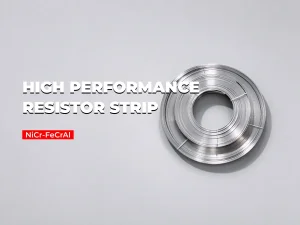
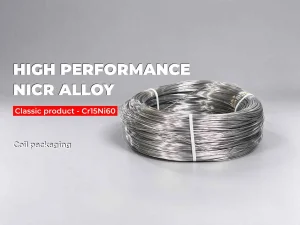
- NiCr Alloy System (e.g., Cr20Ni80, Cr15Ni60, Cr20Ni40): Exhibiting an austenitic face-centered cubic (FCC) crystal structure, NiCr alloys provide outstanding hot strength, superior ductility after prolonged thermal exposure, and non-magnetic properties. While their maximum operating temperature is generally lower (1200°C to 1250°C) and density higher ($8.4\,\text{g/cm}^3$), NiCr elements excel in applications subject to severe mechanical vibration, frequent thermal cycling, or wet/hydrated operating environments.
1.2 Technical Comparison Matrix: FeCrAl & NiCr Commercial Grades
The table below provides certified physical, electrical, and thermal properties for standard resistance alloy grades produced by Shougang Gitane, fully compliant with international standards (ASTM, DIN, GB/T 1234-2012):
| Alloy Grade | Alloy Family | Resistivity @20°C ($\mu\Omega\cdot\text{m}$) | Max Temp (°C) | Density ($\text{g/cm}^3$) | Melting Point (°C) | Oxide Layer Type |
|---|---|---|---|---|---|---|
| SGHT (Powder Met) | FeCrAl (ODS PM) | 1.45 ± 0.05 | 1425°C | 7.10 | 1500°C | $\alpha\text{-Al}_2\text{O}_3$ (Dispersion Stabilized) |
| SGHYZ / HRE | FeCrAl (RE Doped) | 1.42 ± 0.04 | 1400°C / 1350°C | 7.10 | 1500°C | $\alpha\text{-Al}_2\text{O}_3$ (RE Adherent) |
| 0Cr25Al5 | FeCrAl | 1.42 ± 0.04 | 1250°C | 7.10 | 1500°C | $\alpha\text{-Al}_2\text{O}_3$ Standard |
| 0Cr21Al6Nb | FeCrAl + Nb | 1.45 ± 0.04 | 1350°C | 7.10 | 1500°C | $\alpha\text{-Al}_2\text{O}_3$ + Niobium Carbide |
| 0Cr23Al5 | FeCrAl | 1.35 ± 0.03 | 1250°C | 7.25 | 1500°C | $\alpha\text{-Al}_2\text{O}_3$ Standard |
| Cr20Ni80 | Ni-Cr Austenitic | 1.09 ± 0.031200°C | 8.40 | 1400°C | $\text{Cr}_2\text{O}_3$ Spinel Shield | |
| Cr30Ni70 | Ni-Cr High-Cr | 1.18 ± 0.03 | 1250°C | 8.10 | 1380°C | Dense $\text{Cr}_2\text{O}_3$ Complex |
| Cr15Ni60 | Ni-Cr-Fe | 1.12 ± 0.03 | 1150°C | 8.20 | 1390°C | $\text{Cr}_2\text{O}_3 - \text{Fe}_2\text{O}_3$ Mixed |
2. China Industry 4.0: Supply Chain Resilience & Manufacturing Engineering
The global reputation of **China high resistivity heating alloy factories** rests upon continuous investments in automated melt-to-spool production infrastructure. Operating within the industrial matrix of **Shougang Group**, Beijing Shougang Gitane manages an 88,000 square meter integrated manufacturing footprint equipped with state-of-the-art metallurgical technology.
Vacuum Induction Melting (VIM) & ESR
Ultra-clean alloy synthesis utilizing high-vacuum induction melting coupled with Electroslag Remelting (ESR). This minimizes trace impurities (P, S, H, O, N), eliminating inclusions that trigger early thermal failure.
Precision Diamond Wire Drawing
Multi-stage cold drawing through polycrystalline diamond dies ensures sub-micron dimensional tolerances ($\pm 0.01\,\text{mm}$), uniform cross-sectional area, and smooth surface finishes free of micro-cracks.
Continuous Bright Annealing
Controlled hydrogen-atmosphere continuous bright annealing eliminates internal residual stress, imparting precise mechanical elongation and uniform electrical resistance along every spool meter.
2.1 Advanced Micro-Alloying: The Rare Earth Element (REE) Effect
A critical engineering differentiator of Shougang Gitane's **SPARK** brand is the proprietary doping of Rare Earth Elements (REE)—specifically Yttrium (Y), Zirconium (Zr), Hafnium (Hf), and Cerium (Ce). In standard FeCrAl alloys operated at elevated temperatures, outward diffusion of aluminum creates micro-voids at the metal-oxide interface, leading to oxide spallation. By introducing precise micro-additions of Yttrium and Zirconium, Gitane engineers lock grain boundaries, forming "reactive element pegs" that mechanically key the protective $\alpha\text{-Al}_2\text{O}_3$ scale to the metallic substrate. This innovation increases thermal fatigue resistance by over 350% under cyclic heating loads.
3. Thermal Engineering Guide: Surface Load & Element Lifetime Optimization
For industrial furnace builders, heat treatment plant managers, and equipment designers, selecting the proper resistance wire diameter and alloy grade requires balancing thermal output against total element life. The single most important parameter in electric furnace engineering is **Surface Load ($W$, measured in $\text{W/cm}^2$)**.
Surface load represents the thermal power dissipated per unit surface area of the heating element. Operating an element above its recommended surface load elevates its internal temperature far above the ambient furnace atmosphere, drastically accelerating aluminum depletion, oxide degradation, and premature sagging.
Fundamental Surface Load Formula:
$$W = \frac{P}{\pi \cdot d \cdot L}$$
Where $P$ is total electrical power ($\text{Watts}$), $d$ is wire diameter ($\text{cm}$), and $L$ is total active wire length ($\text{cm}$).
3.1 Recommended Surface Load Limits by Furnace Atmosphere
Different chemical atmospheres alter the thermodynamic stability of the protective oxide scale. The matrix below serves as an expert engineering reference for establishing safe surface load design thresholds:
| Furnace Atmosphere | FeCrAl (0Cr25Al5 / HRE) Limit | FeCrAl (SGHT PM Grade) Limit | NiCr (Cr20Ni80) Limit | Primary Failure Mechanism |
|---|---|---|---|---|
| Air / Oxidizing | $1.8 - 2.5\,\text{W/cm}^2$ | $2.5 - 3.2\,\text{W/cm}^2$ | $1.5 - 2.2\,\text{W/cm}^2$ | Al/Cr depletion & thermal oxidation |
| Nitrogen ($N_2$) Dry | $1.2 - 1.6\,\text{W/cm}^2$ | $1.8 - 2.2\,\text{W/cm}^2$ | $1.5 - 2.0\,\text{W/cm}^2$ | Nitridation of Aluminum (AlN formation) |
| Carburizing (CO / $CH_4$) | $1.0 - 1.4\,\text{W/cm}^2$ | $1.4 - 1.8\,\text{W/cm}^2$ | $0.8 - 1.2\,\text{W/cm}^2$ (Green Rot) | Internal Carburization / Chromium Carbide |
| Hydrogen ($H_2$) Pure | $1.5 - 2.0\,\text{W/cm}^2$ | $2.0 - 2.5\,\text{W/cm}^2$ | $1.2 - 1.8\,\text{W/cm}^2$ | Scale reduction (Pre-oxidation required) |
| Vacuum ($< 10^{-2}\,\text{Torr}$) | $0.8 - 1.2\,\text{W/cm}^2$ | $1.2 - 1.5\,\text{W/cm}^2$ | $0.5 - 1.0\,\text{W/cm}^2$ | Volatilization of Chromium & Nickel |
4. Industry Solutions: Macro Engineering Applications
High resistivity heating alloys manufactured in China are deployed across high-precision global industries. Modern heating applications demand rigorous cleanliness, precise temperature control within $\pm 1^\circ\text{C}$, and resistance to thermal shock.
Semiconductor & Photovoltaics
Ultra-clean SGHT powder metallurgy FeCrAl heating elements are critical for silicon crystal growth, LPCVD diffusion furnaces, and solar wafer sintering, providing zero particulate contamination at 1350°C+.
EV Battery Cathode Material Kilns
Lithium Iron Phosphate (LFP) and NCM cathode material manufacturing requires continuous rotary and pusher kilns. SPARK 0Cr25Al5 and 0Cr21Al6Nb ribbons deliver high oxidation resistance under aggressive alkaline dust conditions.
Green Steel & Clean Heat Treatment
Transitioning from direct gas combustion to electric heating radiant tubes allows heat-treaters to cut carbon emissions. Heavy-gauge SPARK FeCrAl strip element cores power high-capacity bright annealing lines.
5. Technology Roadmap & Future Outlook: 2025–2035
The global push for industrial decarbonization is accelerating the replacement of fossil-fuel burners with electric heating systems across steel, glass, ceramic, and chemical manufacturing. Shougang Gitane's metallurgical R&D team is driving key innovations across three primary frontiers:
- Powder Metallurgy Oxide Dispersion Strengthened (ODS) Alloys: Next-generation ODS FeCrAl alloys (such as enhanced SGHT) incorporate nano-scale yttria ($\text{Y}_2\text{O}_3$) dispersions throughout the metallic matrix. This prevents high-temperature grain growth, enabling operating temperatures up to 1425°C with near-zero creep deformation over 10,000+ continuous operating hours.
- Hydrogen-Compatible Electric Heating Cores: As green hydrogen replaces natural gas in industrial reduction furnaces, resistance heating elements must resist hydrogen embrittlement and steam oxidation ($H_2O$ vapor). Advanced micro-alloying recipes are engineered to maintain film adhesion in humidified hydrogen atmospheres up to 1300°C.
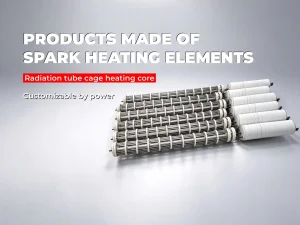
- Smart Ceramic Radiant Heating Elements: Integrating high-resistivity heating wire directly into porous ceramic matrices and ceramic fiber modules. These pre-packaged, plug-and-play heating modules minimize installation downtime while optimizing radiative heat transfer efficiency.
Industrial Resistance Wires, Strips & Special Alloys
Explore our full line of industrial FeCrAl alloys, NiCr heating wires, high-purity nickel raw materials, and custom electric furnace assemblies.



6. Global Enterprise Procurement & Quality Assurance
For international procurement directors and supply chain managers, vetting **China high resistivity heating alloy suppliers** requires verifying certification credentials, quality control protocols, and regulatory compliance frameworks. Beijing Shougang Gitane operates under an integrated management framework designed to meet stringent global procurement standards.
6.1 International Standard Equivalence Mapping
Shougang Gitane alloys are manufactured according to China National Standard **GB/T 1234-2012** and can be cross-referenced to standard global specifications:
| Shougang Gitane Grade | GB/T Standard | US Standard (ASTM) | German Standard (DIN) | Global Trade Equivalent |
|---|---|---|---|---|
| 0Cr25Al5 | GB/T 1234 0Cr25Al5 | ASTM B603 FeCrAl | DIN 17470 W.Nr. 1.4765 | Kanthal D / Alkrothal 70 |
| 0Cr21Al6Nb | GB/T 1234 0Cr21Al6Nb | ASTM B603 Grade A | DIN 17470 W.Nr. 1.4725 | Kanthal A1 / APM |
| Cr20Ni80 | GB/T 1234 Cr20Ni80 | ASTM B344 NiCr 80 | DIN 17470 W.Nr. 2.4869 | Nichrome V / Nikrothal 80 |
| Cr15Ni60 | GB/T 1234 Cr15Ni60 | ASTM B344 NiCr 60 | DIN 17470 W.Nr. 2.4867 | Nichrome C / Nikrothal 60 |
6.2 Compliance, Sustainability & ESG (EU CBAM Preparedness)
Shougang Gitane enforces complete compliance with EU **RoHS Directive 2011/65/EU** and **REACH (EC 1907/2006)** regulations. Hazardous heavy metals (Pb, Cd, Hg, Cr(VI), PBBs, PBDEs) are strictly restricted. Furthermore, as an enterprise backed by Shougang Group, Gitane benefits from scrap recycling initiatives and energy-efficient electric arc furnace smelting. This low-carbon manufacturing process directly lowers embedded carbon footprint data, assisting European buyers with **EU Carbon Border Adjustment Mechanism (CBAM)** reporting.
7. Localization Support & Technical Engineering Services
Navigating global supply logistics requires reliable manufacturer support. Beijing Shougang Gitane provides end-to-end technical engineering consultation to global clients from design through final element installation:
Custom Coiling & Element Fabrication
In-house precision CNC winding capabilities for single-phase and three-phase spiral heating elements, corrugated meander ribbon elements, and ceramic radiant tube cores built to custom mechanical drawings.
Export Packaging & Anti-Corrosion Protection
Spools and heavy-gauge coils are hermetically sealed with desiccant in vapor-corrosion-inhibitor (VCI) plastic film, enclosed within ISPM-15 compliant heat-treated wooden crates for ocean freight protection.
Rapid Metallurgical Diagnostics
Comprehensive failure analysis services for degraded furnace elements. Our analytical lab performs SEM/EDS microstructural scanning to identify localized contamination, over-temperature spallation, or atmosphere attack.
Frequently Asked Questions (FAQ) for Thermal Engineers
Detailed technical answers to common queries regarding material selection, surface loads, coiling practices, and delivery specifications.
Standard FeCrAl grades such as 0Cr23Al5 and 0Cr25Al5 operate reliably up to 1250°C. High-performance grades like 0Cr21Al6Nb and HRE reach 1350°C. For extreme industrial furnace duty, Shougang Gitane's proprietary SGHYZ is rated to 1400°C, while powder-metallurgy SGHT reaches 1425°C in continuous atmospheric service.
FeCrAl alloys contain no nickel, a volatile global commodity. Furthermore, FeCrAl has a lower physical density (approx. $7.10\,\text{g/cm}^3$) compared to NiCr ($8.40\,\text{g/cm}^3$). Combined with higher electrical resistivity ($\sim 1.42\,\mu\Omega\cdot\text{m}$ vs $1.09\,\mu\Omega\cdot\text{m}$), an engineer requires significantly less raw material by weight to achieve the same electrical resistance, reducing component material costs by 20% to 40%.
"Green Rot" is an intergranular oxidation-carburization phenomenon that occurs in NiCr alloys exposed to carburizing or mildly oxidizing atmospheres between 800°C and 1050°C. Chromium selectively reacts with carbon to form chromium carbides ($\text{Cr}_{23}\text{C}_6$) along grain boundaries, depleting the matrix of chromium and causing rapid embrittlement. Using FeCrAl alloys (e.g., 0Cr25Al5 or SGHT) prevents Green Rot due to their immune ferritic structure and stable $\alpha\text{-Al}_2\text{O}_3$ scale.
When coiling round resistance wire into spiral elements, maintain an optimal coil-to-wire diameter ratio ($D/d$) between 3.0 and 6.0. Stretching ratios ($S/D$) should ideally range between 2.0 and 4.0 to ensure uniform inter-turn spacing and adequate heat dissipation. Tightly compressed turns cause localized overheating ("turn-to-turn shorting"), leading to rapid localized burn-outs.
Shougang Gitane supplies alloys in a wide variety of dimensions: Round Wire from $\Phi 0.05\,\text{mm}$ to $\Phi 10.0\,\text{mm}$; Cold-Rolled Strip/Ribbon in thicknesses from $0.05\,\text{mm}$ to $4.0\,\text{mm}$ and widths up to $200\,\text{mm}$; as well as pre-formed spiral elements, meander ribbons, and ceramic radiant tube cores tailored to customer engineering drawings.
Resistivity stability is guaranteed through single-heat VIM smelting, continuous online laser micrometer gauging during drawing, and continuous digital resistance testing across every drawn meter. Electrical resistance tolerance is tightly controlled within $\pm 3\%$ of nominal values, compliant with GB/T 1234-2012 and ASTM B603 standards.