
High-Resistivity FeCrAl & Heating Alloy Portfolio
Precision-engineered electrical resistance wires, strips, and heating elements manufactured under ISO 9001 and GB/T 1234-2012 quality systems.



1. Metallurgical Foundations of High-Resistivity FeCrAl Alloys
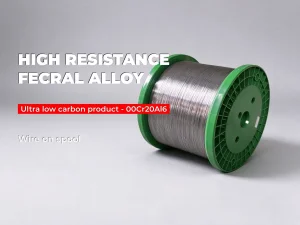
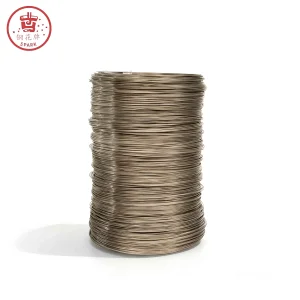
Iron-Chromium-Aluminum (FeCrAl) alloys represent a pinnacle of high-temperature electrical resistance material engineering. Designed specifically to convert electrical energy into intensive thermal energy through Joule heating ($P = I^2 R$), these solid-solution strengthened ferritic alloys achieve operational stability at temperatures exceeding 1400°C. Compared to traditional Austenitic Nickel-Chromium (NiCr) systems, high-resistivity FeCrAl offers distinct thermodynamic, physical, and economic advantages, including lower bulk density ($7.10 \text{ g/cm}^3$ vs. $8.40 \text{ g/cm}^3$), significantly higher electrical resistivity ($1.25 \text{ to } 1.45 \ \mu\Omega\cdot\text{m}$), and superior oxidation resistance at elevated temperatures.
Information Gain Insight: The ultimate thermal limit of an electrothermal alloy is dictated not merely by its melting point, but by the thermodynamic kinetics of its protective oxide scale. FeCrAl alloys spontaneously synthesize a self-healing, highly adherent alpha-alumina ($\alpha\text{-Al}_2\text{O}_3$) outer barrier when exposed to oxidizing atmospheres at temperatures above 900°C, drastically slowing down further internal metallic oxidation.
1.1 The Kinetics of $\alpha\text{-Al}_2\text{O}_3$ Protective Scale Growth
When exposed to thermal stress, the aluminum atoms ($5.0\% - 7.5\%$ mass fraction) within the ferritic lattice diffuse outward to react with atmospheric oxygen. The initial transient phase forms metastable gamma ($\gamma$), theta ($\theta$), or delta ($\delta$) alumina structures. Upon reaching thermal equilibrium ($>1000^\circ\text{C}$), these phase-transform irreversibly into alpha-alumina ($\alpha\text{-Al}_2\text{O}_3$). This hexagonal close-packed oxide scale possesses an exceptionally low ionic defect density, conferring near-zero electrical conductivity and an exceptionally slow parabolic growth rate constant ($K_p$).
To prevent spallation caused by mismatched thermal expansion coefficients between the metallic substrate and the ceramic scale, leading Chinese manufacturers, such as Beijing Shougang Gitane New Materials Co., Ltd., incorporate reactive elements (RE) including Yttrium (Y), Zirconium (Zr), Hafnium (Hf), and Neodymium (Nd). Reactive element micro-alloying pins the oxide scale to grain boundaries, suppressing dynamic spallation during rapid thermal cycling.
1.2 Electrical Resistivity and Temperature Coefficient ($\text{C}_t$)
High electrical resistivity is crucial for industrial element design. Higher resistivity permits furnace engineers to utilize thicker wire cross-sections or wider strip profiles for a given resistance target, dramatically extending element creep life and resistance to mechanical deformation under load. The temperature factor of resistance ($\text{C}_t$), defined as $R_T / R_{20}$, characterizes the resistivity drift from cold start-up ($20^\circ\text{C}$) to peak operating temperature ($1300^\circ\text{C}-1400^\circ\text{C}$). FeCrAl alloys exhibit an remarkably flat $\text{C}_t$ curve compared to pure refractory metals, simplifying power supply transformer design and SCR thyristor control algorithms.
| Alloy Grade (GB/T 1234) | Nominal Composition | Max Temp (°C) | Resistivity at 20°C ($\mu\Omega\cdot\text{m}$) | Density ($\text{g/cm}^3$) | Melting Point (°C) |
|---|---|---|---|---|---|
| 0Cr27Al7Mo2 / SGHT | Fe-27Cr-7.0Al-2.0Mo + RE | 1425°C | 1.45 | 7.10 | 1520°C |
| SGHYZ / HRE | Fe-26Cr-6.0Al + Y/Zr/Hf | 1400°C | 1.42 | 7.10 | 1500°C |
| 0Cr25Al5 | Fe-25Cr-5.3Al + RE | 1250°C | 1.42 | 7.10 | 1500°C |
| 0Cr21Al6Nb | Fe-21Cr-5.5Al-0.5Nb | 1350°C | 1.45 | 7.10 | 1500°C |
| 0Cr23Al5 | Fe-23Cr-5.0Al | 1250°C | 1.35 | 7.15 | 1500°C |
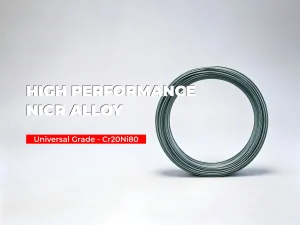
| Cr20Ni80 (NiCr Benchmark) | Ni-20Cr balance | 1200°C | 1.09 | 8.40 | 1400°C |
2. Global Enterprise Procurement Criteria & Supply Chain Metrics
Procurement executives, furnace OEMs, and thermal plant managers evaluated by strict total cost of ownership (TCO) matrices demand more than standard catalog specifications. When sourcing high-resistivity FeCrAl wire and strip from China, international buyers evaluate engineering vendor capabilities across four stringent metallurgical and operational parameters:
Batch-to-Batch Resistivity Delta
Strict tolerances ($\pm 1.5\%$ resistance variability across 10-ton master heats) ensure uniform surface power density, avoiding localized hot-spots that lead to early element rupture.
Trace Element Carbon/Sulfur Control
Ultra-low carbon ($C < 0.020\%$) and ultra-low sulfur ($S < 0.005\%$) refining via Vacuum Induction Melting (VIM) and Electroslag Remelting (ESR) eliminates grain-boundary carbide precipitation.
High-Temperature Creep Resistance
Grain growth inhibition at temperatures above 1100°C prevents wire sagging and inter-turn shorting in heavy coil elements suspended on refractory ceramic tubes.
2.1 Comparative Industry Equivalents (Global Cross-Reference)
To assist global engineering teams in substituting legacy Western alloys with China's high-performance FeCrAl alternatives, the following cross-reference matrix illustrates structural and chemical equivalence:
- Kanthal APM® Equivalent: Powder metallurgy SGHT / 0Cr27Al7Mo2 — Ultra-high creep strength, rated to 1425°C.
- Kanthal A1® Equivalent: Heavy-duty ingot-melted SGHYZ / 0Cr25Al5 (High RE Grade) — Rated to 1400°C.
- Kanthal AF® Equivalent: Stabilized 0Cr21Al6Nb — Niobium-modified grain boundary stability, rated to 1350°C.
- Resistohm 145 Equivalent: High-resistivity 0Cr27Al7Mo2 — Optimized for high watt-density radiant tube heaters.
3. Macro-Industry Solutions & Application Engineering
High-resistivity FeCrAl alloys serve as the thermal backbone for critical global decarbonization initiatives and advanced thermal manufacturing processes. The choice of alloy grade and element wire diameter directly determines thermal efficiency, furnace ramp rates, and plant throughput.
3.1 Semiconductor & Solar PV Wafer Diffusion Furnaces
In monocrystalline silicon crystal growth and PV wafer diffusion processing ($1100^\circ\text{C}-1300^\circ\text{C}$), thermal uniformity within the furnace chamber must be maintained within $\pm 0.5^\circ\text{C}$. SPARK SGHT powder-metallurgy alloy strips prevent structural sagging over 24/7 continuous production campaigns. The non-magnetic, particle-free $\alpha\text{-Al}_2\text{O}_3$ scale minimizes wafer contamination risks during high-purity processing.
3.2 Automotive & Aerospace Heat Treatment Kilns
Continuous mesh-belt furnaces, gas carburizing kilns, and vacuum tempering systems utilize FeCrAl ribbon or heavy coil elements. In carbonaceous or nitrogenous atmospheres, pre-oxidized FeCrAl forms a barrier resistant to carbon soot deposition ("green rot" corrosion) that typically destroys nickel-based alloys.
3.3 Hydrogen Production Reformers & Industrial Decarbonization
As heavy industry shifts from fossil fuel combustion to clean electric heating, high-power radiant tube heating modules powered by 0Cr27Al7Mo2 wire allow petrochemical reformers, steel annealing lines, and ceramic kilns to run cleanly on zero-carbon electric power.
4. Technical Roadmap & Future Outlook (2025–2035)
Innovations in Powder Metallurgy (PM), Oxide Dispersion Strengthening (ODS), and Micro-Alloy Optimization.
4.1 Powder Metallurgy (PM) vs Vacuum Induction Melting (VIM)
Traditional ingot melting routes encounter thermodynamic limits when aluminum content exceeds $6.5\%$ due to severe macro-segregation and embrittlement during hot rolling. Powder Metallurgy (PM) routes bypass liquid segregation. Gas atomization generates spherical alloy powder, followed by Hot Isostatic Pressing (HIP) and extrusion. The resulting ultra-fine, uniform dispersion of reactive oxides ($\text{Y}_2\text{O}_3, \text{HfO}_2$) yields superior creep resistance at temperatures approaching 1450°C.
4.2 Oxide Dispersion Strengthening (ODS) FeCrAl Alloys
Next-generation ODS-FeCrAl alloys incorporate nano-scale yttria-titanium oxide clusters dispersed evenly throughout the ferritic grain matrix. These nano-clusters lock dislocations, enabling elements to maintain yield strengths above $20 \text{ MPa}$ even at $1300^\circ\text{C}$, effectively eliminating the sagging phenomena inherent to classical wire-drawn materials.
5. Global Commercial Status & China's Strategic Supply Advantages
The global industrial heating wire market is undergoing a significant transformation. Historically dominated by European producers, China has established itself as a premier global hub for high-purity, high-resistivity FeCrAl and NiCr manufacturing. Beijing Shougang Gitane New Materials Co., Ltd. (a key enterprise of the Shougang Group) leads this transformation through complete vertical integration—from iron ore refining and vacuum induction melting to precision cold-drawing, diamond-die polishing, and continuous strand hydrogen annealing.
5.1 Regional Demand Dynamics
- Europe & North America: High demand driven by thermal processing retrofits, industrial electrification, glass tempering lines, and high-purity ceramic sintering.
- Asia-Pacific & Middle East: Rapid expansion in solar photovoltaic ingot manufacturing, semiconductor fab heat zones, and heavy-duty industrial brake resistor networks for high-speed rail and marine propulsion.
5.2 China Manufacturing Strengths
With an integrated production footprint spanning tens of thousands of square meters, state-of-the-art testing equipment (including SEM/EDS elemental mapping, high-temperature creep testing rigs, and digital eddy-current flaw detectors), China offers global buyers rapid delivery cycles, customized wire/strip tolerances down to $\pm 0.005 \text{ mm}$, and competitive pricing structures.
6. Quality Assurance, Testing Protocols & International Compliance
Reliability in thermal engineering requires zero defect tolerances. Premature failure of a single furnace element can cause costly un-planned downtime and material losses in large-scale industrial kilns. Shougang Gitane enforces strict quality management frameworks compliant with ISO 9001:2015, ISO 14001, and national standard GB/T 1234-2012.
Accelerated Life Testing (ASTM B78)
Samples undergo rapid cyclical heating and cooling (120 seconds ON, 120 seconds OFF) at 1200°C–1350°C under load to verify oxide scale adhesion and time-to-burnout performance.
Hot Resistance Coefficient ($\text{C}_t$) Verification
Four-wire Kelvin bridge testing across temperatures from 20°C to 1300°C measures exact electrical resistance curves for every produced heat lot.
RoHS, REACH & Export Packaging
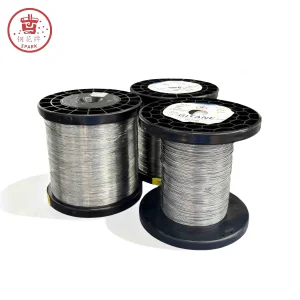
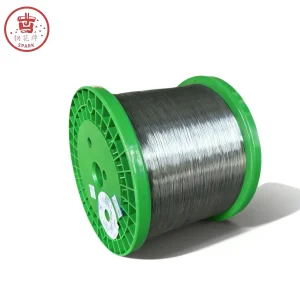
100% compliant with EU RoHS and REACH regulations. Wires and strips are wound on precision spools, vacuum-sealed with desiccant, and packed in ISPM-15 compliant wooden cases.
7. Technical Q&A: Frequently Asked Engineering Questions
Detailed responses from our chief metallurgical engineers to common procurement and heating design questions.
Q1: How does surface watt density ($\text{W/cm}^2$) impact FeCrAl heating element life?
Surface watt density is the electrical power dissipated per unit surface area of the heating wire ($W / (\pi \cdot d \cdot L)$). Higher watt densities increase the operating temperature differential between the element core and the furnace atmosphere. Operating an element above its recommended surface load accelerates aluminum depletion from the core, thinning the protective $\alpha\text{-Al}_2\text{O}_3$ scale and shortening operational life. For industrial furnaces running at 1200°C, typical recommended watt densities range from $1.5 \text{ to } 2.5 \ \text{W/cm}^2$.
Q2: Should I choose FeCrAl or NiCr wire for cycling atmosphere furnaces?
For continuous high-temperature duty ($>1200^\circ\text{C}$), FeCrAl is vastly superior due to its higher maximum operating temperature (up to 1425°C) and superior oxidation barrier. However, in applications featuring rapid, frequent thermal cycling at lower temperatures ($<1000^\circ\text{C}$) or strong mechanical vibration, NiCr (such as Cr20Ni80) may be preferred because its austenitic structure retains ductility after thermal aging, whereas ferritic FeCrAl undergoes grain growth and becomes brittle upon cooling to room temperature.
Q3: What is the optimal pre-oxidation process for newly installed FeCrAl elements?
New FeCrAl elements should undergo a controlled pre-oxidation treatment prior to exposing the furnace to operational workloads or process gases. Heat the dry, clean furnace under normal atmospheric conditions to $1050^\circ\text{C} - 1100^\circ\text{C}$ for 8 to 12 hours without active charge. This forms a uniform, dense, un-cracked alpha-alumina protective scale on the wire surface, serving as an effective diffusion barrier against subsequent chemical attack.
Q4: How do reducing or carbon-bearing atmospheres affect high-resistivity FeCrAl?
FeCrAl relies on atmospheric oxygen to heal its protective alumina scale. In strongly reducing atmospheres (such as dry hydrogen, cracked ammonia, or vacuum) or carbon-rich gas mixtures ($\text{CO}/\text{CH}_4$), oxygen partial pressure is reduced. Under these conditions, aluminum oxidation kinetics slow, leaving the alloy vulnerable to carburization and internal grain boundary attack. In carbon-rich environments, periodic re-oxidation in air is recommended to regenerate the $\alpha\text{-Al}_2\text{O}_3$ coating.
Q5: How does element diameter affect high-temperature sag resistance?
Creep deformation rate scales inversely with the square of wire cross-sectional diameter. Choosing a thicker wire diameter (e.g., $6.0 \text{ mm}$ instead of $3.0 \text{ mm}$) dramatically increases structural rigidity at temperatures above 1100°C. Thicker wires also contain a larger internal aluminum reservoir, extending the time required for aluminum depletion and providing up to 300% longer element service life.
Additional Specialized Alloys & Custom Heating Elements
Explore our complete range of high-resistivity foils, tubing, nichrome wires, and custom furnace solutions.





8. Summary & Engineering Consultation
Selecting the optimal high-resistivity FeCrAl grade involves a careful balance of chemical composition, oxidation dynamics, physical dimensioning, and operating atmosphere control. As China's leading manufacturer of electrical resistance heating alloys, Beijing Shougang Gitane New Materials Co., Ltd. provides global engineering teams with technical support, alloy samples, mill test certifications, and custom element design services.
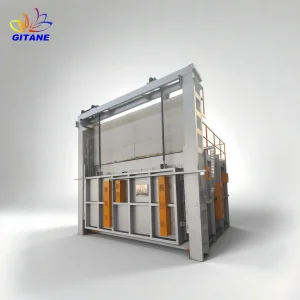
Whether you require bulk 0Cr25Al5 wire coils for industrial furnace manufacturing, ultra-high temperature SGHT powder metallurgy strip for semiconductor wafers, or customized industrial furnace systems, our technical sales engineers are ready to optimize your thermal systems.