
High-Formability Alloy Wires & Industrial Heating Coils
Engineered specifically for automated high-speed coil winding, multi-axis mandrel spinning, and intense continuous bending applications without micro-fissuring or springback variability.

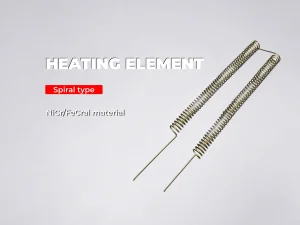

Executive Science: Enabling Smooth Forming into Coils
In high-temperature thermal engineering, industrial furnace manufacturing, and precision electronic inductor fabrication, the phrase "enabling smooth forming into coils" represents the ultimate metallurgical benchmark. Resistance heating wires—specifically Iron-Chromium-Aluminum (FeCrAl) alloys like 0Cr23Al5, 0Cr25Al5, HRE, and Nickel-Chromium (NiCr) alloys like Cr20Ni80 and Cr15Ni60—are inherently prone to strain hardening, lattice embrittlement, and surface galling during rapid cold coiling. When processed on high-speed CNC winding mandrels or automatic helical coil formers, sub-standard wire stock experiences localized stress concentrations, micro-cracking, and non-uniform elastic springback.
China’s advanced electrothermal alloy sector, led by premier integrated manufacturers such as Beijing Shougang Gitane New Materials Co., Ltd., has fundamentally resolved these historic coiling challenges through Microstructure Grain Boundary Engineering and advanced thermodynamic refining. By controlling grain growth during vacuum induction melting (VIM), applying continuous hydrogen-atmosphere bright annealing, and utilizing ultrasonic surface polishing, Chinese manufacturers deliver resistance wire capable of seamless, tight-radius mandrel wrapping without cracking or wall-thinning.
Recrystallization & Ductility
Strict control over grain size distribution ($G = 6.5 \text{ to } 8.0$ ASTM) maintains room-temperature elongation above $20\%$, enabling sharp $R/D \le 1.5$ winding ratios without micro-fissures.
Springback Consistency
Ultra-tight yield-to-tensile strength ratio ($\sigma_s / \sigma_b \le 0.65$) eliminates dimensional variance across thousands of finished spiral heating elements.
Surface Integrity
Mirror-finish bright drawing removes oxide scale micro-voids, preventing friction galling on high-speed automatic winding mandrels.
Conventional FeCrAl wire suffers from cold-work embrittlement when coiled over mandrels smaller than $3 \times \text{wire diameter}$ ($D/d < 3$). Chinese metallurgical advancements in rare-earth micro-alloying (Yttrium, Zirconium, Cerium) pin grain boundaries, reducing dislocation pile-up. This permits heavy-duty cold coiling down to $D/d = 1.2$, providing furnace designers with $40\%$ higher heating density per unit volume.
Metallurgical Data & Formability Parameters
Comparative engineering matrices showcasing the physical, thermal, and mechanical properties of high-formability Chinese resistance alloys under ISO 9001 and GB/T 1234-2012 production standards.
| Alloy Grade | Material Family | Max Temp (°C) | Resistivity ($\mu\Omega\cdot\text{m}$) | Elongation ($\delta_5\%$) | Formability Index ($D/d$) | Primary Industrial Application |
|---|---|---|---|---|---|---|
| 0Cr23Al5 | FeCrAl | 1250 | $1.35 \pm 0.05$ | $\ge 20\%$ | 1.5 | Industrial furnaces, domestic heating coils |
| 0Cr25Al5 | FeCrAl | 1250 | $1.42 \pm 0.05$ | $\ge 18\%$ | 1.8 | Heat treatment kilns, radiant tube heaters |
| HRE 1350 | FeCrAl + RE | 1350 | $1.45 \pm 0.05$ | $\ge 22\%$ | 1.2 | Powder metallurgy, ceramic sintering |
| SPARK SGHT | FeCrAl (PM) | 1425 | $1.48 \pm 0.05$ | $\ge 25\%$ | 1.0 | Semiconductor diffusion, solar wafer production |
| Cr20Ni80 | NiCr | 1200 | $1.09 \pm 0.04$ | $\ge 27\%$ | 0.8 | Precision elements, frequent cycling equipment |
| Cr15Ni60 | NiCr | 1150 | $1.11 \pm 0.04$ | $\ge 25\%$ | 1.0 | Domestic appliances, industrial rheostats |
| SG140 | Specialty FeCrAl | 1300 | $1.40 \pm 0.05$ | $\ge 22\%$ | 1.2 | Tempering furnaces, rapid thermal cycling |
Localized Application Scenarios for Coiled Alloy Elements
The capability of enabling smooth forming into coils translates into critical commercial advantages across high-value thermal and electronic manufacturing sectors.
1. Industrial Heat Treatment & Tempering Furnaces
In heavy-duty tempering furnaces operating up to 1300°C, resistance wire coils (such as SG140 and 0Cr23Al5) are subjected to continuous thermal shock and automated loading. High-ductility coiling enables high-density wave-shaped and spiral heating elements that nest flush inside ceramic groove linings without structural warping. Smooth surface drawing prevents localized hot-spots that lead to premature coil burnout.
2. Precision Power Inductors & Choke Coils
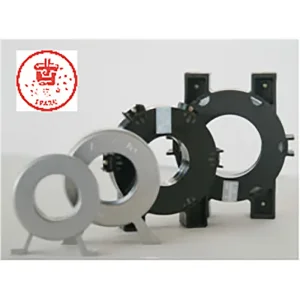
Extending beyond pure electrothermal applications, specialized fine-gauge alloy wires with uniform insulating enamels or oxide coatings are coiled onto surface-mount chip inductors and power line chokes. Excellent tensile uniformity ensures zero wire-snap during automatic 10,000 RPM CNC high-tension bobbin winding, drastically raising yield rates for power supply OEMs.
3. Semiconductor & Photovoltaic Wafer Kilns
Ultra-high purity heating wires (such as SPARK SGHT and HRE 1350) are tightly coiled for vertical diffusion furnaces used in SiC and monocrystalline silicon production. Zero micro-cracking during coiling prevents trace metallic particle shedding, preserving cleanroom standards while operating at continuous $1400^\circ\text{C}$ thresholds under inert or vacuum conditions.
4. Petrochemical & Energy Reformer Tubes
Heavy-gauge alloy strip and thick-diameter wire (up to 10mm) are coiled directly into large-diameter helical heating baskets for petrochemical cracking and synthetic gas reformers. High ductility ensures thick wire bends smoothly around giant ceramic spools without requiring pre-heating or post-bend annealing steps.
China Factory Ecosystem & Supply Chain Efficiency
Why global procurement officers and OEM engineers source high-formability resistance alloys directly from leading Chinese manufacturers like Beijing Shougang Gitane New Materials Co., Ltd.
Upstream Integration
Direct access to raw iron, chromium, and high-purity aluminum smelting under the Shougang Group umbrella guarantees zero contaminant inclusions in the melt.
In-House Annealing
Continuous multi-tube hydrogen bright annealing lines control crystal orientation, locking in stable elongation and soft tensile properties required for coiling.
Sub-Micron Laser QC
Inline 360-degree dual-axis laser calipers monitor wire roundness and gauge consistency in real time, capping diameter deviations under $\pm 0.005\text{ mm}$.
Scale & Rapid Delivery
With over $39,268\text{ m}^2$ of heavy production workshops, annual output exceeds tens of thousands of metric tons, cutting lead times down to days instead of months.
Technology Roadmap: Next-Gen Resistance Coil Metallurgy (2025–2030)
As global industry shifts toward electrification, decarbonization, and ultra-high efficiency thermal processing, Chinese electrothermal metallurgy is advancing along three primary innovation vectors:
1. Oxide Dispersion Strengthening (ODS)
By incorporating nano-scale Yttria ($\text{Y}_2\text{O}_3$) particles into FeCrAl powder metallurgy (PM) matrices (e.g., SPARK SGHT grade), future resistance wire alloys will achieve zero sag under high coil tension at temperatures exceeding $1425^\circ\text{C}$. This elevates cold-formability while simultaneously eliminating high-temperature creep deformation.
2. AI-Driven Adaptive Drawing
Implementation of neural-network controlled drawing dies dynamically regulates back-tension and lubricant temperature in real time. This eliminates micro-frictional surface scratches, yielding pristine wire stock that exhibits 0.00% breakage during automated high-speed coil winding.
3. Self-Healing Pre-Oxidation
Factory-applied thin-film pre-oxidation treatments build a dense, ultra-ductile $\alpha\text{-Al}_2\text{O}_3$ scale layer prior to coiling. The oxide layer is micro-engineered to bend elastically along with the metallic core during winding without spalling off, offering immediate operational protection upon furnace commissioning.
Quality Assurance, Compliance & International Support
Navigating global engineering standards requires non-negotiable compliance and comprehensive technical backup from raw coil delivery to post-installation support.
Certification & Rigorous Testing
Every shipment from Shougang Gitane includes full chemical analysis certificates and physical testing reports compliant with ISO 9001:2015, ISO 14001, GB/T 1234-2012, RoHS, and REACH regulations. Testing procedures cover:
- Resistivity Uniformity Test: Verification across 100% of wire spool length.
- Mandrel Bend Ductility Test: Cold winding verification over $1.0\times$ diameter mandrels.
- Accelerated Life Test (GB/T 1234): High-temperature cyclic burning test to ensure long life.
Custom Coil Engineering & OEM Services
For international furnace builders and equipment manufacturers, China factories provide end-to-end customized spooling and pre-formed spiral element production:
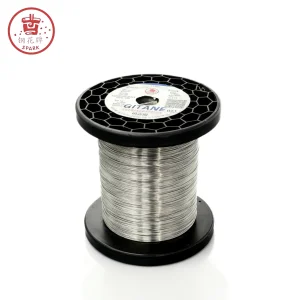
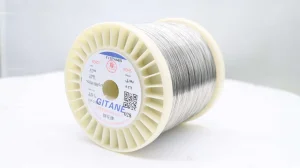
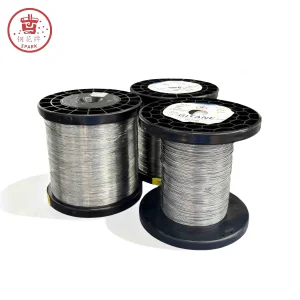
- Custom Spool Packaging: Precision-wound Plastic DIN Spools (DIN 200, DIN 250, DIN 355) preventing coil tangling during automated pay-off.
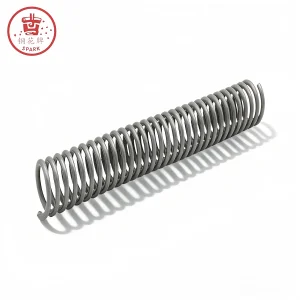
- Variable Pitch Coiling: Tailored pitch-to-diameter ($S/D$) ratios according to customer CAD/CAM element drawings.
- Export Logistics & Rust Protection: Vacuum sealed anti-tarnish packaging with desiccant protection for long sea-freight transport.
Ultra-High Temp Wires, Tubes & Furnace Elements
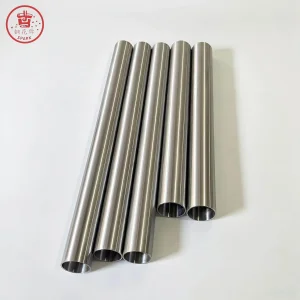
Select from specialized NiCr resistance alloys, ultra-high temperature SGHT powder metallurgy series, and finished industrial furnace solutions.

Frequently Asked Technical Questions (Q&A)
Deep metallurgical explanations regarding smooth coil forming, material selection, tension parameters, and coil element maintenance.