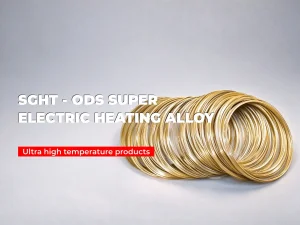
Featured High-Temperature Alloys & Heating Elements
Precision-manufactured electric resistance heating wire, strip, and spiral assemblies tailored for thermal industrial processing.


1. Global Industrial Landscape: Thermal Drying & Melting Applications
Analyzing procurement dynamics, energy electrification shifts, and metallurgical requirements across modern industrial processing plants worldwide.
In the contemporary industrial transformation landscape, electric thermal processing has emerged as the premier mechanism for achieving precision thermal engineering, operational decarbonization, and enhanced energy efficiency. Industrial drying and melting applications encompass a vast spectrum of critical manufacturing sectors—ranging from lithium-ion battery slurry drying and high-tech ceramic sintering to non-ferrous alloy holding, continuous strip annealing, and glass frit melting. As global industrial enterprises transition away from fossil-fuel combustion burners toward clean, controllable electric heating, the demand for ultra-reliable resistance heating alloys manufactured in China has experienced exponential growth.
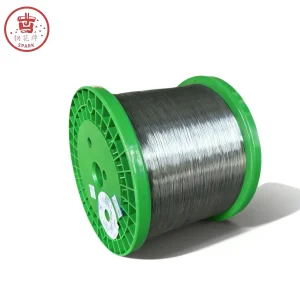
Procurement departments and thermal design specialists evaluating China’s manufacturing ecosystem require deep insight into the metallurgical foundations, alloy classification criteria, and manufacturing quality controls that differentiate standard commercial resistance wire from advanced, long-life heating alloys. **Beijing Shougang Gitane New Materials Co., Ltd.** (SPARK brand), operating backed by six decades of state-level metallurgical heritage, stands at the pinnacle of electric heating material innovation. By integrating vacuum induction melting (VIM), precision cold drawing, intermediate protective-atmosphere annealing, and automated surface defect analysis, modern Chinese production facilities deliver alloy solutions engineered to withstand extreme continuous temperatures up to 1425°C.
2. Metallurgical Science Roadmap: FeCrAl vs. NiCr Alloys
Comprehensive material property comparison for high-temperature selection in drying and melting equipment.
Selecting the optimal electric heating element material requires balancing thermal expansion, electrical resistivity, mechanical hot strength, density, and oxide scale formation physics. The two primary metallurgical families utilized in industrial drying and melting applications are **Iron-Chromium-Aluminum (FeCrAl)** and **Nickel-Chromium (NiCr)** alloys.
| Alloy Grade / Material Family | Nominal Composition (%) | Max Element Temp (°C) | Resistivity (μΩ·m, 20°C) | Density (g/cm³) | Primary Application Matrix |
|---|---|---|---|---|---|
| SGHT (Powder Metallurgy) | Fe-Cr-Al + Rare Earth (RE) | 1425°C | 1.45 | 7.10 | FeCrAl Semiconductor, Advanced Ceramics Melting |
| SGHYZ / HRE | Fe-Cr-Al High Temp Grade | 1350°C - 1400°C | 1.42 - 1.45 | 7.10 | FeCrAl Heavy Industrial Kilns, Powder Sintering |
| 0Cr25Al5 / 0Cr23Al5 | Fe-25Cr-5Al / Fe-23Cr-5Al | 1250°C | 1.35 - 1.42 | 7.15 - 7.25 | FeCrAl Industrial Drying Ovens, Continuous Dryers |
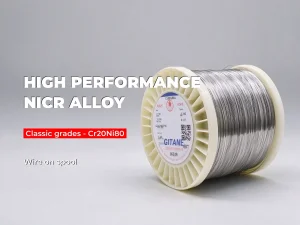
| Cr20Ni80 (Nichrome 80/20) | 80Ni - 20Cr | 1200°C | 1.09 | 8.40 | NiCr Cyclic Drying, Appliance, Salt Bath Melting |
| Cr30Ni70 | 70Ni - 30Cr | 1250°C | 1.18 | 8.10 | NiCr High-Stress Thermal Cycling, Carburizing Atm. |
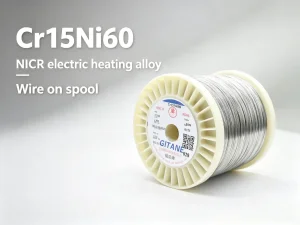
| Cr15Ni60 | 60Ni - 15Cr - Rest Fe | 1150°C | 1.11 | 8.20 | NiCr Medium Temp Conveyor Drying, Dehumidification |
Mechanisms of Oxidation Protection: FeCrAl alloys derive their high temperature capability from the growth of a dense, adherent, self-healing alpha-alumina ($\alpha\text{-Al}_2\text{O}_3$) oxide layer. This layer acts as a superior electrical insulator and chemical barrier against hot corrosion. Conversely, NiCr alloys form a chromia ($\text{Cr}_2\text{O}_3$) protective scale, which provides remarkable mechanical hot strength and ductility after prolonged heating, avoiding room-temperature embrittlement during maintenance shutdowns.
Alumina Scale Stability
Advanced rare-earth additions (Yttrium, Zirconium) in SGHT/SGHYZ alloys retard oxidation kinetics, preventing spallation during intensive drying thermal shocks.
High Resistivity Economy
FeCrAl offers up to 30% higher resistivity and 15% lower specific density than NiCr, enabling up to 20% material weight savings in large-scale drying kilns.
Creep Deformation Control
Powder metallurgy processing (SGHT grade) overcomes classical FeCrAl grain growth issues, delivering structural sag resistance during high-mass alloy melting.
3. System Architecture: Industrial Drying vs. Melting Applications
Specific engineering considerations, element geometry, and heating chamber design for distinct processing thermal regimes.
Industrial Drying Applications (300°C – 900°C)
Industrial drying systems prioritize uniform moisture removal, solvent evaporation, and surface film curing. Heat transfer relies heavily on forced convection coupled with medium-to-longwave infrared radiation.
- Continuous Conveyor Ovens: Utilizes 0Cr23Al5 or Cr15Ni60 ribbon/strip mounted in ceramic racks to maximize radiation surface area.
- Battery Electrode Drying: Requires non-flaking element surfaces to prevent particulate contamination in cleanroom environments.
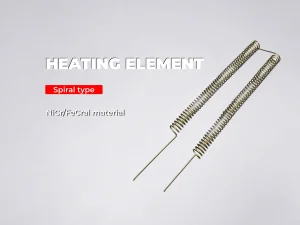
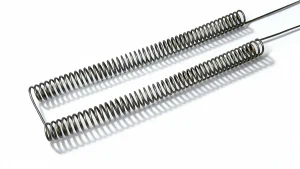
- Dehumidification & Air Heating: Spiral element coils supported on quartz tubes or embedded in ceramic plugs for rapid response time.
Industrial Melting Applications (700°C – 1400°C)
Melting applications require intense, localized energy input to overcome phase-change latent heat. Elements operate near maximum thermal limits in heavy refractory chambers.
- Non-Ferrous Crucible Furnaces: Aluminum, zinc, and magnesium melting using heavy-gauge SGHYZ or 0Cr25Al5 meander elements.
- Immersion Heating Tubes: High watt-density metallic tubes installed directly in liquid metal baths for rapid melting throughput.
- Glass Frit & Salt Baths: High-nickel Cr30Ni70 elements engineered to withstand corrosive volatile vapors and thermal cycling shocks.
4. Surface Watt Loading ($W/cm^2$) Optimization Guide
Mathematical calculations for element lifespan maximization based on working temperature and furnace atmosphere.
The single most critical parameter determining element service life in drying and melting applications is the **Surface Load ($w$)**, defined as the electrical power dissipated per unit area of wire or strip surface ($W/cm^2$). Exceeding allowable surface load limits leads to localized overheating, accelerated oxidation growth, element sag, and premature burn-out.
Surface Load Formula: w = P / (π · d · L)
Where: P = Power (Watts), d = Wire Diameter (cm), L = Total Wire Length (cm), w = Surface Watt Loading ($W/cm^2$)
Recommended Maximum Surface Loading ($W/cm^2$) Guidelines
The allowable watt density decreases inversely with operating furnace temperature and depends on atmospheric interaction:
| Element Temperature (°C) | Air / Oxidizing Atmosphere ($W/cm^2$) | Nitrogen / Inert Atmosphere ($W/cm^2$) | Carburizing Atmosphere ($W/cm^2$) | Melting Crucible Radiation ($W/cm^2$) |
|---|---|---|---|---|
| 600°C (Drying Zone) | 6.0 - 8.0 | 5.0 - 6.5 | 3.5 - 4.5 | 7.0 - 9.0 |
| 900°C (Medium Heat) | 3.5 - 5.0 | 3.0 - 4.0 | 2.0 - 2.8 | 4.0 - 5.5 |
| 1200°C (High Heat) | 1.5 - 2.5 | 1.2 - 1.8 | 0.8 - 1.2 | 1.8 - 2.8 |
| 1350°C (Melting / Sintering) | 0.8 - 1.4 | 0.6 - 1.0 | Not Recommended | 1.0 - 1.6 |
5. B2B Factory Direct Pricelist Framework & Procurement Cost Factors
Understanding alloy pricing structures, market indices, volume discounts, and factory-direct valuation drivers in China.
When procuring industrial resistance wire, strip, and fabricated elements directly from Chinese factories, buyers must navigate dynamic cost structures. Unlike basic carbon steel or standard stainless steel, electric heating alloys are highly sensitive to global non-ferrous metal exchange pricing—specifically **London Metal Exchange (LME) Nickel**, **Chromium**, and **Purity Aluminum** spot rates.
Indicative Factory B2B Pricing Structure Matrix (USD / kg)
*Note: The following price ranges serve as technical procurement benchmarks. Final quotation varies based on wire diameter ($d$), spooling specifications, heat treatment tolerance, and order tonnage.
| Material Family | Standard Grade | Wire Diameter / Strip Size Range | MOQ (Kg) | Indicative Price Range (USD/kg) |
|---|---|---|---|---|
| Commercial FeCrAl | 0Cr23Al5 / 0Cr25Al5 | Ø 1.0mm - Ø 8.0mm Round Wire | 100 Kg | $5.50 - $8.80 / kg |
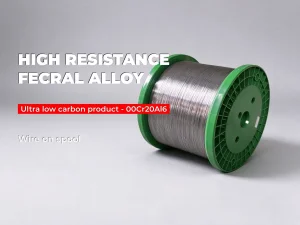
| Ultra-Fine FeCrAl | 0Cr25Al5 / 00Cr20Al6 | Ø 0.10mm - Ø 0.80mm Fine Wire | 50 Kg | $12.00 - $22.00 / kg |
| High-Temp FeCrAl | SGHYZ / HRE Grade | Ø 2.0mm - Ø 10.0mm Rod & Wire | 100 Kg | $9.50 - $15.00 / kg |
| Powder Met. FeCrAl | SGHT PM Grade (1425°C) | Custom Wire / Strip Specs | 50 Kg | $28.00 - $45.00 / kg |
| NiCr Alloy (80/20) | Cr20Ni80 Nichrome | Ø 0.5mm - Ø 6.0mm Round Wire | 50 Kg | $24.00 - $34.00 / kg |
| High-Cr NiCr | Cr30Ni70 Alloy | Ø 1.0mm - Ø 8.0mm Wire & Strip | 50 Kg | $22.00 - $31.00 / kg |
Key Cost Factor 1: Fine Drawing Passes
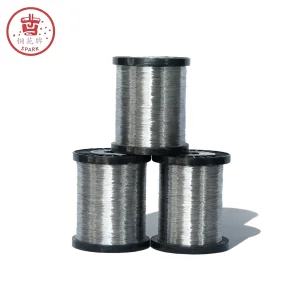
Reducing wire diameter from Ø 3.0mm down to Ø 0.2mm requires multiple diamond-die drawing passes and bright annealing cycles, increasing labor and processing cost per kg.
Key Cost Factor 2: Raw Metal Index
NiCr alloy prices directly correlate with LME Nickel prices. FeCrAl alloys offer significant cost insulation against nickel market volatility.
Key Cost Factor 3: OEM Coil Processing
Custom spiral winding, stretch ratio calibration, terminal welding, and ceramic insulator assembly add value while shortening on-site furnace build times.
6. Quality Compliance, Mill Testing & Global Localization Support
Ensuring rigorous quality verification, international standards compliance, and seamless cross-border supply chains.
Executing large-scale B2B procurement agreements with Chinese manufacturers requires stringent verification of quality assurance protocols. Beijing Shougang Gitane operates under ISO 9001 quality management systems (certified since 2003) and ISO 14001 environmental management protocols. All resistance heating alloys are produced in full compliance with **GB/T 1234-2012** (China National Standard for High-Resistance Electric Heating Alloys), which mirrors or exceeds **ASTM B603**, **DIN 17470**, and **JIS C2520** standards.
Certified Mill Test Reports (MTC)
Every shipment is accompanied by EN 10204 3.1 Certified Test Reports verifying precise chemical composition (spectrographic analysis), 20°C electrical resistance, yield strength, and elongation.
50-Hour High-Temp Accelerated Life Test
Per GB/T 1234 standards, sample wires undergo rapid cyclic heating tests at 1200°C–1350°C to measure oxidation resistance, life expectancy hours, and resistance drift rates.
Export Packaging & Logistics Integration
Spools are sealed in moisture-proof vacuum foil and plastic wrap, packed into solid fumigated wooden crates with inner shock-absorbing foam to prevent transit damage.
7. Technical Frequently Asked Questions (Procurement FAQ)
Expert answers to essential technical and commercial questions raised by thermal engineers and global procurement buyers.
What is the primary operational difference between 0Cr25Al5 FeCrAl and Cr20Ni80 Nichrome?
How does furnace atmosphere impact alloy grade selection for drying and melting?
What factors determine lead times for factory orders from Shougang Gitane?
Why is element stretch ratio important when installing spiral elements in drying kilns?
Can FeCrAl wire be welded during element repair?
Additional Specialized Resistance Heating Alloys & Elements
Explore ultra-high temperature powder metallurgy, low-carbon variants, and engineered spiral elements.