High-Temperature Resistance Alloys & Precision Heating Cores
Explore our primary industrial heating wires, bundle rod radiant tubes, and high-temp alloy solutions engineered for continuous thermal duty up to 1425°C.


Why Actual Operational Lifespan Outpaces Accelerated Laboratory Metrics
In industrial thermal engineering, laboratory testing standardizations—such as accelerated life testing protocols (e.g., GB/T 1234 or ASTM B78 standard fast-cycling tests)—impose violent, unnatural electrical pulses, constant thermal shocking, and severe air velocity fluctuations designed to force alloy destruction within 50 to 100 hours. While these metrics provide a standardized baseline for batch-to-batch quality control, they routinely underestimate the real-world service life of premium Chinese Cr20Ni80 and FeCrAl alloys by orders of magnitude.
In continuous or semi-continuous industrial furnace environments—such as heat treatment lines, sintering plants, ceramic kilns, and semiconductor diffusion furnaces—the thermal dynamics are drastically different. Under stabilized atmospheric pressure and managed ramping cycles, premium electrothermal alloys do not suffer from continuous thermal fatigue. Instead, they leverage thermodynamic equilibrium to develop continuous, self-healing protective oxide scales. Consequently, high-purity Cr20Ni80 alloy elements engineered with optimized grain structures frequently demonstrate actual operational service lives exceeding 20,000 to 35,000 hours, far outpacing the conservative estimates extrapolated from accelerated lab bench testing.
Technical Insight for Thermal Engineers: Accelerated lab testing measures the failure point under catastrophic cyclic fatigue. In contrast, actual industrial longevity relies on oxide layer stoichiometry, creep resistance, and trace reactive element additions (such as Yttrium, Zirconium, and Cerium) that prevent micro-spallation under steady-state operation.
Core Performance Advantages: Spontaneous Dense Cr₂O₃ Protective Film
The exceptional reliability of Cr20Ni80 (80% Nickel, 20% Chromium) nickel-chromium electrothermal alloys stems fundamentally from high-temperature surface chemical kinetics. When exposed to oxidizing environments at elevated operating temperatures (ranging from 800°C to 1200°C), the Chromium content within the solid solution matrix undergoes selective oxidation, spontaneously forming a dense, adherent, and thermodynamically stable Chromium Oxide (Cr₂O₃) protective scale on the outer wire interface.
Passivation Kinetics & Kinetics
The spontaneously formed Cr₂O₃ oxide lattice exhibits an extremely low parabolic growth rate constant. Once a uniform oxide layer of micro-meter thickness is established, oxygen ion diffusion into the internal nickel-chromium matrix drops by orders of magnitude, effectively shutting down further internal oxidation.
High Thermal Shock Resistance
Unlike lower-grade resistance alloys whose oxide scales flake off during cooling cycles due to thermal expansion coefficient mismatches, Cr20Ni80 forms an oxide film with exceptional mechanical adhesion. Micro-alloyed Rare Earth Elements (REEs) peg the oxide layer tightly to the substrate grain boundaries.
Self-Healing Surface Mechanism
Should mechanical friction, localized vibration, or thermal expansion create micro-fissures within the Cr₂O₃ layer, ambient oxygen reacts instantly with the underlying rich Chromium reservoir, instantaneously restoring the passivating film and preventing catastrophic localized burnout.
Detailed Alloy Comparison: NiCr vs. FeCrAl Electrothermal Systems
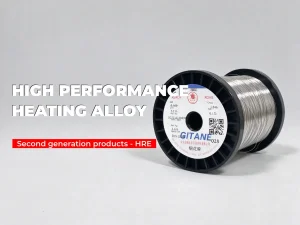
Choosing between Nickel-Chromium (Cr20Ni80, Cr15Ni60) and Iron-Chromium-Aluminum (0Cr25Al5, HRE, SGHT) requires an engineering assessment of operating atmosphere, hot strength, electrical resistivity, and density factors.
| Alloy Grade / Specification | Primary Composition | Max Temp (°C) | Resistivity (μΩ·m) | Oxide Scale Type | Key Industrial Strengths |
|---|---|---|---|---|---|
| Cr20Ni80 (SPARK) | 80% Ni, 20% Cr | 1200°C | 1.09 ± 0.05 | Cr₂O₃ (Chromia) | Superior hot strength, non-magnetic, post-use ductility, cycling stability. |
| Cr15Ni60 (SPARK) | 60% Ni, 15% Cr, Bal. Fe | 1150°C | 1.11 ± 0.05 | Cr₂O₃ / Fe₂O₃ | Cost-effective Ni-Cr option, high electrical resistance for domestic appliances. |
| HRE (High Temp FeCrAl) | 26% Cr, 6% Al, REE, Bal. Fe | 1350°C | 1.45 ± 0.05 | Al₂O₃ (Alumina) | High power density, lightweight, excellent resistance in sulfur atmospheres. |
| SGHT (Powder Metallurgy) | Advanced Fe-Cr-Al PM | 1425°C | 1.48 ± 0.05 | α-Al₂O₃ (Alpha Alumina) | Extreme creep strength at >1350°C, zero sagging, long life in semiconductor kilns. |
Navigating Global Enterprise Procurement Requirements
International EPC procurement teams, industrial furnace original equipment manufacturers (OEMs), and high-volume thermal processing plants operate under stringent total cost of ownership (TCO) matrices. When sourcing resistance heating alloys from Chinese manufacturers, modern procurement protocols have evolved far beyond basic price-per-kilogram quotes. Key strategic considerations include:
1. Dimensional Precision & Resistivity Uniformity
Variations in electrical resistance directly translate to uneven power dissipation, thermal hot spots, and premature element failure. Leading Chinese producers utilize state-of-the-art continuous hydrogen-annealing lines and tension-controlled cold drawing dies to guarantee resistance tolerances within tight ±3% windows across 1,000+ meter spools.
2. Traceable Metallurgical Purity & Vacuum Melting
Industrial performance hinges on tramp element containment. Advanced Vacuum Induction Melting (VIM) followed by Electroslag Remelting (ESR) eliminates harmful trace contaminants like Sulfur (S), Phosphorus (P), and Lead (Pb), guaranteeing exceptional ductility during automated CNC element coiling.
3. Complete Mill Test Certification (MTC)
Tier-1 industrial buyers require fully documented ISO 9001 quality compliance, complete chemical spectrographic analysis, tensile property verification at ambient and elevated temperatures, and batch-specific accelerated lifecycle test reports conforming to international standardizations.
4. Flexible Delivery Forms & Custom Fabrication
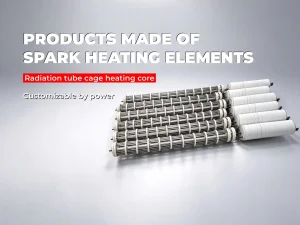
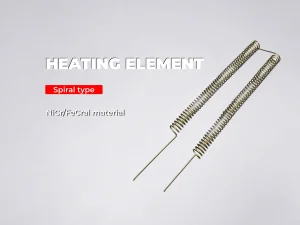
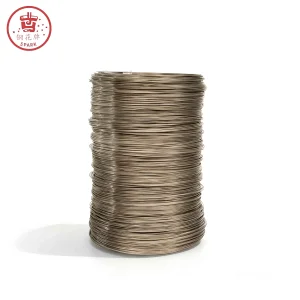
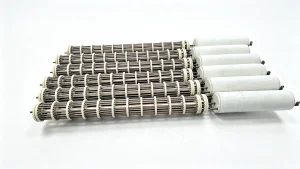
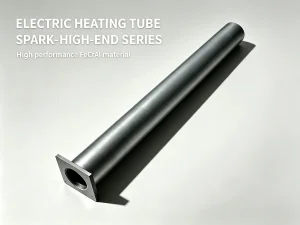
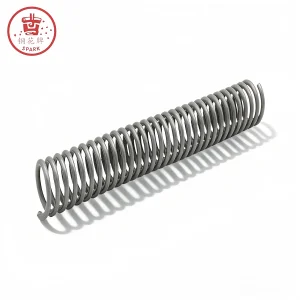
Global enterprises require seamless integration. Alloys must be supplied across varied form factors: ultra-fine round wire (0.05mm to 12mm), heavy-duty rolled ribbon strip, pre-wound spiral elements, or fully integrated ceramic bundle rod radiant tubes ready for immediate furnace installation.
Macro Industry Solutions Across Key High-Temperature Sectors
Precision electrothermal wire solutions play a crucial role in enabling global industrial decarbonization, replacing fossil-fueled combustion systems with high-efficiency electric thermal energy.
Semiconductor & Photovoltaics
High-purity SGHT and Cr20Ni80 alloys are utilized in silicon wafer diffusion tubes, crystal growth furnaces, and PECVD heating blocks. Zero-outgassing properties prevent contamination of sensitive semiconductor substrates.
Lithium Battery Energy Storage
Continuous roller hearth kilns (RHK) for cathode material sintering (LFP and NCM) demand strict temperature uniformity (±2°C). Custom FeCrAl and NiCr heating elements deliver consistent thermal profiles across multi-zone continuous kilns.
Aerospace Heat Treatment
Vacuum aluminum brazing, solution heat treating, and titanium stress-relieving furnaces rely on Cr20Ni80 elements for their non-magnetic properties, exceptional hot strength, and stability under thermal cycling.
Global Commercial Landscape & The Shift to Premium Chinese Manufacturing
The global thermal processing industry is undergoing a structural paradigm shift. Historically, Western European and North American manufacturing dominated the high-tier electrothermal alloy market. However, significant capital investments by leading Chinese manufacturers—specifically in precision continuous casting, rare-earth metallurgical synthesis, and AI-driven automated wire drawing—have redefined global sourcing dynamics.
Today, Chinese resistance alloy manufacturers produce over 60% of the world's electrothermal wire. By integrating vertically—from raw nickel/chromium refinement to finished furnace heating element assembly—Chinese suppliers deliver unmatched price-to-performance ratios. International furnace builders can now reduce capital expenditure on heating alloys by 25% to 40% without compromising operational reliability, creep resistance, or thermal lifespan.
Technological Roadmap & Future Metallurgical Advances
Next-generation high-temperature industrial processes—such as green hydrogen production, ultra-high-temperature ceramic matrix composite sintering, and zero-carbon steel forging—demand thermal capabilities pushing beyond historical limitations.
Oxide Dispersion Strengthened (ODS) Alloys
By incorporating nanoscale Yttrium Oxide (Y₂O₃) particles directly into the metal lattice via advanced powder metallurgy techniques, upcoming SGHT-class alloys achieve virtually zero creep at temperatures exceeding 1400°C. This eliminates wire sagging and short-circuit risks in vertical diffusion tubes.
Nanostructured Smart Passivating Films
Current research focuses on modifying grain-boundary atomic structure to accelerate initial oxidation kinetics. Future Cr20Ni80 formulations will establish a fully protective Cr₂O₃ barrier within minutes of initial heat-up, reducing early-stage oxidation wear by up to 60%.
Localized Engineering Support & International Compliance
To ensure seamless global deployment, top-tier Chinese manufacturers back their alloy production with robust international compliance frameworks and localized technical support networks:
International Standards
Full compliance with GB/T 1234-2012, ASTM B344, DIN 17470, and JIS C2520 standards.
Export Certification
RoHS, REACH, and ISO 9001:2015/ISO 14001 certification for European and North American customs clearance.
Application Consulting
Dedicated thermal engineering teams provide surface load ($W/cm^2$) calculations and alloy selection modeling.
Seaworthy Packaging
Precision spooling, vacuum sealing, moisture-absorbent wrapping, and reinforced wooden crating prevent sea-freight corrosion.
Frequently Asked Questions (FAQ)
High-Temperature FeCrAl Alloys, NiCr Wires & Industrial Tubes
Discover additional high-performance alloy grades including 0Cr21Al6Nb, Cr15Ni60, HRE alloys, spiral elements, and specialized SGHT tubes.