
High-Temperature Kiln Heating Alloys & Resistance Wires
Direct from Factory Direct Production Lines: Premium Grade FeCrAl, NiCr Alloys, and Industrial Elements.




Beijing Shougang Gitane New Materials Co., Ltd.
A flagship state-owned enterprise under Shougang Group, delivering world-class electrothermal alloys for specialized ceramic manufacturing across 60+ countries.
1425°C Max Temperature
State-of-the-art powder metallurgy SGHT & SGHYZ alloys engineered to withstand severe thermal cycling in continuous shuttle and roller kilns without element deformation.
ISO 9001 & GB/T 1234-2012
Rigorous quality control systems backed by full traceability, spectrographic melt audits, optical dimensional checks, and standard mill test reports for global buyers.
88,000 m² Manufacturing Facility
39,268 m² specialized production workshops in Shahe, Changping District, Beijing, housing precision melting, hot rolling, wire drawing, and annealing operations.
Global Ceramic Kiln Sintering & High-Temperature Electrothermal Sourcing Guide
The global ceramic manufacturing landscape—encompassing technical ceramics, structural ceramics, sanitaryware, electronic substrates (LTCC/HTCC), and advanced refractory insulators—is undergoing a profound technological transformation. As industrial kilns transition from fossil-fuel combustion to high-efficiency electric heating systems driven by global decarbonization mandates, the demand for high-performance electric heating materials has escalated dramatically. Ceramic kiln operators require heating elements and resistance wires capable of enduring continuous thermal stress up to 1425°C, aggressive atmospheric environments, and chemical off-gassing while maintaining structural integrity and constant resistivity over thousands of operational hours.
As a leading China ceramic kiln heating material manufacturer and supplier, Beijing Shougang Gitane New Materials Co., Ltd. (SPARK) provides comprehensive, high-gain engineering solutions tailored to the operational demands of contemporary industrial furnaces. Grounded in over six decades of metallurgical research and integrated production under the Shougang Group, SPARK manufactures premier Iron-Chromium-Aluminum (FeCrAl) and Nickel-Chromium (NiCr) alloy products designed specifically to minimize thermal creep, resist oxidation, and reduce total cost of ownership (TCO) for global furnace builders and ceramic producers.
1. Macroscopic Industry Drivers & Global Procurement Trends
Procurement directors and thermal system engineers in major ceramic manufacturing hubs across Europe, North America, Southeast Asia, and the Middle East face three primary operational challenges:
- Electrification of High-Temperature Kilns: Transitioning from natural gas combustion to clean electric radiant and element heating to achieve precise thermal zoning ($\pm 1^\circ\text{C}$ uniformity) and lower carbon intensity.
- Thermal Cycling Stability: Minimizing element sagging, physical elongation, and hot-spot failure caused by rapid thermal ramp-up in batch shuttle kilns and intermittent sintering units.
- Chemical Atmosphere Resistance: Mitigating oxidation and chemical degradation caused by glaze vapor off-gassing, binder burn-out emissions, and localized sulfur or carbon monoxide buildup within tunnel kilns.
2. Technical Comparison Matrix: FeCrAl vs. NiCr Kiln Heating Alloys
Selecting the optimal alloy family is critical for maximizing element longevity and optimizing energy output. FeCrAl alloys form a self-healing, non-conductive Alpha-Alumina ($\alpha\text{-}Al_2O_3$) surface layer, whereas NiCr alloys form a protective Chromic Oxide ($Cr_2O_3$) scale. The table below provides technical performance parameters across core SPARK alloy grades:
| Alloy Grade | Alloy Family | Max Element Temp (°C) | Resistivity at 20°C ($\mu\Omega\cdot\text{m}$) | Density ($\text{g/cm}^3$) | Thermal Expansion ($10^{-6}/\text{K}$) | Primary Kiln Sintering Applications |
|---|---|---|---|---|---|---|
| SPARK SGHT | Powder Metallurgy FeCrAl | 1425°C | 1.45 | 7.10 | 14.7 | Advanced Technical Ceramics, HTCC Substrates, Semiconductor Ceramics |
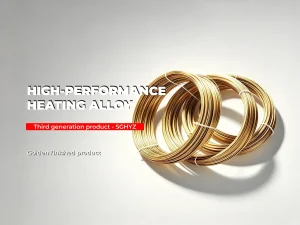
| SPARK SGHYZ | Rare-Earth Enhanced FeCrAl | 1400°C | 1.43 | 7.15 | 14.5 | High-Temperature Roller Kilns, Ceramic Sintering, Powder Metallurgy |
| SPARK HRE | High-Performance FeCrAl | 1350°C | 1.42 | 7.15 | 14.0 | Structural Ceramic Kilns, Sanitaryware Tunnel Kilns, Refractory Firing |
| 0Cr21Al6Nb | Niobium-Alloyed FeCrAl | 1350°C | 1.45 | 7.10 | 14.0 | Heavy-Duty Industrial Heating Elements, Radiant Tubes, Kiln Spirals |
| 0Cr25Al5 | General-Purpose FeCrAl | 1250°C | 1.42 | 7.10 | 14.0 | Standard Ceramic Kilns, Industrial Heat Treatment, Annealing Furnaces |
| Cr30Ni70 | High-Ni Nichrome | 1250°C | 1.18 | 8.10 | 17.0 | Controlled-Atmosphere Kilns, Nitriding & Reducing Ceramic Processing |
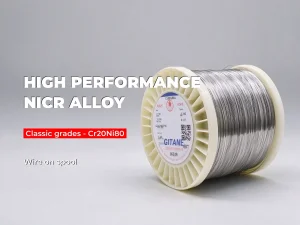
| Cr20Ni80 | Premium 80/20 Nichrome | 1200°C | 1.09 | 8.40 | 18.0 | Frequent Thermal Cycling Appliances, Precision Kilns, Glass Tempering |
3. Metallurgy Insights: Alpha-Alumina Formation and Creep Mechanisms
The superior performance of SPARK FeCrAl alloys (such as 0Cr21Al6Nb, HRE, SGHYZ, and SGHT) at temperatures exceeding 1300°C stems from advanced rare-earth micro-alloying (Yttrium, Zirconium, Hafnium). When operated in oxidizing atmospheres, these elements migrate to the alloy grain boundaries, controlling aluminum diffusion rates and promoting the growth of a dense, adherent $\alpha\text{-}Al_2O_3$ film.
This aluminum oxide film exhibits near-zero electrical conductivity at elevated temperatures, preventing short circuits caused by conductive dust or airborne metallic vapours inside ceramic firing chambers. Furthermore, the inclusion of Niobium in grades like 0Cr21Al6Nb forms fine NbC precipitates, drastically enhancing high-temperature yield strength and sagging resistance—a critical factor when installing long-span horizontal coiled elements or hanging rod supported heating systems in roller kilns.
4. Kiln-Specific Engineering Solutions & Surface Load Design
Optimizing heating element life requires precise surface load calculations. The maximum allowable surface load ($W/cm^2$) dictates the heat flux dissipated by the element per square centimeter of surface area without overheating the internal core. Overloading elements leads to premature grain growth, accelerated oxidation, and burnout.
The operational surface load ($w$) is calculated via the formula:
w = P / (π · d · L)
Where P represents total power (Watts), d is the wire diameter (cm), and L is the active wire length (cm). For ceramic kilns operating continuously between 1200°C and 1380°C, SPARK engineers recommend derating surface loads to 1.2 – 2.2 W/cm² for FeCrAl alloys to maximize service life.
Tunnel Kilns (Continuous Operations)
Utilizing high-diameter SPARK 0Cr21Al6Nb or HRE heavy-gauge wires (5.0mm – 10.0mm) wrapped into open-coil or wavy serpentine ribbon configurations mounted on ceramic tubes. Ensures years of continuous firing without maintenance stops.
Shuttle & Intermittent Batch Kilns
Subject to aggressive thermal shock and rapid cooling rates. SPARK SGHYZ and Cr20Ni80 alloys provide superior thermal fatigue resistance and physical ductility, preventing element embrittlement during rapid unload cycles.
5. Strategic Technology Roadmap: 2026–2035 & Next-Gen Sintering
As advanced technical ceramics expand into semiconductor wafer processing, solid-state battery electrolyte production, and aerospace ceramic matrix composites (CMCs), firing temperatures demand unprecedented thermal uniformity. SPARK is pioneering dispersion-strengthened powder metallurgy alloys (SGHT series) capable of operating at 1425°C under high vacuum and controlled gas environments, bridging the gap between metallic heating elements and fragile Silicon Carbide (SiC) or Molybdenum Disilicide ($MoSi_2$) elements.
6. Quality Assurance, Compliance, and Global Localization
Every shipment of SPARK electrothermal alloy wire, strip, and element coil undergoes rigorous quality control protocols prior to export:
- Spectrographic Chemical Analysis: Verifying exact composition tolerances for Cr, Al, Ni, and trace rare earths using X-ray fluorescence (XRF) and ICP spectroscopy.
- Resistivity Testing: Conforming strictly to GB/T 1234-2012 standards to guarantee resistance variation within $\pm 3\%$ along the full length of every wire spool.
- Accelerated Life Testing: Subjecting alloy batches to continuous 50-hour high-temperature cycling tests at 1250°C/1350°C to measure parabolic oxidation kinetics.
- Full Export Compliance & Support: Complete MTC (Mill Test Certificate) documentation, ISO 9001 certified batch tracking, customized seaworthy packaging, and localized engineering consultation.
Frequently Asked Questions (FAQ)
Technical solutions for procurement leaders, furnace designers, and ceramic plant engineers.
Why choose FeCrAl over NiCr heating alloys for industrial ceramic kilns?
What causes electric heating elements to sag and fail in continuous roller kilns?
How does kiln atmosphere impact the service life of FeCrAl heating wires?
In what delivery forms can SPARK heating materials be customized?
What is the lead time and quality documentation provided for international orders?
High-Performance Resistance Alloys & Specialized Products
Explore our extended range of electrothermal wires, nichrome alloys, and specialized industrial materials.


Partner with China's Premier Electrothermal Alloy Manufacturer
Whether you require custom coil dimensions, specific alloy grades for 1400°C+ continuous ceramic kilns, or direct mill-price quotes for bulk spools, SPARK engineering team is ready to assist.