1. Technical White Paper: The Evolution of Ceramic Heat Treatment Ignition Elements
In modern high-temperature industrial processing, ceramic heat treatment ignition elements represent a critical convergence of structural ceramic technology and physical metallurgy. Operating in demanding thermal, mechanical, and chemical environments, these elements provide instant, precise, and repeatable heat energy required for gas ignition, industrial burner systems, heat-treatment furnaces, ceramic sintering kilns, and semiconductor processing equipment.
Historically, industrial heat treatment relied heavily on conventional open-flame pilot lights or metallic resistance sparks. However, modern decarbonization goals, strict fuel-efficiency mandates, and the demand for rapid thermal cycles have propelled advanced silicon-based ceramics (Silicon Nitride $Si_3N_4$, Silicon Carbide $SiC$) and specialized rare-earth doped FeCrAl/NiCr electrothermal matrix alloys into the foreground of ignition engineering.
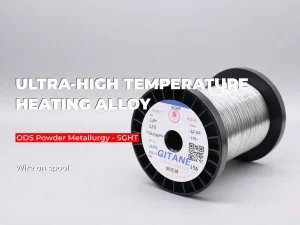
Information Gain Key Insight: Unlike standard metal igniters that degrade rapidly due to high-temperature oxidation and localized thermal shock, advanced ceramic ignition elements leverage hot-pressed Silicon Nitride ($Si_3N_4$) combined with powder-metallurgy FeCrAl substrates (such as SPARK SGHT and SGHYZ). This hybrid configuration allows continuous surface temperatures up to 1425°C while offering a dielectric breakdown strength exceeding 15 kV/mm and thermal ramp speeds up to 1000°C/second.
1.1 Microstructural Synergies Between Ceramic Encapsulation and Heating Alloys
The operational reliability of a ceramic heat treatment ignition element depends on the thermomechanical compatibility between the conductive heating core and the insulating/protective ceramic sleeve. When utilizing metallic resistance elements—such as 0Cr25Al5, 0Cr21Al6Nb, or Cr20Ni80—within a ceramic matrix, engineers must carefully manage the Coefficient of Thermal Expansion (CTE).
FeCrAl alloys exhibit a CTE of approximately $14.0 \times 10^{-6}/\text{K}$ at elevated temperatures, whereas Silicon Nitride ceramic exhibits a much lower CTE of roughly $3.0 \times 10^{-6}/\text{K}$. To prevent micro-cracking and interfacial delamination during rapid thermal cycling, China’s top manufacturers, led by Beijing Shougang Gitane New Materials Co., Ltd., employ engineered transition gradient layers and ultra-pure rare-earth micro-alloying (Yttrium, Zirconium, and Hafnium) within the metal substrate. This forms a self-healing, highly adherent $\alpha\text{-}Al_2O_3$ (alpha-alumina) film that anchors the metallic core within the ceramic body.
2. Material Selection Matrix: FeCrAl, NiCr, and Advanced Ceramic Substrates
Selecting the optimal material system for high-temperature heat treatment ignition requires evaluating several key factors: electrical resistivity, maximum service temperature, atmospheric corrosion resistance, creep resistance, and resistance to frequent thermal cycling.
| Material Grade / Alloy Type | Substrate Composition | Max Temp (°C) | Resistivity (μΩ·m) | Thermal Shock Resistance | Primary Application Environment |
|---|---|---|---|---|---|
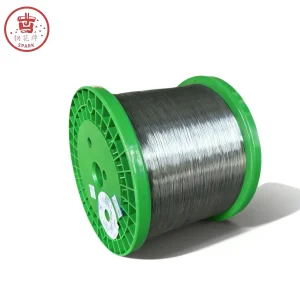
| SPARK SGHT (Powder Metallurgy) | FeCrAl + Rare Earth (Y/Zr) | 1425°C | 1.45 | Exceptional | Ultra-high-temp ceramic kilns, semiconductor thermal processing |
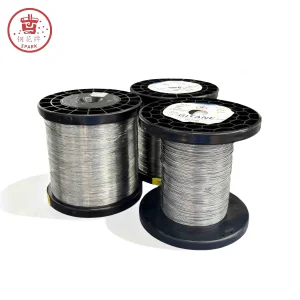
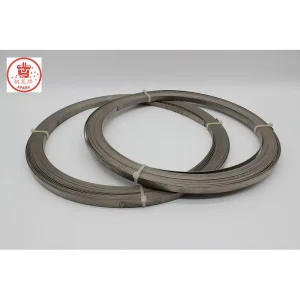
| SPARK SGHYZ | Golden FeCrAl High-Purity | 1400°C | 1.40 | High | Gas burner ignition systems, continuous heat-treatment furnaces |
| 0Cr21Al6Nb | Fe-Cr-Al-Nb Alloy | 1350°C | 1.45 | Moderate-High | Industrial radiant tubes, heavy-duty gas igniters |
| 0Cr25Al5 | Standard FeCrAl | 1250°C | 1.42 | Moderate | Industrial heating elements, cost-effective burner systems |
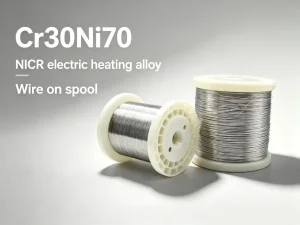
| Cr20Ni80 (Nichrome) | 80% Ni, 20% Cr | 1200°C | 1.09 | Superior (Ductile) | Frequent thermal cycling, reducing or nitrogen atmospheres |
| Hot-Pressed $Si_3N_4$ Ceramic | Silicon Nitride Substrate | 1400°C | N/A (Insulator) | Extreme (>1000°C/s) | Direct hot-surface igniters for natural gas & hydrogen burners |
2.1 Thermodynamics of Oxidation and Atmosphere Resilience
In heat treatment applications involving endothermic gas, carburizing atmospheres, nitriding, or direct gas combustion, ignition components are subject to chemical attack. Standard metals experience "green rot" (internal oxidation of chromium) or carburization, which leads to volume expansion, embrittlement, and rapid electrical failure.
By contrasting Nickel-Chromium (NiCr) with Iron-Chromium-Aluminum (FeCrAl), engineering teams can optimize element lifetime:
- FeCrAl Systems (e.g., SPARK SGHT & 0Cr25Al5): When heated in the presence of oxygen, FeCrAl forms a dense, non-porous layer of alpha-alumina ($\alpha\text{-}Al_2O_3$). This alumina shell exhibits extremely low ionic conductivity, blocking carbon ingress and protecting the interior alloy from degradation up to 1425°C.
- NiCr Systems (e.g., Cr20Ni80 & Cr30Ni70): NiCr forms a protective chromia ($\text{Cr}_2\text{O}_3$) scale. While chromia volatizes above 1200°C in oxygen-rich environments, NiCr retains exceptional hot ductility and resistance to mechanical shock, making it ideal for systems with frequent mechanical vibrations or specific nitrogen-rich atmospheres.
Vertical Metallurgical Integration
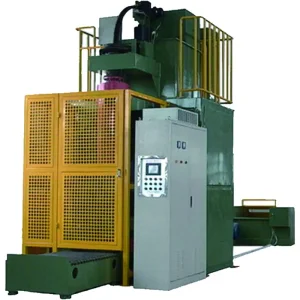
China's industrial heating manufacturing ecosystem spans vacuum induction melting (VIM), electroslag remelting (ESR), precision hot rolling, fine wire drawing down to 0.05mm, and advanced ceramic HIP (Hot Isostatic Pressing) sintering—all within unified regional clusters. Beijing Shougang Gitane operates 39,268 m² of specialized workshops ensuring batch-to-batch chemical homogeneity.
Rare-Earth Element Supply Chain
FeCrAl alloys require precise micro-doping of rare-earth elements (Lanthanum, Cerium, Yttrium) to increase oxidation film adhesion and prevent grain coarsening. China produces over 70% of the world's refined rare-earth elements, giving domestic suppliers an unmatchable metallurgical edge in creating ultra-high-temperature grades like SPARK SGHT.
Total Cost of Ownership (TCO) Optimization
Leveraging scale economies, streamlined automation, and lower raw material procurement overheads, Chinese suppliers deliver world-class ignition components at 30% to 45% lower total procurement cost than European or North American equivalents, without sacrificing dimensional tolerance or chemical purity.
Automotive Heat Treatment & Forging
Continuous mesh-belt heat treatment furnaces require instant ignition of radiant burner tubes. SPARK FeCrAl ignition coils enclosed in alumina tubes ensure zero flameouts during case hardening, carburizing, and annealing of drive gear components.
Hydrogen & Clean Gas Ignition Systems
As the global energy sector transitions to green hydrogen blends, burner flame speeds increase exponentially. Silicon Nitride hot-surface igniters achieve ignition temperatures exceeding 1000°C within 2 seconds, delivering safe, immediate combustion without spark degradation.
Ceramic & Glass Kiln Firing Systems
Kilns operating continuously at 1300°C–1400°C demand ignition elements that resist sagging and creep. Powder-metallurgy SPARK SGHT wire provides exceptional dimensional stability under high thermal loads, preventing short circuits and furnace downtime.
Semiconductor & Solar Wafer Processing
Cleanroom processing furnaces require contamination-free heating. High-purity 0Cr21Al6Nb and silicon nitride heating elements prevent particulate spallation, keeping quartz chambers ultra-clean during silicon wafer diffusion and oxidation phases.
3. Global Procurement Guide: Engineering Specifications & Watt Density Design
When purchasing managers and furnace designers specify ceramic heat treatment ignition elements from China, relying solely on nominal chemical compositions is insufficient. To ensure long-term durability and operational safety, procurement engineers must evaluate three key design parameters:
3.1 Surface Watt Density ($W/\text{cm}^2$) Calculation
Surface watt density measures the electrical power dissipated per unit area of the heating element's surface. Operating at excessive watt densities accelerates element burnout, while under-designing results in sluggish ignition speeds.
The maximum allowable watt density is inversely proportional to the furnace operating temperature and directly dependent on element geometry:
$$\text{Watt Density } (w) = \frac{P}{\pi \cdot d \cdot L}$$
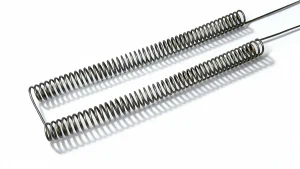
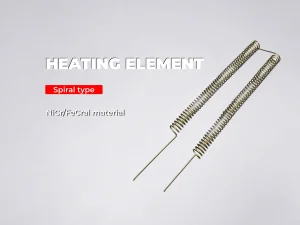
Where P represents total power (Watts), d is wire diameter (cm), and L is the active heated length (cm). For ceramic-encapsulated hot-surface igniters operating at 1200°C in still air, allowable surface loads range between $6.0 \text{ W/cm}^2$ and $10.0 \text{ W/cm}^2$, whereas exposed spiral wire elements in industrial furnaces should be maintained between $1.5 \text{ W/cm}^2$ and $2.5 \text{ W/cm}^2$.
3.2 Cold Electrical Resistance Tolerances and Quality Certification
Strict resistance tolerances prevent current imbalances across multi-element burner arrays. Premium suppliers like Beijing Shougang Gitane supply heating wires and spiral elements calibrated to a cold resistance tolerance of $\pm 3\%$, compliant with GB/T 1234-2012 standards. Each manufacturing lot undergoes key quality checks:
- Metallographic Grain Size Analysis: Verifying uniform equiaxed grain structures to prevent premature intergranular failure.
- Accelerated Life Testing (Bash Test): Subjecting wire samples to rapid electrical on/off cycling at 1100°C–1250°C to guarantee a minimum lifespan exceeding 50 continuous test hours.
- Dimensional & Concentricity Checks: Ensuring precise ceramic wall thickness to eliminate localized thermal hotspots and electrical breakdown.