
High-Purity Nickel & 80% Ni-Matrix Alloy Catalogue (Part I)
Explore optimized resistance wires, high-purity raw metal cakes, and electric heating alloys manufactured under ISO 9001 and GB/T 1234-2012 quality systems.


Understanding Alloys with ~80% Nickel Matrix Balance
In high-temperature thermal engineering and advanced chemical processing, materials designated with "Nickel content ~80% balance matrix" (镍含量约80%为余量基体) represent the pinnacle of microstructural stability, corrosion mitigation, and controlled electrical resistivity. Nickel forms a stable Face-Centered Cubic (FCC) single-phase gamma ($\gamma$) solid solution, which remains crystallographically stable from cryogenic temperatures up to its melting point near 1400°C–1425°C.
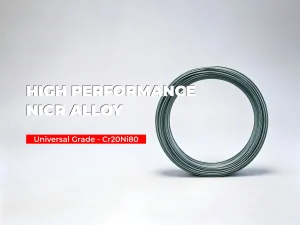
When alloyed with approximately 19% to 21% Chromium (forming standard Cr20Ni80, UNS N06003, or Ni80Cr20), the matrix develops a self-healing, passivating surface oxide layer dominated by Chromia ($\text{Cr}_2\text{O}_3$) and Nickel Chromate ($\text{NiCr}_2\text{O}_4$) spinels. This protective barrier inhibits further inward oxygen transport and prevents catastrophic intergranular degradation, making 80% nickel alloys the preferred specification for critical heat-treating furnace elements, industrial resistor banks, and defense-grade thermal processing units.
Core Thermodynamic Advantages
- FCC Crystal Stability: Zero phase transformation during thermal cycling eliminates thermal expansion fatigue.
- High Hot Strength: Exceptional creep resistance at continuous operating temperatures up to 1200°C.
- Ductility Post-Heating: Unlike FeCrAl alloys which embrittle after thermal aging, ~80% Ni alloys remain ductile when cold.
- Non-Magnetic Behavior: Fully austenitic matrix ensures zero magnetic permeability shifts in precision electrical circuits.
Macro-Industrial Solutions Driven by 80% Nickel Alloys
From clean energy transition to advanced semiconductor manufacturing, high-nickel alloys provide structural reliability where thermal failure is not an option.
Industrial Electric Furnaces & Thermal Processing
In heat treatment, bright annealing, and ceramic sintering, Cr20Ni80 strip and wire coils maintain consistent electrical resistance ($\rho \approx 1.09\ \mu\Omega\cdot\text{m}$). The absence of structural sagging at elevated temperatures prolongs element service life by over 300% compared to conventional iron-base substitutes in cyclic operations.
Grid Braking & High-Power Resistor Banks
In renewable energy integration (wind power dump loads) and heavy locomotive dynamic braking grid systems, 80/20 NiCr ribbon alloys absorb massive energy surges. Their ultra-low temperature coefficient of resistance (TCR) guarantees linear performance under severe current overload conditions.
Semiconductor & Quartz Tube Heating Elements
Wafer processing furnaces demand ultra-clean environments free of particulate spalling. High-purity 80% nickel alloys processed via Vacuum Induction Melting (VIM) prevent metal vapor contamination, enabling stable thermal diffusion up to 1150°C.
Metallurgical Property Comparison & Grade Standards
Detailed chemical composition, electrical resistivity, and mechanical parameters for China origin 80% nickel alloys compared against standard high-temperature grades.
| Alloy Grade | UNS / EN Equivalent | Ni Composition (%) | Cr Composition (%) | Max Temp (°C) | Resistivity at 20°C (μΩ·m) | Density (g/cm³) |
|---|---|---|---|---|---|---|
| Cr20Ni80 (SPARK) | UNS N06003 / 2.4869 | 77.0 – 80.0 (Bal.) | 20.0 – 23.0 | 1200°C | 1.09 ± 0.05 | 8.40 |
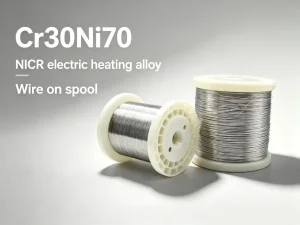
| Cr30Ni70 | UNS N06008 / 2.4658 | 65.0 – 71.0 (Bal.) | 28.0 – 31.0 | 1250°C | 1.18 ± 0.05 | 8.10 |
| Cr15Ni60 | UNS N06004 / 2.4867 | 55.0 – 61.0 (Bal.) | 15.0 – 18.0 | 1150°C | 1.12 ± 0.05 | 8.20 |
| 0Cr25Al5 (FeCrAl) | 1.4765 / Kanthal D | < 0.60 | 23.0 – 26.0 | 1250°C | 1.42 ± 0.07 | 7.10 |
| Norway Ni Cake 99.99 | ISO 6283 NR9999 | ≥ 99.99 | Trace | 1455°C (Melting) | 0.068 (Pure) | 8.90 |
Chemical Control & Impurity Limits (Cr20Ni80)
China high-tier suppliers strictly control residual tramp elements to ensure maximum grain-boundary cohesion during thermal exposure:
- Carbon (C): ≤ 0.08% (Prevents chromium carbide precipitation along grain boundaries)
- Silicon (Si): 0.75% – 1.60% (Enhances oxidation passivation kinetics)
- Manganese (Mn): ≤ 0.70% (Maintains hot workability)
- Sulfur (S) & Phosphorus (P): ≤ 0.015% (Eliminates hot-shortness cracking)
- Iron (Fe): ≤ 1.0% (Enforces high matrix purity)
Formulas & Thermal Resistance Design Equations
Calculating the required length ($L$) and diameter ($d$) of 80% Nickel wire for a given power output ($P$) and voltage ($V$):
L = \frac{R_{20} \cdot \pi \cdot d^2}{4 \cdot \rho_{20}}
Where $C_t$ is the temperature correction factor ($C_t = 1.04$ at 1000°C for NiCr 80/20) and $\rho_{20} = 1.09\ \mu\Omega\cdot\text{m}$.
Global Commercial Status & Nickel Matrix Pricelist Structure
How China's metallurgical sector leverages raw material integration, LME hedging, and advanced extrusion technology to deliver cost advantages.
Pricelist Dynamics & LME Indexing
Because Nickel accounts for ~80% of the alloy weight, finished product pricing is directly tied to the London Metal Exchange (LME) and Shanghai Futures Exchange (SHFE) nickel cash settlement prices.
Pricing Formula:
Unit Price (USD/kg) = [LME Ni Cash Price × 80%] + [LME Cr Price × 20%] + Fabrication Conversion Surcharge + Packaging/Customs Fee
Supply Scale & Raw Material Sourcing
Leading Chinese manufacturers maintain strategic reserves of high-purity (99.99%) electrolytic nickel cathodes, Norway Plum Nickel cakes, and sulfur-bearing nickel crowns. Vacuum melting capacity ensures rapid order turnaround for both bulk coils and custom drawn fine wires down to 0.05mm diameter.
Export Logistics & Tariffs Compliance
Seamless international trade support via standardized HS Codes:
- HS Code 7505.22: Nickel Alloy Wire
- HS Code 7506.20: Nickel Alloy Plates, Sheets, Strip & Foil
- HS Code 7502.10: Unwrought Unalloyed Nickel (Cakes/Buckles)
Full-Spectrum Testing & Localized Compliance
Procuring ~80% Nickel alloys from China requires rigorous quality validation. Certified manufacturers execute multi-stage destructive and non-destructive evaluations to match international standards such as ASTM B344, DIN 17470, GB/T 1234, and JIS C2520.
Spectrometric Chemical Verification
Inductively Coupled Plasma Optical Emission Spectrometry (ICP-OES) ensures elemental composition matches strictly within 77.0-80.0% Ni balance.
Accelerated Life Testing (Bash Test)
Per ASTM B78 standards, wire samples undergo rapid thermal cycling to measure time-to-failure, proving superior scale adherence.
Every shipment is dispatched with a mill test certificate according to EN 10204 3.1, including full trace chemical heat analysis, room-temperature tensile strength, elongation percentages, and electrical resistance values per meter.
Compliance & Material Certification Checklist
Factory-wide process control from VIM melt to final bright annealing.
Free of restricted heavy metals (Lead, Cadmium, Mercury, Hexavalent Chromium).
Fine wire tolerances down to ±0.002mm; strip width tolerances within ±0.1mm.
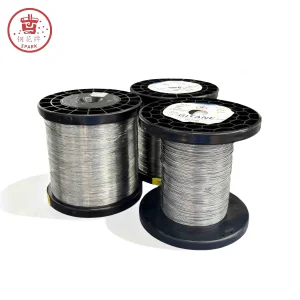
DIN125, DIN160, DIN200 plastic spools or heavy coils wrapped in vapor corrosion inhibitor (VCI) film.
Future Outlook: Next-Generation Nickel Alloys & Additive Manufacturing
Strategic advancements in melt refining, rare-earth micro-alloying, and powder metallurgy for next-decade thermal environments.
VIM + ESR Double Vacuum Refining
To meet the extreme cleanliness required by aerospace thermal treatment and semiconductor furnaces, leading China mills are adopting Vacuum Induction Melting combined with Electroslag Remelting (VIM+ESR). This process reduces non-metallic oxide inclusions to near-zero levels, preventing premature element burn-out.
Rare-Earth Element (REE) Micro-Alloying
By doping 80% nickel matrix alloys with micro-additions of Yttrium (Y), Cerium (Ce), and Zirconium (Zr), researchers have increased oxide scale spallation resistance under extreme thermal shock. REE doping anchors the protective chromia scale via "reactive element effect," extending life at 1200°C by up to 40%.
Spherical Powders for 3D Metal Printing
Expanding beyond conventional wire and strip drawing, gas atomization technology now produces high-sphericity 80% nickel matrix powders (15-45μm particle size). These powders enable Selective Laser Melting (SLM) of complex, custom internal-cooling furnace geometries and specialized heating elements.
Frequently Asked Questions (Technical & Procurement FAQ)
Direct answers to common technical queries regarding chemical composition, performance differences, and ordering logistics for 80% nickel products.
What does "Nickel content ~80% as balance matrix" mean in technical quotes?
How does Cr20Ni80 compare to FeCrAl (Kanthal) alloys in continuous high-temperature service?
Why is high-purity Norway Plum Nickel or Electrolytic Nickel Cake used in alloy production?
What factors influence the pricelist of China-origin 80% Nickel wires and ribbons?
Can Cr20Ni80 wire be used in reducing or sulfur-containing atmospheres?
What are the standard delivery forms available from China suppliers?
How can I request Mill Test Certificates (MTC) and samples for trial batch validation?
High-Purity Nickel & 80% Ni-Matrix Alloy Catalogue (Part II)
Review additional grade offerings including ultra-high temperature FeCrAl, Cr30Ni70 heating alloys, and electric heating tubes.



Request Custom Technical Quotes & Mill Pricelist
Consult with our senior metallurgical engineers for grade selection, resistance calculations, and direct factory pricing indexed to real-time LME nickel benchmarks.
Connect with Metallurgy Specialist