
Spain Priority High Resistance Alloys
Top-rated electrical resistance alloys specified by European furnace builders, ceramic kiln OEMs, and industrial heat treatment operations across Catalonia, Basque Country, and Valencia.

1. Macro Industrial Landscape: FeCrAl Alloys in Spain's Clean Energy & Manufacturing Transition
The global electric heating element market is undergoing a seismic technical transition, accelerated by industrial decarbonization initiatives, stringent European Green Deal standards, and surging fossil-fuel-to-electric furnace conversions across key manufacturing ecosystems. Within the European Union, Spain stands as a crucial industrial pillar, hosting intensive high-temperature processing sectors including ceramic tile manufacturing, automotive metallurgical heat treating, glass processing, and concentrated solar power (CSP) thermal storage integration.
High Resistance FeCrAl (Iron-Chromium-Aluminium) alloys have emerged as the premier material class for thermal electrification projects across Spain's core industrial regions:
- Castellón Ceramic Cluster (Valencian Community): World-renowned ceramic tile and glaze manufacturers requiring heavy-duty tunnel kilns and roller hearth kilns capable of continuous 1200°C to 1350°C operation.
- Basque Country & Catalonia Automotive & Metallurgy Hubs: Automotive component stamping, drop forging, and precision thermal treatment plants (e.g., Martorell, Bilbao) relying on controlled-atmosphere electric furnaces.
- Andalusia & Extremadura Renewable Energy Projects: Advanced CSP thermal power plants using high-resistance alloy elements for molten-salt reheating and thermal energy storage systems.
Compared to traditional Nickel-Chromium (NiCr) heating wires, FeCrAl alloys offer a significantly higher resistivity (up to 1.45 Ω·mm²/m), superior oxidation resistance via a self-healing alpha-alumina ($\alpha-\text{Al}_2\text{O}_3$) protective scale, and a 15% lower density. This structural density advantage enables furnace engineering teams in Spain to achieve equivalent thermal power output while consuming significantly less alloy weight, delivering direct cost reductions in wholesale procurement.
2. Metallurgical Architecture & Chemical Dynamics of High Resistance FeCrAl Alloys
To evaluate FeCrAl alloy suppliers for Spanish manufacturing contracts, procurement executives and chief thermal engineers must analyze the chemical composition, microstructure stability, and oxide scale growth rates under long-term cyclic thermal loading.
Microstructural Oxidation Mechanics: The Alpha-Alumina ($\alpha-\text{Al}_2\text{O}_3$) Barrier
When subjected to temperatures above 900°C in oxygen-containing or ambient air atmospheres, FeCrAl alloys undergo selective oxidation. Aluminium within the matrix diffuses rapidly to the surface, forming a dense, non-porous layer of $\alpha-\text{Al}_2\text{O}_3$. This ceramic-grade dielectric oxide layer serves two key engineering functions:
- Chemical Isolation: Prevents further oxidation of the underlying iron and chromium matrix, dramatically extending service life compared to NiCr alloys.
- Electrical Insulation: Prevents micro-arcing between adjacent heating element coils, allowing tighter pitch winding in compact industrial heating chambers.
Technical Property Comparison: FeCrAl vs. NiCr Alloys in European Industrial Applications
| Parameter / Specification | FeCrAl (0Cr25Al5 / SGHT) | FeCrAl (0Cr23Al5) | NiCr (Cr20Ni80) | NiCr (Cr15Ni60) |
|---|---|---|---|---|
| Max Continuous Temp (°C) | 1350°C - 1425°C | 1250°C - 1300°C | 1200°C | 1150°C |
| Electrical Resistivity (20°C, μΩ·m) | 1.42 - 1.45 | 1.35 - 1.40 | 1.09 | 1.12 |
| Density (g/cm³) | 7.10 | 7.25 | 8.40 | 8.20 |
| Thermal Expansion (x10⁻⁶/K) | 14.7 (20-1000°C) | 15.0 (20-1000°C) | 17.0 (20-1000°C) | 17.0 (20-1000°C) |
| Sulfur Atmosphere Tolerance | Excellent (Self-Protecting) | Very Good | Poor (Sulfidation Prone) | Poor |
| Hot Yield Strength & Creep | Moderate (Requires Support) | Moderate | High | High |
3. Localized Spain Application Scenarios & Engineering Case Studies
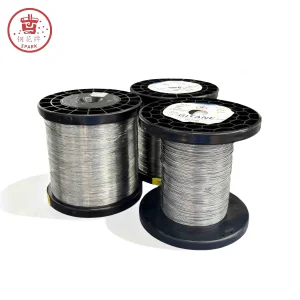
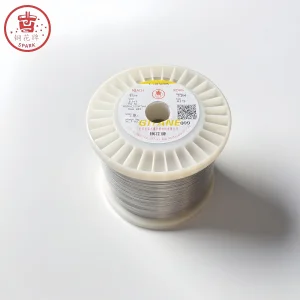
Understanding regional industrial requirements allows SPARK (Beijing Shougang Gitane New Materials Co., Ltd.) to supply specialized FeCrAl wire and strip forms tailored to specific manufacturing plants across Spain.
Castellón Ceramic Glaze Sintering (1350°C Kilns)
Challenge: Excessive element sag and aggressive chemical degradation from vaporized ceramic glazes in continuous roller kilns.
Solution: Implementation of wholesale SPARK SGHT Powder Metallurgy FeCrAl wire with fine rare-earth element additions (Yttrium and Zirconium). The modified grain boundary pinning prevents rapid creep sag while resisting glaze vapor attack.
Martorell & Automotive Stamping Heat Treatment
Challenge: Rapid thermal cycling in car chassis component annealing lines causes standard wire oxide coatings to spall off, leading to hot spots.
Solution: Deployment of pre-oxidized 0Cr25Al5 high resistance flat wire with optimized surface load ratio ($W/cm^2$), increasing element lifetime by over 40% under dynamic cycling.
Andalusia Concentrated Solar Power (CSP) Storage
Challenge: Extreme high-density power dissipation required for high-temperature molten salt heating vessels.
Solution: Heavy-gauge coiled FeCrAl elements providing high electrical resistance within reduced physical footprints, operating continuously without localized burning.
4. FeCrAl Technology Roadmap: Powder Metallurgy & Reactive Element Addition
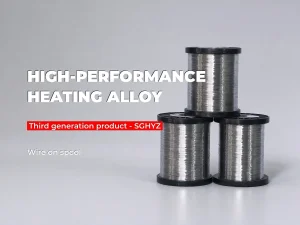
Traditional ingot-melted FeCrAl alloys suffer from grain coarsement when maintained at elevated temperatures above 1100°C, rendering the material brittle upon room-temperature cooling. To address this technical limitation for advanced European furnace designers, Beijing Shougang Gitane New Materials Co., Ltd. has developed the SGHT and SGHYZ metallurgical lines.
Innovation Highlight: Powder Metallurgy (PM) Dispersion Strengthening
By shifting from standard induction melting to gas atomization and hot isostatic pressing (HIP), SPARK powder metallurgy FeCrAl alloys achieve:
- Grain Boundary Pinning: Uniform dispersion of oxide nanoparticles limits grain growth, preserving mechanical integrity even after 10,000+ operating hours.
- Enhanced Creep Strength: Yield strength at 1200°C is elevated up to 300% compared to standard 0Cr25Al5 grades, eliminating the need for complex ceramic support structures in horizontal furnace chambers.
- Controlled Resistivity Drift: Researched chemical homogenization prevents sudden resistance drops during multi-year industrial campaigns.
5. Strategic B2B Sourcing Guide: Quotes, Logistics & Compliance for Spanish Buyers
Purchasing Directors and Procurement Managers importing wholesale electrical resistance alloys into Spain must balance unit material costs against operational efficiency, EU tariff regulations, and ISO certification compliance.
Key Evaluation Factors for Spanish Wholesale Inquiries
- Dimensional Tolerance Precision: Ensure round wire and strip tolerances meet EN 10218 and GB/T 1234 standards to prevent resistance variances across heating zones.
- Packaging & Corrosion Prevention: Marine freight shipping to ports such as Valencia, Barcelona, or Bilbao requires sealed plastic spools, VCI anti-corrosion film wrapping, and reinforced export wooden cases.
- Custom Coil & Ribbon Fabrication: Order pre-wound spiral heating elements or ready-to-mount corrugated ribbons to minimize local labor assembly costs in Spain.
Obtain Direct Wholesale Quotes for Spain
Connect directly with Beijing Shougang Gitane technical specialists for mill-direct pricing, custom alloy selection, and full EN 10204 3.1 Mill Test Certification.
Send Inquiry Now6. Frequently Asked Questions (FAQ) for Spain Procurement & Engineering Teams
FeCrAl wire offers higher operating temperatures (up to 1425°C vs 1200°C for NiCr), higher electrical resistance (1.45 μΩ·m vs 1.09 μΩ·m), higher resistance to sulfur-containing kiln atmospheres, and lower raw material weight. This yields substantial cost savings in high-temperature ceramic firing.
You can contact our sales engineering team via the Inquiry Portal with your required alloy grade (e.g., 0Cr25Al5, SGHT), wire diameter or ribbon dimensions, spool weight, and delivery destination port (Barcelona, Valencia, Bilbao). Our commercial team provides quotes within 24 hours.
Yes, all SPARK heating alloys manufactured by Beijing Shougang Gitane adhere strictly to ISO 9001 quality management systems, RoHS environmental standards, and GB/T 1234-2012 / ASTM / DIN equivalent technical standards. Mill test reports (EN 10204 3.1) are supplied with every shipment.
For applications involving frequent thermal cycling (such as batch heat treating furnaces in the Basque Country), we recommend our reactive-element enriched grades (such as SGHYZ or Cr20Ni80S for lower temperature regimes) which feature enhanced oxide scale adherence to prevent spalling.
Full Catalog: High Resistance Alloys & Elements for Wholesale
Explore our complete range of resistance wire, nickel-chromium alloys, bare heating conductors, and industrial furnace materials manufactured by Beijing Shougang Gitane.





Ready to Optimize Your Heating Systems in Spain?
Partner with Beijing Shougang Gitane New Materials Co., Ltd. for engineering expertise, certified metallurgical consistency, and aggressive factory-direct wholesale pricing.