
High-Performance Heating Alloys for Korean Industry
Precision-drawn resistance heating wire and powder metallurgy alloys customized for high-temperature stability, fast cycle thermal endurance, and zero-defect yield in Korean manufacturing hubs.


South Korea's High-Tech Heating Alloy Market Landscape
South Korea stands as a global epicenter for advanced technological manufacturing, driven by world-leading conglomerates in semiconductor fabrication (Yongin Mega Cluster, Pyeongtaek), secondary lithium-ion battery production (Pohang, Cheongju, Ulsan), flexible OLED displays (Cheonan, Asan), and precision automotive metallurgy. The operational efficiency, yield rate, and thermal control of these high-tech production lines depend directly on the physical stability and longevity of resistance heating elements.
With the Korean industrial sector accelerating its decarbonization transition from gas-fired combustion kilns to high-efficiency electric thermal processing systems, demand for high-performance electric heating alloys—specifically high-purity Iron-Chromium-Aluminum (FeCrAl) and Nickel-Chromium (NiCr) alloys—has reached an unprecedented peak.
Korean original equipment manufacturers (OEMs) and furnace engineering firms demand material specs that eliminate hot-spots, prevent oxidation spallation, offer superior resistance to high-temperature creep, and deliver absolute thermal profile uniformity (less than ±1.0°C deviation at 1300°C+ continuous operation).
Key Thermal Requirements in Korean Clusters
Zero volatile particle emission, ultra-pure alumina scale formation, continuous rating up to 1350°C–1425°C without deformation.
Extreme resistance to alkaline lithium/nickel vapor corrosion in high-throughput roller hearth kilns (RHK).
High resistance to carburization, nitriding, and thermal shock in fast-cycling electric reaction vessels.
Material Science: FeCrAl vs. NiCr Electrothermal Alloys
Selecting the optimal electric heating wire for Korean industrial applications requires a deep understanding of high-temperature thermodynamics, electrical resistivity temperature coefficients, and protective oxide scale kinetics.
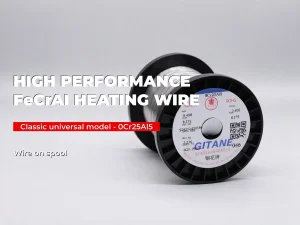
FeCrAl Alloys (SPARK HRE, SGHT, 0Cr25Al5)
Characterized by high electrical resistivity (1.25–1.45 μΩ·m) and lower density (7.10 g/cm³) compared to nickel alloys. At elevated temperatures (>1000°C), FeCrAl forms a dense, continuous layer of thermodynamically stable alpha-alumina (α-Al₂O₃). This protective oxide provides exceptional oxidation resistance up to 1425°C, making it ideal for high-density furnace heating elements.
NiCr Alloys (Cr20Ni80, Cr30Ni70)
Featuring high hot strength, ductility after prolonged heating, and superior mechanical toughness. NiCr alloys form a chromia oxide (&Cr₂O₃) protective layer. They exhibit minimal elongation under load and perform exceptionally well in cycling heating/cooling environments, humid air, and ammonia/nitrogen atmospheric furnaces where alumina scale spallation could occur.
Powder Metallurgy (PM) Technology
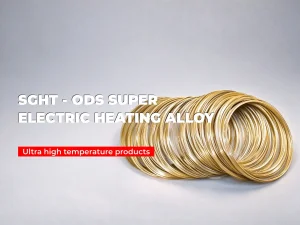
SPARK’s proprietary PM process (as used in SGHT grade) eliminates macro-segregation of rare-earth elements (Y, Zr, Hf, La). By creating a fine, uniform grain structure strengthened by oxide dispersion, PM FeCrAl achieves extraordinary sagging resistance and extends element working lifetime by 150% to 300% in demanding 1400°C thermal processing applications.
| Alloy Grade | Composition Family | Max Temp (°C) | Resistivity at 20°C (μΩ·m) | Density (g/cm³) | Primary Industrial Application in Korea |
|---|---|---|---|---|---|
| SGHT (PM FeCrAl) | Fe-Cr-Al + RE (Powder Met) | 1425°C | 1.45 ± 0.05 | 7.10 | Semiconductor diffusion furnaces, ceramic sintering |
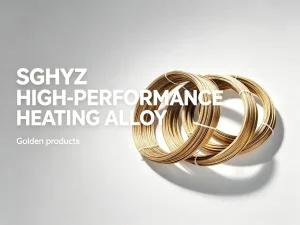
| SGHYZ / HRE | Fe-Cr-Al + Y/Zr Micro-alloy | 1400°C / 1350°C | 1.42 ± 0.05 | 7.10 | Lithium battery cathode kilns, rapid thermal processing |
| 0Cr25Al5 | Fe-Cr-Al Standard | 1250°C | 1.42 ± 0.04 | 7.10 | General industrial heat-treating furnaces, domestic heating |
| Cr20Ni80 | Ni-Cr (80/20) | 1200°C | 1.09 ± 0.04 | 8.40 | Precision medical devices, laboratory heaters, cyclic element |
| Cr30Ni70 | Ni-Cr (70/30) | 1250°C | 1.18 ± 0.04 | 8.10 | OLED panel annealing, special gas atmosphere furnaces |
Localized Application Scenarios in Korean Industrial Hubs
To maintain competitive market advantage in Korea, heating alloy supply must directly match the rigorous engineering parameters of local manufacturing operations.
Wafer Oxidation & LPCVD Vertical Furnaces
Vertical thermal processing equipment for 300mm silicon wafers operates under ultra-clean conditions at temperatures up to 1350°C–1400°C. SPARK SGHT powder metallurgy FeCrAl wire is crafted to maintain strict roundness and zero deformation during vertical winding. The formation of a high-purity, non-flaking α-Al₂O₃ protective film prevents metallic element evaporation from contaminating cleanroom wafer chambers.
Roller Hearth Sintering Kilns for High-Nickel Cathodes
The production of NCM (Nickel-Cobalt-Manganese) and LCA cathode active materials requires multi-zone continuous Roller Hearth Kilns (RHK). Heating elements must withstand continuous thermal holding at 800°C–1100°C in pure oxygen (O₂) or lithium-enriched atmospheres. SPARK 0Cr21Al6Nb and SG140 strip alloys offer elevated hot strength and oxidation immunity, reducing kiln downtime by over 35%.
OLED Glass Substrate Rapid Thermal Annealing (RTA)
Flexible OLED panel processing demands precise temperature ramping (up to 100°C/sec) with strict spatial temperature uniformity across 8.5-generation glass substrates. SPARK Cr30Ni70 low-resistivity-drift wire provides smooth thermal response without resistance hysteresis, guaranteeing reproducible glass compaction and thermal strain relief.
Stress Relieving & Carburizing Furnace Infrastructure
Heavy forging, automotive gear tempering, and marine engine component heat treatment utilize high-capacity electric pit and batch furnaces. SPARK heavy-gauge spiral heating elements and heavy ribbons (0Cr23Al5 / 0Cr25Al5) provide optimal surface load capacity (W/cm²), maximizing service life under carbon-rich protective atmospheres.
China's Factory Scale Edge: Direct Logistics to Incheon & Busan
For South Korean procurement officers, sourcing directly from top-tier Chinese electrothermal alloy factories provides an unmatched balance of metallurgical excellence, structural cost optimization, and rapid delivery assurance.
Integrated Manufacturing & Quality Control
As part of Shougang Group’s specialized alloy division, Beijing Shougang Gitane New Materials operates an end-to-end, state-of-the-art production system. From Vacuum Induction Melting (VIM) and Electro-Slag Remelting (ESR) to hot rolling, cold drawing, bright annealing, and automated coil spooling—every process is conducted in-house.
This vertical integration guarantees exact chemical stoichiometry, minimal tramp element impurities (S, P, C under extreme limits), and uniform wire diameter tolerances (down to ±0.005mm on fine wires).
Localized Freight & Customs Optimization
Located near Beijing/Tianjin freight hubs, shipments destined for South Korea enjoy direct maritime routes to Incheon, Busan, and Pyeongtaek ports within 2 to 3 days. Standard stock items (wire diameters 0.5mm–8.0mm, strip thicknesses 0.2mm–3.0mm) can be dispatched on compressed schedules.
Full compliance with China-Korea FTA trade guidelines reduces import tariff friction, allowing Korean furnace builders to lower raw material cost structures by 20%–35% compared to European or domestic supply options.
Next-Generation Heating Alloy R&D for Smart Green Factories
As Korean industrial mandates push toward zero-carbon RE100 manufacturing targets, heating element metallurgy is evolving to meet unprecedented stress and temperature parameters.
Micro-Alloying Precision with Yttrium & Zirconium
Fine-tuning trace Y, Zr, and Hf additions to lock grain boundaries at extreme temperatures. This prevents rapid grain growth at 1300°C+, extending sagging resistance by over 80% under cantilever loads in horizontal kilns.
Breaking the Thermal Limits of Metallic Resistance Alloys
Developing second-generation Powder Metallurgy compositions that approach the operating boundaries of Silicon Carbide (SiC) elements, while retaining metallic ductility, machinability, and coilability for complex heater shapes.
Factory Pre-Conditioning for Accelerated Installation
Supplying pre-oxidized, pre-formed spiral and wave-shaped elements featuring uniform factory-grown α-Al₂O₃ layers, reducing client commissioning times in Korean cleanrooms from days to hours.
Rigorous Quality Standards & Korean Market Compliance
To satisfy the stringent incoming quality control (IQC) protocols of top-tier Korean enterprises, every batch of SPARK heating alloy wire, strip, and fabricated element undergoes exhaustive physical and chemical validation.
- ISO 9001:2015 & ISO 14001 Quality & Environmental Certification
- Fully Compliant with GB/T 1234-2012, JIS C 2520, and ASTM B344 Standards
- RoHS & REACH Environmentally Safe Certifications
- 100% Eddy Current Flaw Detection & Optical Diameter Verification
Korean Engineering Consultation Support
Our specialized international engineering desk assists South Korean clients with detailed electrothermal calculations:
Comprehensive Electrothermal Products for Korea
Explore our full wholesale range of high-temperature FeCrAl, NiCr, and specialized industrial furnace elements manufactured for direct export to South Korean facilities.



Frequently Asked Questions by Korean Technical Buyers
Key metallurgical, logistics, and engineering queries regarding electric heating alloy procurement for South Korean industrial operations.
1. Why is FeCrAl preferred over NiCr for ultra-high temperature furnaces (>1250°C) in South Korea?
2. How does SPARK SGHT powder metallurgy wire prevent heating wire sagging in horizontal kiln tubes?
3. What is the typical lead time and shipping route for wholesale heating wire orders to South Korea?
4. Can SPARK produce pre-formed spiral elements according to CAD engineering drawings?
5. How do atmospheric gases (O2, N2, H2, CO) affect element choice in battery and semiconductor processing?
6. What documentation accompanies bulk heating alloy shipments to South Korea?
Optimize Your Industrial Thermal Systems in South Korea Today
Partner with Beijing Shougang Gitane New Materials Co., Ltd. for factory-direct wholesale pricing, direct technical consultation with Senior Metallurgical Engineers, and high-performance electrothermal alloys engineered for absolute reliability.