
High-Temperature Alloy Flagships for Kazakhstan Industrial Applications
Discover our ultra-high-temperature FeCrAl and powder-metallurgy heating alloys, specifically tailored to withstand thermal fatigue and harsh operational duty cycles in Kazakhstani industrial electric furnaces up to 1425°C.
1. Industrial Landscape & Resistance Heating Needs in Kazakhstan
Kazakhstan stands as the industrial powerhouse of Central Asia. Driven by vast natural resource reserves, heavy metallurgical manufacturing, mining processing, and petrochemical refining, the country is undergoing an extensive industrial modernization drive. Core manufacturing centers in regions such as Karaganda (steelmaking and heavy machinery), Pavlodar (aluminum and ferroalloys), Aksu, and Ust-Kamenogorsk (non-ferrous and rare metallurgy) rely continuously on high-capacity electric heating systems.
Operating electrical heating elements in Kazakhstan presents unique metallurgical challenges. Industrial equipment must endure severe operational realities:
Extreme Climate Cycling
Ambient temperatures in Kazakhstan range from -40°C in harsh Eurasian winters to +40°C in summer. Thermal shocking during furnace start-up and shutdown cycles demands superior physical toughness and low mechanical brittleness.
Aggressive Corrosive Atmospheres
Metallurgical processing and petrochemical heating often involve atmospheres containing sulfur gases, carbon deposition, or reduced oxygen levels, which rapidly destroy conventional lower-grade heating wires.
High Creep Resistance at 1350°C+
Continuous heavy-industry sintering kilns require elements that do not sag, deform, or short-circuit under their own mass over thousands of hours of uninterrupted high-temperature operation.
To address these stringent operational demands, Beijing Shougang Gitane New Materials Co., Ltd. supplies its flagship **SPARK Electric Heating Alloys** across Kazakhstan, providing certified metallurgical consistency, extended furnace element life, and reduced maintenance overhead.
2. Technical Breakdown: Metallurgy & Materials Science of SPARK Alloys
Electric heating alloys convert electrical energy into thermal energy based on Joule heating ($P = I^2 R$). Selecting between **Iron-Chromium-Aluminum (FeCrAl)** and **Nickel-Chromium (NiCr)** alloys depends on maximum element temperature, atmospheric chemistry, electrical resistivity, and long-term dimensional stability.
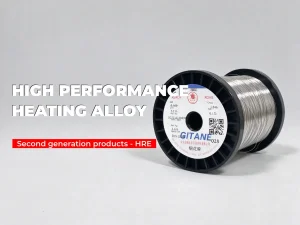
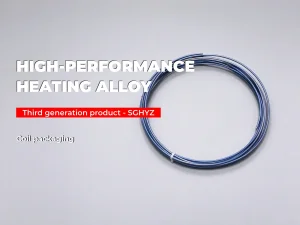
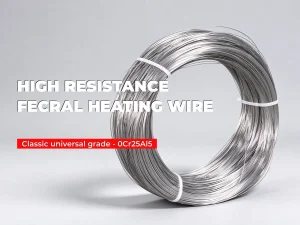
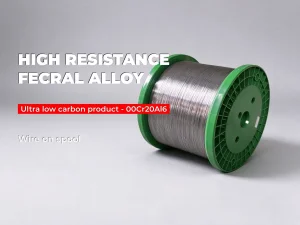
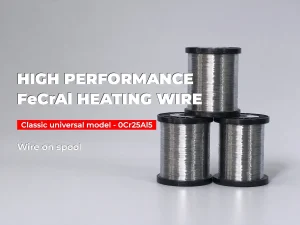
FeCrAl Alloys (SPARK SGHT, SGHYZ, HRE, 0Cr25Al5, 0Cr21Al6Nb)
SPARK FeCrAl alloys form a continuous, dense protective scale of **Alpha-Alumina ($\alpha\text{-Al}_2\text{O}_3$)** when heated above 1000°C. This oxide barrier slows further oxidation, offers exceptionally high electrical resistivity ($1.25 - 1.45\,\mu\Omega\cdot\text{m}$), and reduces energy consumption due to lower material density compared to NiCr alloys.
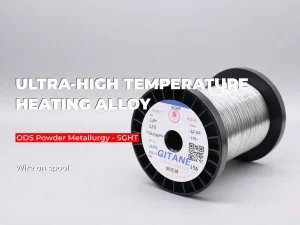
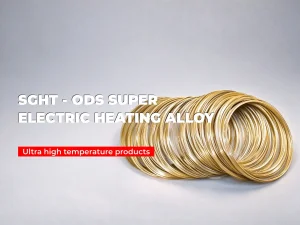
Through **Powder Metallurgy (PM)** manufacturing (utilized in SPARK SGHT Grade), rare-earth element additions such as Yttrium (Y), Zirconium (Zr), and Hafnium (Hf) refine the grain boundaries. This micro-alloying engineering dramatically retards high-temperature grain growth and creep elongation, pushing maximum operating limits to **1425°C**.
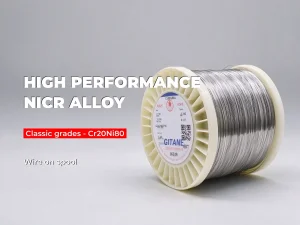
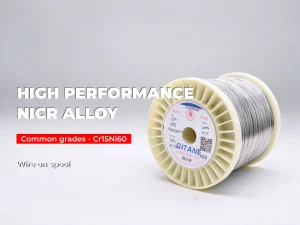
NiCr Alloys (SPARK Cr20Ni80, Cr15Ni60)
Nickel-Chromium alloys form a tenacious **Chromium Oxide ($\text{Cr}_2\text{O}_3$)** protective layer. While rated for slightly lower temperatures (up to 1200°C), NiCr alloys retain superior hot strength, flexural ductility after prolonged exposure, and exceptional resistance to thermal cycling fatigue. They are preferred in complex element geometries, ceramic bobbin heaters, and frequent thermal start-stop applications.
| Alloy Grade | Alloy Family | Max. Element Temp. | Resistivity at 20°C ($\mu\Omega\cdot\text{m}$) | Density ($\text{g/cm}^3$) | Primary Industrial Application in Kazakhstan |
|---|---|---|---|---|---|
| SPARK SGHT | PM FeCrAl | 1425°C | 1.45 | 7.10 | Advanced powder metallurgy, ceramic sintering, heat treat kilns |
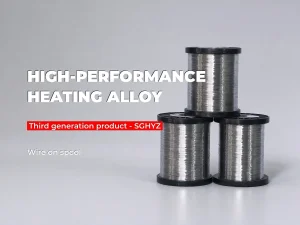
| SPARK SGHYZ | FeCrAl + Rare Earth | 1400°C | 1.42 | 7.10 | Heavy industrial furnaces, continuous annealing lines |
| SPARK HRE | FeCrAl | 1350°C | 1.40 | 7.15 | High-temp steel treatment, laboratory muffle furnaces |
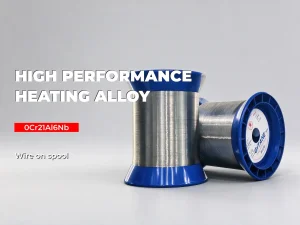
| 0Cr21Al6Nb | FeCrAl + Nb | 1350°C | 1.45 | 7.10 | Creep-resistant element spirals, ceramic roller hearth kilns |
| 0Cr25Al5 | Standard FeCrAl | 1250°C | 1.42 | 7.10 | General industrial heating, radiant tube elements |
| SPARK Cr20Ni80 | NiCr (80/20) | 1200°C | 1.09 | 8.40 | Ductile heating coils, thermal processing, plastic extrusion |
| SPARK Cr15Ni60 | NiCrFe | 1150°C | 1.11 | 8.20 | Industrial heat treatment, commercial heating appliances |
3. Industrial Decarbonization & Furnace Electrification Solutions
As Kazakhstan aligns with global carbon-neutrality initiatives and updates its national environmental legislation, industrial producers are aggressively transitioning from fossil gas combustion heaters to clean **electric resistance heating**.
Electrifying industrial process heating with SPARK alloy elements delivers substantial macro-economic and engineering advantages:
- Near-Zero On-Site Emissions: Direct conversion of electrical energy into thermal energy removes direct NOx, SOx, and carbon dioxide emissions from heat treatment operations.
- Precision Temperature Uniformity ($\pm 1^\circ\text{C}$): Unlike gas burners with variable flame thermal zones, electric resistance coils enable precise localized power distribution, critical for aerospace-grade steel tempering and high-purity aluminum smelting.
- Superior Energy Efficiency: Up to 95%+ of supplied electrical energy converts directly into radiant heat inside insulated modern furnace chambers.
4. Global Supply Chain & Direct Logistics Infrastructure to Kazakhstan
Supply chain stability is vital for manufacturing enterprises in Kazakhstan. Beijing Shougang Gitane New Materials Co., Ltd. leverages direct cross-border logistical routes connecting Chinese manufacturing hubs directly to major Kazakhstani industrial centers.
Cross-Border Rail & Transit (Altynkol / Khorgos)
Direct rail freight routes via Khorgos Gateway and Altynkol dry ports ensure rapid containerized shipment delivery to Almaty, Karaganda, Astana, and Shymkent within accelerated transit times.
Full EAEU Duty & Custom Harmony
Export documentation complies seamlessly with Eurasian Economic Union (EAEU) standards, simplifying customs clearance, reducing tariff friction, and accelerating factory receiving schedules.
Certified Mill Test Traceability (EN 10204 3.1)
Every lot of SPARK resistance wire, strip, and element arrives with complete chemical analysis certificates, exact resistance measurements per meter, and mechanical tolerance validation.
5. Technology Roadmap: Next-Generation High-Temp Resistance Alloys
Looking toward 2030, Shougang Gitane's metallurgical R&D team continues to advance electric resistance alloy boundaries. Focus areas include:
- Advanced Powder Metallurgy (PM) Dispersion: Increasing nano-scale Yttria ($\text{Y}_2\text{O}_3$) particle distribution to allow continuous operation up to 1450°C without mechanical degradation.
- Ultra-Low Carbon FeCrAl Substrates: Reducing interstitial carbon and nitrogen levels to minimize oxide scale spallation during rapid temperature ramp cycles.
- Pre-Oxidized Ready-to-Install Elements: Delivering factory pre-oxidized wire spirals with established $\alpha\text{-Al}_2\text{O}_3$ films, reducing initial conditioning downtime for Kazakhstan end-users.
6. Localized Engineering, Compliance & Custom Manufacturing
Standardization and safety compliance are critical when integrating electrical components into Kazakhstan’s industrial infrastructure. SPARK products manufactured by Beijing Shougang Gitane conform with rigorous international and regional standard systems:
- GB/T 1234-2012: Chinese National Standard for High-Resistance Electric Heating Alloys.
- GOST 12766 Alignment: Standard parameters harmonized for seamless replacement of legacy GOST-spec resistance alloys (e.g., Kh23Ju5T, Kh20N80) across CIS industrial units.
- ISO 9001:2015 Certification: Comprehensive quality assurance throughout smelting, hot rolling, wire drawing, cold rolling, and coil winding.
We provide custom processing tailored to exact customer technical drawings: supply forms include **bright annealed round wire (0.05mm to 12.0mm)**, **flat ribbon strip**, **heavy coiled wire spirals**, and **pre-fabricated furnace element frames**.
Complete SPARK Resistance Heating Portfolio for Kazakhstan Procurement
Explore our full selection of high-performance FeCrAl and NiCr heating elements, wire coils, and specialized industrial furnace alloy grades available for immediate quote and export to Kazakhstan.

Frequently Asked Questions (Q&A) for Kazakhstan Procurement
Technical guidance for engineering managers, furnace designers, and industrial purchasing agents in Kazakhstan seeking to specify SPARK resistance heating materials.
Which SPARK alloy grade is equivalent to legacy GOST Kh23Ju5T in Kazakhstani plants?
Our SPARK 0Cr25Al5 and 0Cr21Al6Nb alloys directly correspond to GOST Kh23Ju5T (Х23Ю5Т) specifications in terms of chemical resistance and thermal capability. For higher operating temperatures up to 1400°C–1425°C, we recommend upgrading legacy plants to SPARK SGHYZ or powder-metallurgy SGHT grade to achieve up to 35% longer element service life.
Why choose FeCrAl over NiCr alloys for heavy industrial kilns in Kazakhstan?
FeCrAl alloys offer higher maximum operating temperatures (up to 1425°C compared to 1200°C for NiCr), higher electrical resistivity (reducing wire cross-section required), and lower material density ($7.10\,\text{g/cm}^3$ vs $8.40\,\text{g/cm}^3$ for NiCr). This yields approximately 15% to 20% savings in total alloy mass for identical heating capacity, significantly lowering procurement costs.
How does SPARK handle logistics and cross-border delivery to Karaganda, Pavlodar, or Almaty?
We supply goods directly under CIP or DDP terms via Khorgos and Altynkol border rail ports. Shipments are packaged in reinforced export wooden crates or heavy-duty plastic spools to protect against humidity and transit vibration during international rail/truck transport.
Are mill test certificates and chemical compliance documentation provided?
Yes. Every dispatch is accompanied by certified Mill Test Reports (EN 10204 3.1 compliant) detailing spectrographic chemical composition, room temperature resistivity ($\mu\Omega\cdot\text{m}$), tensile strength, elongation, and dimensional tolerance checks strictly aligned with ISO 9001 quality systems.
Can SPARK alloys resist sulfur-bearing or carbonaceous atmospheres in refineries?
FeCrAl alloys (such as SPARK SGHT and 0Cr25Al5) form an impermeable $\alpha\text{-Al}_2\text{O}_3$ scale that provides vastly superior resistance to sulfur gases and carbon carburization compared to Nickel-Chromium alloys. NiCr alloys can suffer rapid degradation ("green rot") in reducing or sulfurous gas atmospheres.
Accelerate Your Industrial Heating Efficiency in Kazakhstan
Consult with Shougang Gitane's senior metallurgical application engineers. Request tailored alloy datasheets, technical thermal calculations, or immediate direct factory pricelists.
Send Inquiry Now