
Primary Industrial Alloy Solutions for Norway
Premium grade FeCrAl and NiCr electrothermal heating alloys certified for high-duty continuous service up to 1425°C.


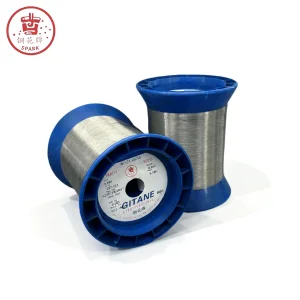
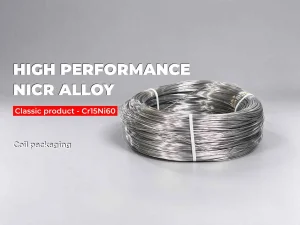
The Norwegian Industrial Landscape: Driving High-Temperature Thermal Efficiency
A strategic overview of Norway's evolving electro-metallurgical, maritime electrification, and process heating sectors.
Norway's Green Industrial Transformation
Norway stands as a global leader in sustainable industrial processes. Powered by abundant hydro-electric capacity, Norwegian heavy industries—ranging from aluminium smelting and silicon production (such as Hydro and Elkem operations in Sunndalsøra, Årdal, and Kristiansand) to advanced battery cathode sintering in Porsgrunn—are transitioning away from gas-fired heating toward 100% electrified thermal processing systems.
Electrification requires ultra-reliable heating elements capable of enduring severe thermal cycling without chemical breakdown or creep. High Resistance FeCrAl (Iron-Chromium-Aluminium) alloys are central to this transformation due to their high electrical resistivity ($\approx 1.45 \ \mu\Omega\cdot\text{m}$), low density, and ability to operate continuously up to 1400°C–1425°C under harsh atmospheric conditions.
Demands of North Sea & Maritime Operating Environments
Beyond land-based metal refining, Norway's offshore energy assets, subsea flowline heating networks, and zero-emission marine vessels demand thermal materials with extreme oxidation and corrosion resistance. In marine and subsea trace heating, alloys are subjected to sulfur compounds, saline moisture, and high thermal shocks during start-stop duty cycles.
Standard resistance alloys often suffer from rapid oxidation spallation or grain coarsening. Premium FeCrAl alloys enriched with rare-earth micro-additions (such as Yttrium, Zirconium, and Niobium) form a dense, protective $\alpha\text{-Al}_2\text{O}_3$ alumina oxide scale that self-heals in high-temperature air, mitigating element failure and minimizing costly downtime on offshore and marine platforms.
Metallurgical Deep-Dive: High Resistance FeCrAl Engineering Science
Understanding the thermodynamics, scale growth kinetics, and micro-alloying mechanisms of FeCrAl resistance alloys.
High Resistivity & Material Efficiency
FeCrAl alloys feature a nominal resistivity ranging from 1.35 to 1.45 $\mu\Omega\cdot\text{m}$, significantly higher than classic NiCr 80/20 alloys ($1.09 \ \mu\Omega\cdot\text{m}$). Coupled with a lower density ($7.10 \ \text{g/cm}^3$ vs $8.40 \ \text{g/cm}^3$), FeCrAl enables furnace designers to use less total metal weight for equivalent resistance, yielding substantial cost savings in large-scale Scandinavian industrial kilns.
$\alpha\text{-Al}_2\text{O}_3$ Oxide Layer Kinetics
When heated above 900°C, Aluminium within the FeCrAl matrix diffuses outwards to react with atmospheric oxygen, creating an ultra-thin, electrically insulating, and highly adherent layer of alpha-alumina ($\alpha\text{-Al}_2\text{O}_3$). This passive scale acts as a barrier against aggressive chemical species, carbon penetration, and sulfur compounds common in Norwegian mineral processing furnace atmospheres.
Reactive Element (RE) Addition & Creep Resistance
Traditional FeCrAl alloys faced limitations regarding high-temperature sagging and grain growth. Premium grades developed by Shougang Gitane incorporate micro-alloyed Reactive Elements (RE) such as Yttrium (Y), Zirconium (Zr), and Niobium (Nb). These elements segregate to the grain boundaries, pinning movement, preventing premature scale spallation, and extending creep rupture life by up to 300% in horizontal element layouts.
Comparative Engineering Matrix: FeCrAl vs. NiCr Alloys for Nordic Industries
| Property Parameter | 0Cr25Al5 (FeCrAl) | 0Cr21Al6Nb (FeCrAl+RE) | SGHT (Powder Metallurgy FeCrAl) | Cr20Ni80 (Nichrome) |
|---|---|---|---|---|
| Max Working Temp (°C) | 1250°C | 1350°C | 1425°C | 1200°C |
| Resistivity at 20°C ($\mu\Omega\cdot\text{m}$) | 1.42 | 1.45 | 1.45 | 1.09 |
| Density ($\text{g/cm}^3$) | 7.10 | 7.10 | 7.10 | 8.40 |
| Sulfur Atmosphere Resistance | Excellent | Superior | Maximum | Poor (Prone to Sulfidation) |
| Hot Yield Strength & Ductility | Moderate | High | Ultra-High (Creep Proof) | Excellent Ductility Post-Use |
| Primary Norwegian Use Case | Heat Treatment & Air Heating | Aluminium & Ceramic Kilns | Battery Cathode Sintering | Marine Appliances & De-Icing |
Localized Application Scenarios Across Norway's Industry Sectors
Tailored electrothermal alloy engineering designed to meet rigid regional specifications and environmental demands.
1. Hydro-Electric Aluminium Smelting & Anode Baking (Sunndalsøra & Årdal)
Norway is Europe's largest primary aluminium producer. Aluminium holding furnaces, trough heating systems, and anode bake ovens operate around the clock. The high aluminium fluorides and abrasive ambient dust require heating elements with protective alumina films that do not flaking or contaminate molten baths. FeCrAl wire coils (0Cr25Al5 and 0Cr21Al6Nb) provide superior life spans and lower electrical power draw.
2. Green Battery Materials & Cathode Sintering (Porsgrunn & Kristiansand)
Norway's fast-growing battery manufacturing ecosystem utilizes tunnel kilns and roller hearth furnaces to sinter lithium-ion cathode active materials. Sintering reactions release corrosive lithium vapors at temperatures exceeding 1100°C. Shougang Gitane's powder metallurgy SGHT grade FeCrAl alloy displays unmatched resistance to chemical attack and thermal deformation in these high-tech cleanroom kilns.
3. Offshore Oil & Gas Subsea Thermal Management (Stavanger & Bergen)
Offshore processing modules and subsea pipelines require direct electrical trace heating and heavy-duty immersion heaters to prevent hydrate formation in extreme North Sea waters. Encapsulated FeCrAl resistance elements deliver constant watt-density, stable thermal conductivity, and structural resilience under continuous high pressure and deep-water vibrations.
4. Marine Electrification & Zero-Emission Vessel Boilers (Ålesund)
Norwegian maritime legislation mandating low-and-zero-emission fjords has accelerated electric boiler installation aboard ferries and OSVs. Compact electric heating bundle rods equipped with high-resistance FeCrAl coils ensure rapid steam generation and dynamic power control while reducing shipboard weight compared to bulky heavy-fuel oil heaters.
China's Manufacturing Excellence: Beijing Shougang Gitane New Materials
Over six decades of state-of-the-art metallurgical R&D, precision wire drawing, and stringent quality governance.
Integrated Smelting to Finished Wire
As a key subsidiary of the state-owned Shougang Group, Shougang Gitane operates an 88,000 m² integrated production complex in Shahe, Beijing. From Vacuum Induction Melting (VIM) and Electroslag Remelting (ESR) to hot rolling, precision wire drawing, and continuous bright annealing, every step is executed in-house for complete chemistry control.
Breakthrough Powder Metallurgy Technology
To overcome high-temperature creep limitations inherent to standard FeCrAl wire, our technical team (comprising over 30% senior engineers) developed the SGHT series using powder metallurgy techniques. This produces an ultra-fine, homogeneous grain structure capable of resisting grain growth up to 1425°C, outperforming imported Western equivalents at competitive price points.
ISO 9001 Certified Quality Traceability
Certified to ISO 9002 in 1996 and ISO 9001 in 2003, all our electrothermal alloys comply with Chinese GB/T 1234-2012, international ASTM B603, and DIN 17470 standards. Every master spool or coil shipped to Norway comes with a 3.1 Mill Test Certificate detailing exact chemical heat analysis, resistivity tolerance ($\pm 3\%$), and yield elongation.
Global Procurement Guide: Technical Selection & Engineering Checklist
Key parameters for Norwegian procurement specialists, plant managers, and furnace engineering OEMs.
When selecting high resistance FeCrAl alloy products for high-duty Scandinavian operations, purchasing directors and design engineers should evaluate the following core parameters:
1. Surface Load Rating ($W/cm^2$)
Selecting the correct watt density prevents element overheating. In ceramic and aluminium furnaces operating around 1100°C–1200°C, recommended surface loads range between 1.5 to 2.5 $W/cm^2$ depending on element layout and furnace insulation.
2. Atmosphere Compatibility
Air and oxidizing environments foster protective $\alpha\text{-Al}_2\text{O}_3$ scale growth. If operating in nitrogen, hydrogen, or vacuum atmospheres, special pre-oxidation heat treatment is required to pre-form the protective oxide layer prior to gas exposure.
3. Wire Diameter & Form Factor Choice
Thicker wire gauges ($\ge 3.0\text{ mm}$) offer significantly longer lifespan in aggressive high-temp service because the internal reservoir of Aluminium available to repair oxide scale spallation is proportional to wire volume.
4. Delivery Forms & Mechanical Packaging
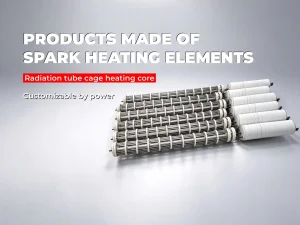
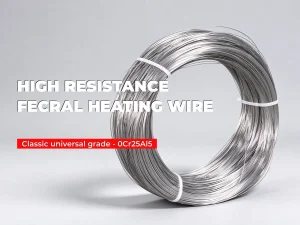
Shougang Gitane exports wire from 0.05mm fine wire to 10.0mm heavy rod, cold-rolled strip, wound spiral coils, and fully fabricated ceramic bundle rod radiant tubes packaged in export-ready ISPM-15 wooden crates.
Comprehensive FeCrAl & Heating Element Catalog
Explore our full range of resistance alloys, radiant tubes, and customized heating coils engineered for global distribution.
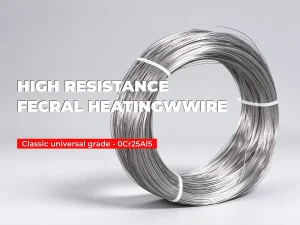

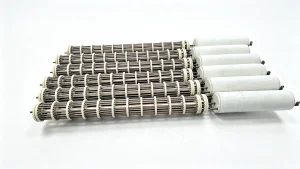

Frequently Asked Questions (FAQ) - Technical Sourcing for Norway
Direct answers from our metallurgical engineering department regarding alloy selection, lead times, and application parameters.
Why is FeCrAl preferred over Nichrome (NiCr) in Norwegian industrial furnace applications?
- Higher Maximum Operating Temperature: FeCrAl grades such as SGHT and SGHYZ reach continuous temperatures of 1400°C–1425°C, compared to 1200°C for Cr20Ni80.
- Greater Electrical Resistivity: With a resistivity of ~1.45 $\mu\Omega\cdot\text{m}$ (vs $1.09 \ \mu\Omega\cdot\text{m}$ for NiCr), FeCrAl requires less conductor cross-section to generate equivalent heat resistance.
- Sulfur Resistance & Density Advantages: FeCrAl forms a protective $\alpha\text{-Al}_2\text{O}_3$ scale resistant to sulfur compounds common in heavy processing, and its lower density ($7.10 \ \text{g/cm}^3$ vs $8.40 \ \text{g/cm}^3$) yields roughly 15% weight savings in raw material costs.
What is the difference between standard 0Cr25Al5 and Shougang Gitane's powder metallurgy SGHT grade?
The SGHT grade is synthesized via advanced Powder Metallurgy (PM). This process ensures a uniform dispersion of oxide micro-particles and reactive elements throughout the alloy matrix, preventing grain coarsening and boosting creep resistance. SGHT maintains structural stability up to 1425°C, making it ideal for battery cathode sintering kilns and semiconductor diffusion furnaces.
How do you ship resistance wire products to Norway, and what are typical lead times?
Standard wire stock and standard coil dimensions ship within 7 to 10 working days. Custom fabricated radiant tube heating cores or specific non-standard wire strip dimensions generally carry a production lead time of 2 to 3 weeks upon drawing approval. All shipments are packed in moisture-proof plastic wrapping inside export-standard wooden cases.
Can SPARK FeCrAl alloys be used in marine atmosphere heat exchangers and de-icing systems?
Which quality certifications and testing documentation accompany each order?
- Full ladle heat chemical analysis (Fe, Cr, Al, Zr, Nb, RE balances).
- Electrical resistance testing at 20°C ($\Omega/\text{m}$ and resistivity $\mu\Omega\cdot\text{m}$).
- Tensile strength, elongation, and dimensional tolerance inspection records.
- Accelerated high-temperature life test results (per GB/T 1234-2012 standards).
How can Norwegian furnace designers request custom coil windings or technical drawings assistance?
Ready to Optimize Your Furnace Thermal Efficiency & Material Costs?
Partner with Beijing Shougang Gitane New Materials Co., Ltd.—your trusted, state-owned Chinese manufacturer supplying world-class FeCrAl and NiCr electrothermal resistance alloys to Norway and Northern Europe.