High-Temperature Resistance Alloys for Pakistan's Industrial Furnaces
Direct mill-supplied functional heating wires and elements optimized for extreme thermal duty cycles in Pakistani steel, ceramic, and manufacturing plants.


Macro Economic Context: The Strategic Role of Functional Alloys in Pakistan's Industrial Transformation
As Pakistan undergoes a rapid industrial modernization driven by national infrastructure initiatives and the expanding China-Pakistan Economic Corridor (CPEC Phase II), key manufacturing sectors—ranging from steel re-rolling, automotive forging, and surgical instrument fabrication to high-temperature ceramics, textiles, and defense electronics—require robust, energy-efficient thermal processing solutions. At the core of every heat-treatment furnace, sintering kiln, and industrial heating system lies the electrical resistance heating alloy, a specialized category of functional alloy engineered to convert electrical energy into uniform, controllable high-temperature thermal energy.
Historically, industrial enterprises across Pakistan's major manufacturing hubs—such as Gujranwala, Lahore, Sialkot, Karachi, and Faisalabad—faced significant operational hurdles due to premature alloy element burnout, excessive oxide spalling, grain growth embrittlement, and inconsistent electrical resistivity in locally sourced or low-grade imported heating wires. In high-temperature continuous operations where temperatures range from 1,000°C to exceeding 1,400°C, alloy structural failure leads to costly kiln shutdowns, ruined product batches, and inflated power bills.
Beijing Shougang Gitane New Materials Co., Ltd. (SPARK), leveraging over 60 years of state-of-the-art metallurgical heritage under the Shougang Group, stands as China's flagship manufacturer and supplier of functional alloys. By bridging world-class vacuum induction melting (VIM), electro-slag remelting (ESR), precision wire drawing, and controlled-atmosphere annealing, SPARK provides industrial partners across Pakistan with direct factory access to high-grade FeCrAl (Iron-Chromium-Aluminium), NiCr (Nickel-Chromium), and precision resistance alloys that deliver documented durability, superior hot strength, and significant energy savings.
Deep Metallurgical Analysis: FeCrAl vs. NiCr Functional Alloys
Selecting the optimal functional alloy grade requires a rigorous understanding of high-temperature solid-state chemistry, phase stability, oxidation dynamics, and mechanical properties under thermal shock. Electrothermal resistance alloys are primarily categorized into two major metallurgical families: Iron-Chromium-Aluminium (FeCrAl) and Nickel-Chromium (NiCr/NiCr-Fe).
1. FeCrAl Alloys (Iron-Chromium-Aluminium): High Resistivity & Extreme Thermal Limits
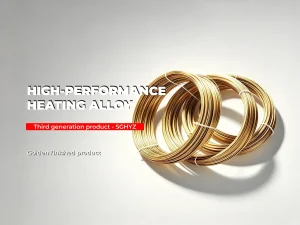
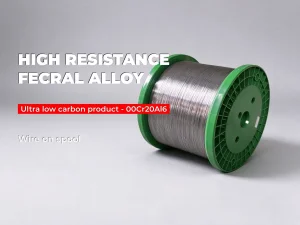
FeCrAl alloys (such as 0Cr25Al5, 0Cr23Al5, 0Cr21Al6Nb, HRE, SGHYZ, and powder metallurgy SGHT) are ferritic alloys characterized by exceptionally high electrical resistivity ($\rho \approx 1.25 - 1.45 \, \mu\Omega\cdot\text{m}$) and lower material density ($\approx 7.10 \, \text{g/cm}^3$). When exposed to elevated temperatures in oxidizing environments, FeCrAl alloys form a continuous, highly adherent, protective surface layer of alpha-alumina ($\alpha-\text{Al}_2\text{O}_3$).
- Alpha-Alumina Oxide Scale ($\alpha-\text{Al}_2\text{O}_3$): Unlike chromium oxide, the $\alpha-\text{Al}_2\text{O}_3$ layer is thermodynamically stable up to 1,425°C, exhibits extremely low ionic permeability, and prevents deeper internal oxidation of the metal matrix.
- Lower Specific Gravity: Due to lower density compared to NiCr, using FeCrAl results in a material weight saving of approximately 15% for equivalent heating capacity, making it exceptionally cost-effective for large industrial kilns in Pakistan.
- High Electrical Resistivity: High resistivity enables larger wire cross-sections, prolonging element operational life and accommodating compact element designs.
2. NiCr Alloys (Nickel-Chromium): Exceptional Hot Strength & Ductility
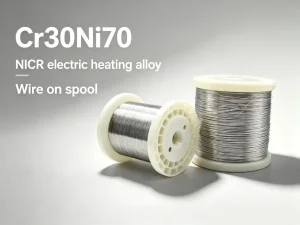
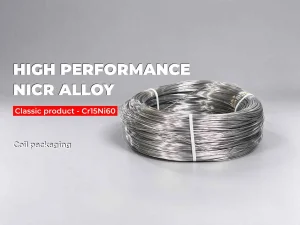
NiCr alloys (such as Cr20Ni80, Cr30Ni70, and Cr15Ni60) are austenitic alloys featuring high mechanical strength at elevated temperatures, superior resistance to thermal fatigue, and excellent cold ductility after long-term thermal service. They form a protective chromium oxide ($\text{Cr}_2\text{O}_3$) scale.
- Mechanical Hot Strength: NiCr alloys resist sagging and mechanical deformation under high temperatures without needing extensive ceramic support structure interlocks.
- Ductility Post-Service: Unlike ferritic FeCrAl alloys which undergo grain coarsening and become embrittled at room temperature after exposure above 1,000°C, NiCr alloys remain ductile, allowing furnace maintenance teams to reshape or repair cold elements easily.
- Atmospheric Versatility: Excellent performance in wet atmospheres, nitrogen-rich carburizing environments, and protective gas heat-treatment furnaces.
| Property / Grade | FeCrAl (e.g., SGHYZ / HRE) | FeCrAl (e.g., 0Cr25Al5) | NiCr (e.g., Cr20Ni80) | NiCr-Fe (e.g., Cr15Ni60) |
|---|---|---|---|---|
| Max Operating Temperature | 1,350°C - 1,400°C | 1,250°C | 1,200°C | 1,150°C |
| Electrical Resistivity at 20°C ($\mu\Omega\cdot\text{m}$) | 1.42 - 1.45 | 1.42 | 1.09 | 1.11 |
| Density ($\text{g/cm}^3$) | 7.10 | 7.10 | 8.40 | 8.20 |
| Melting Point (°C) | 1,500°C | 1,500°C | 1,400°C | 1,390°C |
| Protective Oxide Scale | $\alpha-\text{Al}_2\text{O}_3$ (Alumina) | $\alpha-\text{Al}_2\text{O}_3$ (Alumina) | $\text{Cr}_2\text{O}_3$ (Chromia) | $\text{Cr}_2\text{O}_3$ / Fe Oxide |
| Hot Strength & Sag Resistance | Moderate (Requires support) | Moderate | Very High | High |
| Ductility After Long Heating | Brittle when cold | Brittle when cold | Remains Ductile | Remains Ductile |
Pakistan's Localized Industrial Landscape & Thermal Processing Demands
Pakistan’s industrial growth centers around highly specialized regional manufacturing clusters, each presenting unique engineering demands for functional alloys. Addressing these regional challenges requires direct engineering interaction and alloy customization.
Gujranwala & Sialkot Ceramic & Kiln Sector
Gujranwala is famous as Pakistan's hub for sanitaryware, ceramic tiles, and porcelain manufacture. Kilns operating continuously at 1,250°C to 1,380°C require SPARK SGHYZ and HRE FeCrAl alloys to prevent premature sagging and withstand corrosive glaze vapors.
Sialkot Surgical & Cutlery Heat Treatment
Sialkot exports global-grade stainless steel surgical instruments. Heat-treating martensitic stainless steel requires precise vacuum and protective atmosphere furnaces fitted with high-purity Cr20Ni80 Nichrome or ceramic radiant tubes to prevent surface decarburization.
Karachi & Lahore Metallurgy & Fasteners
Industrial hubs in Karachi (Korangi, Landhi) and Lahore (Kot Lakhpat) rely on continuous mesh-belt heat treatment furnaces for automotive gear hardening and high-tensile fasteners, utilizing SPARK Cr30Ni70 and ceramic bundle rod elements.
Mitigating Pakistan Power Grid Fluctuations & Thermal Cycling Stress
A major technical challenge faced by industrial plant operators across Pakistan is grid voltage instability and intermittent power interruption (load-shedding). When electric heating elements undergo rapid, repeated thermal cycling (cooling down rapidly and reheated to 1,200°C+), standard low-grade heating wires experience severe oxide scale cracking due to differential thermal expansion between the metal substrate and the brittle oxide layer.
SPARK functional alloys overcome thermal fatigue through precision rare-earth micro-alloying. By adding micro-additions of Yttrium (Y), Zirconium (Zr), and Hafnium (Hf) into the alloy melt, SPARK alloys establish strong "atomic pegs" at the scale-metal interface. This anchors the protective $\alpha-\text{Al}_2\text{O}_3$ or $\text{Cr}_2\text{O}_3$ scale, preventing oxide spalling even under severe thermal cycling conditions caused by local power grid fluctuations in Pakistan.
Macro Industry Solutions: Precision Surface Load & Element Design
To maximize element operational lifespan and thermal efficiency, industrial engineers must balance total electrical power input ($P$), supply voltage ($U$), wire diameter ($d$), and allowable element surface load ($w$, measured in $\text{W/cm}^2$). SPARK’s technical support team works directly with furnace manufacturers and maintenance engineers across Pakistan to calculate optimized thermal profiles.
Key Surface Load Guidelines for Functional Heating Alloys:
1. Ceramic & Kiln Applications (1,200°C - 1,350°C): Keep surface load $w \le 1.5 - 2.2 \, \text{W/cm}^2$ using FeCrAl (HRE or SGHYZ) to prevent localized overheating and coil collapse.
2. Industrial Heat Treatment (800°C - 1,100°C): Surface loads of $2.5 - 4.0 \, \text{W/cm}^2$ are permissible with Cr20Ni80 Nichrome ribbon or coiled wire.
3. Air Heating & Appliance Elements: Surface loads up to $5.0 - 7.0 \, \text{W/cm}^2$ can be safely sustained under forced convection conditions.
Custom Delivery Forms Supplied to Pakistan Procurement Teams
Beijing Shougang Gitane offers a complete spectrum of supply options tailored to engineering drawings and kiln retrofitting requirements:
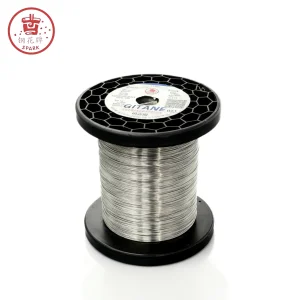
- Round Resistance Wire: Diameters ranging from 0.05 mm ultra-fine wire to 12.0 mm heavy industrial rod wire.
- Flat Wire & Cold-Rolled Strip: Thicknesses from 0.1 mm to 6.0 mm, widths from 1.0 mm to 200 mm for heavy-duty furnace heating bands.
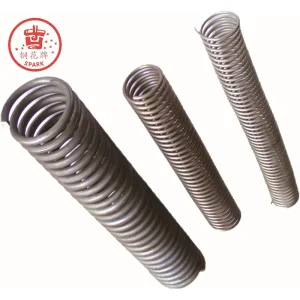
- Pre-Wound Spiral Elements: Custom pitch, outer diameter ($D_o$), and terminal leg configurations ready for ceramic tube mounting.
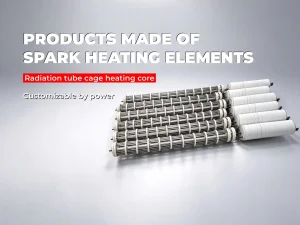
- Assembled Heating Elements: Ceramic bundle rod heating cores, radiant tubes, and embedded furnace panel elements.
Localized Application Scenarios & Proven Industrial Success in Pakistan
Case Study 1: Gujranwala Sanitaryware Kiln Upgrade
Challenge: A major ceramic manufacturing plant in Gujranwala experienced element burnout every 3 months in their 1,320°C tunnel kiln using standard imported wire.
Solution: Retrofitted with SPARK SGHYZ high-purity FeCrAl wire ($d = 7.0 \, \text{mm}$) micro-alloyed with rare earths.
Result: Continuous operation extended beyond 14 months without element replacement, reducing downtime costs by 68%.
Case Study 2: Karachi Fastener Bright Annealing
Challenge: Excessive wire stretch and surface oxidation in a continuous mesh-belt furnace in Landhi Industrial Zone, Karachi.
Solution: Installed SPARK Cr20Ni80 Nichrome flat heating ribbon ($3.0 \times 25 \, \text{mm}$) with ceramic spacer supports.
Result: Achieved steady heat distribution, zero sagging, and improved high-tensile bolt annealing quality.
Case Study 3: Sialkot Vacuum Heat Treatment
Challenge: Stainless surgical instrument manufacturer needed contamination-free heating cores resistant to repeated vacuum cycles.
Solution: Integrated SPARK Ceramic Bundle Rod Radiant Tube Heating Elements.
Result: Eliminated carbon pick-up on surgical tools and cut power draw by 18% due to optimized core thermal radiation.
Localization Support, Quality Standards & CPEC Supply Chain Security
To ensure seamless international trade and full integration into Pakistani manufacturing supply chains, Beijing Shougang Gitane enforces rigorous metallurgical quality control systems and compliant export documentation.
Global Quality Certification & Mill Traceability
Every shipment of SPARK functional alloys delivered to Pakistan is certified in accordance with internationally recognized standards, including ISO 9001:2015, GB/T 1234-2012 (Chinese National Standard for High-Resistance Electric Heating Alloys), ASTM B603, and ASTM B344. Each coil or spool is accompanied by a comprehensive Mill Test Certificate (MTC 3.1) detailing exact chemical composition analysis (ICP-OES), room-temperature electrical resistance, density, tensile strength, elongation, and accelerated life test results.
Efficient CPEC Logistics Corridors to Pakistan
Leveraging China-Pakistan Economic Corridor infrastructure, SPARK provides optimized sea, overland, and air freight options to all Pakistani industrial centers:
- Sea Freight: Direct vessel routes from Tianjin / Shanghai ports to Karachi Port and Port Qasim (typical transit time: 14-18 days).
- Overland Freight via Khunjerab Pass: Expedited truck transit connecting Xinjiang to Islamabad, Lahore, and Punjab industrial hubs via the Karakoram Highway.
- Air Freight: Fast-track express air cargo to Allama Iqbal International Airport (Lahore) and Jinnah International Airport (Karachi) for urgent emergency maintenance spools.
Technical Roadmap & Future Outlook (2025–2030)
As global industries transition toward net-zero carbon emissions, industrial heating processes across Pakistan are shifting rapidly from direct fossil fuel (natural gas and diesel) combustion to clean electric thermal processing. SPARK is leading this revolution through next-generation powder metallurgy alloys and smart heating systems.
Powder Metallurgy SGHT (1,425°C)
Advanced powder metallurgy FeCrAl alloys engineered for extreme temperature ceramic kilns and semiconductor wafer processing, offering superior creep resistance and structural integrity.
Nano-Doped Rare Earth Stabilization
Incorporating sub-micron dispersion oxide particles (ODS technology) to restrict crystal grain growth up to 1,400°C, extending element life by over 100% in harsh atmospheres.
Decarbonized Electric Heating Cores
Custom radiant tube bundle assemblies designed to replace gas burners directly in steel re-rolling and drop-forging reheat furnaces throughout Pakistan.
Frequently Asked Questions (Q&A) for Engineering & Procurement Teams in Pakistan
Comprehensive Electrothermal Alloys & Industrial Tubing
Explore our complete factory catalog of functional heating wires, ultra-high temperature FeCrAl, Nichrome alloys, and heat exchanger tubes ready for direct supply to Pakistan.