
Featured Resistance Wires & Strips for German OEMs
Direct factory supply of high-temperature FeCrAl and NiCr heating alloys engineered to DIN EN ISO specifications for immediate deployment in German industrial heat treatment facilities.


Industrial Heat Processing & Delivery Form Demands in Germany
Navigating the shift toward industrial electrification, decarbonization, and precision thermal engineering in Germany’s manufacturing heartlands.
Germany stands as the industrial backbone of the European Union, driven by automotive manufacturing in Baden-Württemberg and Bavaria, heavy metallurgy in North Rhine-Westphalia, and specialized ceramic and semiconductor production across Saxony and Thuringia. As the German government accelerates its Energiewende (energy transition) and enforces strict ESG (Environmental, Social, and Governance) guidelines, thermal processing industries are rapidly shifting away from fossil-fuel-fired burners toward high-efficiency electric heating systems.
This macro-industrial transition has drastically altered procurement requirements for electric resistance materials. German OEMs (Original Equipment Manufacturers) and industrial furnace engineering companies no longer seek raw metal alloy components in isolation. Instead, the market demands optimized DELIVERY FORMS—ranging from precision-spooled micro-wires (DIN 160 to DIN 355 spools) and tension-controlled strip coils to custom pre-formed wave elements, rod heating modules, and high-stability spiral coils.
Information Gain: Why Delivery Form Precision Dictates Furnace Efficiency
In high-speed automated element winding machines used by German furnace builders (e.g., in Solingen or Nuremberg), slight inconsistencies in wire cast, helix pitch, surface oxide roughness, or spool tension cause immediate line stoppage and localized hot spots during thermal cycling. Shougang Gitane’s SPARK resistance alloy delivery forms are manufactured with computer-controlled tension winding and optical dimensional verification, guaranteeing zero-defect integration for European automated manufacturing lines.
Comprehensive Engineering Guide to Alloy Delivery Forms
Selecting the optimal geometric configuration, alloy grade, and delivery package for specialized thermal processing applications.
Round Resistance Wire (0.05mm - 12.0mm)
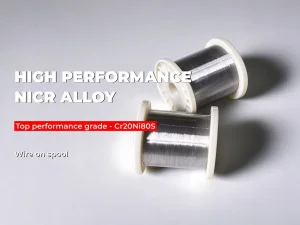
Precision-drawn FeCrAl (0Cr25Al5, HRE, SGHYZ) and NiCr (Cr20Ni80, Cr30Ni70) round wires. Delivered on DIN spools, plastic bobbins, or continuous pay-off carriers with uniform grain structure and tight electrical resistance tolerances (±3%).
Cold-Rolled Strip & Ribbon (0.1mm - 4.0mm)
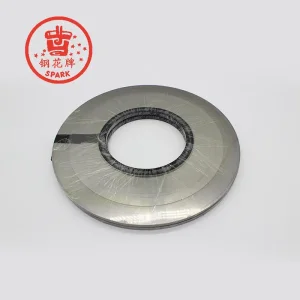
High-density flat strip and ribbon optimized for industrial furnace heating elements, automotive braking resistors, and heavy-duty load banks. Features smooth deburred edges, bright annealed surface finishes, and controlled spring-back behavior.
Pre-Formed Spirals & Wave Elements
Factory-wound spiral coils and CNC-bent wave/meander heating elements custom-tailored to engineering drawings. Eliminates on-site handling damage and ensures instant installation into ceramic fiber modules or refractory bricks.
| Alloy Grade & Delivery Form | Composition Family | Max Temp (°C) | Resistivity at 20°C (μΩ·m) | Primary Industrial Use Case in Germany |
|---|---|---|---|---|
| SGHT (Powder Metallurgy) Wire / Strip | FeCrAl + Rare Earth (PM) | 1425°C | 1.45 | Semiconductor crystal growth, dental ceramics, high-vacuum kilns |
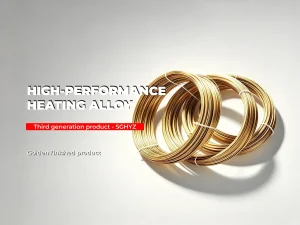
| SGHYZ Golden Alloy Wire / Coil | Advanced FeCrAl | 1400°C | 1.42 | Continuous steel annealing, powder metallurgy sintering |
| HRE 1350 Woven / Wave Form | FeCrAl + Nb Microalloyed | 1350°C | 1.39 | Automotive ceramic catalyst roasting, tunnel furnaces |
| 0Cr25Al5 / 0Cr23Al5 Spool / Strip | Standard FeCrAl | 1250°C | 1.42 / 1.35 | Industrial heat-treatment furnaces, radiant heater tubes |
| Cr20Ni80 / Cr20Ni80S Wire / Ribbon | 80/20 Nickel-Chromium | 1200°C | 1.09 | Precision lab heaters, medical sterilization, plastic welding |
| Cr30Ni70 Strip / Flat Wire | 70/30 Nickel-Chromium | 1250°C | 1.18 | Corrosive chemical heat exchangers, high-cycle appliances |
FeCrAl vs. NiCr: Microstructural Behavior under Thermal Stress
Understanding oxidation dynamics, creep deformation, and life-cycle economics for high-temperature applications.
Selecting between Iron-Chromium-Aluminum (FeCrAl) and Nickel-Chromium (NiCr) delivery forms requires a comprehensive analysis of the thermal environment, gas atmosphere, operating cycle, and mechanical strain:
1. Protective Oxide Scale Dynamics: $\alpha-Al_2O_3$ vs. $Cr_2O_3$
When FeCrAl alloys (such as 0Cr21Al6Nb, HRE, or SGHYZ) are exposed to temperatures exceeding 1000°C, aluminum selectively migrates to the alloy surface to form a continuous, dense, and thermodynamically stable layer of alpha-alumina ($\alpha-Al_2O_3$). This ceramic oxide layer acts as an electrical insulator and an extraordinary barrier against oxygen diffusion. Conversely, NiCr alloys form a protective chromia ($Cr_2O_3$) scale. While chromia offers superior ductility and hot strength, it begins to volatilize into $CrO_3$ vapor at temperatures above 1200°C, limiting its continuous operation peak compared to top-tier FeCrAl grades.
2. Creep Strength, Sagging, and Grain Boundary Stabilization
Historically, legacy FeCrAl wire forms suffered from thermal sag and embrittlement after prolonged exposure to high temperatures due to grain growth. Shougang Gitane’s proprietary SGHT (Powder Metallurgy) and SGHYZ process solves this issue through Reactive Element Addition (Yttrium, Zirconium, Rare Earths). This grain-boundary pinning technology inhibits grain growth, increases hot-yield strength, and eliminates sagging in vertically or horizontally suspended heating spirals in large German industrial kilns.
Localization, Regulatory Compliance & Quality Assurance for Germany
Full alignment with DIN standards, EU REACH/RoHS directives, and seamless logistics integration for German importers.
DIN EN 10204 3.1 Traceability
Every shipment of SPARK delivery forms is accompanied by an official Inspection Certificate 3.1 detailing chemical melt analysis, room-temperature resistivity, tensile strength, and elongation test records.
REACH & RoHS 3 Compliance
Strict control over raw material purity ensures complete compliance with EU Directive 2011/65/EU (RoHS) and Regulation (EC) No 1907/2006 (REACH), prohibiting hazardous heavy metal contaminations.
VCI Anti-Corrosion Packaging
Export-grade delivery forms undergo vacuum sealing with VCI (Vapor Corrosion Inhibitor) desiccants inside heat-treated ISPM-15 compliant wooden cases, safeguarding spools against sea transport humidity.
Technological Roadmap & Decarbonization Horizons
Pioneering ultra-clean alloy melting, micro-dispersion oxide technology, and green hydrogen atmosphere heating solutions.
As German heavy industries transition to Hydrogen-based direct reduction steelmaking (H2-DRI) and carbon-neutral thermal processing, high-temperature heating alloys must perform under un-purified hydrogen ($H_2$) and moist water vapor atmospheres. Shougang Gitane is investing heavily in the next generation of resistance alloy delivery forms designed specifically for green energy applications:
- Micro-Dispersion Oxide (ODS) Alloys: Utilizing high-energy mechanical alloying to disperse nano-yttria ($Y_2O_3$) particles uniformly throughout the metal matrix, elevating maximum service temperature limits beyond 1450°C.
- Zero-Carbon Smelting Traceability: Partnering with Shougang Group’s green steel manufacturing network to produce electric resistance wires utilizing 100% renewable electricity during induction melting and refining.
- Hydrogen-Compatible FeCrAl Delivery Forms: Optimized chemical formulas resistant to hydrogen embrittlement and steam-induced scale spallation in hydrogen-fired industrial furnaces.
Complete Delivery Form Product Matrix for German Industrial Applications
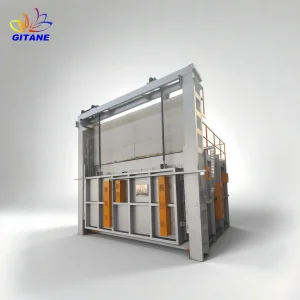
Explore our full line of specialized heating elements, customized industrial furnace coils, and precision resistance alloy products available for direct procurement in Germany.


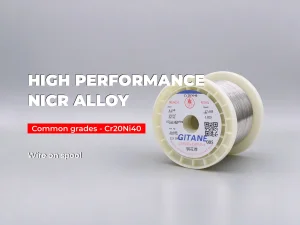
Commercial Quotes, Price Drivers & Total Cost of Ownership (TCO)
A transparent breakdown of procurement pricing dynamics, LME index correlations, and landed cost efficiency for European buyers.
When evaluating quotes from Chinese delivery form suppliers versus legacy European suppliers (such as Kanthal, Sandvik, or Isabellenhütte), procurement managers in Germany must analyze Total Cost of Ownership (TCO) beyond initial per-kilogram material costs:
1. Raw Material & LME Index Transparency
NiCr delivery form prices are directly tied to London Metal Exchange (LME) Nickel prices. Shougang Gitane offers transparent pricing formulas with clear alloy surcharges based on official LME and Ferro-Chromium market indexes.
2. Lower Density Savings with FeCrAl
FeCrAl alloys have a lower density (~7.10 g/cm³) compared to NiCr alloys (~8.40 g/cm³). This yields up to 15-18% more wire length per kilogram, allowing German element makers to reduce total raw material weight while maintaining identical heating output.
3. Direct Factory-to-Plant Freight Options
We provide full CIF Hamburg, CIF Rotterdam, or DDP (Delivered Duty Paid) door-to-door logistics terms including customs clearance and EU tariff handling, ensuring zero administrative friction for German accounting teams.
Frequently Asked Questions (FAQ) for German Procurement Managers
Detailed engineering and commercial answers to clear your technical evaluation process.
Request Fast Quotation & Technical Samples for Germany
Partner with Beijing Shougang Gitane New Materials Co., Ltd. for direct factory prices, ISO 9001 quality assurance, and engineering support for your furnace projects.
Send Inquiry Now