High-Temperature Electrothermal Products for London Applications
Precision-drawn wire, cold-rolled strip, and specialty coils dispatched directly from our Beijing manufacturing complex to UK industrial hubs.
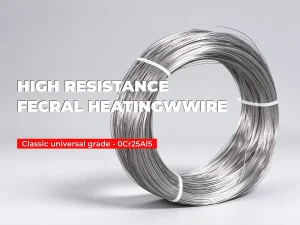

Macro-Industrial Context: Electrification of Industrial Heat in London & Greater UK
The United Kingdom's legal commitment to achieving Net-Zero carbon emissions by 2050 has catalyzed a profound paradigm shift across Greater London’s advanced manufacturing, thermal processing, and high-tech R&D corridors. Key industrial zones stretching from the Thames Estuary manufacturing clusters to the technology parks in Cambridgeshire and Oxfordshire are systematically replacing legacy fossil gas combustion kilns with high-efficiency electric resistance heating systems.
In this evolving landscape, the choice of electrothermal alloy and its physical DELIVERY FORM (such as spooled round wire, cold-rolled strip, continuous ribbon, pre-wound spirals, and radiant ceramic bundle cores) serves as a critical engineering determinant. The geometry and metallurgical integrity of the alloy delivery form dictate total watt-density, surface thermal dissipation, mechanical oxidation fatigue, and overall system longevity under intense cycling conditions.
Optimizing Alloy Delivery Forms for Specific Thermal Architectures
Selecting the ideal electrothermal alloy composition—whether Iron-Chromium-Aluminium (FeCrAl) or Nickel-Chromium (NiCr)—is only half the design equation. UK OEMs, thermal system integrators, and plant engineers must meticulously select the appropriate physical delivery form to match furnace geometry and heat transfer dynamics:
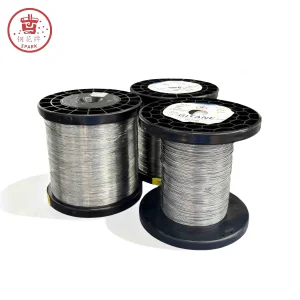
Spooled Fine & Heavy Wire
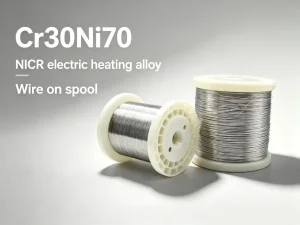
Ranging from 0.05mm ultra-fine wire for precision sensor heaters to 12.0mm heavy rod for high-power ceramic kilns. Supplying uniform tensile strength and zero-tangle spooling for automatic coil winding machines in UK production lines.
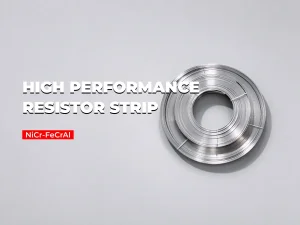
Cold-Rolled Strip & Ribbon
Thicknesses from 0.1mm to 4.0mm and widths up to 200mm. Offers a significantly higher surface area-to-cross-section ratio compared to round wire, enabling higher watt densities while maintaining lower internal alloy operating temperatures.
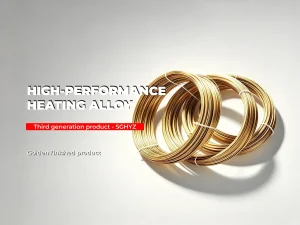
Pre-Formed Coils & Radiant Bundles
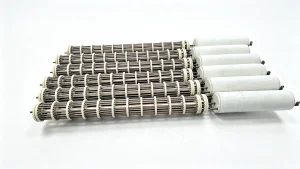
Ready-to-install wave-shaped elements, rod-frame structures, and ceramic bundle core heating elements designed specifically for rapid retrofitting into existing London heat treatment furnaces without field bending stress.
Global Commercial Landscape & Technology Roadmap (2025–2035)
The global demand for high-performance electrothermal materials is projected to grow at a CAGR of 6.8% through 2032, driven primarily by semiconductor wafer fabrication, advanced technical ceramic sintering, and green steel pilot facilities. As raw material costs fluctuate on the London Metal Exchange (LME), China's advanced metallurgical manufacturing hubs—led by Shougang Gitane—have established automated, high-precision manufacturing lines capable of guaranteeing absolute chemical homogeneity and strict dimensional tolerances.
Technology Roadmap Milestones:
- Near-Term (2025–2027): Expansion of Powder Metallurgy (PM) SGHT grade alloys operating continuously up to 1425°C with superior resistance to sagging and high-temperature creep.
- Mid-Term (2028–2030): Implementation of AI-monitored continuous bright annealing lines, reducing surface oxide defect density to near-zero levels on all exported strip delivery forms.
- Long-Term (2031–2035): Development of nano-structured oxide dispersion strengthened (ODS) FeCrAl alloys designed for 1500°C atmosphere-controlled hydrogen sintering applications in zero-carbon industrial parks.
FeCrAl vs NiCr Electrothermal Alloy Delivery Form Properties
Comparative engineering metrics compiled under GB/T 1234-2012 and international ISO standards for London thermal system designers.
| Alloy Grade | Alloy Family | Max Service Temp | Resistivity @ 20°C (μΩ·m) | Density (g/cm³) | Primary Delivery Forms | Recommended London Applications |
|---|---|---|---|---|---|---|
| SPARK SGHT | FeCrAl (Powder Met) | 1425°C | 1.45 | 7.10 | Heavy Wire, Rod, Ribbon | Semiconductor, High-purity Ceramics, Lab Furnaces |
| SPARK SGHYZ | FeCrAl + Rare Earth | 1400°C | 1.42 | 7.10 | Spooled Wire, Coils, Strip | Industrial Heat Treatment, Rapid Thermal Processing |
| 0Cr25Al5 | Standard FeCrAl | 1250°C | 1.42 | 7.10 | Fine/Heavy Wire, Wide Strip | Industrial Kilns, Radiant Tubes, Ceramic Heaters |
| 0Cr23Al5 | Standard FeCrAl | 1250°C | 1.35 | 7.25 | Spools, Ribbons, Coils | Commercial Appliances, Air Heaters, Brakes |
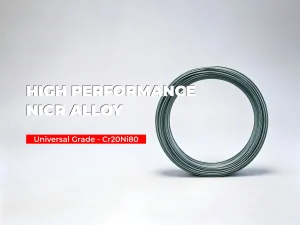
| Cr20Ni80 | 80/20 Nichrome | 1200°C | 1.09 | 8.40 | Wire, Precision Strip, Ribbon | Medical Devices, Plastic Welding, Cleanroom Ovens |
| Cr30Ni70 | 70/30 Nichrome | 1250°C | 1.18 | 8.10 | Wire, Strip, Formed Elements | Carburizing Atmospheres, Heavy Duty Industrial Heating |
London Pricelist Benchmarks & Procurement Factors
Procuring electrothermal alloy delivery forms directly from a Chinese state-owned metallurgical leader like Beijing Shougang Gitane offers substantial cost advantages—typically 25% to 40% below European distributors—without sacrificing quality. Pricing for London buyers is calculated transparently based on raw metal index costs, alloy chemistry, delivery form cold-working complexity, and shipping logistics:
- Raw Material Metal Indexing: Prices for NiCr alloys correlate directly with London Metal Exchange (LME) Nickel spot prices. FeCrAl alloys provide a significantly more stable cost structure due to their iron-aluminium matrix.
- Delivery Form Processing Factor: Ultra-fine wires (e.g., <0.10mm) and thin cold-rolled foils require multiple annealing passes and diamond die drawing, incurring higher per-kilogram processing fees than heavy hot-rolled rods.
- Custom Packaging & Spooling: Options include DIN standard plastic spools (DIN125, DIN160, DIN200, DIN250), cardboard drums for continuous ribbon, and moisture-sealed vacuum foil wrapping for long maritime or air freight shipment to London Heathrow (LHR) or Port of London docks.
Request Custom Quotation & Technical Pricelist for London
Contact our senior engineering sales managers for precise, factory-direct quotes scaled to your project dimensions, delivery form specifications, and volume requirements.
Send Inquiry NowFrequently Asked Questions for UK Thermal Engineers & Procurement Teams
Clear, authoritative answers regarding delivery form compliance, shipping, oxidation lifetimes, and engineering support.
What is the typical shipping lead time for electrothermal alloy delivery forms to London?
For standard wire spools, cold-rolled strip, and continuous ribbon stocked in our Beijing warehouse, air freight to London Heathrow (LHR) takes 5 to 7 business days. Custom pre-wound coils or large-volume sea freight shipments via London Gateway or Felixstowe typically require 25 to 35 days, inclusive of export clearance documentation.
How do I determine whether to specify FeCrAl or NiCr wire delivery forms for my furnace?
FeCrAl alloys (such as SGHYZ, 0Cr25Al5) are recommended for higher operating temperatures (up to 1400°C+), higher electrical resistivity, and lower material weight/cost. NiCr alloys (such as Cr20Ni80) are preferred for applications requiring post-use ductility, resistance to frequent thermal cycling, and performance in reducing or carburizing furnace atmospheres.
What Quality Inspection Certificates are provided with each shipment?
Every shipment from Shougang Gitane includes full Mill Test Certificates according to EN 10204 3.1. This documentation covers exact ladle chemical composition analysis, room-temperature electrical resistance testing, dimensional tolerance verification, and high-temperature oxidation life testing results.
Can you manufacture custom pre-wound wave or spiral delivery forms to our CAD drawings?
Yes. Our state-of-the-art element processing division is equipped with CNC automatic winding and bending machines. We fabricate wave-shaped ribbons, spiral coils on ceramic tubes, and complete radiant tube cores manufactured strictly according to your engineering schematics.
What spool sizes and packaging options are available to prevent wire damage during transit?
We supply fine wire on plastic DIN spools (DIN125 to DIN250), heavy wire in self-supporting coils, and strip in custom plastic-wrapped coils. All goods are packed in heavy-duty export plywood crates reinforced with steel banding and desiccant packs to prevent surface oxidation during ocean transit.
How does the surface watt-density (W/cm²) affect delivery form selection?
Operating at excessive watt densities accelerates alloy degradation and surface scale spallation. Strip and ribbon delivery forms offer a larger radiating surface area, allowing higher total power output while keeping the alloy surface load within safe thermal limits compared to round wire in tight spaces.
Explore Our Complete Range of Resistance Heating Alloys & Systems
Comprehensive selection of industrial heating wire, custom furnace elements, high-purity raw materials, and specialized ribbons available for immediate order to London.