
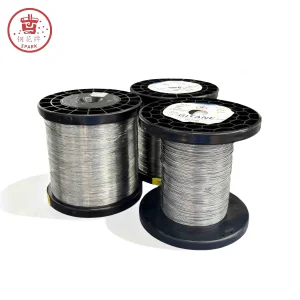
⚙ Premium Industrial Heating Wires & Resistance Alloys
Direct factory wholesale options for woven mesh manufacturing, precision stamping, and high-temperature electrical heating elements.




Eliminating Post-Service High-Temperature Embrittlement in Woven Meshes & Stamped Heating Elements
An authoritative metallurgical analysis of grain boundary engineering, micro-alloying mechanisms, and mechanical stability in severe thermal cycling environments.
The Physics of Embrittlement
Traditional FeCrAl (Iron-Chromium-Aluminum) alloys are globally renowned for their exceptional oxidation resistance up to 1400°C due to the formation of a protective alpha-alumina (α-Al₂O₃) surface scale. However, standard commercial grades suffer from severe room-temperature embrittlement following elevated temperature thermal service.
This loss of ductility stems from massive ferrite grain growth (governed by Hall-Petch relationships) combined with 475°C embrittlement (α-α' phase separation) and intermetallic phase precipitation (σ-phase) along grain boundaries. When woven meshes or stamped shapes cool during maintenance shutdown, micro-stress concentration triggers catastrophic brittle fracture.
Micro-Alloying Breakthrough
To preserve mechanical ductility after thousands of hours of continuous thermal exposure, advanced metallurgical processing relies on precise micro-alloying additions of Reactive Elements (RE) such as Yttrium (Y), Zirconium (Zr), Hafnium (Hf), and Rare Earth Elements (REE).
These elements segregate directly to grain boundaries, effectively "pinning" grain growth through Zener pinning mechanics. Furthermore, controlled Powder Metallurgy (PM) routes—such as Dispersion Strengthened (ODS) FeCrAl alloys—introduce nanoscale oxide dispersions that prevent dislocations from coalescing into brittle cleavage cracks during thermal cycling.
Post-Service Ductility Advantage
Retaining ductility post-service radically alters furnace maintenance economics. Standard heating elements shatter when handled, reshaped, or subjected to mechanical impact during routine cleaning.
Alloys engineered with controlled grain structure retain an elongation at break exceeding 15–20% even after prolonged high-temperature exposure. This allows woven mesh heating grids and complex 3D stamped shape elements to be flexed, repaired, or adjusted without snapping, drastically lowering total cost of ownership (TCO).
📊 Standard Alloys vs. Advanced Ductile Elements
Quantitative comparison of mechanical and thermal properties before and after prolonged thermal exposure (>1000 Hours at 1150°C).
| Performance Parameter | Standard Melt FeCrAl (0Cr25Al5) | High-Ni Nichrome (Cr20Ni80) | SPARK Ductile FeCrAl (SGHT / HRE) | Advanced PM ODS FeCrAl Mesh |
|---|---|---|---|---|
| Max Operating Temp (°C) | 1250°C | 1200°C | 1350°C - 1400°C | 1425°C |
| As-Received Elongation (%) | > 20% | > 30% | > 22% | > 25% |
| Post-Service Room Temp Elongation | < 1% (Highly Brittle) | 10% - 15% (Ductile) | 8% - 12% (Retained) | > 18% (Highly Ductile) |
| Grain Growth Resistance | Poor (Rapid Coarsening) | Moderate | High (RE Pinning) | Extreme (Nanoscale Pinning) |
| Hot Strength & Sag Resistance | Low | Moderate to High | High | Exceptional |
| Resistance to Thermal Fatigue | Moderate | High | Very High | Maximum Class |
Where Ductile Woven Meshes & Stamped Shapes excel
Real-world operational environments demanding severe thermal cycling resistance, zero-particle shedding, and non-brittle structural integrity.
⚡ Semiconductor Wafer Processing & Photovoltaics
In high-purity LPCVD, diffusion, and solar cell sintering furnaces, heating elements operate under rapid thermal ramps. Traditional coiled elements sag, leading to temperature non-uniformity across 300mm silicon wafers.
Woven wire meshes woven from non-brittle FeCrAl wire form planar radiant panels. Because these woven elements retain their post-service ductility, they withstand thermal shocks during rapid cooling cycles without micro-cracking or particulate generation that could contaminate semiconductor wafers.
🔥 Petrochemical Reforming & Catalytic Screens
Hydrogen reformers, ammonia plants, and ethylene cracking units utilize catalyst support meshes subjected to aggressive high-pressure hydrocarbon gas streams at 900°C–1150°C.
FeCrAl alloys enriched with Yttrium resist carburization and sulfur attack better than Ni-Cr alloys. When stamped shapes or woven screen discs preserve their ductility, maintenance technicians can safely remove, back-flush, and re-install catalytic support structures during turnarounds without tearing or brittle snapping.
🚗 Automotive E-Catalyst & Exhaust Thermal Systems
Electrically Heated Catalytic Converters (EHC) for modern hybrid and ultra-low emission vehicles require corrugated stamped metal foils and woven heating grids. These components undergo tens of thousands of cold-start electrical surge heat cycles.
Zero brittle fracture is mandatory to prevent broken metal foil fragments from entering exhaust gas turbines or damaging downstream catalysts. Stamped shapes retain their geometric elasticity and bend radius across the vehicle's entire multi-year lifecycle.
✈ Aerospace Sintering & Vacuum Heat Treatment
High-vacuum muffles, aerospace ceramic matrix composite (CMC) sintering furnaces, and hot-isostatic pressing (HIP) units rely on customized suspended 3D stamped element grids.
By retaining post-service ductility, element terminals can be bolted, clamped, or welded without pre-heating or special embrittlement precautions, simplifying furnace overhaul and reducing downtime from days to hours.
🚀 Technology Roadmap & Future Outlook (2025–2035)
How next-generation metallurgical engineering and AI-guided alloy design are reshaping industrial electrothermal systems.
Phase 1: 2025 – 2027
Nanoscale RE Dispersion Commercialization
Widespread industrial scaling of powder metallurgy FeCrAl alloys featuring ultra-fine oxide dispersion (<10nm Y₂O₃ particles). Objective: Achieve 1400°C continuous service while maintaining 20% room-temperature post-service bend ductility.
Phase 2: 2028 – 2031
AI-Guided Stamping & Weaving Optimization
Integration of finite element mechanical-thermal simulation algorithms into high-speed stamping presses. Real-time stress relief during stamping eliminates micro-void nucleation, raising thermal cycle life by 250%.
Phase 3: 2032 – 2035
Self-Healing Alumina Scale Networks
Smart alloy compositions capable of localized rapid self-healing upon scale spallation in hydrogen or moisture-rich atmospheres, eliminating creep failure in complex woven mesh geometries.
China Supply Chain Resilience & Manufacturing Efficiency
How Shougang Gitane leverages vertically integrated metallurgical production to deliver unmatched quality, scale, and cost efficiency to global markets.
🏭 Vertical Integration (Melt-to-Mesh)
Unlike secondary fabricators who source wire from third-party mills, Beijing Shougang Gitane controls the entire metallurgical chain: Vacuum Induction Melting (VIM), Electroslag Remelting (ESR), precision hot rolling, fine wire drawing down to 0.02mm, bright annealing, and direct weaving/stamping.
This end-to-end oversight ensures complete traceability from raw ingot chemistry to finished ductile mesh coils.
📦 Rapid Prototyping & Scaling
With 39,268 m² of modernized production workshops and dedicated custom tooling centers, custom stamped element shapes and specialized mesh weave patterns transition from CAD drawing to physical prototype in under 7 business days.
High-volume automated wire weaving looms guarantee seamless fulfillment of large-scale OEM orders without quality drift.
🛡 Raw Material Security & Cost Efficiency
Backed by the industrial foundation of the Shougang Group, raw material inputs (high-purity Iron, Chromium, Nickel, Aluminum, and Rare Earth metals) are secured via direct long-term supply agreements. This buffers global buyers from volatile metal market fluctuations while maintaining competitive wholesale pricing.
🌎 Global Commercial & Industrial Trends
Driven by global decarbonization mandates and strict Scope 1 emission reduction targets, industrial heating systems worldwide are rapidly shifting from natural gas combustion to high-efficiency electric thermal conversion.
In North America, Europe, and Asia-Pacific, industrial heat-treatment operators are upgrading to high-density woven mesh elements and stamped radiant shapes. By specifying ductile FeCrAl elements, plant operators reduce emergency maintenance shutdowns by up to 70%, achieving paybacks on material upgrades in less than six months of operation.
📜 Localization Support & Compliance
Every shipment of wholesale woven meshes, stamped elements, and resistance heating wires leaves our facility fully certified to international quality frameworks:
- ✔ ISO 9001:2015 Quality Management Systems Certified
- ✔ Compliance with GB/T 1234-2012 High Resistance Alloys Standard
- ✔ EN 10204 3.1 Mill Test Certificates providing exact heat chemical analysis
- ✔ Customized packaging (vacuum sealed / inert gas flushed) for long-distance sea and air freight
Frequently Asked Questions (FAQ)
In-depth answers to common engineering, procurement, and metallurgical questions regarding ductile resistance elements.
⚙ Additional High-Temperature Products & Wire Elements
Explore our comprehensive range of NiCr, FeCrAl, and high-temp alloy tube solutions.


Engineer Your High-Ductility Heating Solution Today
Consult with Beijing Shougang Gitane's technical team to specify custom mesh weaves, stamped elements, and FeCrAl/NiCr alloys tailored to your exact thermal process conditions.