
Precision Resistance Wire & Element Catalog





Comprehensive Verification & Procurement Compliance in Electrical Resistance Metallurgy
In modern global procurement, cross-border sourcing of high-temperature resistance alloys demands absolute technical verification, complete material traceability, and third-party laboratory authentication to guarantee industrial process reliability.
"Global thermal engineering standards require absolute consistency. Material Test Reports (MTRs) and third-party metallurgical validation are not merely documentation; they form the foundation of thermal efficiency, operational safety, and system longevity."
Full Chemical Traceability
Every batch of FeCrAl (0Cr25Al5, 0Cr21Al6Nb) and NiCr (Cr20Ni80, Cr30Ni70) undergoes Optical Emission Spectrometry (OES) and X-ray Fluorescence (XRF) to guarantee chemical limits per GB/T 1234-2012, ASTM B344, and DIN 17470 standards.
Independent Lab Reports
We supply third-party test verification from ISO/IEC 17025 accredited laboratories covering tensile strength, hot yield resistance, 50-hour accelerated life tests, electrical resistivity tolerances, and surface oxide stability.
Environmental Compliance
Our complete material series strictly adheres to global environmental frameworks, fully compliant with EU RoHS 3 (Directive 2015/863) and REACH SVHC standard guidelines, ensuring seamless global market integration.
China Manufacturing Advantages in High-Temperature Resistance Alloys
Evaluating the strategic, technical, and logistical benefits of sourcing precision electric heating wires and finished elements directly from China's premier metallurgical enterprise cluster.
Vertical Integration & Melt Control
China's top-tier resistance alloy manufacturers control the entire production chain: vacuum induction melting (VIM), electroslag remelting (ESR), hot rolling, micro-wire drawing, and annealing. Under the SPARK (Shougang Gitane) framework, this vertical alignment guarantees zero cross-contamination, precise rare-earth element additions (Yttrium, Zirconium), and exact grain boundary control.
Powder Metallurgy & Advanced Alloy Engineering
China leads the industrial transition toward high-end Powder Metallurgy (PM) FeCrAl alloys, such as SGHT (rated to 1425°C) and SGHYZ (rated to 1400°C). By applying rapid solidification and hot isostatic pressing, these alloys overcome traditional high-temperature sag and thermal creep, outperforming standard melting methods at lower production costs.
Unrivaled Scale & Cost Efficiency
Operating from modern industrial parks covering over 88,000 m², Chinese manufacturing infrastructure enables massive volume production while maintaining tight dimensional tolerances (down to ±0.01 mm for fine wire). Scale efficiencies allow global OEMs to lower procurement costs by 20–35% while upgrading alloy grade specs.
Customized Delivery Formats
Flexibility is central to Chinese industrial leadership. Whether procurement teams require continuous spooled bare wire, precision flat ribbon, cold-rolled strip, or fully fabricated spiral-wound heating elements with specialized terminal leads, Chinese facilities provide end-to-end custom production tailored to OEM technical drawings.
Industry Trends Driving Next-Generation Resistance Alloys
Global decarbonization, industrial furnace electrification, and high-tech manufacturing are placing unprecedented thermal and chemical demands on electric heating materials.
Electrification of Heavy Metallurgy
Steel, glass, and ceramic manufacturing are aggressively replacing fossil-fuel combustion with zero-emission electric heating. This shift requires industrial heating wires capable of handling high surface loads ($W/cm^2$) and operating continuously at temperatures above 1300°C without premature oxidation or mechanical failure.
Advanced Oxides ($Al_2O_3$ Scale Control)
Modern FeCrAl research focuses on controlling the kinetics of protective alpha-alumina ($ \alpha-Al_2O_3 $) scale formation. By introducing micro-dopes of reactive elements (RE = Y, Zr, Hf), new alloy variants prevent oxide spallation, drastically extending life in cyclic thermal applications.
Semiconductor Sintering & Clean Thermal Processes
As semiconductor wafer fabrication and lithium battery cathode sintering expand globally, high-purity alloy elements with minimal iron contamination or particulate flaking are required to maintain strict cleanroom conditions during thermal processing.
Comprehensive Resistance Alloy Specification Benchmark
Compare physical, electrical, and thermal properties across key FeCrAl and NiCr alloy grades to determine the optimal solution for your thermal environment.
| Alloy Grade | Alloy Family | Max Temp (°C) | Resistivity at 20°C ($\mu\Omega\cdot m$) | Density ($g/cm^3$) | Primary Industrial Applications |
|---|---|---|---|---|---|
| SGHT | FeCrAl (PM) | 1425°C | 1.45 | 7.10 | Advanced ceramic sintering, semiconductor furnaces, ultra-temp kilns |
| SGHYZ | FeCrAl | 1400°C | 1.45 | 7.10 | High-temperature industrial heat treatment, heavy ceramic firing |
| HRE | FeCrAl | 1350°C | 1.42 | 7.15 | Powder metallurgy furnaces, diffusion heaters, radiant tube elements |
| 0Cr25Al5 | FeCrAl | 1250°C | 1.42 | 7.10 | Industrial furnaces, electric heat exchangers, commercial elements |
| 0Cr21Al6Nb | FeCrAl | 1300°C | 1.45 | 7.10 | Kiln heating elements, high-resistance wire grids, domestic heaters |
| Cr20Ni80 | NiCr | 1200°C | 1.09 | 8.40 | Precision electronic resistors, medical devices, cycling-heavy appliances |
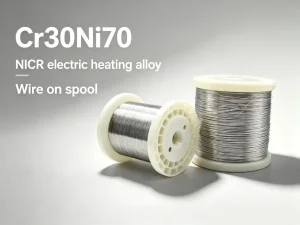
| Cr30Ni70 | NiCr | 1250°C | 1.18 | 8.10 | Corrosive chemical atmosphere furnaces, carburizing equipment |
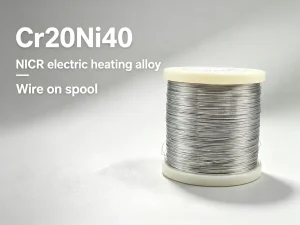
| Cr20Ni40 | NiCr | 1100°C | 1.04 | 8.60 | Night storage heaters, low-temp industrial drying equipment |
Macro Solutions & Localized Application Scenarios
Engines of industrial thermal processing: See how custom high-temperature alloys are integrated into critical global production sectors.
Photovoltaics & Solar Wafer Manufacturing
Challenge: Diffusion and oxidation furnaces in solar cell fabrication require absolute thermal uniformity and zero alloy outgassing at continuous temperatures exceeding 1150°C.
Solution: High-purity HRE and SGHYZ heavy-gauge wire formed into pre-baked ceramic cylinder elements. The dense alumina scale isolates the metal core, preventing chemical contamination of quartz process tubes and silicon wafers.
Automotive Component Carburizing & Heat Treat
Challenge: Gear and bearing carburizing furnaces use carbon-rich atmospheres, which cause rapid green-rot corrosion and embrittlement in standard heating alloys.
Solution: High-nickel Cr30Ni70 or 0Cr21Al6Nb strip elements. High chromium concentrations create a barrier layer that resists carbon ingress, significantly extending element life in harsh heat-treating lines.
Continuous Ceramic Roller Kilns
Challenge: Industrial ceramic kilns demand continuous operation at 1250°C to 1350°C for months without element sag, hot spots, or sudden resistance shifts.
Solution: Custom-wound 0Cr25Al5 and SGHYZ spiral elements mounted on high-alumina support tubes, delivering verified watt-density profiles and minimal resistance drift over thousands of operational hours.
High-Performance Domestic & Commercial Heating
Challenge: Home appliances, instant water heaters, and air-heating modules require rapid cycle response, high cold ductility, and compact footprints.
Solution: Micro-calibrated Cr20Ni80 Nichrome fine wire and ribbon. Exceptional cold workability allows tight coiling without cracking, providing stable performance across thousands of rapid power cycles.
Engineering Governance for Corporate Sourcing Teams
How we eliminate cross-border sourcing risks through standardized quality controls, complete material verification, and mill test reporting.
1. Raw Material Melts & Heat Traceability
Every shipment is linked to a unique Heat Code. Sourcing teams receive verified documentation tracking the chemical melt, ingot refining steps, electroslag processing, and final dimensional inspection metrics.
2. 50-Hour Accelerated Life Test Validation
Per GB/T 1234-2012 standards, sample wires undergo an accelerated cyclic life test under high surface load at maximum rated temperature to guarantee durability before full batch dispatch.
3. Electrical Resistance & Uniformity Audit
Electrical resistance ($\Omega/m$) is measured continuously using automatic digital bridges during final spooling. Tolerances are held strictly within ±3% of nominal design values to prevent hot-spotting.
Frequently Asked Technical & Sourcing Questions
Direct answers to crucial technical, procurement, and compliance questions faced by furnace designers and global procurement managers.
High-Temperature Resistance Wire & Special Alloy Series



Accelerate Your High-Temperature Alloy Sourcing
Connect directly with our engineering team to review technical drawings, request complete Material Test Reports (MTRs), and secure wholesale pricing for certified FeCrAl and NiCr alloy wires.
Request Technical Quote & Certificates