
High-Precision Heating Wire & Element Solutions
Direct factory wholesale supply for heat treating, ceramic sintering, and heavy industrial thermal equipment.
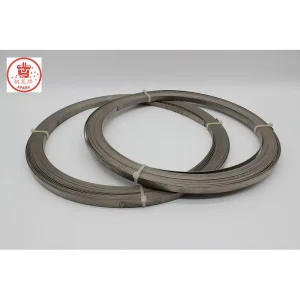






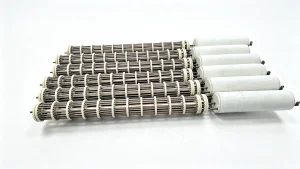
Engineering Excellence in High-Temperature Resistance Alloys
Industrial electric furnaces require material reliability under extreme thermal stresses. Achieving ultra-uniform electrical resistivity and superior cold/hot formability is critical to preventing hot spots, mechanical sag, and early oxidation burnout.
Uniform Electrical Resistivity ($\rho$)
Micro-segregation of alloying elements like Chromium, Aluminium, or Nickel creates localized resistance variance along a heating coil. When current flows, regions with higher electrical resistivity generate excessive ohmic heat ($P = I^2 R$), creating localized thermal hot-spots. Our proprietary vacuum induction melting (VIM) and secondary electroslag remelting (ESR) technologies guarantee a cross-sectional resistivity variance within $\pm 1.5\%$. This extreme uniformity prevents premature local wire burnout and extends overall furnace element life by up to 40%.
Superior Cold & Hot Formability
Electric heating elements must undergo tight automated coiling, bending, or wave-shaping without micro-cracking. High-aluminium FeCrAl alloys are historically prone to room-temperature brittleness. Through precise micro-alloying with rare earth elements (Yttrium, Zirconium, Tantalum) and tension-annealing line control, our resistance wires display exceptional ductility (elongation at break $\ge 20-25\%$). This allows rapid automated mandrel winding down to bending ratios of $R/d \le 1.5$ without structural fracturing.
Procurement Drivers Across High-Temperature Industries
As global manufacturing transitions toward decarbonization, high-efficiency electric heating systems are rapidly replacing gas-fired combustion units in heavy industries. Procurement officers and plant managers require resistance materials engineered for total thermal reliability.
Metallurgical Heat Treatment
In carburizing, nitriding, and tempering furnaces, thermal uniformity dictates component metallurgy. Standardized resistivity maintains consistent heat fluxes across multi-zone continuous car-bottom and box furnaces.
Photovoltaic & Semiconductor
Quartz tube furnaces for silicon wafer diffusion and ingot growth require non-contaminating, extreme temperature (up to 1400°C) alloys that resist creep deformation during continuous 24/7 cycles.
Technical Ceramics & Glass
High-density alumina sintering and glass bending kilns require dense protective oxide scales ($\alpha\text{-Al}_2\text{O}_3$) to withstand aggressive atmospheric conditions without spallation.
Total Cost of Ownership (TCO) Equation for Furnace Builders
Evaluating heating elements solely on initial cost per kilogram leads to sub-optimal operational expenditure. Elements manufactured with strict resistivity control ($\pm 1.5\%$) and high hot-yield strength experience up to 50% fewer mid-cycle failures, saving thousands of dollars per hour in unscheduled furnace downtime and thermal re-ramping energy costs.
Metallurgical Roadmap: FeCrAl vs. NiCr Alloys
Choosing the appropriate resistance heating alloy family depends on operating temperature, atmosphere, weight limitations, and electrical power density. Below is a comprehensive engineering comparison of primary wholesale alloy grades.
| Alloy Grade | Alloy Type | Max Temp (°C) | Resistivity ($\mu\Omega\cdot\text{m}$) | Density ($\text{g/cm}^3$) | Formability Index | Primary Industrial Application |
|---|---|---|---|---|---|---|
| 0Cr25Al5 | FeCrAl | 1250°C | 1.42 | 7.10 | High (Cold Winding) | Industrial Furnaces, Heat Treatment Kilns |
| 0Cr23Al5 | FeCrAl | 1250°C | 1.35 | 7.25 | Excellent | Heavy Electrical Heating Systems |
| HRE (1350) | FeCrAl (Rare Earth) | 1350°C | 1.45 | 7.10 | Good (Warm Bending) | High-Temp Sintering, Powder Metallurgy |
| SG140 / SGHYZ | FeCrAl (Advanced) | 1400°C | 1.48 | 7.05 | Controlled | Diffusion Furnaces, Ceramic Kilns |
| Cr20Ni80 | NiCr (80/20) | 1200°C | 1.09 | 8.40 | Superior (Ductile) | Medical, Precision & Cycling Furnaces |
| Cr30Ni70 | NiCr (70/30) | 1250°C | 1.18 | 8.10 | Superior | Reducing Atmosphere Furnaces |
| Cr20Ni40 | NiCr (Fe-Ni-Cr) | 1100°C | 1.04 | 8.70 | Maximum Ductility | Tempering & Low-Temp Drying Ovens |
FeCrAl Alloys: High Temperature & Energy Efficiency
Iron-Chromium-Aluminium (FeCrAl) alloys form a self-healing, adherent film of alpha-alumina ($\alpha\text{-Al}_2\text{O}_3$) when heated above 1000°C. This surface oxide is exceptionally dense, electrically insulating, and highly resistant to oxidation. FeCrAl offers a higher electrical resistivity than NiCr, allowing smaller wire cross-sections and saving material weight by up to 15-20%.
NiCr Alloys: Superior Hot Strength & Ductility
Nickel-Chromium (NiCr) alloys form a protective chromium oxide ($\text{Cr}_2\text{O}_3$) layer. While limited to lower maximum temperatures (1200-1250°C) compared to advanced FeCrAl, NiCr maintains excellent hot strength and high-temperature sag resistance. Furthermore, NiCr remains fully ductile after prolonged heating, allowing easy maintenance and reshaping of elements.
End-to-End Quality Assurance Architecture
From raw virgin ingot melting to finished wire spooling, every step is controlled under our ISO 9001:2015 quality protocol to guarantee mechanical and electrical specifications.
1. Spectrographic Melt Control
Utilizing Optical Emission Spectroscopy (OES) and ICP-MS analysis, chemical composition tolerances for Cr, Al, Ni, and RE additions are kept within narrow boundaries to avoid trace impurities (e.g., S, P, Pb) that degrade high-temperature grain boundaries.
2. Precision Wire Drawing
Polycrystalline diamond (PCD) dies and dynamic laser micrometer feedback loops maintain wire diameter tolerances down to $\pm 0.005\text{ mm}$. Surface finishes are electropolished or bright-annealed to remove draw-lubricant residues.
3. Continuous Resistivity Testing
Inline double-bridge resistance testing monitors real-time linear electrical resistance per meter. Coils failing tight variance thresholds are automatically flagged and segregated, ensuring 100% compliant shipments.
Global Regulatory Compliance & Factory Delivery
We provide full documentation and compliance support for international industrial operations. Every wholesale order is shipped with certified Mill Test Certificates (MTC) according to EN 10204 3.1, confirming chemical composition, electrical resistivity, tensile properties, and dimensional verification.
- International Standards: Fully compliant with GB/T 1234-2012, ASTM B603, ASTM B344, and DIN 17470.
- Environmental Standards: Certified RoHS and REACH compliant; free from hazardous heavy metal contaminants.
- Custom Packaging: Spooled on plastic reels (DIN 160, DIN 200, DIN 250), cardboard drums, or coiled in protective seaworthy wooden cases.
Wholesale OEM & Factory Direct Services
Whether you require master spools of fine wire ($d = 0.10\text{ mm}$), heavy industrial rod elements ($d = 12.0\text{ mm}$), or pre-formed ceramic radiant tube assemblies, our factory offers competitive wholesale pricing structures scaled to annual volume contracts.
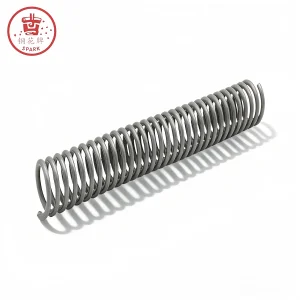
Specialized Furnace Alloy Wires & Radiant Cores
Explore factory direct quotes, datasheets, and wholesale pricelists for premium heating alloys.

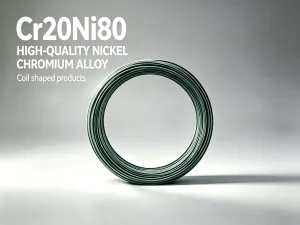
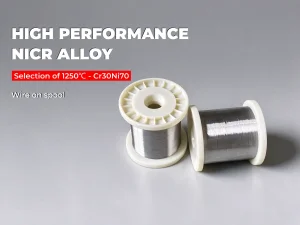

Frequently Asked Questions: Resistance Heating Materials
Technical answers to technical procurement and furnace design questions.