Featured Industrial Heating Alloys & Wires
Select from our premium catalog of FeCrAl, NiCr, and specialized resistance wires engineered for demanding thermal processing environments.




Section 1: The Metallurgical Foundation of Long-Term High-Temperature Service
In industrial thermal processing, component failure is rarely a random event; it is the predictable culmination of microstructural degradation, localized hot-spot formation, and oxidation kinetics under continuous thermal stress. For resistance heating elements operating in temperatures ranging from 1000°C to 1425°C, providing a reliable structural foundation for long-term high-temperature service requires an uncompromising approach to alloy design and melt control.
When resistance wire is exposed to extreme temperatures over thousands of hours, it undergoes continuous grain growth, micro-segregation, and phase transformations. Without specialized micro-alloying and strict chemical control, traditional alloys suffer from accelerated creep deformation,sagging, embrittlement, and premature electrical open-circuits. As a leading manufacturer backed by over 60 years of metallurgical legacy under Shougang Gitane, our technical strategy focuses on two decisive metallurgical pillars: microstructural creep suppression and protective oxide scale kinetics.
Grain Boundary Stabilization
At elevated service temperatures, uncontrolled grain growth leads to coarse, embrittled microstructures susceptible to mechanical fracture during thermal cycling. By introducing rare earth elements (RE) such as Yttrium (Y), Zirconium (Zr), Cerium (Ce), and Lanthanum (La), we pin grain boundaries, drastically slowing secondary recrystallization and enhancing sagging resistance in hanging heating coils.
Adherent Al₂O₃ Scale Kinetics
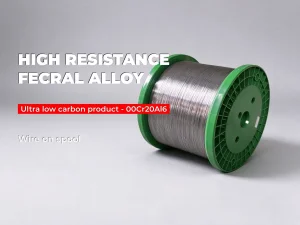
For iron-chromium-aluminium (FeCrAl) alloys (such as 0Cr25Al5, HRE, SGHYZ, and SGHT), service life depends on forming a slow-growing, highly adherent alpha-alumina ($\alpha-Al_2O_3$) surface film. Precise chemical purity prevents scale spallation caused by sulfur contamination, preserving the underlying metal matrix against rapid oxidation oxidation attack.
Powder Metallurgy Innovation
Our premium SGHT grade leverages advanced powder metallurgy (PM) processing to break physical limitations of conventional ingots. PM manufacturing guarantees zero macro-segregation, uniform dispersed oxide particles, and exceptional creep strength, establishing a new global benchmark for operation at 1425°C.
Precise Chemical Composition Uniformity Control: The Key to Eliminating Resistance Hot-Spots
Precise chemical composition uniformity control is not merely a laboratory quality metric—it is the single most critical variable determining electrical resistance consistency along the entire length of a wire spool. In heating elements, electrical resistance ($R$) is inversely proportional to cross-sectional area and directly proportional to material resistivity ($\rho$). If chromium or aluminium concentrations fluctuate by even 0.3% along a coil, localized high-resistance zones develop.
Under operational current, these minor composition deviations generate localized over-heating ("hot-spots"). A temperature rise of just 30°C at a hot-spot can reduce the oxidation life of the alloy by more than 50%, triggering early wire burnout while the rest of the heating element remains un-degraded. To eliminate this issue, our vacuum induction melting (VIM) and electroslag remelting (ESR) lines enforce microscopic chemical tolerances far stricter than standard GB/T 1234-2012 or ASTM B603 standards.
Section 2: Technical Performance Comparison & Alloy Selection Matrix
Choosing between Iron-Chromium-Aluminium (FeCrAl) and Nickel-Chromium (NiCr) alloys requires balancing maximum working temperature, mechanical ductility, atmosphere compatibility, and overall cost-efficiency. Below is an engineering comparison matrix designed for wholesale buyers and furnace engineers.
| Alloy Grade | Alloy Family | Max Temp (°C) | Resistivity @20°C (μΩ·m) | Density (g/cm³) | Primary Industrial Application |
|---|---|---|---|---|---|
| SPARK SGHT | FeCrAl (PM Grade) | 1425°C | 1.45 ± 0.05 | 7.10 | Semiconductor diffusion, ceramic sintering kilns |
| SPARK SGHYZ | FeCrAl (RE Micro-alloy) | 1400°C | 1.45 ± 0.05 | 7.10 | Ultra-high temp industrial heat treatment furnaces |
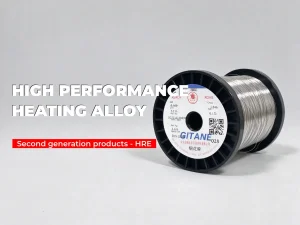
| SPARK HRE | FeCrAl Grade | 1350°C | 1.42 ± 0.05 | 7.15 | Powder metallurgy, high-temperature ceramic kilns |
| 0Cr25Al5 | FeCrAl Standard | 1250°C | 1.42 ± 0.05 | 7.15 | Industrial furnaces, radiant tube heaters, baking ovens |
| Cr20Ni80 | NiCr (Nichrome) | 1200°C | 1.09 ± 0.05 | 8.40 | Medical electronics, domestic appliances, cyclic heating |
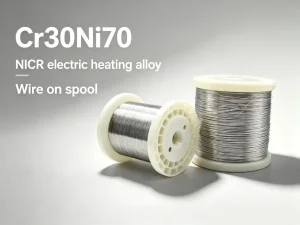
| Cr30Ni70 | NiCr High Temp | 1250°C | 1.18 ± 0.05 | 8.10 | Carbonitriding atmospheres, heavy industrial furnaces |
Why FeCrAl Dominates High-Temperature Applications
FeCrAl alloys offer significant engineering advantages over nickel-based alternatives in high-temperature industrial environments. With a maximum continuous operating rating up to 1425°C compared to NiCr's typical limit of 1200°C–1250°C, FeCrAl materials allow higher furnace power density and faster throughput.
Furthermore, FeCrAl has a lower density (7.10 g/cm³ vs 8.40 g/cm³ for Cr20Ni80) and higher electrical resistivity. This combination means heating element designers require up to 20% to 30% less alloy weight for identical kilowatt output, drastically reducing raw material purchasing costs for wholesale procurement programs.
When to Specify NiCr Alloys
While FeCrAl excels in raw thermal endurance and weight savings, Nickel-Chromium (NiCr) alloys remain essential for specific thermal cycles. NiCr forms a tough, self-healing Chromium Oxide ($Cr_2O_3$) scale that retains excellent room-temperature ductility even after thousands of hours of service. This prevents element breakage during maintenance or mechanical vibration.
NiCr is also highly recommended for fast-cycling heating systems, nitrogen-containing furnace atmospheres, and low-temperature precision control elements where dimensional stability under frequent cooling contraction is critical.
Section 3: China Factory Supply Chain Advantages & Wholesale Capacity
As global industrial equipment manufacturers face tighter production deadlines, fluctuating raw material costs, and increasingly complex regulatory landscapes, securing a stable, vertically integrated manufacturing partner is paramount. Sourcing wholesale resistance heating wire directly from a premier China factory supplier like Beijing Shougang Gitane New Materials Co., Ltd. delivers distinct structural cost and operational guarantees.
1. End-to-End Vertical Integration
From electrolytic raw metal selection, vacuum melting, hot rolling, cold drawing, continuous annealing, to final spooling and coil formation, our entire manufacturing chain is executed within our 88,000 m² Beijing site. This complete control eliminates supplier markups, shortens production lead times, and enforces 100% trace-ability for every melt heat lot.
2. Economies of Scale & Raw Material Hedging
As part of the renowned Shougang Group, our massive purchasing power for high-purity Nickel (99.99%), Chromium, and Iron insulates wholesale enterprise buyers from wild market volatility. We offer flexible multi-ton contracts, fixed pricing locks, and buffer stock programs to safeguard your operational margins.
3. Advanced Testing Infrastructure
Our state-of-the-art testing center is equipped with Optical Emission Spectrometers (OES), Scanning Electron Microscopy (SEM), high-temperature creep testing rigs, and rapid life test apparatus. Every wholesale consignment is accompanied by certified EN 10204 3.1 Mill Test Reports detailing chemical analysis and electrical resistance measurements.
Section 4: Global Enterprise Sourcing, Localization Support & Compliance Assurance
Modern procurement directors require far more than high-grade physical metal; they require seamless global logistics, customized technical engineering support, and full regulatory compliance. Servicing international clients across North America, Europe, Asia-Pacific, and the Middle East, our customer-centric model addresses every facet of enterprise purchasing.
International Regulatory & Environmental Compliance
All SPARK resistance heating alloys, wires, strips, and fabricated elements conform strictly to global environmental standards, including EU RoHS 3 (Directive 2015/863) and REACH (EC 1907/2006). We maintain a robust ISO 9001 quality management framework (certified since 2003) and ISO 14001 environmental safety certifications, ensuring seamless importation into strict regulatory markets.
Packaging is custom-engineered for international long-haul freight: spools are sealed in moisture-proof vacuum barrier bags, packed with desiccant packs, and secured inside heavy-duty ISPM 15 compliant wooden cases to prevent oxide skin damage or corrosion during sea transport.
Localization & Technical Application Engineering Support
To bridge international time zone gaps and technical specifications, our dedicated engineering team offers direct OEM integration support. We assist your design department in calculating precise surface load parameters (W/cm²), optimizing coil pitch-to-wire diameter ratios, and specifying ideal terminal leads for custom furnace configurations.
Whether you require custom wire drawing tolerances ($\pm 0.005$ mm), custom ribbon widths, pre-oxidized element surfaces, or pre-wound furnace heating coils ready for instant drop-in installation, our localized support infrastructure guarantees rapid prototyping and rapid dispatch.
Section 5: High-Impact Industry Application Scenarios
Our SPARK resistance alloys and custom electric heating elements are deployed across high-precision industrial sectors worldwide. The operational success of these mission-critical systems relies directly on our chemical uniformity and structural stability.
Semiconductor & Photovoltaic Manufacturing
In silicon wafer diffusion, oxidation, and crystal growth furnaces running continuous 1300°C–1400°C cycles, thermal uniformity is decisive for chip yield. Our powder metallurgy SGHT and ultra-pure SGHYZ wires deliver stable heating without risk of heavy metal contamination or element sag over multi-month thermal runs.
Advanced Technical Ceramics & Glass Processing
Sintering zirconia, alumina, and structural ceramics requires clean, high-temperature thermal profiles up to 1400°C. SPARK FeCrAl alloys form a inert $\alpha-Al_2O_3$ protective layer that prevents chemical reaction between the heating elements and corrosive ceramic vapors or high-purity glass melt environments.
Industrial Heat Treatment & Automotive Forging
Large-scale carburizing, nitriding, annealing, and hardening furnaces demand resilient heating elements capable of handling high mechanical vibration, heavy thermal mass loads, and aggressive furnace atmospheres. Our Cr30Ni70 and 0Cr25Al5 strips deliver long life and reliable power density.
Section 6: Frequently Asked Questions (Industrial Sourcing Q&A)
Explore Additional SPARK Resistance Alloy Products
Complete your procurement specifications with our specialized range of high-temperature alloy wires, strips, and raw metal materials.