Top-Tier Resistance Wire & Element Catalog


The Critical Impact of Trace Elements (C, S, P) on Resistance Alloy Lifespan
In high-temperature electrothermal applications operating between 1000°C and 1425°C, the performance limits of Iron-Chromium-Aluminum (FeCrAl) and Nickel-Chromium (NiCr) alloys are not solely dictated by their primary constituent elements. Advanced metallurgical research proves that trace impurities—specifically Carbon (C), Sulfur (S), and Phosphorus (P)—exert a disproportionate impact on high-temperature oxidation kinetics, intergranular embrittlement, and structural creep resistance. Controlling these elements at ultra-low ppm (parts per million) thresholds is the single most decisive factor separating standard-grade industrial heating wire from premium-grade alloys engineered for zero-defect continuous operation.
Carbon (C) Mitigation
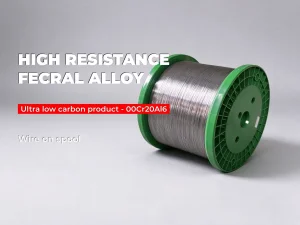
Excess carbon combines with chromium and niobium at elevated temperatures to form coarse grain-boundary carbides (e.g., M23C6, M6C). These precipitates deplete matrix chromium, triggering localized micro-corrosion, reduction in cold ductility, and catastrophic hot-brittleness. Strict control under 0.02% (or ultra-low 0.008% in 00Cr20Al6) prevents grain coarsening and maintains high ductility during wire drawing and spiraling.
Sulfur (S) Elimination
Sulfur exhibits near-zero solid solubility in iron and nickel matrices. During thermal cycling, sulfur segregates toward the metal-scale interface (Al2O3 or Cr2O3 oxide film), dramatically lowering interfacial adhesion energy. This results in premature scale spallation, accelerated internal oxidation, and rapid resistance drift. Ultra-low sulfur refining (<0.003%) ensures a dense, tenacious self-healing protective oxide scale.
Phosphorus (P) Suppression
Phosphorus segregates to grain boundaries, forming low-melting-point eutectic phases that cause 'hot shortness' during high-temperature forging and rolling. By holding phosphorus levels strictly below 0.015%, the structural cohesion of crystal boundaries is preserved, ensuring exceptionally high hot tensile strength and preventing sag under suspended load furnace configurations.
Technical Benchmark & Metallurgical Control Metrics
Through VOD (Vacuum Oxygen Decarburization) and ESR (Electroslag Remelting) refining workflows, Beijing Shougang Gitane New Materials Co., Ltd. achieves ultra-clean melt chemistry meeting GB/T 1234-2012 and international standards.
Why Chinese High-Purity Metallurgy Leads the Global B2B Market
China's modern industrial transformation has positioned its specialized metallurgical sector at the forefront of global material synthesis. The integration of state-owned raw material security, large-scale primary vacuum induction melting (VIM), secondary electroslag refining (ESR), and fully automated continuous wire drawing lines creates an unmatched value proposition for international procurement directors.
At Shougang Gitane, over 60 years of dedicated electrothermal alloy experience is combined with modern digital quality monitoring systems. Controlling carbon, sulfur, and phosphorus at the raw melt stage eliminates downstream heat-treatment failures, delivering consistent coil-to-coil mechanical properties at direct-from-factory wholesale pricing structure.
Integrated Metallurgical Process Pipeline
- Raw Material Selection: High-purity sponge iron, electrolytic nickel (>99.99%), and low-carbon ferro-chrome.
- Vacuum Induction Melting (VIM): Degassing under deep vacuum to extract dissolved hydrogen, nitrogen, and oxygen.
- AOD/VOD Refining: Decarburization down to ultra-low levels without oxidizing critical alloying elements like aluminum and reactive rare earths (RE).
- Precision Micro-Alloying: Addition of Yttrium (Y), Zirconium (Zr), and Niobium (Nb) to lock up micro-trace sulfur and stabilize grain boundaries.
- Hydrogen-Protected Bright Annealing: Eliminates surface carbon pick-up and maintains mirror-smooth surface quality across wire and strip dimensions.
Global Solutions Across High-Thermal Critical Industries
High-purity electrothermal alloys with micro-alloyed impurity suppression are crucial components in modern energy, electronics, and heavy equipment sectors.
Photovoltaic & Semiconductor
Silicon ingot growth furnaces, quartz tube heating rings, and wafer annealing diffusion equipment require zero-outgassing heating alloys. Ultra-low C & S prevents carbon contamination of monocrystalline silicon structures during high-temp runs up to 1380°C.
Automotive & Heat Treatment
Continuous mesh belt carburizing, nitriding, and tempering lines. Alloys like 0Cr21Al6Nb and Cr20Ni80 provide exceptional resistance to carburizing gases and thermal shock during cyclic loading of auto transmission parts.
Lithium Battery Cathode Sintering
Roller hearth kilns (RHK) producing NCM/LFP battery cathode materials demand stable heating elements that resist corrosive chemical dust and oxygen-enriched atmospheres without scaling or thermal sagging.
Industrial Ceramics & Glass
High-temperature ceramic sintering kilns and glass bending furnaces requiring powder-metallurgy SGHT or SGHYZ wire rated to 1400°C–1425°C, ensuring long continuous life cycles without frequent operator intervention.
Development Trends in Electrothermal Resistance Materials
The global transition toward green industrial electrification—replacing fossil-fuel burners with zero-emission electric heating systems—is accelerating demand for higher-performance resistance alloys. To meet the stringent requirements of next-generation thermal processing, material development is focusing on three key vectors:
1. Powder Metallurgy & Oxide Dispersion Strengthening (ODS)
Traditional ingot metallurgy faces physical limits in creep strength above 1300°C. Advanced powder metallurgy (as implemented in SPARK SGHT grade) creates ultra-fine Y2O3 dispersoids throughout the FeCrAl matrix, yielding exceptional dimensional stability, minimal elongation, and service capability up to 1425°C.
2. Reactive Element Optimization (RE)
The exact stoichiometric balancing of Yttrium, Cerium, Lanthanum, and Zirconium is replacing primitive 'rare earth addition'. Controlled RE chemistry acts as an internal sulfur trap, converting free sulfur into ultra-stable oxysulfides and preventing interfacial oxide scale detachment.
Global B2B Procurement Risk Mitigation Strategies
When sourcing resistance alloys globally, enterprise procurement managers must evaluate Total Cost of Ownership (TCO) rather than purely initial price per kilogram. Substandard heating wire with unchecked C, S, and P levels introduces severe operational risks:
- Unscheduled furnace shutdowns due to premature wire burnout.
- Resistivity drift exceeding ±5%, causing non-uniform temperature zones and ruined heat-treatment batches.
- Intergranular fracture during coil winding or installation due to high carbon embrittlement.
- Frequent re-calibration costs and excessive spare parts inventory.
The Shougang Gitane Quality Guarantee
To safeguard international orders, Shougang Gitane provides comprehensive verification and compliance documentation with every wholesale shipment: