Executive Technical Report: Wholesale Mid-to-High End Electric Heating Elements for Industrial Thermal Processing
The global thermal processing landscape is undergoing a monumental paradigm shift. Driven by aggressive international carbon-neutrality targets, industrial electrification, and the demand for extreme thermal precision, modern manufacturing sectors—ranging from automotive forging and aerospace alloy aging to powder metallurgy and semiconductor quartz synthesis—are systematically phasing out traditional fossil-fuel burner systems in favor of advanced electric heating systems. Within this transition, high-temperature electric resistance heating elements and specialized alloy wires act as the foundational engine of thermal transfer efficiency.
As a flagship industrial enterprise backed by over six decades of metallurgical heritage under the Shougang Group, Beijing Shougang Gitane New Materials Co., Ltd. (SPARK) stands at the forefront of this industrial transformation. Delivering engineered electrothermal solutions across China, North America, Europe, and the Asia-Pacific, SPARK provides wholesale mid-to-high end heating elements designed to survive operating atmospheres reaching up to 1425°C.
Full-Scenario Industrial Heat Treatment Engineering
Industrial electric heat treatment requires granular alignment between furnace structural dynamics, loading mechanics, atmospheric reactivity, and heating element geometry. Below is an exhaustive technical evaluation of heating element configurations across four core industrial furnace classifications.
1. Box Furnaces (Muffle & Chamber Batch Furnaces)
Application Focus: Tool steel hardening, precision die annealing, ceramic calcination, laboratory thermal testing, and small-batch component stress relieving.
Heating Element Requirements: High thermal shock resistance, tight physical dimensions, radiant heat uniformity, and rapid thermal cycling responsiveness. Box furnaces frequently transition between ambient temperature and 1000°C–1300°C multiple times per day.
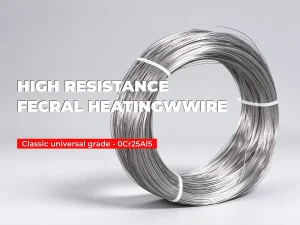
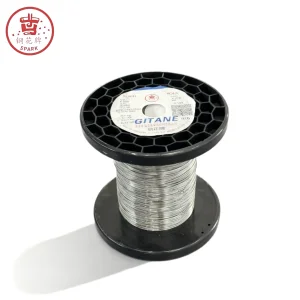
Optimal Alloy Alloys: SPARK 0Cr25Al5 and HRE 1350°C FeCrAl wire coils mounted on ceramic tube supports or embedded in high-purity vacuum-formed ceramic fiber modules. The rapid growth of a protective, self-healing Alpha-Alumina ($\alpha-Al_2O_3$) surface layer prevents oxidation breakdown during aggressive temperature ramping.
2. Trolley / Bogie Hearth Furnaces
Application Focus: Heavy steel casting stress relief, large scale forging normalization, wind turbine gear annealing, and heavy industrial machinery thermal processing.
Heating Element Requirements: Mechanical robustness against physical impacts during loading, resistance to mechanical vibration, long span sagging resistance, and multi-zone heating control across large internal furnace volumes.
Optimal Alloy Alloys: Heavy-gauge SPARK FeCrAl strips (flat ribbon elements) or thick rod elements (e.g., 0Cr21Al6Nb or SGHYZ 1400°C) formed into meander patterns held by ceramic hooks. Flat ribbon elements maximize radiant surface area per kilogram of alloy, reducing watt-density loading while extending operational lifespan in multi-ton batch processing environments.
3. Continuous Mesh Belt Furnaces
Application Focus: Mass production of automotive fasteners, continuous powder metallurgy sintering, bright copper/stainless steel brazing, and high-volume carbonitriding.
Heating Element Requirements: Extreme atmosphere stability (endothermic gas, cracked ammonia, nitrogen-hydrogen mixes), immunity to carbon deposition/sooting, and prolonged creep rupture strength under continuous thermal loads.
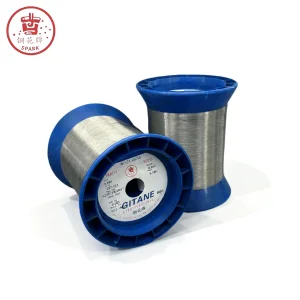
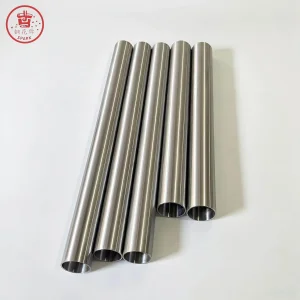
Optimal Alloy Alloys: Radiant tubes constructed with SPARK SGHT or SGHYZ high-performance heating wire inserted inside high-nickel or ceramic protection tubes. Where unshielded elements are required, Nickel-Chromium alloys like Cr20Ni80 are favored due to their superior resistance to carburizing degradation and carbon-pickup green rot phenomena.
4. Pit Furnaces (Vertical Retort / Well Furnaces)
Application Focus: Deep-case gas carburizing of long gear shafts, vertical rod/wire rod annealing, titanium component heat treatment, and specialized aerospace shaft tempering.
Heating Element Requirements: Vertical sag resistance over lengths exceeding 3 to 6 meters, resistance to vertical thermal gradients, and minimal thermal elongation over thousands of operational hours.
Optimal Alloy Alloys: SPARK SGHT (Powder Metallurgy FeCrAl) spiral wire coils or heavy-duty Cr30Ni70 ribbons arranged in vertical multi-zone wall circuits. SGHT powder-metallurgy technology provides unmatched high-temperature yield strength, eliminating the characteristic sagging and short-circuiting inherent to conventional drawn wire elements over long vertical spans.
Metallurgical Foundations: FeCrAl vs. NiCr Electrothermal Alloys
Selecting the correct resistance heating material requires a deep comprehension of physical chemistry, phase stability, microstructural kinetics, and high-temperature oxidation mechanisms. Electrothermal alloys fall into two primary family trees: Iron-Chromium-Aluminum (FeCrAl) and Nickel-Chromium (NiCr).
1. Iron-Chromium-Aluminum Alloys (FeCrAl Family)
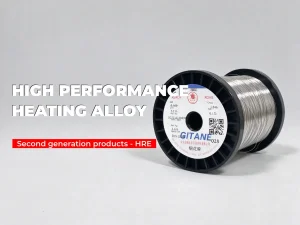
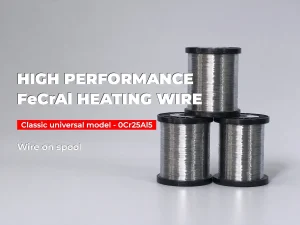
FeCrAl alloys (such as SPARK 0Cr25Al5, 0Cr23Al5, HRE, SGHYZ, and SGHT) are characterized by higher maximum operating temperatures (up to 1425°C), higher electrical resistivity ($1.25 - 1.45\,\mu\Omega\cdot\text{m}$), and lower mass density compared to NiCr alternatives.
The Alumina Scale Mechanism: When heated above 900°C in oxygen-containing environments, Aluminum atoms rapidly migrate toward the alloy surface to form a dense, continuous layer of Alpha-Alumina ($\alpha-Al_2O_3$). This ceramic film serves as an impermeable barrier against inward diffusion of oxygen, nitrogen, and sulfur gases. Advanced SPARK grades (SGHYZ and SGHT) incorporate micro-dopants of Rare Earth Elements (REE) such as Yttrium ($Y$), Hafnium ($Hf$), Zirconium ($Zr$), and Niobium ($Nb$). REE doping refines grain boundaries and anchors the protective oxide layer to the metallic core, drastically suppressing oxide spallation during rapid thermal shock cycles.
2. Nickel-Chromium Alloys (NiCr Family)
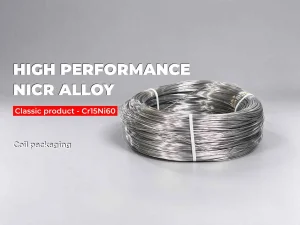
NiCr alloys (such as SPARK Cr20Ni80, Cr15Ni60, and Cr30Ni70) possess an FCC (Face-Centered Cubic) austenitic crystal structure. While limited to a maximum service temperature of 1200°C–1250°C, they offer significant mechanical advantages over FeCrAl alloys.
Austenitic Phase Advantages: NiCr alloys exhibit superior hot strength, high ductility at elevated temperatures, and non-magnetic electrical behavior. Crucially, NiCr alloys remain ductile after extended high-temperature aging, whereas FeCrAl alloys undergo grain growth and embrittlement upon cooling to room temperature. This makes NiCr elements vastly easier to repair, maintain, or reshape without brittle fracturing. Furthermore, NiCr forms a Chromia ($\text{Cr}_2\text{O}_3$) protective oxide scale that resists green-rot attack in nitrogen-rich and reducing furnace atmospheres.
| Property / Characteristic | SPARK FeCrAl Alloys (e.g., SGHT, SGHYZ, HRE) | SPARK NiCr Alloys (e.g., Cr20Ni80, Cr30Ni70) |
|---|---|---|
| Max Service Temperature | 1300°C – 1425°C (Extreme High Temp) | 1150°C – 1250°C (Moderate/High Temp) |
| Electrical Resistivity (20°C) | High ($1.35 - 1.45\,\mu\Omega\cdot\text{m}$) | Moderate ($1.09 - 1.18\,\mu\Omega\cdot\text{m}$) |
| Alloy Density | $\approx 7.10\,\text{g/cm}^3$ (Saves weight/material cost) | $\approx 8.40\,\text{g/cm}^3$ (Higher material weight) |
| Protective Surface Oxide Layer | Alpha-Alumina ($\alpha-Al_2O_3$) - White/Grey | Chromia ($\text{Cr}_2\text{O}_3$) - Dark Green/Black |
| Post-Aging Ductility | Brittle upon room-temperature cooling | Excellently ductile (re-coilable/repairable) |
| Atmospheric Compatibility | Excellent in Air, Oxidizing, Dry Hydrogen | Excellent in Nitrogen, Ammonia, Reducing, Carburizing |
| Hot Strength & Creep Resistance | Standard grades require support; PM (SGHT) excellent | Naturally high creep strength; resistant to sags |
China Manufacturing Synergy: Quality, Scale, and Supply Chain Supremacy
Global OEM furnace builders and industrial end-users face continuous pressure to shorten equipment lead times while maintaining strict quality standards and controlling capital expenditure. The concentration of electrothermal manufacturing excellence in China—exemplified by Beijing Shougang Gitane New Materials Co., Ltd.—delivers unmatched operational advantages.
Full-Process Metallurgical Control
Unlike downstream converting workshops that source wire rods externally, SPARK executes vertical integration. From Vacuum Induction Melting (VIM) and Argon Oxygen Decarburization (AOD) refining to ingot casting, hot rolling, precision wire drawing, hydrogen atmosphere annealing, and automatic CNC coiling—every microstructural state is monitored in-house under ISO 9001 and ISO 14001 certified protocols.
Economies of Scale & Cost Efficiency
Operating within an 88,000 m² industrial facility with annual production capacity exceeding thousands of metric tons, SPARK leverages bulk raw material procurement (high-purity Nickel, Chromium, Aluminum, and Rare Earth metals). This yields a 25% to 45% cost-per-kilogram performance gain compared to European or North American alloy mills without compromising metallurgical purity or lifespan.
Rapid Customization & Global Logistics
Global buyers benefit from specialized engineering support. SPARK provides custom wire gauges (0.05mm ultra-fine wire to 12mm heavy rods), tailored flat ribbon dimensions, customized spiral pitches, and pre-formed meander element assemblies. Accelerated freight channels ensure seamless delivery to European, North American, Middle Eastern, and Southeast Asian industrial hubs.
Global Industry Development Trends (2025–2035)
The future of industrial thermal processing is defined by higher operating temperatures, smart element monitoring, ultra-clean processing environments, and severe energy efficiency requirements. Key metallurgical and operational trends reshaping the electrothermal industry include:
1. Powder Metallurgy (PM) Dominance
Conventional melting and casting processes reach physical limits due to macro-segregation of alloying elements at extreme temperatures. Powder Metallurgy (PM) technology—utilized in SPARK SGHT—yields completely homogeneous microstructures with ultrafine grain dispersion. PM FeCrAl alloys eliminate sagging and creep elongation at temperatures exceeding 1350°C, extending service life by up to 300% in heavy continuous furnaces.
2. Green Carbon-Free Heat Treatment
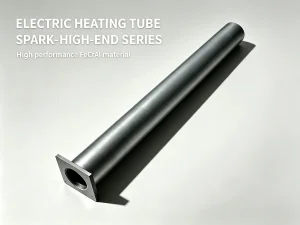
Steel mills, automotive component foundries, and aerospace manufacturers are rapidly replacing natural gas radiant burner tubes with high-output electric radiant heating tubes. This transition eliminates direct Scope 1 CO₂ emissions on production lines, driving exponential market growth for ultra-high-temperature FeCrAl heating wire coils capable of high power densities ($W/cm^2$).
3. Semiconductor & Battery Material Demand
The global expansion of semiconductor fabrication and Lithium-Ion / Solid-State battery cathode production (LFP, NMC) demands high-purity thermal environments free from metallic flake contamination. High-purity FeCrAl alloys with self-adherent $\alpha-Al_2O_3$ scales prevent particulate spallation, ensuring pristine atmosphere purity inside rotary kilns and roller hearth furnaces.
Global Enterprise Procurement & Engineering Decision Framework
Procurement directors and thermal engineers must evaluate total cost of ownership (TCO) rather than simple initial purchase price. Unexpected furnace shutdown caused by premature heating element failure can cost tens of thousands of dollars per hour in lost production.
Step-by-Step Selection Methodology:
- Step 1: Calculate Maximum Element Temperature: Account for thermal lag. The heating element temperature is typically 50°C to 150°C higher than the furnace chamber target temperature. For a 1250°C chamber, select an alloy rated for at least 1350°C–1400°C (e.g., SPARK SGHYZ or HRE).
- Step 2: Determine Surface Watt-Density ($W/cm^2$): Excessive watt loading causes internal hot-spots and premature burn-outs. Box and trolley furnaces running in air generally tolerate $1.5 - 2.5\,\text{W/cm}^2$, whereas continuous enclosed radiant tubes require conservative loading ($1.0 - 1.8\,\text{W/cm}^2$).
- Step 3: Analyze Operating Atmosphere Chemistry:
- Oxidizing / Air: Optimal for FeCrAl ($\alpha-Al_2O_3$ protection).
- Carburizing / Endothermic Gas: Prefer NiCr (Cr20Ni80) or FeCrAl enclosed in ceramic/radiant tubes.
- Pure Hydrogen / Vacuum: Requires high-purity FeCrAl or NiCr depending on dew point and temperature.
- Step 4: Verify Mechanical Mounting & Sagging Geometry: For long unsupported vertical or horizontal spans, specify SPARK SGHT Powder Metallurgy wire or heavy-gauge ribbon elements to prevent phase deformation and adjacent coil short-circuiting.