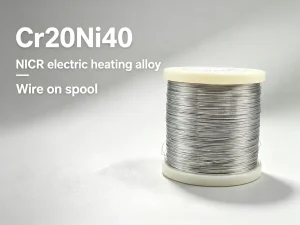
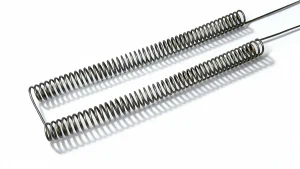
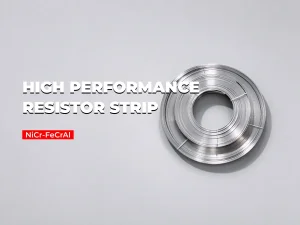
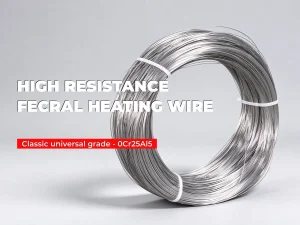
Precision-engineered resistance wire, heating elements, and alloy components designed for thermal endurance up to 1425°C.
An authoritative deep dive into thermo-mechanical stability, grain growth suppression, phase chemistry, and load-bearing connection integrity at temperatures exceeding 1000°C.
Industrial thermal processing requires joining heating elements, leads, structural support pins, and terminal connections capable of retaining tensile and shear strength under continuous thermal cycling. Establishing reliable joints in electric heating alloys—such as 0Cr25Al5, 0Cr23Al5, Cr20Ni80, and SGHYZ/SGHT—presents a complex physical challenge: thermal expansion mismatch, grain boundary diffusion, oxidation along joint seams, and phase embrittlement.
1. Mechanism of Oxide Scale Protection ($\alpha-Al_2O_3$ vs. $Cr_2O_3$)
The durability of welded or mechanically crimped high-temperature joints depends directly on the formation of a dense, thermodynamically stable oxide scale. In FeCrAl-based joints (e.g., 0Cr25Al5, HRE, SGHYZ), aluminum selectively diffuses to the surface at temperatures above 900°C to form an alpha-alumina ($\alpha-Al_2O_3$) film. This oxide film exhibits an extremely low ionic diffusion rate, serving as an impermeable barrier against further oxygen penetration and mechanical degradation.
Alpha-Alumina ($\alpha-Al_2O_3$) Scale
Formed primarily on FeCrAl alloys at temperatures up to 1425°C. Offers superior electrical insulation, low growth stress, and resistance to spallation during cyclic thermal shocks.
Chromia ($Cr_2O_3$) Scale
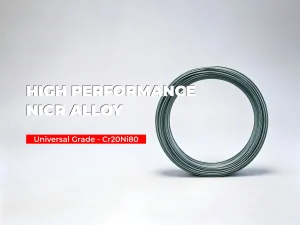
Characteristic of NiCr alloys (Cr20Ni80, Cr30Ni70) up to 1200°C. Provides high hot ductility, exceptional adhesion, and resistance to mechanical flexure, though subject to volatilization above 1200°C ($CrO_3$ gas formation).
Rare Earth Doping Effect
Addition of micro-alloying elements (Yttrium, Zirconium, Rare Earths) dynamic-pins grain boundaries, suppressing vacancy coalescence at the oxide-metal interface and preventing joint delamination.
Understanding chemical stability, partial pressure dynamics, and environment-specific degradation limits for industrial heating joints.
| Atmosphere Environment | FeCrAl Alloys (0Cr25Al5, SGHYZ) | NiCr Alloys (Cr20Ni80, Cr30Ni70) | Joint Failure Mode & Prevention |
|---|---|---|---|
| Air / Oxidizing Atmosphere | Excellent (Up to 1425°C) | Excellent (Up to 1200°C) | Spallation under severe thermal shock; minimize thermal ramp rate. |
| Dry Hydrogen ($H_2$) | Very Good (Up to 1350°C) | Excellent (Up to 1250°C) | Pre-oxidize FeCrAl to form $\alpha-Al_2O_3$ scale before hydrogen exposure. |
| Nitrogen / Ammonia ($N_2/NH_3$) | Susceptible to Nitridation above 1000°C | Superior Resistance (Up to 1150°C) | FeCrAl forms brittle $AlN$ precipitates; specify NiCr for nitrogen-rich kilns. |
| Carburizing / Endothermic Gas | Good (Resists "Green Rot") | Prone to "Green Rot" (Carburization) | Carburization leads to internal $Cr_3C_2$ precipitation; pre-oxidize and monitor carbon potential. |
| Sulfur-Bearing Atmospheres ($H_2S, SO_2$) | POOR (Severe Attack) | CRITICAL FAIL ($Ni-Ni_3S_2$ Eutectic) | Forms liquid eutectic phases at 635°C; requires sealed protective radiant tubes. |
| Halogen-Containing ($Cl_2, F_2, HCl$) | SEVERE VOLATILIZATION | SEVERE VOLATILIZATION | Volatile metal halides ($AlCl_3, FeCl_3$) rapidly strip metal thickness. Avoid halogens. |
Sulfur & Halogen Degradation Mechanisms
Sulfidation: In sulfur-containing reducing atmospheres, nickel reacts to form nickel sulfide ($Ni_3S_2$), which forms a low-melting eutectic mixture with nickel metal at $635^\circ\text{C}$. This results in rapid catastrophic melting along grain boundaries.
Halogen Corrosion: Chlorine, fluorine, and their acidic vapors breach passive oxide layers and form high-vapor-pressure halides. This strips protective elements, leading to catastrophic joint embrittlement and rapid cross-sectional wire loss.
Examining decarbonization, energy transition, semiconductor manufacturing growth, and powder metallurgy breakthroughs shaping modern high-temperature joint engineering.
Industrial Electric Decarbonization
Global zero-carbon initiatives are accelerating the transition from gas-fired industrial burners to electric resistance heating. High-capacity furnaces require heavy-gauge element joints operating continuously with zero maintenance downtime.
Semiconductor & PV Silicon Boom
Silicon ingot growth (Czochralski process) and semiconductor wafer thermal diffusion demand ultra-pure, non-contaminating heating elements like powder metallurgy FeCrAl (SGHT) operating at 1350°C–1425°C with minimal thermal creep.
Battery Cathode Sintering
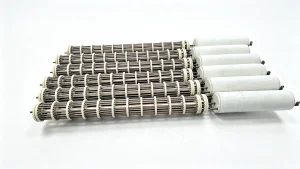
Lithium-ion battery materials (LFP, NCM) processing requires multi-zone roller hearth kilns. These kilns rely on precision ceramic rod bundle heating modules and robust joint connections resistant to lithium vapor contamination.
Field-proven engineering applications demonstrating high-strength thermal joint stability across demanding industrial environments.
1. Automotive Gear Heat Treatment
Environment: Sealed pit furnaces running carburizing gas mixtures ($850^\circ\text{C} - 980^\circ\text{C}$).
Solution: 0Cr25Al5 heavy strip elements with flash-butt welded terminal leads. The high aluminum content prevents carbon ingress and "green rot" embrittlement, extending joint service life from 6 months to over 24 months.
2. High-Temperature Ceramic Sintering
Environment: Continuous shuttle kilns operating in air up to $1380^\circ\text{C}$.
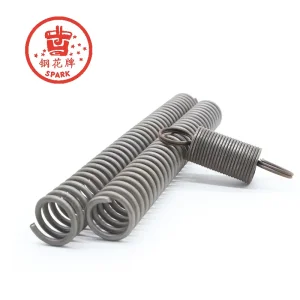
Solution: SPARK SGHYZ high-purity rare-earth doped FeCrAl coils mounted on high-alumina ceramic bundle rods. Cold-end joints utilize double-gauge twisted leads to minimize junction temperature and maintain structural rigidity.
3. Aerospace Superalloy Vacuum Brazing
Environment: High-vacuum furnaces ($10^{-4}\text{ Torr}$) operating up to $1200^\circ\text{C}$.
Solution: Cr20Ni80 Nichrome ribbon elements with mechanical clamp-and-bolt cold ends. Eliminates outgassing risks while maintaining ductility and dimensional stability through thousands of thermal evacuation cycles.
Next-generation metallurgical research directions for high-strength thermal joint reliability and ultra-high-temperature heating materials.
Oxide Dispersion Strengthening (ODS)
Injecting nano-scale $Y_2O_3$ (yttria) particles via powder metallurgy creates ODS FeCrAl alloys (e.g., SGHT). ODS structures increase high-temperature creep strength by up to 400% compared to ingot-melted alloys, allowing element service up to 1425°C without sagging.
Additive Manufacturing of Custom Coils
Laser Powder Bed Fusion (LPBF) 3D printing enables monolithic production of complex, gradient-density heating element geometries and seamless cold-end transitions, eliminating conventional mechanical welded joints entirely.
Smart Ceramic-Alloy Hybrid Interfaces
Developing micro-structured gradient buffer layers between high-purity alumina insulators and metal joints to absorb differential thermal expansion stress, drastically reducing ceramic cracking during rapid thermal quenching.
Best practices for industrial furnace builders, electrical engineers, and procurement specialists to guarantee structural joint integrity.
1. Surface Load Rating ($W/cm^2$) vs. Joint Lifetime
Element joint failure is frequently caused by excessive surface load ($W/cm^2$). High surface loads elevate the internal temperature of the wire relative to the furnace ambient. At terminal joints, lower electrical resistance must be engineered to prevent localized overheating.
| Furnace Operating Temp | Recommended Max Surface Load (FeCrAl) | Recommended Max Surface Load (NiCr) | Cold-End Joint Ratio Recommendation |
|---|---|---|---|
| 800°C – 1000°C | 2.5 – 3.5 $W/cm^2$ | 2.0 – 3.0 $W/cm^2$ | Cold-end wire diameter 1.5x larger than active wire |
| 1000°C – 1200°C | 1.8 – 2.5 $W/cm^2$ | 1.2 – 1.8 $W/cm^2$ | Cold-end wire diameter 2.0x larger than active wire |
| 1200°C – 1350°C | 1.0 – 1.6 $W/cm^2$ | Not Recommended (>1200°C) | Triple-strand twisted cold ends or solid welded rod terminals |
| 1350°C – 1425°C | 0.6 – 1.0 $W/cm^2$ (SGHT Grade) | Not Applicable | Low-resistance powder metallurgy terminals with ceramic sleeve headers |
2. Critical Joint Execution Rules
- TIG / Inert Arc Welding: Use argon shielding gas with high purity (99.999%). For FeCrAl alloys, pre-heating the joint area to 200°C–300°C reduces cracking susceptibility during cooling.
- Mechanical Bolted Connections: Maintain uniform clamping force using high-temperature stainless steel or nickel-alloy bolts equipped with spring washers to accommodate thermal expansion cycles.
- Terminal Wall Penetration Insulation: Ensure cold terminals passing through furnace refractory walls are insulated with high-purity ceramic sleeves (minimum 95% $Al_2O_3$) to prevent electrical shorting and thermal degradation of joint leads.
Clear engineering guidance regarding material selection, high-temperature joint performance, atmosphere constraints, and wholesale supply specifications.
Explore our full catalog of high-temperature resistance alloy wires, strips, elements, and specialty heating plates.