
Featured High-Temperature Alloys & Elements (Top Portfolio)
Explore our certified direct-from-factory oxidation-resistant alloys, engineered for furnace builders, OEMs, and heavy metallurgical processing facilities worldwide.





Macro Industrial Context: The Global Shift Toward Electrification & Extreme Thermal Efficiency
The worldwide transition toward carbon-neutral manufacturing has placed unprecedented engineering demands on thermal processing infrastructure. As industrial sectors pivot from fossil-fuel combustion burners to high-efficiency electric furnace architectures, the global demand for advanced oxidation resistant heating alloys has accelerated exponentially. From continuous ceramic sintering lines in Western Europe to semiconductor wafer diffusion kilns in East Asia, procurement executives and furnace design teams require resistance materials that guarantee zero unexpected downtime, exceptional hot strength, and ultra-low oxidation kinetics.
Information Gain & Technical Insight: Industrial resistance heating failure is rarely caused by simple melting; it is overwhelmingly driven by cyclic thermal oxidation fatigue, protective oxide scale spallation, and catastrophic localized hot-spot formation. Selecting the optimal alloy chemistry (FeCrAl vs. NiCr) requires balancing thermodynamic oxidation oxide growth rates with physical mechanical stability at service temperatures ranging from 1100°C to 1425°C.
Creep Deformation & Sagging
Conventional iron-chromium-aluminum alloys tend to experience grain boundary sliding at temperatures exceeding 1200°C, causing heating element deformation and phase short-circuits. Advanced powder metallurgy processes mitigate this through oxide dispersion strengthening (ODS).
Scale Spallation Mechanics
Frequent thermal cycling creates severe thermal expansion mismatches between the metallic substrate and its external protective scale ($\alpha\text{-Al}_2\text{O}_3$ or $\text{Cr}_2\text{O}_3$). Micro-alloying with rare earth elements (Y, Zr, Hf) dramatically increases oxide scale adhesion.
Procurement Total Cost of Ownership
While initial purchasing quotes dictate short-term capital expenditure (CAPEX), element operational longevity directly governs process profitability (OPEX). High-purity resistance wire reduces maintenance intervals by up to 300% in continuous duty kilns.
Metallurgical Foundations: How Oxidation-Resistant Heating Alloys Work
The fundamental mechanism that grants electrothermal alloys their high-temperature capability is the continuous thermodynamic formation of a passivating, self-healing oxide layer on the alloy's surface. When exposed to oxidizing environments at elevated temperatures, selective oxidation occurs, driving specific element species outward to react with atmospheric oxygen.
1. The Alumina Scale ($\alpha\text{-Al}_2\text{O}_3$) Advantage in FeCrAl Alloys
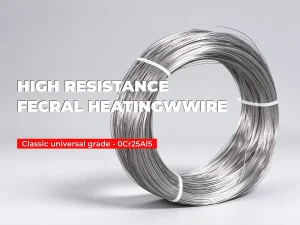
Iron-Chromium-Aluminum (FeCrAl) alloys, such as 0Cr25Al5, 0Cr23Al5, HRE 1350, and SGHYZ 1400, depend on the preferential diffusion of aluminum atoms to the surface, forming a dense, thermodynamically stable film of alpha-alumina ($\alpha\text{-Al}_2\text{O}_3$). Alumina exhibits an exceptionally low parabolic oxidation rate constant and extremely low electrical conductivity. This layer functions as an impenetrable ion diffusion barrier, preventing further oxygen ingress and beneath-scale metallic consumption even at temperatures exceeding 1350°C.
2. The Chromia Scale ($\text{Cr}_2\text{O}_3$) Response in NiCr Alloys
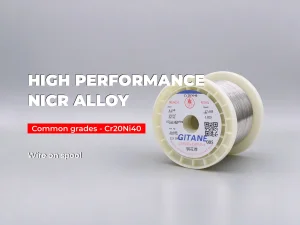
Nickel-Chromium (NiCr) alloys, including Cr20Ni80, Cr30Ni70, and Cr15Ni60, develop a protective surface layer consisting predominantly of chromia ($\text{Cr}_2\text{O}_3$) combined with a spinel sub-layer ($\text{NiCr}_2\text{O}_4$). While chromia scales are prone to volatilization into gaseous $\text{CrO}_3$ at temperatures above 1200°C, NiCr alloys exhibit vastly superior mechanical hot strength, resistance to thermal shock, and outstanding ductility post-service, making them ideal for high-cycle and complex mechanical element geometries.
3. Reactive Element Effect (REE) & Grain Refinement Metallurgy
To prevent premature scale spallation caused by growth stress and thermal expansion mismatch, modern high-grade factories introduce trace controlled additions of Rare Earth Elements (REE)—specifically Yttrium (Y), Zirconium (Zr), Hafnium (Hf), and Cerium (Ce). These reactive elements segregate to the oxide scale grain boundaries, pinning the scale to the metallic substrate via microscopic "pegging" structures and eliminating vacancy accumulation at the alloy-scale interface.
Comparative Engineering Matrix: FeCrAl vs. NiCr Alloys
To streamline industrial procurement and engineering selection, the table below provides a comprehensive physical and thermodynamic comparison across standard and specialized resistance heating alloy families produced according to GB/T 1234-2012 and international standards.
| Alloy Grade | Alloy Family | Max Temp (°C) | Resistivity (μΩ·m, 20°C) | Density (g/cm³) | Primary Industrial Application |
|---|---|---|---|---|---|
| SGHT Grade | PM FeCrAl (ODS) | 1425°C | 1.45 | 7.10 | Semiconductor diffusion, advanced ceramic sintering |
| SGHYZ 1400 | High-Purity FeCrAl | 1400°C | 1.42 | 7.10 | Powder metallurgy kilns, heavy industrial heat-treat |
| HRE 1350 | REE-Doped FeCrAl | 1350°C | 1.40 | 7.15 | Continuous mesh-belt furnaces, radiant tubes |
| 0Cr25Al5 | Standard FeCrAl | 1250°C | 1.42 | 7.10 | Industrial furnaces, heating elements, brake resistors |
| 0Cr23Al5 | Standard FeCrAl | 1250°C | 1.35 | 7.25 | Heat-treatment equipment, domestic appliances |
| Cr30Ni70 | Premium NiCr | 1250°C | 1.18 | 8.10 | Extreme atmospheric cycling, chemical processing |
| Cr20Ni80 | Standard Nichrome | 1200°C | 1.09 | 8.40 | Precision instruments, industrial heaters, appliances |
| Cr15Ni60 | NiCrFe Alloy | 1150°C | 1.11 | 8.20 | Domestic heating, industrial convection heaters |
| Cr20Ni40 | Economy NiCrFe | 1100°C | 1.04 | 8.00 | Low-temperature industrial ovens, rheostats |
Sector-Specific Industrial Solutions
The practical engineering requirements for resistance alloys vary wildly depending on chemical atmospheres, mechanical support designs, and duty cycle frequency. Below is how customized oxidation resistant alloys solve specific manufacturing pain points.
1. Powder Metallurgy & Vacuum Sintering
Challenge: Continuous belt sintering furnaces running at 1150°C–1300°C operate in aggressive reducing or cracked-ammonia atmospheres where standard heating wires experience severe carburization or nitridation.
Factory Solution: Deploying REE-doped HRE 1350 and SGHYZ 1400 wire coils. The pre-oxidized dense alumina surface prevents carbon ingress and maintains mechanical integrity under hydrocarbon atmospheres.
2. Semiconductor Wafer Thermal Processing
Challenge: Horizontal and vertical LPCVD diffusion furnaces demand strict ultra-clean heat zones free from metallic particulate flaking or outgassing that could contaminate silicon wafers.
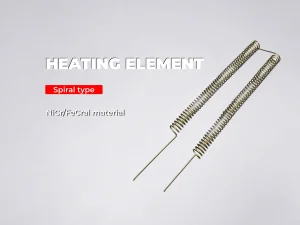
Factory Solution: Powder metallurgy manufactured SGHT grade wire formed into APM-equivalent heavy-gauge spiral coils. Zero scale flaking ensures ISO Class 4 cleanroom thermal stability up to 1425°C.
3. Photovoltaic (PV) Crystal Growth & Solar Cells
Challenge: Ingot pulling and polysilicon purifications demand intense thermal output over thousands of uninterrupted hours without resistance creep or electrical value drift.
Factory Solution: High-purity Cr30Ni70 and 0Cr25Al5 precision strip elements engineered with tight cross-sectional tolerances, providing linear power distribution across large spatial volumes.
4. Heavy Duty Industrial Braking & Load Resistors
Challenge: Locomotive braking grids, wind turbine power dissipation units, and crane hoisting drives subject resistor strips to extreme instantaneous thermal shocks and high current surges.
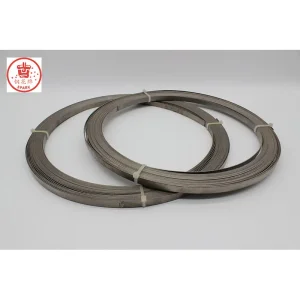
Factory Solution: Heavy-gauge 0Cr23Al5 and Cr15Ni60 corrugated strip modules boasting high vibration resistance, superior heat dissipation, and long-term ohmic stability.
Technology Roadmap: Next-Generation Metallurgical Innovations (2025–2035)
As global energy systems demand higher operational temperatures, faster ramp rates, and longer service intervals, research and development in electrothermal alloys is moving along three main engineering vectors:
Powder Metallurgy & ODS Synergy
Replacing traditional ingot casting with gas atomization and hot isostatic pressing (HIP) yields ultra-fine, homogeneous grain structures. Infusing nano-scale yttrium oxide ($\text{Y}_2\text{O}_3$) particles raises resistance to creep deformation up to 1425°C, effectively competing with expensive silicon carbide (SiC) elements.
Digital Melt Control & Purity Refining
Vacuum Induction Melting (VIM) coupled with Electroslag Remelting (ESR) allows real-time atomic emission spectroscopy monitoring. Pushing tramp impurities like sulfur, phosphorus, and carbon below 0.005% vastly improves ductility and scale adhesion.
Green Hydrogen Sintering Compatibility
As industrial furnaces transition to 100% pure hydrogen green atmospheres, resistance alloys must resist steam oxidation and embrittlement. Next-generation FeCrAl formulations optimize aluminum concentrations to maintain protective $\alpha\text{-Al}_2\text{O}_3$ growth in humidified $\text{H}_2$ environments.
Quality Assurance, Factory Audits & Export Logistics Support
As a specialized manufacturer with over six decades of metallurgical heritage, our production facilities enforce total process quality control—from raw nickel cake melting to final wire spooling and export packaging.
ISO 9001 & GB/T Compliance
Every master batch is produced strict to GB/T 1234-2012 specifications, tested via automated optical eddy-current inspection for surface defect elimination, and shipped with complete EN 10204 3.1 Mill Test Certificates (MTC).
Precision Resistance Tolerance
Our cold-drawing and bright-annealing lines guarantee cross-sectional dimensional tolerances down to ±0.01mm, maintaining tight ±3% electrical resistance uniformity across entire wire spools.
Export Custom Packaging
To prevent moisture damage or surface oxidation during ocean transit, finished coils and spools are sealed in desiccant-infused vapor barrier foil, cushioned, and packaged in solid fumigated export wooden cases.
Complete High-Temperature Portfolio & Raw Materials (Bottom Showcase)
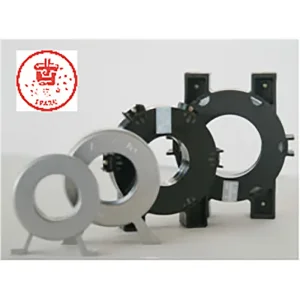
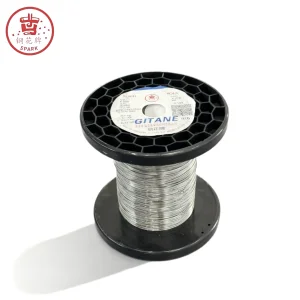
Direct purchasing quotes for raw pure nickel inputs, special ultra-high temperature FeCrAl grades, and pre-formed industrial spiral elements.


Frequently Asked Technical Questions & Sourcing Guide
Detailed engineering answers to the most common procurement, design, and metallurgical inquiries regarding high-temperature resistance heating alloys.