
Premier Factory-Direct Electric Heating Wire & Tubes
Explore high-temperature resistance wires, FeCrAl alloys, and customized industrial heating tube solutions manufactured directly from our Beijing facility.




Executive Summary: The Strategic Value of Wholesale Nickel-Chromium Wire
In modern industrial thermal processing, resistance heating alloys serve as the critical core for conversion efficiency, temperature uniformity, and operational durability. As a flagship subsidiary of Shougang Group, Beijing Shougang Gitane New Materials Co., Ltd. brings over 60 years of integrated metallurgical experience, specialized melting, vacuum refining, precision drawing, and cold-rolling to global B2B procurement networks.
This technical whitepaper examines the strategic selection, chemical kinetics, production standards, and global supply chain dynamics of Nickel-Chromium (Ni-Cr) and Iron-Chromium-Aluminum (Fe-Cr-Al) alloys under the SPARK brand portfolio. For procurement directors, furnace designers, and industrial distributors, understanding the nuance of nickel-chromium wire grade selection directly impacts total cost of ownership (TCO) and heating element service life in severe thermal environments up to 1425°C.
Metallurgical Comparison: Nickel-Chromium vs. FeCrAl Alloys
Understanding the microstructural phase stability, oxide growth kinetics, and hot strength differences between NiCr and FeCrAl systems is paramount for optimal element design.
Nickel-Chromium (NiCr) Alloys
Austenitic Phase Microstructure: NiCr alloys (such as Cr20Ni80, Cr30Ni70, and Cr15Ni60) exhibit a face-centered cubic (FCC) crystal structure that remains non-magnetic and structurally stable at high temperatures.
Superior Hot Strength & Ductility: Unlike ferritic alloys, NiCr wire retains high mechanical ductility after prolonged thermal cycling. It does not become brittle upon cooling, making maintenance, rewinding, or repairing furnace coils feasible without fracturing.
Adherent Chromia Scale (Cr₂O₃): NiCr forms a tough, self-passivating chromia oxide scale that prevents catastrophic spallation during rapid temperature ramping and power cycling.
Iron-Chromium-Aluminum (FeCrAl) Alloys
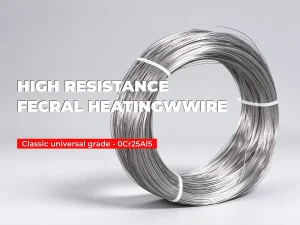
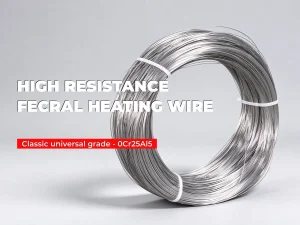
Ferritic Phase Microstructure: FeCrAl alloys (e.g., 0Cr25Al5, SGHYZ, SGHT) feature a body-centered cubic (BCC) structure characterized by high electrical resistivity and lower density than NiCr.
Ultra-High Temperature Rating (Up to 1425°C): FeCrAl forms an adherent, dense alpha-alumina ($Al_2O_3$) scale that protects the core alloy in extreme temperature applications where NiCr reaches its thermal limits.
Weight Efficiency & Cost Savings: With ~15% lower density than NiCr, FeCrAl yields significantly more linear meters per kilogram, providing major raw material savings in large-scale furnace constructions.
Technical Specification Matrix: Primary Resistance Alloy Grades
Comparative chemical compositions, electrical resistivity specs, and thermal limits compliant with GB/T 1234-2012, ASTM B267, and DIN 17470 standard benchmarks.
| Alloy Grade | Alloy System | Nominal Composition (%) | Resistivity at 20°C (μΩ·m) | Max Temp (°C) | Density (g/cm³) | Primary Industrial Applications |
|---|---|---|---|---|---|---|
| Cr20Ni80 / Cr20Ni80S | NiCr Austenitic | 80% Ni, 20% Cr | 1.09 ± 0.05 | 1200°C | 8.40 | Precision heat-treat, appliances, sealed heaters |
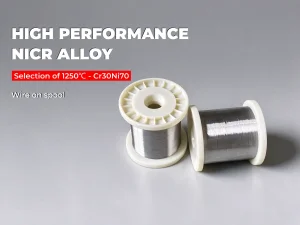
| Cr30Ni70 | NiCr Austenitic | 70% Ni, 30% Cr | 1.18 ± 0.05 | 1250°C | 8.10 | High-temp industrial furnaces, oxidizing atmosphere |
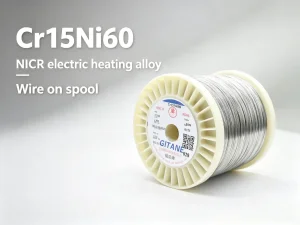
| Cr15Ni60 | NiCr Austenitic | 60% Ni, 15% Cr, Bal. Fe | 1.12 ± 0.05 | 1150°C | 8.20 | Domestic appliances, industrial bank resistors |
| SPARK SGHT | FeCrAl Powder Metal | High Cr-Al + Rare Earth | 1.45 ± 0.07 | 1425°C | 7.10 | Semiconductor diffusion, ceramic sintering |
| SPARK SGHYZ | FeCrAl Advanced | 25% Cr, 6% Al + Rare Earth | 1.42 ± 0.07 | 1400°C | 7.10 | Ultra-high-temp industrial kilns & furnaces |
| 0Cr25Al5 / 0Cr23Al5 | FeCrAl Standard | 23–25% Cr, 5% Al, Bal. Fe | 1.35–1.42 | 1250°C | 7.25 | Heat-treatment furnaces, radiant tube heaters |
China Factory Supply Chain & Manufacturing Ecosystem
How Shougang Gitane leverages vertically integrated metallurgical production to deliver unmatched quality consistency, scale, and cost performance for global B2B buyers.
End-to-End Vertical Integration
From primary vacuum induction melting (VIM) and electroslag remelting (ESR) down to precision cold drawing and annealing, complete internal control eliminates batch variation and trace impurity contamination.
Rigorous Metallurgical QA
Equipped with optical emission spectrometers, hydrogen/oxygen analyzer tools, tensile testing rigs, and continuous accelerated life-testing equipment operating per GB/T 1234 standards.
Scalable Global Supply Logistics
Operating an 88,000 m² modern manufacturing plant, our automated spooling, coiling, and rust-inhibitive vacuum packaging lines ensure fast international order fulfillment without transport degradation.
Strategic Sourcing Framework for Global Wholesale Buyers
A decision guide for enterprise procurement officers balancing element longevity, surface power loading ($W/cm^2$), and operational atmosphere dynamics.
1. Surface Load Density ($W/cm^2$) Optimization
The operational lifecycle of a nickel-chromium or FeCrAl wire is directly governed by its surface power loading density ($W/cm^2$). Exceeding maximum allowable surface loading causes localized hot-spots, accelerating protective oxide degradation.
- Industrial Air Furnaces: 1.5 – 2.5 $W/cm^2$ recommended for NiCr wire.
- Radiant Tube Elements: 2.0 – 3.2 $W/cm^2$ recommended for SPARK SGHYZ FeCrAl.
- Enclosed Appliance Cartridges: Up to 5.0 $W/cm^2$ depending on heat dissipation.
2. Atmosphere Compatibility Considerations
Atmospheric chemical makeup heavily dictates whether NiCr or FeCrAl should be deployed in custom industrial furnace applications:
- Carburizing & Carbon-Rich Environments: NiCr wire is highly resistant to "green rot" attack when micro-alloyed with silicon, outperforming basic FeCrAl.
- Nitrogen / Ammonia Atmospheres: NiCr forms a stable surface state, whereas FeCrAl may undergo nitriding, reducing core ductility.
- Sulfur-Bearing Gases: FeCrAl strongly outperforms NiCr, as nickel readily reacts with sulfur to form low-melting-point nickel sulfide eutectic phases.
Regulatory Compliance, Standards & Localization Support
Full conformance with global material engineering benchmarks, environmental standards, and custom localized packaging formats.
International Standard Conformance
Our nickel-chromium and FeCrAl resistance wire products strictly comply with ASTM B267 (Standard Specification for Wire for Electrical Resistance Resistors), DIN 17470, and JIS C2520 international engineering codes.
RoHS & REACH Compliance
All SPARK series resistance alloys are certified hazardous-substance free under EU RoHS 3 (Directive 2015/863) and SVHC REACH regulations, ensuring smooth compliance for downstream appliance OEM exporters.
Localized Supply & Custom Packaging
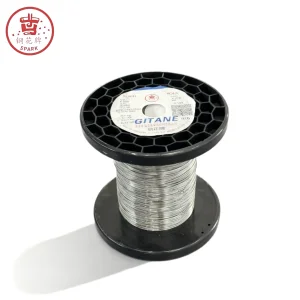
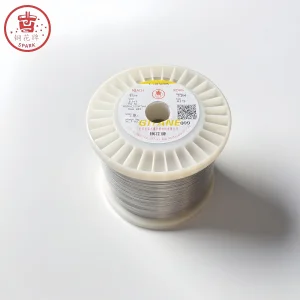
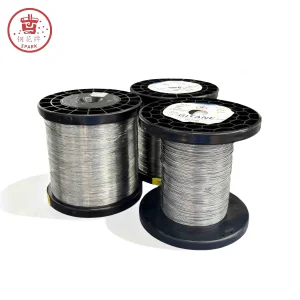
We supply fine wire on DIN100 to DIN250 plastic spools, heavy wire in catch-weight coils or payoff packs, and offer localized engineering consultation, custom dual-language mill test certificate (MTC) reports, and flexible incoterms (FOB, CIF, DDP).
Industry Trends & Advanced Application Scenarios
How modern decarbonization, high-tech manufacturing, and green electrification are driving demand for high-grade nickel-chromium and specialized resistance wires.
Green Energy & Photovoltaic Sintering
Photovoltaic silicon wafer production relies heavily on high-purity diffusion furnaces powered by SPARK SGHT and SGHYZ alloys, delivering ultra-precise temperature control across thermal zones up to 1400°C.
Industrial Kiln Decarbonization
Global ceramic, glass, and metallurgical industries are transitioning from gas-fired combustion to clean electric heating. High-strength nickel-chromium elements enable efficient, zero-emission high-temperature operation.
Semiconductor & Electronics Processing
In wafer thermal annealing, leadframe soldering, and thick-film resistor manufacturing, SPARK precision drawn fine NiCr wire ensures stable micro-resistance tolerances and low drift over time.
Frequently Asked Questions (FAQ) for Wholesale Procurement
Get fast, expert answers regarding specifications, minimum order quantities, life expectancy, and custom element fabrication.
What is the difference between Cr20Ni80 and Cr20Ni80S grade wires?
Why should an OEM choose NiCr over FeCrAl for industrial furnace elements?
What delivery forms and dimension ranges are available from your factory?
How does Shougang Gitane guarantee batch-to-batch electrical resistance uniformity?
What is the wholesale minimum order quantity (MOQ) and lead time?
Specialized Resistance Wires, Alloys & Custom Industrial Elements
Complete your supply chain requirements with our ultra-high temperature FeCrAl series, NiCr alloy strips, and custom furnace heating elements.



Partner with a Leading Nickel-Chromium Wire Manufacturer
Whether you require bulk spools of Cr20Ni80, ultra-high-temperature FeCrAl SGHT wire, or custom fabricated furnace elements, our engineering team provides complete technical support, sample testing, and worldwide delivery.