
High-Temperature Electrothermal Alloy Wire & Tubular Elements
Direct factory supply of FeCrAl and NiCr electrothermal products engineered for extreme thermal stability, low creep rate, and extended lifespan up to 1425°C.
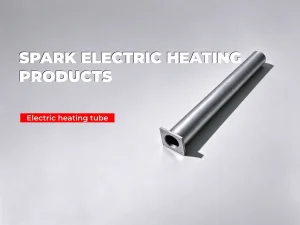
Wholesale SPARK SGHT Ultra-High Temperature FeCrAl Heating Tube | 1425°C Industrial Tubular Heating Element Factory, Quotes
View Product Details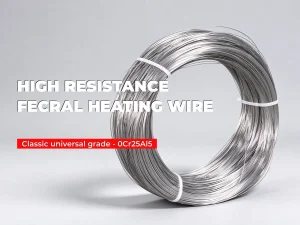
Wholesale 0Cr25Al5 FeCrAl Heating Wire | High Temp Industrial Resistance Wire Factory, Pricelist
View Product Details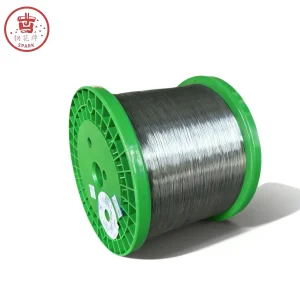
China High-Performance SPARK 0Cr20Al6 Heating Wire 1350℃ - China Suppliers & Factory for Electrothermal Applications Factory, Pricelist
View Product Details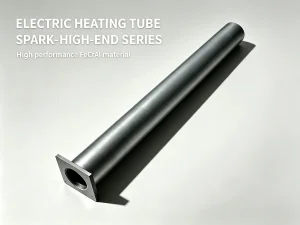
Wholesale Ultra-High Temperature FeCrAl Heating Tube 1425°C | China Suppliers & Factory for Industrial Applications Factory, Factories
View Product Details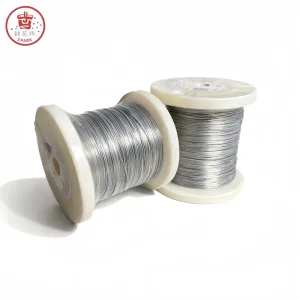
China High-Temperature Cr30Ni70 Alloy Wire - Durable 50 Hours @ High Temp | China Suppliers & Factory Manufacturer, Pricelist
View Product Details
Wholesale 1400℃ High Temperature Electric Resistance Wire - SGHYZ from China Suppliers and Factory Manufacturers, Factories
View Product Details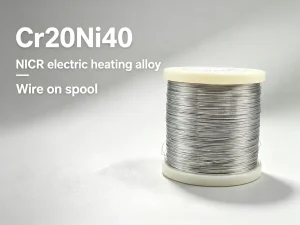
Wholesale China Cr20Ni40 Nickel Chrome Heating Wire: High-Temperature Resistant Alloy from Trusted Suppliers and Factory Manufacturer, Factory
View Product Details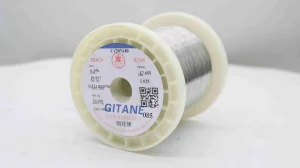
Wholesale Cr20Ni40 Nickel Chrome Heating Wire - High-Temperature Resistance Alloy from China Suppliers & Factory Manufacturer, Factories
View Product Details1. Executive Summary: Electrical Resistivity in High-Temperature Metallurgy
Understanding the physics of high resistivity ($\rho$) alloys for precision electrothermal conversion, structural thermal stability, and energy-efficient heating design.
In modern high-temperature thermal engineering, high electrical resistivity ($\rho \ge 1.00 \, \mu\Omega\cdot\text{m}$) represents a core metallurgical parameter required to achieve optimal Joule heating efficiency ($P = I^2 R = V^2 / R$). Sourcing wholesale electrothermal alloys from certified global manufacturers necessitates a granular analysis of how electrical resistivity interacts with chemical composition, phase stability, surface oxidation dynamics, and temperature coefficient of resistance ($C_t$).
High resistivity materials, specifically Iron-Chromium-Aluminum (FeCrAl) and Nickel-Chromium (NiCr) alloys, serve as the primary thermal generation engines across global industrial kilns, semiconductor diffusion furnaces, lithium-ion battery cathode sintering equipment, and aerospace heat-treating facilities. By maintaining high specific electrical resistance at elevated operating temperatures ($1000^\circ\text{C}$ to $1425^\circ\text{C}$), thermal design engineers can utilize thicker wire cross-sections or strip dimensions. This directly extends element operational life, prevents hot-spot formation, and reduces structural sag caused by thermal creep.
Joule Conversion Efficiency
High specific resistance optimizes electric energy dissipation directly into infrared and conductive thermal heat, minimizing resistive current losses in lead-in rods and electrical terminals.
Alpha-Alumina Protection
FeCrAl alloys form a self-healing, thermodynamically stable $\alpha\text{-Al}_2\text{O}_3$ scale at temperatures above $1000^\circ\text{C}$, providing complete dielectric and oxidation defense in air and aggressive gases.
High Formability & Creep Strength
NiCr alloys maintain superior hot strength and room-temperature ductility post-heating, preventing embrittlement during maintenance or thermal shock cycling.
2. Global Commercial & Industrial Landscape of High Resistivity Alloys
Market dynamics, global decarbonization directives, and procurement trends driving high-temperature electrothermal material demand across tier-1 industrial markets.
The worldwide market for wholesale high resistivity alloys is undergoing a structural expansion, driven primarily by the global transition from fossil-fuel-fired combustion heating to electric-driven thermal processing. Driven by net-zero industrial mandates across Europe, North America, and Asia-Pacific, industries such as metallurgy, ceramic sintering, semiconductor crystal growth, and glass manufacturing are electrifying their furnace infrastructure.
Green Steel & Hydrogen Processing
Industrial green steel annealing and direct reduced iron (DRI) plants require ultra-high-temperature electric preheaters operating in pure $H_2$ or reducing gas environments, accelerating demand for specialized FeCrAl grades such as SPARK SGHYZ and SGHT rated up to 1425°C.
Lithium Battery Cathode Kilns
Production of LFP (Lithium Iron Phosphate) and NCM (Nickel Cobalt Manganese) precursor powders requires continuous roller hearth kilns (RHK). Electrothermal wire with high resistivity and resistance to corrosive lithium vapor contamination is essential for un-interrupted 24/7 kiln campaigns.
Semiconductor & Solar Silicon
Photovoltaic ingot pulling and wafer diffusion furnaces require resistance wire featuring sub-micron chemical purity, exceptional thermal uniformity ($\pm 0.5^\circ\text{C}$ across heat zones), and near-zero particle spallation.
3. Metallurgy Technology Roadmap: Powder Metallurgy vs. Induction Melting
Comparative structural analysis of traditional melt processing versus advanced Powder Metallurgy (PM) dispersion-strengthened electrothermal alloys.
Historically, resistance heating alloys were produced via standard Vacuum Induction Melting (VIM) followed by Electro-Slag Remelting (ESR). While cost-effective for medium-temperature applications (up to 1200°C), conventional FeCrAl alloys suffer from severe grain coarsening at temperatures exceeding 1300°C, leading to structural sag, embrittlement, and premature furnace element failure.
Beijing Shougang Gitane New Materials Co., Ltd. has established a technical benchmark by developing Powder Metallurgy (PM) High-Resistivity Alloys (such as SPARK SGHT). By utilizing gas atomization, cold isostatic pressing (CIP), and hot extrusion, PM alloys introduce fine Oxide Dispersion Strengthening (ODS), preventing grain boundary sliding under high thermal stress.
| Performance Parameter | Conventional VIM/ESR FeCrAl (e.g. 0Cr25Al5) | SPARK PM Series (SGHT / SGHYZ) | NiCr Alloys (e.g. Cr20Ni80) |
|---|---|---|---|
| Max Operating Temperature | 1250°C | 1400°C – 1425°C | 1200°C |
| Electrical Resistivity (20°C) | 1.42 $\mu\Omega\cdot\text{m}$ | 1.45 – 1.50 $\mu\Omega\cdot\text{m}$ | 1.09 $\mu\Omega\cdot\text{m}$ |
| Sag Resistance & Creep Life | Moderate (Grain coarsening above 1100°C) | Extreme (ODS grain pinning mechanism) | High hot strength, low sag |
| Oxide Scale Type | Standard $\alpha\text{-Al}_2\text{O}_3$ scale | Ultra-dense, non-spalling $\alpha\text{-Al}_2\text{O}_3$ | Adherent $\text{Cr}_2\text{O}_3$ layer |
| Ductility Post-High Temp Service | Brittle at room temperature | Improved grain retention | Excellent (Remains ductile) |
4. Engineering Grade & Physical Property Data Matrix
Comprehensive engineering reference data according to GB/T 1234-2012 and ASTM international standards for electrothermal alloy procurement.
| Alloy Grade | Family | Max Temp (°C) | Resistivity ($\mu\Omega\cdot\text{m}$) | Density ($\text{g/cm}^3$) | Atmosphere Suitability |
|---|---|---|---|---|---|
| SPARK SGHT | FeCrAl (PM) | 1425°C | 1.45 | 7.10 | Air, Oxidizing, Carburizing resistant |
| SPARK SGHYZ | FeCrAl | 1400°C | 1.45 | 7.10 | Air, Inert, Vacuum, High-Temp Ceramic |
| SPARK HRE | FeCrAl | 1350°C | 1.42 | 7.15 | Powder metallurgy, Kilns |
| 0Cr25Al5 | FeCrAl | 1250°C | 1.42 | 7.15 | Industrial furnaces, Radiant tubes |
| 0Cr20Al6 | FeCrAl | 1350°C | 1.35 | 7.20 | Resistive heating coils, Appliances |
| Cr30Ni70 | NiCr | 1250°C | 1.18 | 8.10 | Nitrogen ($N_2$), Ammonia, Reducing |
| Cr20Ni80 | NiCr | 1200°C | 1.09 | 8.40 | Frequent thermal cycling, Appliances |
| Cr15Ni60 | NiCr | 1150°C | 1.11 | 8.20 | Industrial rheostats, Floor heating |
5. Surface Load ($W/\text{cm}^2$) & Element Sizing Calculations
Mathematical framework for thermal design engineers to optimize electrical resistivity, wire gauge selection, and surface load dissipation.
Key Sizing Formulas
1. Electrical Resistance at Operating Temp ($R_t$):
$$R_t = R_{20} \times C_t$$
Where $C_t$ is the temperature correction factor for specific alloy resistivity.
2. Surface Watt Loading ($w$):
$$w = \frac{P}{\pi \cdot d \cdot L} \quad (\text{W/cm}^2)$$
Where $P$ is power (Watts), $d$ is wire diameter (cm), and $L$ is active heating wire length (cm).
3. Wire Diameter Sizing Formula ($d$):
$$d = \sqrt[3]{\frac{4 \cdot \rho_{t} \cdot P^2}{\pi^2 \cdot U^2 \cdot w}}$$
Where $U$ is applied system voltage and $\rho_t$ is resistivity at operating temperature.
Recommended Maximum Surface Load Limits
Exceeding recommended watt loading causes rapid oxidation scaling and hot-spot failure. Always adjust surface load based on furnace operating temperature:
- 1400°C (FeCrAl SGHT/SGHYZ): $1.2 - 1.8 \, \text{W/cm}^2$ (Exposed elements)
- 1200°C (FeCrAl 0Cr25Al5): $2.0 - 2.8 \, \text{W/cm}^2$ (Tubular / Spiral coils)
- 1000°C (NiCr Cr20Ni80): $3.0 - 4.5 \, \text{W/cm}^2$ (Intermittent appliance)
- Ceramic Fiber Embedded Modules: $1.0 - 1.5 \, \text{W/cm}^2$ (Insulated environment)
6. Global Application Scenarios & Heavy Industry Integration
Customized electrothermal solutions designed for high-stress manufacturing environments around the world.
Lithium Battery Production
Roller hearth kilns utilizing heavy-gauge SPARK 0Cr25Al5 ribbon elements to resist corrosive lithium salt vaporization during cathode calcination.
Industrial Heat Treatment
Pit furnaces and bell-type annealing furnaces fitted with SPARK SGHYZ spirals to deliver fast, uniform heat for aerospace alloy components.
Semiconductor Processing
Ultra-clean vertical diffusion furnaces using powder metallurgy SGHT heating tubes to ensure minimal particle contamination during wafer annealing.
Advanced Technical Ceramics
Sintering furnaces operating up to 1400°C for zirconia and alumina components using high-density FeCrAl element arrays.
High Resistivity Wire, Strips & Specialized Ceramic Assemblies
Explore our complete catalog of factory-certified electrothermal resistance wire, coiled elements, and ceramic heating plates.
Wholesale SPARK SGHYZ 1400℃ High Temperature Electric Heating Wire | China Suppliers & Factory Suppliers, Pricelist
View Product Details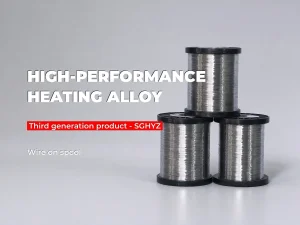
China High-Temperature FeCrAl Heating Wire 1400°C - Premium China Suppliers & Factory for Industrial Use Manufacturers, Supplier
View Product Details
China High-Temperature Cr30Ni70 Alloy Wire from China Suppliers - Durable 50-Hour Life in Extreme Conditions Factory, Quotes
View Product Details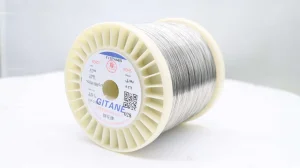
China China Cr15Ni60 High Temp Electric Heating Wire - Quality Suppliers & Factory for Industrial Heating Solutions Manufacturer, Factories
View Product Details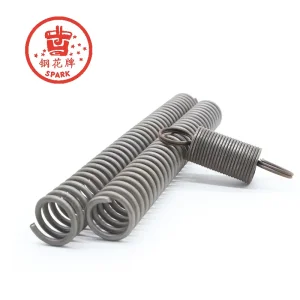
China Hot sale China Alumina Ceramic Fiber Resistance Wire Heating Plate Factory, Quotes
View Product Details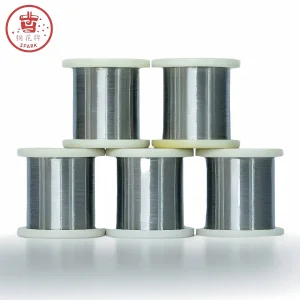
China China Cr20Ni80 Electric Heating Wire Suppliers | High-Quality Resistance Wire from Factory Manufacturer, Pricelist
View Product Details
Wholesale High-Temperature Cr30Ni70 Alloy Wire - Durable, 50-Hour Life | China Suppliers & Factory Factory, Quotes
View Product Details
Wholesale High-Temperature Durable Cr30Ni70 Alloy Wire from China Suppliers - 50 Hours Life at High Temp Factory Direct Factory, Quotes
View Product Details7. Shougang Gitane Quality Management & Metallurgical Testing
Combining 60+ years of state-owned steel conglomerate legacy with modern ISO 9001 precision engineering.
50-Hour Accelerated Life Test
Every melt batch undergoes strict high-temperature accelerated life testing per GB/T 1234-2012 / ASTM B78 standards, confirming oxidation lifespan prior to mill release.
Spectral Analysis & Tolerances
Inductively Coupled Plasma (ICP) spectroscopy verifies trace rare earth additions (Y, Ce, Zr), guaranteeing uniform electrical resistivity ($\pm 3\%$) across 10,000+ meter spools.
Traceable Mill Test Reports
Full EN 10204 3.1 certification provided with every wholesale shipment, recording mechanical tensile strength, elongation, physical density, and room-temperature resistivity.
8. Technical & Procurement Frequently Asked Questions
Expert answers based on Google EEAT search quality criteria for industrial heating elements and alloy wire procurement.
Why is FeCrAl alloy chosen over Nichrome (NiCr) for high-temperature industrial furnaces?
FeCrAl alloys offer a higher maximum operating temperature (up to 1425°C compared to NiCr's 1200°C), higher electrical resistivity (1.45 vs 1.09 $\mu\Omega\cdot\text{m}$), lower specific density (saving up to 15% material weight), and superior resistance to sulfur-containing atmospheres. However, NiCr is preferred in applications requiring post-heating ductility and frequent thermal shock or cycling.
How does electrical resistivity change with temperature in electrothermal alloys?
Resistivity increases with temperature based on the Temperature Coefficient of Resistance ($C_t$). FeCrAl alloys exhibit a very low and stable temperature factor ($C_t$ stays between 1.00 and 1.06 up to 1400°C), minimizing cold-to-hot current surges upon startup. NiCr alloys exhibit a slightly higher resistance increase ($C_t \approx 1.08$ at 1100°C).
What standard delivery forms are available for wholesale electrothermal resistance materials?
We supply round wire (diameters 0.10 mm to 12.0 mm), cold-rolled flat strip/ribbon (thickness 0.2 mm to 4.0 mm, width 5.0 mm to 200 mm), pre-wound spiral coils, ceramic fiber embedded heating elements, and fabricated tubular heating tubes customized to engineering drawings.
What is the impact of protective atmospheres (Hydrogen, Nitrogen, Vacuum) on element life?
In pure Nitrogen or Ammonia atmospheres, NiCr alloys (e.g. Cr30Ni70) perform better because FeCrAl is prone to nitridation above 950°C unless pre-oxidized. In vacuum, element vapor pressure must be evaluated; NiCr has higher chromium evaporation rates at high temperatures, whereas FeCrAl pre-formed alumina scale provides excellent dielectric protection.
Request Custom Technical Calculation & Wholesale Pricing
Our metallurgical engineering team provides precise surface load calculations, custom alloy grade selection, and factory-direct wholesale quotations within 24 hours.
Connect with Application Engineers