
Featured Precision Alloy Wire & Industrial Elements (Part I)
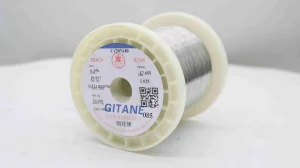
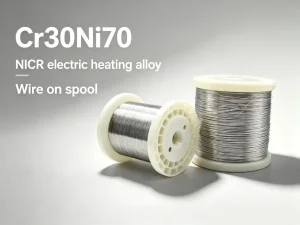
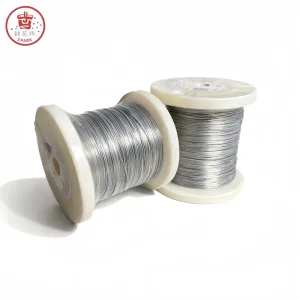
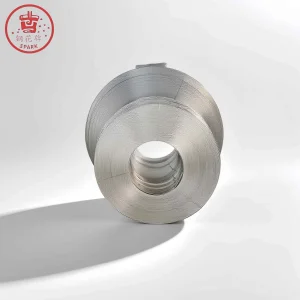
Metallurgical Science of Cold Formability: Enabling Seamless Coiling, Bending, Weaving, and Stamping
In automated heating element fabrication, material cold-formability dictates operational throughput, tool wear, and component failure rates. Standard resistance alloys frequently suffer from work-hardening brittleness, surface micro-cracking, and electrical resistance drift when subjected to severe mechanical deformation. Shougang Gitane's specialized metallurgical processing overcomes these engineering bottlenecks.
Grain Boundary Engineering
By controlling vacuum induction melting (VIM) and precision ingot solidification, we achieve ultra-fine grain microstructures. This ensures uniform strain distribution across grain boundaries during multi-axis bending and high-speed coiling.
Controlled Hydrogen Annealing
Continuous bright annealing under pure hydrogen atmosphere removes internal residual stress while maintaining a completely oxide-free surface, ensuring high ductility ($\delta \ge 20\%$) and pristine die contact during stamping.
Zero Resistance Drift
Mechanical deformation alters crystal lattices, often causing resistance spikes. SPARK alloys undergo thermal stabilization to guarantee that cross-sectional dimensional changes yield predictable $\Omega/m$ values post-forming.
4-Axis Manufacturing Compatibility Breakdown
Different thermal processing applications require distinct cold-forming disciplines. The table and technical roadmap below outline the mechanical behaviors of SPARK FeCrAl and NiCr alloys across automated fabrication lines.
High-Speed Coiling (绕丝)
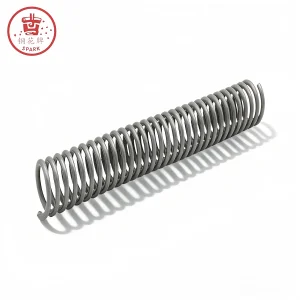
Optimized for high-turn ratio helical coils on automatic CNC coiling machines. Eliminates springback variability, allowing tight mandrel ratios ($D/d \ge 3$) without internal micro-fracturing or coil pitch deformation.
Precision Bending (折弯)
Essential for hairpin (U-shape), meander, and corrugated radiant tube heating cores. Supports tight bending radii ($R \ge 1.5d$) without outer-radius necking or localized electrical hotspot formation.
High-Tensile Weaving (编织)
Engineered for woven mesh furnace belts, flexible heating blankets, and filtration nets. High yield-to-tensile ratio ensures smooth shuttle operation without strand snapping or abrasive surface galling.
Progressive Stamping (冲压)
Tailored for cold-rolled strip, ribbon elements, and brake resistor disks. Excellent Erichsen cupping values allow clean blanking, deep drawing, and piercing without edge burring or burr-induced cracking.
Metallurgical Formability & Performance Matrix
| Alloy Grade | Alloy Family | Max Temp (°C) | Resistivity ($\mu\Omega\cdot\text{m}$) | Elongation ($\delta\%$) | Min. Bend Radius ($R$) | Primary Forming Suitability |
|---|---|---|---|---|---|---|
| SPARK SGHT | FeCrAl (PM) | 1425°C | 1.45 | ≥ 18% | $2.0 \times d$ | Coiling, Bending, Heavy Strip Stamping |
| SPARK SGHYZ | FeCrAl Rare-Earth | 1400°C | 1.42 | ≥ 20% | $1.8 \times d$ | Helical Coiling, Corrugated Bending |
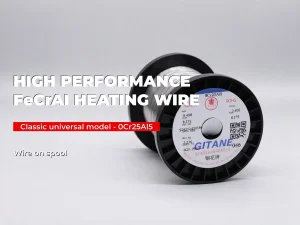
| 0Cr25Al5 | Standard FeCrAl | 1250°C | 1.42 | ≥ 20% | $1.5 \times d$ | High-Speed Coiling, Stamping |
| 0Cr23Al5 | Standard FeCrAl | 1250°C | 1.35 | ≥ 22% | $1.5 \times d$ | Mesh Weaving, Coiling, Bending |
| Cr20Ni80 | NiCr Nichrome | 1200°C | 1.09 | ≥ 27% | $1.0 \times d$ | Intricate Stamping, Weaving, Fine Coiling |
| Cr30Ni70 | NiCr Nichrome | 1250°C | 1.18 | ≥ 25% | $1.2 \times d$ | Complex Bending, Heavy Stamping |
Meeting Demand Across High-Growth Thermal Processing Sectors
The global transition toward industrial electrification, renewable energy manufacturing, and high-efficiency thermal processing requires resistance wire capable of handling intense thermal cycling and rigorous cold fabrication.
Solar Photovoltaic & Semiconductor
Diffusion furnaces and polysilicon crystal growth systems demand high-purity FeCrAl alloys (HRE, SGHYZ) wound into tight, zero-contamination heating cores operating continuously up to 1350°C–1400°C.
Electric Vehicle (EV) Battery Manufacturing
Lithium-ion cathode material calcination kilns require continuous woven wire mesh belts and stamped heating elements built to withstand corrosive lithium vapor and thermal shock.
Green Hydrogen & Decarbonized Steel
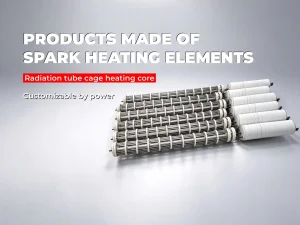
Electrolyzer preheating units and direct reduced iron (DRI) reheating furnaces rely on high-capacity stamped ribbon elements and radiant tube heating bundles designed for prolonged continuous duty.
Localized Application Scenarios & Engineering Case Studies
How global industrial manufacturers implement SPARK formable alloys in regional production hubs.
Case Study 1: North American Automotive Heat Treating
Scenario: A leading Tier-1 automotive supplier in the US Midwest experienced frequent wire cracking during automated CNC multi-axis bending of hairpin radiant elements.
SPARK Solution: Replaced standard 0Cr25Al5 with SPARK 0Cr23Al5 custom-annealed wire. The tighter grain size distribution increased elongation to 23%, reducing bend-radius fracture rates from 4.2% to 0.00% across 50,000 meters of wire.
Case Study 2: European Glass Tempering & Ceramic Kilns
Scenario: A German furnace manufacturer needed woven mesh belts capable of operating at 1150°C in cyclic atmosphere kilns without premature creep elongation.
SPARK Solution: Deployed SPARK Cr30Ni70 high-nickel alloy wire for fine mesh weaving. The high hot-strength and micro-addition of reactive elements doubled belt operating lifespan while preserving mesh geometric consistency.
Case Study 3: East Asian Semiconductor Diffusion Lines
Scenario: A wafer fabrication equipment maker required ultra-dense ceramic bundle rod heating cores operating at 1350°C without sag.
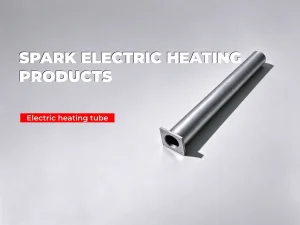
SPARK Solution: Integrated SPARK HRE and SGHT powder-metallurgy alloy tubes and heavy gauge coiling wire, achieving zero surface particle flaking and extended high-temperature shape retention.
Shougang Gitane: Fully Integrated Metallurgical Ecosystem
As part of the world-renowned Shougang Group, Beijing Shougang Gitane New Materials Co., Ltd. controls the complete supply chain from raw ore melting to finished precision wire, strip, and fabricated elements.
88,000 m² Manufacturing Footprint
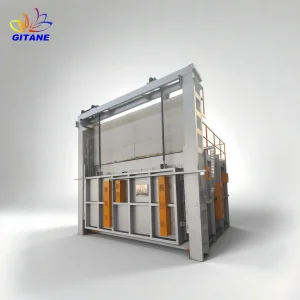
Our modern production facility in Changping, Beijing houses 39,268 m² of specialized metallurgy workshops, including VIM furnaces, cold rolling mills, wire drawing lines, and automated coiling equipment.
100% In-House Quality Assurance
Every batch undergoes chemical spectral analysis, continuous eddy current flaw detection, room-temperature tensile testing, and accelerated high-temperature life cycle testing according to GB/T 1234-2012.
Raw Material & Cost Stability
Direct access to primary chromium, nickel, aluminum, and rare-earth metal reserves insulates OEM buyers from volatile spot-market price swings and guarantees multi-year contract delivery reliability.
Global Compliance & Localized Technical Services
Ensuring seamless international integration through rigorous certification, custom packaging, and engineering technical support.
International Certifications
Certified under ISO 9001 quality management systems since 2003 (and ISO 9002 since 1996). All FeCrAl and NiCr alloys fully comply with EU RoHS, REACH, and ASTM material standards, shipped with certified Mill Test Reports (MTR).
Export Packaging & Protection
Wire spools, spooled coils, and flat strips are vacuum-sealed with desiccant in moisture-proof foil packaging, enclosed in heavy-duty wooden crates to prevent surface oxidation or physical distortion during transoceanic transit.
Engineering On-Call Support
Over 30% of Shougang Gitane's 500+ workforce consists of technical and research engineers. We provide custom surface-load calculations ($W/\text{cm}^2$), alloy selection guidance, and die design advice for global client projects.
Frequently Asked Questions by Furnace Engineers & Buyers
In-depth answers covering cold-forming parameters, alloy selection criteria, and maintenance guidelines.
Why do FeCrAl alloys require specific handling during cold coiling and bending compared to NiCr?
FeCrAl alloys possess a body-centered cubic (BCC) crystal structure, which inherently exhibits higher yield strength and slightly lower room-temperature ductility than face-centered cubic (FCC) NiCr alloys. While SPARK FeCrAl wire is bright-annealed to maximize elongation ($\ge 20\%$), we recommend maintaining a minimum bend radius ($R \ge 1.5d$) and ensuring coiling mandrels maintain consistent tension to prevent localized stress concentration. For wire diameters above 6mm, pre-warming the material to 200°C–300°C can facilitate ultra-tight forming radii if required.
How does cold stamping or severe bending affect the electrical resistance of strip elements?
Cold deformation causes localized work-hardening, slightly altering the dislocation density within the crystal lattice, which can lead to minor temporary fluctuations in electrical resistivity. However, because SPARK resistance alloys feature ultra-homogeneous chemical compositions, cross-sectional thinning is minimized during stamping or deep drawing. Once the heating element reaches its operating temperature, residual mechanical stresses relieve naturally, and electrical resistance stabilizes precisely within design specs ($\pm 1.5\%$).
Can SPARK alloys be re-bent or repaired after high-temperature operation?
FeCrAl alloys form a protective, dense aluminum oxide ($\alpha\text{-Al}_2\text{O}_3$) layer during elevated temperature service, which causes grain growth and embrittlement upon cooling to room temperature. Therefore, used FeCrAl elements should not be cold-formed or re-bent. Conversely, NiCr alloys (such as Cr20Ni80 and Cr30Ni70) retain excellent post-service room-temperature ductility and can be re-bent or welded if maintenance repairs are required.
What delivery forms and dimensional tolerances are available for automated processing lines?
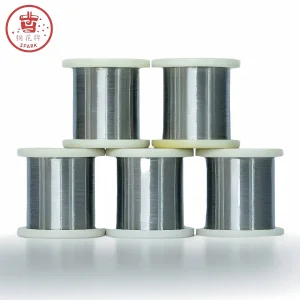
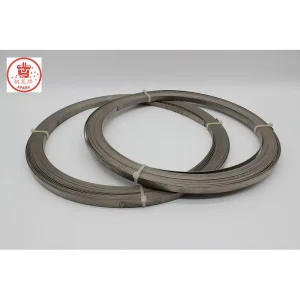
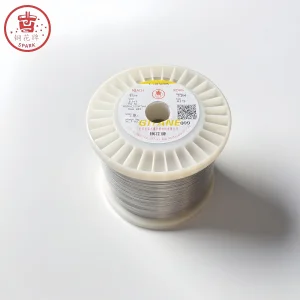
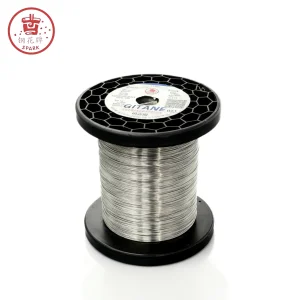
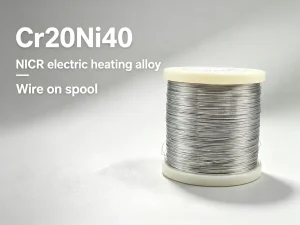
We supply round wire from 0.05mm to 12.0mm in plastic spools or carrierless coils, flat ribbon wire from 0.2×1.0mm to 5.0×12.0mm, cold-rolled strip up to 350mm width, and custom pre-formed helical coils or radiant tube heating elements. Diameter tolerances are tightly controlled down to $\pm 0.01\text{mm}$ for fine wire, ensuring flawless feed on high-speed CNC forming equipment.
Which alloy family (FeCrAl vs NiCr) offers lower total cost for industrial furnaces?
FeCrAl alloys offer significant cost advantages due to their lower material density (approximately 15% lighter than NiCr) and higher electrical resistivity, meaning less material weight is required to achieve the same electrical wattage. Additionally, FeCrAl supports higher maximum operating temperatures (up to 1425°C vs 1250°C for NiCr). However, NiCr is preferred in applications requiring post-use ductility, frequent thermal cycling, or nitrogen/carburizing atmospheres.
How do I request mill test certificates or sample spools for trials?
Sample spools and customized strip trial quantities are readily available for qualifying engineering teams. Every sample shipment includes comprehensive Mill Test Reports (MTR) detailing chemical analysis (spectrometry), tensile strength, elongation percentage, and room-temperature electrical resistance per meter.
Featured Precision Alloy Wire & Industrial Elements (Part II)
Optimize Your Formed Heating Element Production Today
Connect with Shougang Gitane's metallurgical engineering team to specify ideal wire gauges, cold-forming parameters, and alloy grades tailored to your furnace designs.
Request Engineering Consultation & Quote