
High Performance Resistance Wires & Heating Core Elements
Explore our top-tier wholesale resistance heating wires, tubes, and alloy strip products engineered with exceptional oxide film tenacity to minimize flaking and thermal degradation.


Metallurgical Foundations: Why Oxide Film Adhesion Dictates Heating Alloy Longevity
In high-temperature electric heating systems operating between 1000°C and 1425°C, the service life of resistance wire is directly governed by the structural integrity, density, and adherence of its protective oxide layer.
Passivation Film Dynamics ($\alpha-\text{Al}_2\text{O}_3$ & $\text{Cr}_2\text{O}_3$)
When exposed to elevated temperatures, FeCrAl alloys form an alpha-alumina ($\alpha-\text{Al}_2\text{O}_3$) surface layer, whereas NiCr alloys form a chromia ($\text{Cr}_2\text{O}_3$) protective scale. This microscopic passivation barrier prevents rapid oxygen diffusion into the core metallic matrix, drastically lowering the parabolic oxidation rate.
The Mechanics of Oxide Scale Spalling
Thermal cycling induces severe thermomechanical stress due to mismatch in Coefficient of Thermal Expansion ($\Delta \text{CTE}$) between the oxide layer and the base alloy. Standard wire alloys suffer micro-cracking and flaking (spalling). Loss of protective oxide accelerates local aluminum/chromium depletion, leading to hot spots and rapid catastrophic burnout.
Reactive Element Effect (REE) Micro-Alloying
SPARK proprietary electrothermal alloys incorporate controlled micro-additions of rare earth elements (Yttrium Y, Zirconium Zr, Cerium Ce, Neodymium Nd). REE ions segregate to oxide grain boundaries, creating mechanical oxide "pegs" that lock the scale to the substrate, virtually eliminating oxide peeling under frequent thermal shock.
The SPARK Information Gain Advantage: Non-Spalling Oxide Layer Engineering
Conventional wholesale resistance wire suppliers often focus purely on cold resistance and composition. However, true operational economy is determined by oxide adhesion density under high-frequency thermal cycling. By optimizing melt purity via Vacuum Induction Melting (VIM) and Electroslag Remelting (ESR), SPARK eliminates harmful trace contaminants (such as sulfur and phosphorus) that degrade oxide interface strength. The result is a non-peeling oxide film that maintains dimensional integrity, suppresses element sagging, and extends operational lifespan by up to 180% compared to standard commercial grades.
Electrothermal Alloy Grade Comparison & Oxide Adhesion Metrics
Select the optimal high-adhesion heating wire or ribbon grade tailored to your furnace atmosphere, temperature threshold, and cycle frequency requirements.
| Alloy Grade | Alloy System | Max Temp (°C) | Resistivity (μΩ·m, 20°C) | Oxide Scale Type | Oxide Adhesion Rating | Primary Industrial Application |
|---|---|---|---|---|---|---|
| SPARK SGHYZ | FeCrAl + Rare Earths | 1400°C | 1.45 | $\alpha-\text{Al}_2\text{O}_3$ (Dense) | Superior (Non-Spalling) | Ultra-High Temp Ceramic Sintering & Diffusion |
| SPARK 0Cr25Al5 | FeCrAl Standard | 1250°C | 1.42 | $\alpha-\text{Al}_2\text{O}_3$ | High Adhesion | Industrial Heat Treating & Radiant Tubes |
| SPARK 0Cr21Al6Nb | FeCrAl + Niobium | 1350°C | 1.45 | $\text{Al}_2\text{O}_3$ + Nb Carbonitrides | Superior Creep Resistance | Heavy Duty Kilns & Continuous Annealing |
| SPARK Cr20Ni80S | NiCr Premium | 1200°C | 1.09 | $\text{Cr}_2\text{O}_3$ / $\text{NiCr}_2\text{O}_4$ | Excellent Ductility | Precision Lab Equipment & Rapid Thermal Cycling |
| SPARK Cr30Ni70 | NiCr High Chrome | 1250°C | 1.18 | $\text{Cr}_2\text{O}_3$ Rich Scale | High Corrosion Resilience | Controlled Atmosphere & Chemical Process Furnaces |
| Standard FeCrAl (Competitor) | FeCrAl Basic | 1200°C | 1.38 | Mixed Porous Oxide | Moderate (Prone to Peeling) | Low-Cost Commercial Heating Elements |
Solving Global Enterprise Procurement Challenges in High-Temp Operations
For procurement officers and chief thermal engineers at enterprise industrial furnace builders, alloy selection directly impacts Total Cost of Ownership (TCO) and operational risk.
Reducing Unplanned Downtime & Maintenance Costs
When low-adhesion resistance wire oxide peels off, micro-particles drop onto heating elements or refractory hearths, causing localized short circuits and hot-spot melting. SPARK non-spalling technology guarantees continuous oxide layer protection, dramatically extending element change intervals.
Batch-to-Batch Uniformity & Traceability
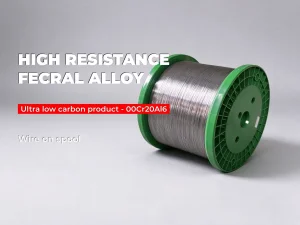
Inconsistent coil resistance leads to un-even thermal distribution in multi-zone diffusion furnaces. We ensure batch consistency through strict ingot spectrographic analysis, automated wire drawing dies, and digital resistance measuring for every single spool.
Customized Supply Forms & Quick Delivery
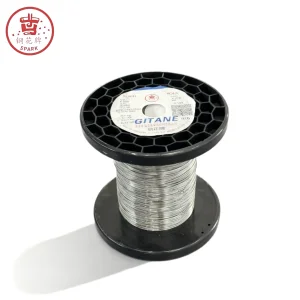
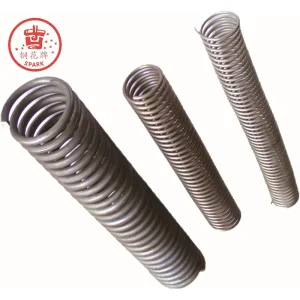
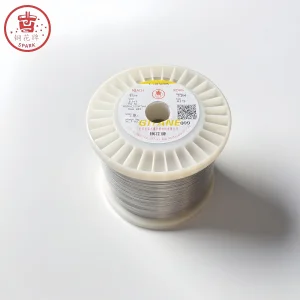
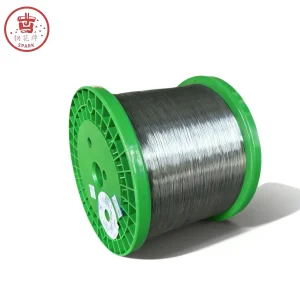
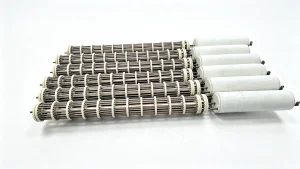
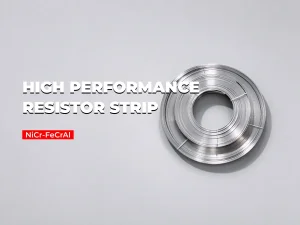
From fine wire (0.1mm) to thick rod (12mm), flat strip ribbons, pre-wound spiral coils, and bundle rod radiant cores, our flexible production lines accommodate OEM custom drawings with short lead times and sea/air export packaging.
China Sourcing & Manufacturing Superiority: Backed by Shougang Group
Beijing Shougang Gitane New Materials Co., Ltd. combines state-owned enterprise metallurgical mastery with agile, state-of-the-art alloy processing.
Fully Integrated Production Line
Our 88,000 m² modern manufacturing plant houses everything from primary melting furnaces, ESR refining, hot forging, cold rolling, precision wire drawing, to hydrogen atmosphere bright annealing, ensuring absolute control over alloy purity.
30%+ R&D & Metallurgical Specialists
Over 30% of our workforce consists of senior metallurgists and thermal engineers dedicated to developing next-generation FeCrAl and NiCr alloys. Our in-house testing center features high-temp oxidation rigs, scanning electron microscopes (SEM), and creep rupture testing devices.
Scale Economies & Cost Efficiency
Leveraging China's comprehensive raw material supply chain and Shougang Group’s steelmaking synergies, SPARK delivers premium-grade, non-spalling electrothermal alloys at competitive direct-from-factory wholesale pricing.
Where Non-Spalling Resistance Alloys Are Essential
From semiconductor crystal growth to continuous heavy industrial heat-treating lines, explore how high oxide adhesion empowers critical applications.
1. Semiconductor & Photovoltaic Wafer Processing
In quartz tube diffusion furnaces operating above 1150°C, zero particulate contamination is mandatory. Oxide flaking ruins silicon wafers. SPARK SGHYZ and SGHT non-peeling FeCrAl wire maintains a smooth, adherent oxide shield, preventing oxide dust contamination inside cleanrooms.
2. High-Temperature Technical Ceramic Sintering
Zirconia and alumina ceramic sintering kilns require sustained thermal cycles reaching up to 1400°C. SPARK high-adhesion alloy wires prevent sagging and oxidation degradation, ensuring stable furnace thermal profiles and uniform ceramic shrinkage.
3. Industrial Radiant Tube Heating Cores
Ceramic bundle rod radiant tubes in automotive carburizing lines experience violent thermal expansion shocks. SPARK bundle rod cores engineered with 0Cr25Al5 and 0Cr21Al6Nb feature strong surface oxide adhesion, protecting against reactive atmosphere attack.
International Quality Certifications & Global Customer Support
Full compliance with world metallurgical standards accompanied by dedicated local engineering assistance for seamlessly integrated procurement.
Standard Compliance (GB/T 1234, ASTM, DIN)
All SPARK resistance wire products comply rigorously with GB/T 1234-2012 (Chinese National Standard for Resistance Heating Alloys), equivalent to ASTM B603, DIN 17470, and JIS C2520. Full Mill Test Certificates (MTC / EN 10204 3.1) are supplied with every order.
ISO 9001:2015, REACH & RoHS Certified
We maintain a certified ISO 9001 Quality Management System, ISO 14001 Environmental System, and full REACH & RoHS environmental compliance, guaranteeing clean, non-hazardous, sustainable manufacturing practices.
Global Technical Support & Local Engineering
Our global application engineering team provides thermal design calculations, surface load optimization advice ($W/cm^2$), atmosphere compatibility analysis, and fast custom sample prototyping for international clients.
Industry Future Trends: Decarbonization & Powder Metallurgy Alloys
As global industrial thermal processes shift toward electrification and green energy, resistance alloy performance must evolve.
1. Electrification of High-Temp Industrial Kilns
To meet net-zero carbon targets, heavy industries are replacing gas burners with electric resistance heaters. This shift demands high-capacity radiant elements and ultra-thick FeCrAl wires capable of operating continuously above 1350°C without spalling oxide contamination.
2. Powder Metallurgy (PM) Advanced FeCrAl
Powder metallurgy manufacturing eliminates macro-segregation, yielding FeCrAl alloys with superior hot-strength and micro-dispersion of rare earths. SPARK powder metallurgy grades (SGHT) push working limits to 1425°C while maintaining unmatched oxide scale retention.
3. Hydrogen Atmosphere Compatibility
With hydrogen becoming a key reducing agent in green steelmaking and powder annealing, heating alloys must resist hydrogen embrittlement while retaining protective surface passivating oxide films in reducing environments.
Comprehensive Wholesale Resistance Alloys & Custom Elements
Browse additional high-demand resistance ribbons, spiral coils, and specialized heating alloy wires manufactured direct in China.




Technical & Procurement FAQ: Oxide Film Adhesion Resistance Alloys
Expert answers addressing critical engineering, material selection, oxidation chemistry, and wholesale sourcing questions.
What specifically makes an oxide film "strong in adhesion and resistant to peeling"?
Oxide film adhesion refers to the mechanical and chemical bond strength at the interface between the substrate alloy and its outer protective oxidation scale ($\alpha-\text{Al}_2\text{O}_3$ or $\text{Cr}_2\text{O}_3$). In SPARK alloys, this bond is reinforced through micro-alloying with rare earth elements (Yttrium, Zirconium, Cerium). These elements form intergranular "pegs" into the metal substrate, relieving growth stress and preventing thermal expansion mismatch ($\Delta\text{CTE}$) from cracking or spalling the protective layer off during rapid cooling and heating cycles.
Why should I choose FeCrAl over NiCr alloy for high-temperature kilns?
FeCrAl alloys offer a higher maximum operating temperature (up to 1425°C vs. 1250°C for NiCr), higher electrical resistivity (approx. 1.45 μΩ·m vs 1.09 μΩ·m), and lower mass density (approx. 7.1g/cm³ vs 8.4g/cm³). This means you require significantly less material weight for the same power rating while benefiting from a denser, more protective $\alpha-\text{Al}_2\text{O}_3$ scale that is highly resistant to sulfur-containing gases.
When is NiCr (like Cr20Ni80S) preferred over FeCrAl?
NiCr alloys retain high ductility after prolonged use, whereas FeCrAl becomes embrittled upon cooling after high-temperature service. NiCr is superior in applications requiring frequent mechanical shock, re-coiling, or rapid on/off thermal cycling at temperatures under 1200°C, such as domestic appliances, industrial air heaters, and cleanroom equipment.
How does pre-oxidation treatment improve oxide film performance?
Pre-oxidation involves heating the installed elements in an oxidizing clean air atmosphere at 1000°C–1100°C for several hours prior to furnace production startup. This forms a uniform, defect-free initial alumina or chromia passivating skin under controlled low-stress conditions, establishing maximum oxide film adhesion and preventing carbon embrittlement in carburizing atmospheres.
What is the typical minimum wholesale order quantity (MOQ) and lead time?
For standard wire gauges (e.g., 0.5mm to 6.0mm 0Cr25Al5 or Cr20Ni80), our factory maintains stock spools with an MOQ as low as 50 kg. Custom alloy formulations, flat strip sizes, or specialized pre-wound elements have an MOQ starting at 100-200 kg. Standard wholesale manufacturing lead times range from 10 to 20 days, backed by worldwide express and sea freight capabilities.