
High-Temperature Electrothermal Alloy Catalog (Top Tier Selection)
Factory-direct wholesale alloys engineered with ultra-tight chemical uniformity and micron-level dimensional tolerances.





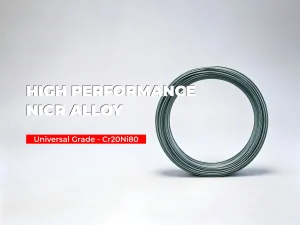
The Metallurgy of Lifetime Uniformity: Controlling Segregation & Tolerances
Why chemical homogenization and geometric precision are the twin pillars of industrial thermal stability.
In high-temperature industrial electric heating applications—spanning from semiconductor crystal growth kilns to automotive heat-treatment furnaces—the longevity and thermal efficiency of resistance alloys depend entirely on metallurgical uniformity. When procuring wholesale resistance heating wire, strip, and fabricated elements, engineering teams frequently face premature element failure, localized hot-spot burnouts, and unpredicted electrical resistance drift.
The primary root causes of these failures are non-uniform chemical distribution (known as alloy composition segregation) and loose dimensional tolerances during cold drawing and rolling. At Beijing Shougang Gitane New Materials Co., Ltd. (SPARK Brand), over 60 years of specialized metallurgical refinement have yielded advanced manufacturing processes designed specifically to eliminate micro-segregation and maintain micron-level dimensional accuracy.
1. Metallurgical Deep Dive: Alloy Composition Segregation
Alloy segregation occurs during ingot solidification when alloying elements partition between the liquid and solid phases due to thermodynamic equilibrium gaps. In Iron-Chromium-Aluminium (FeCrAl) and Nickel-Chromium (NiCr) systems, segregation presents in two major forms:
- Macro-Segregation: Large-scale elemental variations across the ingot cross-section, causing significant heat-to-heat variations in electrical resistivity ($\rho$) and thermal expansion coefficients ($\alpha$).
- Micro-Segregation (Interdendritic Segregation): Solute enrichment in dendrite arm spaces during solidification. In FeCrAl alloys (such as 0Cr25Al5, SGHYZ, and SGHT), Aluminium or Chromium segregation leads to localized phase instabilities, brittle $\sigma$-phase formation, and uneven protective $\text{Al}_2\text{O}_3$ (alumina) scale growth.
When an un-homogenized alloy operates above 1100°C, regions depleted of Aluminium fail to form a continuous, self-healing passivating alumina film. Instead, fast-growing iron or chromium oxides penetrate the alloy substrate, causing rapid spallation, internal oxidation, and early mechanical failure. By employing Vacuum Induction Melting (VIM) followed by Electroslag Remelting (ESR) and high-temperature homogenization annealing, SPARK strictly eliminates dendrite arm solute variances, ensuring elemental uniformity down to the microscopic scale.
2. The Physics of Precision: Strict Control of Dimensional Tolerances
Electrical resistance ($R$) is defined by the fundamental relationship $R = \rho \frac{L}{A}$. For industrial furnace builders, predictable resistance per meter is non-negotiable for system balance and temperature field uniformity.
In traditional manufacturing, wire drawing die wear causes progressive diameter increases and cross-sectional ovality along a continuous spool. SPARK solves this through real-time dual-axis laser micrometer monitoring integrated directly into dynamic multi-pass cold drawing lines. By maintaining wire diameter tolerances within $\pm 0.01 \text{ mm}$ (and down to $\pm 0.005 \text{ mm}$ for fine resistance wires), total resistance variance across an entire 500 kg spool is restricted to under $\pm 1.5\%$.
Global Procurement Trends & Macro Industry Demands
How global decarbonization, semiconductor growth, and total cost of ownership (TCO) are reshaping buyer priorities.
Industrial Decarbonization & Electrification
Global net-zero policies are forcing heavy industries (steel tempering, glass melting, ceramics) to transition from gas-fired burners to high-efficiency electric heating systems. Demand for ultra-high temperature FeCrAl alloys capable of replacing combustion heaters without sagging or oxidizing has surged globally.
TCO Shift Over Upfront Material Cost
Tier-1 OEMs and heat-treatment plants no longer purchase resistance wire based purely on raw price per kilogram. Unplanned furnace downtime can cost upwards of $50,000 per hour in continuous thermal processing lines. Procuring alloys with zero micro-segregation doubles campaign life and minimizes TCO.
Semiconductor & Clean Energy Purity Requirements
Photovoltaic wafer diffusion and semiconductor ingot furnaces require zero contamination. Micro-segregated alloys shed oxide flakes and outgas trace impurities. Tight dimensional control prevents electromagnetic field distortion in high-precision semiconductor crystal growers.
China Industry 4.0: Supply Chain Resilience & Shougang Gitane Leadership
Integrating state-owned metallurgical heritage with automated digital quality control for worldwide exports.
As a core member of the prestigious Shougang Group, Beijing Shougang Gitane New Materials Co., Ltd. operates an 88,000 m² modern manufacturing hub in Shahe, Changping District, Beijing. Housing 39,268 m² of specialized heavy industrial workshops, Shougang Gitane combines massive economies of scale with high-end powder metallurgy innovation.
Fully Integrated Vertical Manufacturing Pipeline
Unlike secondary re-drawers who source wire rod from commercial steel mills, Shougang Gitane manages the complete value chain from raw metal melting to finished spiral elements:
- VIM + ESR Melting: Precise control of elemental composition, trace rare-earth additions (Yttrium, Zirconium, Lanthanum), and ultra-low carbon/nitrogen impurities.
- Hot Rolling & Homogenization: Extended soaking pit cycles to fully dissolve interdendritic solute build-up and achieve isotropic microstructures.
- Automated Multi-Pass Cold Drawing: In-line diamond dies paired with dynamic laser micrometers for absolute continuous dimensional control.
- Atmospheric Continuous Bright Annealing: Hydrogen-shielded thermal treatment ensuring clean, shiny wire surfaces free of carbon deposits or pre-oxidation.
Supply Chain Security for Global OEMs
In an era of global supply chain volatility, Gitane offers unmatched production capacity and raw material hedging capabilities. With over 30% of its 500+ workforce dedicated to metallurgical engineering and quality assurance, Gitane provides batch-to-batch consistency governed by ISO 9001 quality systems (certified since 2003) and compliance with China's national standard GB/T 1234-2012.
SPARK Grade Selection & Technical Parameter Matrix
Comprehensive performance metrics for FeCrAl & NiCr resistance heating alloys.
| Alloy Grade | Alloy Family | Max Temp (°C) | Resistivity @ 20°C (μΩ·m) | Density (g/cm³) | Thermal Expansion (10⁻⁶/K) | Primary Industrial Applications |
|---|---|---|---|---|---|---|
| SGHT | FeCrAl (PM Tech) | 1425°C | 1.45 ± 0.05 | 7.10 | 14.7 | Semiconductor diffusion, advanced ceramic sintering, PV furnaces |
| SGHYZ | FeCrAl (Rare-Earth) | 1400°C | 1.43 ± 0.04 | 7.15 | 14.9 | Ultra-high temp industrial kilns, powder metallurgy equipment |
| HRE | FeCrAl (High-Temp) | 1350°C | 1.42 ± 0.04 | 7.20 | 15.0 | Heavy industrial furnaces, radiant heating tubes, heat treatment |
| 0Cr25Al5 | FeCrAl Standard | 1250°C | 1.42 ± 0.03 | 7.25 | 15.1 | General industrial heating, ceramic kilns, domestic appliances |
| 0Cr23Al5 | FeCrAl High-Resist | 1250°C | 1.35 ± 0.03 | 7.25 | 15.2 | Tempering furnaces, load resistors, eco-friendly heating units |
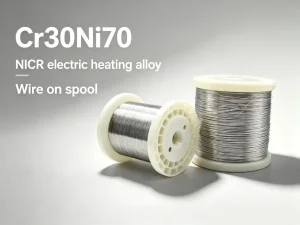
| Cr30Ni70 | NiCr Premium | 1250°C | 1.18 ± 0.03 | 8.10 | 17.0 | Corrosive atmosphere heating, cycling duty, precision elements |
| Cr20Ni80 | NiCr Standard | 1200°C | 1.09 ± 0.02 | 8.40 | 17.3 | Industrial appliances, sealed elements, frequent cycling heaters |
Localized Application Scenarios & Case Demonstrations
Where strict segregation control and tolerance management deliver operational breakthroughs.
Photovoltaic & Silicon Ingot Furnaces
Solar-grade silicon crystallization furnaces demand continuous operation at ~1380°C for hundreds of hours. Utilizing SPARK SGHYZ wire with micro-alloyed Yttrium ensures a tight, protective alumina shell with zero particle shedding, preventing silicon ingot contamination and preserving solar cell efficiency.
Automotive Continuous Annealing Lines
Automotive press-hardening and spring steel annealing require strict furnace temperature uniformity within ±2°C across a 3-meter wide zone. Precision-drawn Cr20Ni80 strip with ±0.01mm tolerance prevents thermal gradient fluctuations, guaranteeing uniform tensile strength in finished automotive parts.
Powder Metallurgy & Sintering Furnaces
Sintering technical ceramics (such as Alumina, Zirconia, and Silicon Nitride) requires thermal ramps up to 1400°C in protective atmospheres. SPARK HRE and SGHT powder metallurgy alloys offer superior sag resistance and immunity to carbonization during debinding cycles.
Frequently Asked Questions by Technical Procurement Teams
Expert insights on alloy selection, tolerance specifications, and quality verification.
How does micro-segregation directly affect the lifespan of FeCrAl heating wires?
What dimensional tolerances can Beijing Shougang Gitane guarantee for wholesale wire coils?
When should an engineer specify NiCr over FeCrAl resistance alloys?
What quality testing documentation is provided with wholesale orders?
How does Shougang Gitane ensure minimum batch-to-batch resistance drift?
High-Temperature Electrothermal Alloy Catalog (Second Tier Selection)
Factory-direct solutions for industrial heating elements, furnace tubes, and specialized alloys.


Optimize Your High-Temperature Alloy Supply Chain Today
Contact our senior metallurgical engineering team for custom wire drawing tolerances, chemical composition certification, or wholesale factory pricing on FeCrAl and NiCr resistance alloys.