
Featured Industrial Heating Alloys & Wire Specifications
Direct factory procurement for certified FeCrAl and NiCr heating elements optimized for maximum thermal yield and micro-structural longevity.




Global B2B Procurement Needs & Macro-Industrial Demands
Analyzing thermal processing economics, furnace downtime mitigation, and Total Cost of Ownership (TCO) across worldwide manufacturing sectors.
OPEX Optimization
Global buyers are transitioning from traditional element replacement cycles to predictive thermal metallurgical alloys. Long service life resistance wires minimize unscheduled line shutdowns in continuous heat-treatment facilities.
Decarbonization Drives
As global heavy industries shift from fossil gas combustion to zero-emission electric industrial kilns, the demand for high-resistivity, high-surface-load FeCrAl & NiCr heating elements has spiked by over 34% worldwide.
Corrosive Atmosphere Resistance
Advanced manufacturing processes—such as lithium-ion battery cathode sintering and semiconductor CVD—require specialized alloy formulations resistant to carburization, nitriding, and halide gas attack.
Precision Resistance Stability
Engineered heating wires maintain stable electric resistance over thousands of thermal cycles, preventing localized hot-spotting, power draw drift, and non-uniform zone heating in critical furnaces.
Metallurgical Life Extension Mechanics & Alloy Synthesis
Understanding oxidation dynamics, reactive element additions, and powder metallurgy routes that grant SPARK heating wires superior thermal longevity.
| Alloy Classification | Primary Grade Exemplars | Max Temp (°C) | Resistivity (μΩ·m) | Protective Oxide Layer | Primary Industrial Utility |
|---|---|---|---|---|---|
| FeCrAl (Ultra-High Grade) | SGHYZ / SGHT (PM) | 1380°C – 1425°C | 1.45 – 1.48 | Alpha-Alumina (α-Al₂O₃) | Semiconductor wafers, ceramic sintering, high-temp kilns |
| FeCrAl (Standard Industrial) | 0Cr25Al5 / 0Cr21Al6Nb | 1250°C – 1350°C | 1.42 – 1.45 | Alumina Film (Al₂O₃) | Heat-treatment furnaces, tempering, radiant tube heaters |
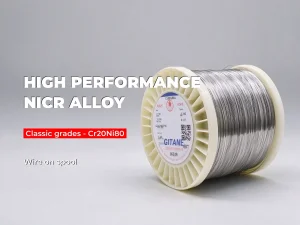
| NiCr (High Ductility) | Cr20Ni80 (80/20 Nichrome) | 1200°C | 1.09 | Chromium Oxide (Cr₂O₃) | Frequent on/off cycling, precision heaters, appliances |
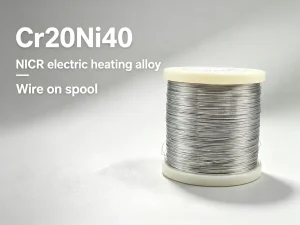
| NiCr (Mid-Nickel Grade) | Cr20Ni40 / Cr30Ni70 | 1100°C – 1250°C | 1.18 – 1.04 | Chromite Scale Complex | Industrial furnaces, immersion heaters, sealed elements |
1. Adherent α-Al₂O₃ Passivation
FeCrAl heating wires protect themselves by forming a dense, thermodynamically stable Alpha-Alumina surface film. This protective layer acts as an ionic diffusion barrier, slowing internal oxidation rates down to near zero.
2. Reactive Element Doping (Y/Zr/Nb)
By micro-alloying with rare earth elements such as Yttrium, Zirconium, and Niobium, SPARK prevents scale spallation during rapid thermal shock cycles, dramatically extending heating wire operational lifespans.
3. Creep Resistance & Powder Metallurgy
Advanced grades like SGHT leverage Dispersion Strengthened Powder Metallurgy. This microstructure prevents high-temperature grain growth, eliminating wire sagging, elongation, and premature electrical shorting.
Macro-Industry Heating Solutions
Engineered electrothermal wire configurations tailored to rigorous sector-specific manufacturing environments.
Metallurgical Heat Treating
For tempering, hardening, annealing, and carburizing furnaces. Wire elements engineered for low surface power density ($W/cm^2$) ensure rapid heat distribution and long thermal cycle endurance.
Ceramic & Glass Processing
Continuous roller hearth kilns and glass tempering plants operating at 1100°C–1350°C rely on heavy-gauge FeCrAl coils (0Cr25Al5, 0Cr21Al6Nb) to resist heavy thermal inertia and thermal stress.
Lithium Battery Material Sintering
Pusher kilns and rotary furnaces firing cathode materials (LFP / NCM) require strict resistance against corrosive chemical off-gassing. Specialized alloy treatments prevent scale deterioration.
Semiconductor Wafer Processing
Ultra-pure SGHT and SGHYZ powder metallurgy elements deliver hyper-uniform zone control in diffusion furnaces, minimizing ionic contamination in silicon and silicon carbide processing.
Localization Support, Certification & Quality Systems
Ensuring seamless international compliance, direct mill traceability, and customized delivery configurations for OEM manufacturers.
Standard Harmonization
All SPARK resistance heating wires are manufactured in compliance with international standards: GB/T 1234-2012, ASTM B603, DIN 17470, and JIS C2520. Full Material Test Certificates (EN 10204 3.1) accompany every shipment.
Custom Geometry & Supply Formats
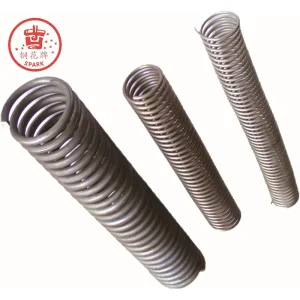
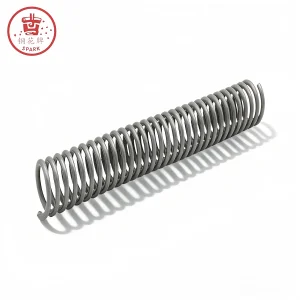
Available in round wire (0.05mm to 12.0mm), cold-rolled strip, flat ribbon, pre-wound spiral elements, and custom furnace heating bank configurations tailored to client CAD prints.
ISO 9001:2015 Audit Guarantee
Our Beijing facility features 39,268 m² of advanced metallurgy workshops utilizing vacuum induction melting (VIM), continuous wire drawing, bright annealing, and automated resistance testing.
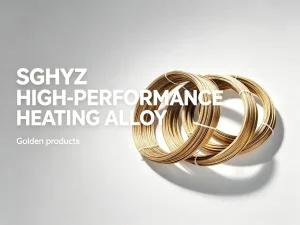
Specialized Electrothermal Wire & Element Series
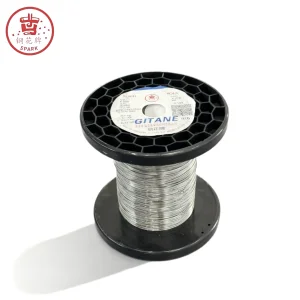
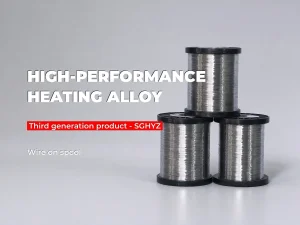
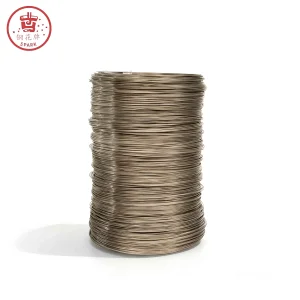
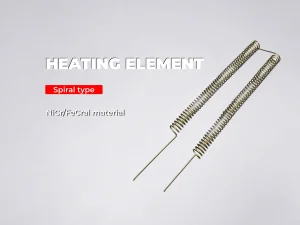
Browse quotes, datasheets, and factory wholesale inventory for specialized heat-resistant alloys.

Frequently Asked Questions & Engineering Diagnostics
Expert answers to high-intent procurement and technical questions regarding heating wire selection, lifespans, and performance.
How do FeCrAl and NiCr heating wires compare in long service life performance?
FeCrAl alloys (e.g., 0Cr25Al5, 0Cr21Al6Nb, SGHYZ) offer higher maximum operating temperatures (up to 1425°C), higher electrical resistivity, and lower physical density than NiCr. This allows for lighter-weight elements and reduced material costs. FeCrAl forms a protective Alpha-Alumina (Al₂O₃) scale that provides superior oxidation life at high temperatures. NiCr alloys (e.g., Cr20Ni80, Cr20Ni40) exhibit excellent hot strength, ductility after prolonged use, and resistance to thermal shock and mechanical vibration under frequent power-cycling conditions.
What causes premature heating wire burn-out, and how can it be prevented?
Premature failures are primarily caused by: (1) Excessive Surface Load ($W/cm^2$) leading to localized melting; (2) Spallation of the oxide scale due to thermal shock; (3) Contamination by sulfur, carbon, or fluxing agents; and (4) Creep sagging causing adjacent turns to short-circuit. To maximize life, select engineered grades with rare-earth additions (such as SPARK SGHYZ or SGHT), optimize wire diameter, and maintain proper furnace atmosphere control.
How is the wholesale price of long service life heating wire calculated?
Wholesale pricing is based on raw material market rates (Nickel, Chromium, Aluminum, Iron spot prices), wire diameter/strip thickness (fine wire drawing under 0.10mm incurs higher processing cost), micro-alloying additives (such as Niobium or Yttrium), surface finishing (golden oxide or bright annealed), and order volume. Request direct factory quotes for custom quantity discounts.
Can SPARK heating wires replace established European or Japanese alloy brands?
Yes. SPARK alloys manufactured by Beijing Shougang Gitane New Materials Co., Ltd. are metallurgically equivalent to leading international grades (such as Kanthal A1, APM, N80, or Nichrome V). Our technical engineering team provides cross-reference matching, technical datasheets, and mill test reports to ensure seamless replacement in existing furnace designs.