
High-Performance FeCrAl & Heating Alloy Products (Part I)
Direct factory supply of precision resistance wire, high-temperature tubes, and custom industrial furnace heating elements engineered for ultra-demanding thermal environments.

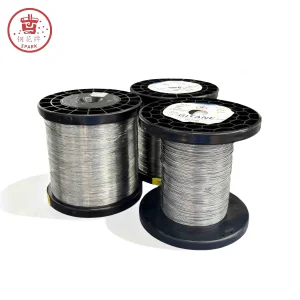



The Global Landscape for Kanthal Alternative Resistance Alloys
The global high-temperature processing sector is currently undergoing a structural pivot. Historically dominated by long-established Western brands such as Kanthal (Sandvik Group), global original equipment manufacturers (OEMs), thermal engineering consultants, and furnace builders are actively diversifying their supply chains toward advanced Kanthal alternative manufacturers. This strategic migration is not merely driven by cost rationalization, but by the urgent necessity for supply resilience, tailored metallurgical formulations, and accelerated lead times in an increasingly volatile global manufacturing climate.
Iron-Chromium-Aluminum (FeCrAl) and Nickel-Chromium (NiCr) electrothermal alloys represent the thermal baseline of modern industrial manufacturing. From continuous annealing lines in metallurgy to precision diffusion kilns in semiconductor fabrication, the stability of resistance heating wire dictates overall thermal efficiency and equipment operational uptime. As industrial sectors accelerate their transition from fossil-fuel combustion heating to clean electric heating architectures, demand for high-grade resistance wire rated above 1200°C has reached unprecedented levels globally.
Cost-to-Performance Optimization
Legacy brand markups often impose prohibitive CAPEX and OPEX premiums on industrial heating projects. Direct factory alternatives provide identical metallurgical chemical purity and mechanical tolerance profiles at 30% to 45% lower total cost of procurement.
Electrification of Industrial Thermal Processes
Driven by global Net-Zero carbon mandates, heavy industrial sectors—including steel, glass, and ceramics—are retrofitting gas-fired burners with high-density electric furnace wire coils, triggering exponential global demand for high-watt-density FeCrAl alloys.
Mitigation of Supply Chain Bottlenecks
Relying on single-source European manufacturers introduces significant vulnerability regarding extended lead times and custom dimension availability. Advanced Chinese alloy hubs provide scalable wholesale production with rapid global export logistics.
Industry Development Trends: Next-Generation FeCrAl & PM Alloys
The technical superiority of modern Kanthal alternatives rests upon breakthrough advances in powder metallurgy (PM) and micro-alloying engineering. Traditional ingot melting methods often suffer from grain growth at ultra-high temperatures (>1300°C), leading to high-temperature creep, physical sag, and eventual embrittlement. Modern high-tier alternatives utilize advanced dispersion strengthening and vacuum induction refining to overcome these classic metallurgical failure modes.
Protective Alumina Scale ($\alpha\text{-Al}_2\text{O}_3$) Formation
FeCrAl alloys function by forming a self-healing, thermally grown, non-porous alpha-alumina protective oxide scale when heated above 1000°C. Advanced formulations add controlled trace quantities of rare-earth elements (RE)—such as Yttrium (Y), Zirconium (Zr), and Hafnium (Hf)—which anchor the scale to the alloy substrate, completely preventing oxide spallation during rapid thermal cycling.
Powder Metallurgy (SGHT & APM Equivalent)
By producing alloys via gas atomization followed by hot isostatic pressing (HIP), grades like **SGHT** achieve ultra-fine, homogeneous grain structures. This eliminates macro-segregation, significantly increases hot yield strength, and raises maximum operating temperature capability up to **1425°C**, matching premium powder-metallurgy standards.
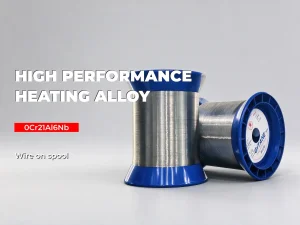
Micro-Doping with Niobium (0Cr21Al6Nb)
The strategic addition of Niobium (Nb) forms stable precipitates at grain boundaries. This hinders grain coarsening at elevated temperatures, dramatically improves sag resistance in horizontally suspended heating spirals, and extends physical service life under continuous heavy electrical loads.
Technical Specification Matrix: Kanthal Alternative Alloys vs. Standard Grades
The following engineering data highlights the chemical, electrical, and thermal parameters of key industrial resistance alloy families available for wholesale supply:
| Alloy Grade | Alloy Type | Max Temp (°C) | Resistivity at 20°C ($\mu\Omega\cdot\text{m}$) | Density ($\text{g/cm}^3$) | Primary Industrial Application |
|---|---|---|---|---|---|
| SPARK SGHT | FeCrAl (PM / Rare-Earth Doped) | 1425°C | 1.45 | 7.10 | Semiconductor diffusion, high-temperature kilns, powder metallurgy |
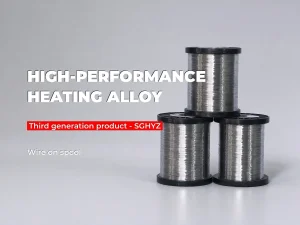
| SPARK SGHYZ | FeCrAl (Ultra-High Temp) | 1400°C | 1.45 | 7.10 | Industrial ceramic sintering, laboratory furnaces, radiant tubes |
| 0Cr21Al6Nb | FeCrAl + Nb Modification | 1350°C | 1.45 | 7.10 | Heavy-duty industrial furnace coils, heat treating equipment |
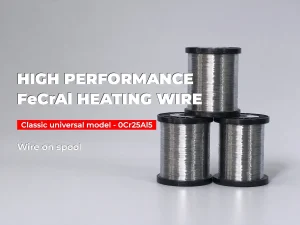
| 0Cr25Al5 (Kanthal d/D Equivalent) | Standard High-Temp FeCrAl | 1250°C | 1.42 | 7.10 | General industrial furnaces, domestic heaters, tube elements |
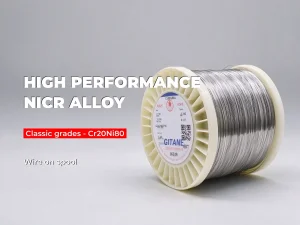
| Cr20Ni80 (Nichrome 80) | Ni-Cr 80/20 Nickel-Chromium | 1200°C | 1.09 | 8.40 | Controlled atmosphere furnaces, frequent cycling applications |
| SG140 Alloy | Specialized Furnace Alloy | 1100°C - 1200°C | 1.38 | 7.20 | Tempering furnaces, low-temperature heat treatment lines |
Localized Application Scenarios Across Global Heavy Industries
High-performance resistance heating alloys are deployed across vastly different thermal and chemical environments. Choosing the correct Kanthal alternative grade depends fundamentally on operating atmosphere, physical support design, and surface power loading ($W/\text{cm}^2$).
1. Petrochemical & Energy Refineries
Scenario: High-temperature radiant cracking tubes, process gas superheaters, and catalyst regeneration beds requiring long-term structural integrity up to 1250°C.
Alloy Choice: SGHT Steel Tubes & 0Cr21Al6Nb Wire. High oxidation resistance prevents catastrophic wall degradation under continuous sulfur and hydrocarbon traces.
2. Semiconductor & Solar PV Manufacturing
Scenario: Silicon ingot growth, wafer oxidation chambers, and LPCVD diffusion furnaces operating with precise thermal uniformity zones (±0.5°C) up to 1400°C.
Alloy Choice: SPARK SGHYZ & SGHT. Extremely low resistance drift ensures ultra-stable temperature profiling and prevents heavy metal contamination during sensitive chip wafer baking.
3. Metallurgy & Heat Treatment Plants
Scenario: Carburizing, nitriding, hardening, and tempering furnaces for automotive gear and aerospace component manufacturing.
Alloy Choice: SG140 & Cr20Ni80 Nichrome. In carbon-rich or reducing atmospheres, NiCr alloys resist green rot and carburization significantly better than non-modified FeCrAl materials.
4. Advanced Ceramics & Glass Kilns
Scenario: High-temperature ceramic sintering (Zirconia/Alumina), glass annealing, and optical fiber drawing towers reaching 1350°C - 1425°C.
Alloy Choice: SPARK 0Cr25Al5 & SGHT Spirals. Low density (7.10 $\text{g/cm}^3$) yields more meters of wire per kilogram compared to NiCr, offering substantial material weight and cost savings.
Macro Technical Solutions & Resistance Heating Element Calculations
Designing durable furnace heating systems requires precise balance between electrical loading, heat dissipation surface area, and atmospheric chemistry. Our engineering department provides comprehensive technical calculations for global OEM partners retrofit projects.
1. Surface Load Optimization ($p$)
Surface load represents the thermal power dissipated per unit area of wire surface ($\text{W/cm}^2$). Excess surface loading accelerates scale fatigue and causes localized overheating.
Rule of Thumb: For industrial kilns at 1200°C, keep surface load between $1.5 \text{ W/cm}^2$ and $2.5 \text{ W/cm}^2$. Higher values drastically shorten total operating hours.
2. Atmosphere Correction Factor ($C_a$)
The maximum service temperature of resistance wire must be adjusted based on furnace atmosphere gas composition:
- Air / Oxidizing: 100% Rated Temp Limit
- Hydrogen ($H_2$ Dry): FeCrAl up to 1400°C
- Nitrogen ($N_2$): NiCr Preferred (FeCrAl forms nitrides above 1000°C)
- Carburizing Gas: NiCr Preferred or Pre-oxidized SGHT
3. Electrical Resistance Drift Formula
Resistance changes with operating temperature according to the Temperature Resistance Factor ($C_t$):
R_t = R_20 \times C_t
Our SGHT and 0Cr21Al6Nb alloys maintain tight, predictable $C_t$ curves, preventing transformer overload during cold startup phases.
Technical Roadmap & Future Outlook for High-Temperature Alloys
As industrial thermal processing demands higher energy densities, extreme temperature endurance, and seamless integration with renewable energy microgrids, metallurgical research is advancing rapidly across three core vectors:
Phase I: Nano-Oxide Dispersion Strengthening (ODS)
Integration of nano-scale Yttria ($Y_2O_3$) particles directly into the FeCrAl matrix via high-energy mechanical alloying. ODS alloys will push stable metallic element operation beyond **1450°C**, narrowing the gap with expensive Silicon Carbide (SiC) elements while retaining metallic coil ductility.
Phase II: Intelligent & Self-Diagnostic Heating Elements
Embedding micro-sensor diagnostic capabilities into heavy industrial heating elements. By monitoring real-time micro-impedance shifts and local hot-spot development, preventive furnace maintenance can be scheduled automatically before element failure occurs.
Phase III: Green Hydrogen Sintering & Zero-Carbon Production
Decarbonizing the manufacturing process of the alloy wire itself. By utilizing green hydrogen for ingot annealing and atmospheric heat treatment, our manufacturing facilities aim for zero-carbon embedded footprint across all export alloy lines by 2030.
Frequently Asked Questions: Kanthal Alternative Sourcing & Engineering
Comprehensive engineering responses addressing technical comparison, cross-brand conversion, quality certification, and purchasing procedures.
- SPARK SGHT: Direct alternative to Kanthal APM / APMT (Powder Metallurgy Grade, up to 1425°C).
- SPARK SGHYZ: Direct alternative to Kanthal A1 (Ultra-High Temp Wire, up to 1400°C).
- 0Cr21Al6Nb: High-performance alternative to Kanthal AF (Niobium stabilized for anti-sag properties).
- 0Cr25Al5: Alternative to Kanthal D / Alkrothal (Standard industrial wire, up to 1250°C).
- Cr20Ni80: Alternative to Nikrothal 80 (80/20 Nickel-Chromium premium wire).
High-Performance FeCrAl & Heating Alloy Products (Part II)
Explore additional high-grade heating solutions, ultra-high temperature elements, and custom furnace components manufactured by our ISO-certified facilities.


Request Factory Quotes & Technical Consultation
Connect directly with our metallurgical engineering team for sample requests, custom dimension requests, and wholesale price sheets.