
Featured Industrial Resistance Alloys & Heating Elements
Precision-engineered FeCrAl and NiCr electric heating wires, strips, and coiled elements designed for thermal processing environments up to 1425°C.
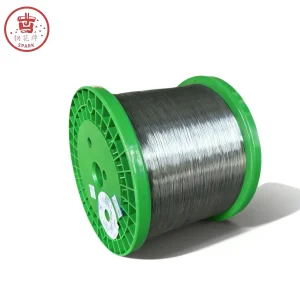




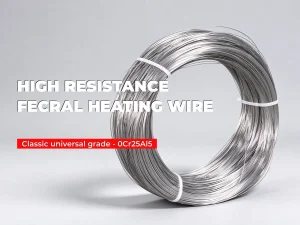

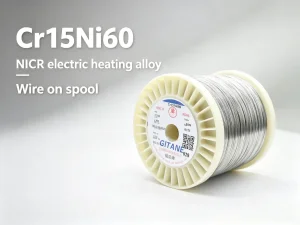
Industry Whitepaper: Ensuring Product Performance Stability & Mechanical Reliability
A Technical Deep Dive into High-Temperature Electrothermal Metallurgy, ISO Quality Controls, and Sustainable Manufacturing Systems.
Core Commitment: In extreme thermal environments where temperatures routinely surpass 1200°C to 1400°C, material performance stability is directly correlated with industrial productivity, operational safety, and furnace lifecycle economics. Our dual certification under ISO9001 Quality Management Systems and ISO14001 Environmental Management Systems validates our integrated approach: combining ultra-pure raw material selection, vacuum induction melting (VIM), precision wire drawing, and eco-friendly manufacturing.
ISO 9001 Quality Assurance Standardisation
Our ISO 9001 certified manufacturing frameworks mandate full chemical and mechanical traceability from ingot melting to final coiled product. Every batch of Iron-Chromium-Aluminum (FeCrAl) and Nickel-Chromium (NiCr) alloy undergoes rigorous spectral chemical analysis, hot-yield testing, room-temperature tensile testing, and high-temperature electrical resistance drift measurement. This relentless quality control ensures zero localized hot spots and homogeneous electrical resistivity across thousands of meters of resistance wire.
ISO 14001 Environmental Stewardship
As a global supplier, our commitment extends beyond product durability to green metallurgy. Operating under the ISO 14001 environmental management umbrella, our production facilities utilize closed-loop acid pickling recycling systems, energy-efficient continuous annealing furnaces, and modern dust containment technology. By optimizing thermodynamic efficiency, we lower carbon emissions per ton of alloy produced, satisfying global ESG criteria for supply chain sustainability.
Global Macro Industrial Landscape & Thermal Electrification Trends
Analyzing the shift from fossil-fuel industrial combustion to high-efficiency electric resistance heating across key global markets.
Decarbonization of Industrial Heat
Global net-zero mandates are accelerating the transition from gas-fired industrial furnaces to electric heating systems. Industrial electric resistance alloys provide near 100% thermal conversion efficiency at point of use, enabling steel mills, ceramic producers, and glass processors to eliminate direct fossil combustion emissions while securing pinpoint temperature profile accuracy within ±1°C.
Semiconductor & Photovoltaic Expansion
The global boom in solar PV cell manufacturing and semiconductor fabrication requires high-purity thermal process equipment. Diffusion furnaces and crystal-growing apparatus rely on ultra-high-temperature FeCrAl alloys (such as SGHYZ and SGHT) capable of operating continuously up to 1425°C without particulate flaking or heavy metal contamination.
Automotive Electrification & Heat Treatment
Electric vehicle (EV) battery manufacturing, lightweight aluminum die-casting, and traction motor stator annealing demand continuous-duty heat treatment lines. Resistance heating elements must withstand rapid thermal cycling, aggressive atmospheres, and high mechanical shock loads without premature creep deformation or thermal fatigue failure.
Technical Comparison: FeCrAl vs. NiCr Alloy Families
| Alloy Class | Representative Grades | Max Temp (°C) | Resistivity (μΩ·m) | Primary Oxide Layer | Key Industrial Advantages |
|---|---|---|---|---|---|
| FeCrAl (Ultra High Temp) | SGHT, SGHYZ, HRE, 00Cr20Al6 | 1350°C - 1425°C | 1.40 - 1.45 | Alpha-Aluminium Oxide (α-Al₂O₃) | Maximum temperature tolerance, resistance to carbon buildup, lower density (7.1 g/cm³), excellent lifespan in high-temp kilns. |
| FeCrAl (Standard Industrial) | 0Cr25Al5, 0Cr23Al5, 0Cr21Al6Nb | 1200°C - 1250°C | 1.35 - 1.42 | Aluminium Oxide (Al₂O₃) | Cost-effective workhorse material, high electrical resistivity, excellent yield strength at medium-to-high process temperatures. |
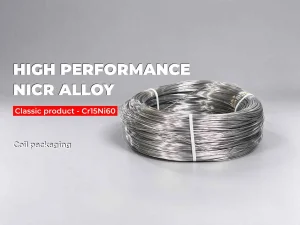
| NiCr (High Ductility) | Cr20Ni80, Cr30Ni70, Cr15Ni60 | 1150°C - 1250°C | 1.09 - 1.18 | Chromium Oxide (Cr₂O₃) | Superior hot strength, remains ductile post-aging, outstanding thermal cycling performance, non-magnetic characteristics. |
| NiCr (Industrial Grade) | Cr20Ni40, Ni70Cr30 | 1000°C - 1150°C | 1.04 - 1.12 | Chromium-Iron Oxide Complex | High corrosion resistance in moist or mildly reducing atmospheres, ideal for commercial appliance & heat equipment elements. |
Metallurgical Engineering: Oxide Layer Mechanics & Microstructural Control
How advanced alloy chemistry and controlled passivation kinetics create stable protective oxides to extend resistance wire service life.
Alpha-Alumina (α-Al₂O₃) Scale Kinetics in FeCrAl Alloys
When subjected to elevated temperatures, FeCrAl resistance alloys (such as 0Cr25Al5, 0Cr23Al5, and 0Cr21Al6Nb) selectively migrate aluminum ions to the wire surface, establishing a light grey, dense, highly adherent layer of Alpha-Aluminium Oxide (α-Al₂O₃). This passivation layer features an ultra-low electrical conductivity and extremely low ion permeability, acting as a impermeable thermal diffusion barrier against further atmospheric oxidation, sulfur attack, and carburization.
Our proprietary chemical formulation includes precise additions of reactive rare earth elements (Yttrium, Zirconium, and Cerium). These micro-additions anchor the oxide scale to the metallic substrate via a "pegging" mechanism at grain boundaries, preventing spallation or cracking during cyclic heating and cooling loops.
Chromia (Cr₂O₃) Oxide Stability & Ductility in NiCr Alloys
Nickel-Chromium alloys (Cr20Ni80, Cr30Ni70, Cr15Ni60) rely on a resilient Chromium Oxide (Cr₂O₃) passive layer. Unlike FeCrAl materials which become brittle upon cooling after exposure to elevated temperatures, NiCr alloys retain their austenitic lattice structure and room-temperature ductility post-service.
This structural property allows NiCr coils to be repeatedly unwound, re-formed, or mechanically serviced during maintenance overhauls. Furthermore, NiCr exhibits superior hot tensile strength, preventing sagging or structural collapse when suspended across heavy ceramic support rods in vertical element configurations.
Creep Resistance Engineering
Under continuous thermal load, atomic diffusion induces grain growth and creep elongation. By deploying powder metallurgy techniques (SGHT technology) and grain boundary pinning micro-additions, our high-tier FeCrAl alloys dramatically reduce sag and deformation over tens of thousands of operating hours.
Resistance Stability & Zero Hot-Spot Tech
Resistance drift leads to unbalanced power distribution and premature wire burnout. Micro-variations in wire cross-sectional diameter are kept within ±0.01mm using inline laser micrometer monitoring, ensuring steady current density and uniform thermal radiation.
Atmospheric Compatibility
Different chemical process gas atmospheres require targeted alloy choices. FeCrAl excels in oxidizing, sulfurous, and carburizing environments, whereas NiCr is superior in pure nitrogen, argon, or crack-ammonia reducing gas atmospheres.
Comprehensive Macro Industry Solutions & Turnkey Applications
Field-proven thermal engineering solutions tailored for heavy industrial, commercial, and laboratory heating equipment worldwide.
1. Heat Treatment & Heavy Metallurgy Industry
Application: Pit furnaces, continuous box kilns, car-bottom annealing furnaces, hardening and tempering lines (SG140 grade).
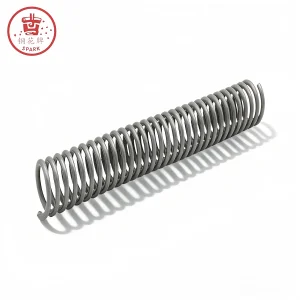
Solution: Heavy-gauge FeCrAl strip and large-diameter spiral heating elements deployed along furnace walls. Designed for high surface power loading (up to 2.5 W/cm²) to rapidly heat multi-ton steel forgings while resisting scale contamination and carbon soot buildup.
2. Advanced Technical Ceramics & Powder Metallurgy
Application: Zirconia sintering, alumina ceramic firing, tungsten-carbide powder reduction kilns operating between 1250°C and 1400°C.
Solution: SPARK HRE and SGHYZ ultra-high-temperature wires formed into self-supporting meander-ribbon or heavy-gauge rod elements. Provides clean, non-contaminating radiational heat transfer required for high-purity structural ceramic components.
3. Glass Manufacturing & Precision Forming
Application: Automotive glass bending furnaces, architectural glass tempering lines, container glass annealing lehrs.
Solution: Precision-wound Cr20Ni80 and Cr30Ni70 Nichrome spiral elements installed in radiant roof panels. Guarantees uniform infrared thermal flux across glass surfaces to prevent optical distortion and residual mechanical stress.
4. Appliance, Commercial & HVAC Heating Systems
Application: Commercial cooking equipment, industrial air duct heaters, ceramic panel heaters, laboratory tube furnaces.
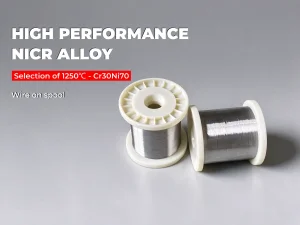
Solution: Fine-to-medium wire diameters (0Cr25Al5, Cr15Ni60) packaged on spools for automated coil winding. Features high oxidation life under continuous power cycling and high vibrational resistance.
Complete Wholesale Catalog: Premium Alloys & Customized Heating Elements
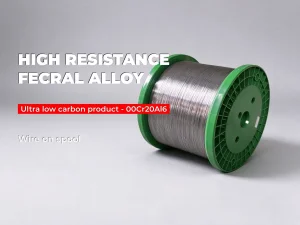
Explore our full range of ultra-low carbon alloys, high-temperature wires, and engineered spiral heating elements.



Technical FAQ & Engineering Procurement Guide
Addressing fundamental engineering questions regarding resistance wire selection, furnace design calculations, and ISO-certified manufacturing controls.
ISO9001 guarantees rigorous process control across raw material melting, hot rolling, cold drawing, and continuous annealing. This ensures consistent alloy chemistry, precise cross-sectional tolerance (preventing localized hot spots), and stable electrical resistance (μΩ·m) from coil to coil. ISO14001 mandates clean, eco-friendly manufacturing, verifying that wire surfaces are free from oil contaminants or heavy carbon residue that could cause premature burnout or atmosphere contamination during furnace commissioning.
FeCrAl alloys (e.g., 0Cr25Al5, SGHYZ) feature higher maximum operating temperatures (up to 1425°C), higher electrical resistivity, and lower density (7.1 g/cm³) compared to NiCr, making them more cost-effective for large industrial kilns. However, FeCrAl becomes embrittled after heating. NiCr alloys (e.g., Cr20Ni80, Cr30Ni70) feature superior hot strength, retain room-temperature ductility post-service, and handle rapid thermal cycling and mechanical vibration exceptionally well.
Surface load (W/cm²) represents the electrical power dissipated per unit surface area of the heating wire. It depends on operating temperature, furnace atmosphere, and element layout. For standard industrial furnaces operating at 1000°C–1200°C in air, recommended surface loads range between 1.5 and 2.5 W/cm² for FeCrAl wires. Higher operating temperatures require lower surface loads to prevent overheating of the internal wire core relative to the furnace chamber.
For temperatures between 1350°C and 1425°C, we recommend specialized FeCrAl grades such as SPARK HRE, SGHYZ, or powder-metallurgy SGHT. These materials utilize advanced rare-earth doping (Yttrium/Zr) and refined grain structures to form a ultra-dense Alpha-Al2O3 oxide film, providing exceptional oxidation resistance and sag resistance at extreme temperatures.
Air/oxidizing atmospheres help form protective Al2O3 or Cr2O3 oxide films. Reducing gas atmospheres (such as hydrogen, cracked ammonia, or carbon monoxide) can strip oxide films or induce carburization ("green rot" in NiCr or carbon embrittlement in FeCrAl). FeCrAl is superior in carburizing and sulfur-containing environments, whereas NiCr performs better in nitriding or pure hydrogen environments when correctly derated.
We supply materials in round wire (0.05mm to 12.0mm diameter), flat ribbon/strip (thickness 0.1mm–5.0mm, width 0.5mm–200mm), cold-rolled sheet, spools, coils, and pre-formed spiral or wavy heating elements built to customer engineering drawings.