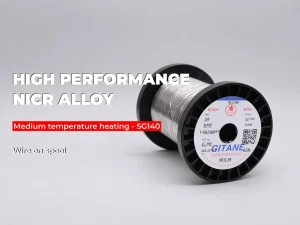
ISO Certified FeCrAl & NiCr Heating Alloys
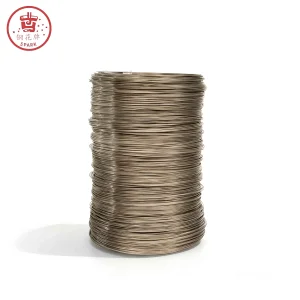
Direct factory supply of premium grade resistance wire, strips, and furnace components with verified mill certifications.
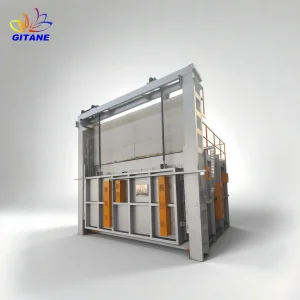
Understanding Anti-Carburization Dynamics in FeCrAl Alloys
Engineering durable heating elements for carbon-rich, endothermic atmospheres requires precise surface metallurgy and micro-alloying control.
The Carburization Challenge in Heat Treatment Furnaces
In gas carburizing, carbonitriding, and endothermic atmosphere heat-treating furnaces, conventional resistance alloys face catastrophic premature failure due to carbon ingress. At elevated operating temperatures ($850^\circ\text{C}$ to $1100^\circ\text{C}$), carbon atoms diffuse rapidly into standard Nickel-Chromium (NiCr) or un-optimized Iron-Chromium-Aluminum (FeCrAl) wire matrices. This carbon enrichment precipitates brittle chromium carbides ($\text{Cr}_{23}\text{C}_6$ and $\text{Cr}_7\text{C}_3$) along grain boundaries, depleting the matrix of essential chromium, inducing extreme thermal stresses, volume expansion, and eventually severe embrittlement—a phenomenon often resulting in localized burning or catastrophic fracturing.
The Passive $\alpha-\text{Al}_2\text{O}_3$ Oxide Protective Film
Our ISO-certified FeCrAl anti-carburization heating wires leverage a high aluminum content combined with active element additions (Yttrium, Zirconium, and Rare Earth RE micro-alloying). During thermal commissioning, the wire forms an ultra-dense, non-porous, highly adherent alpha-alumina ($\alpha-\text{Al}_2\text{O}_3$) oxide scale on its outer surface. This ceramic interface exhibits exceptionally low ionic diffusivity for carbon, serving as a dynamic, self-healing physical barrier that resists carbon monoxide ($\text{CO}$), methane ($\text{CH}_4$), and propane decomposition gases even under frequent thermal cycling.
| Alloy Property / Feature | Standard NiCr (80/20) | Standard FeCrAl (0Cr25Al5) | ISO Certified Anti-Carburization FeCrAl (SPARK Series) |
|---|---|---|---|
| Max Continuous Operating Temp | 1200°C | 1250°C - 1300°C | 1350°C - 1425°C |
| Carburization Resistance Index | Poor (Susceptible to Green Rot) | Moderate (Scale spalling risks) | Exceptional (Dense $\alpha-\text{Al}_2\text{O}_3$ Shield) |
| Resistivity ($\mu\Omega\cdot\text{m}$ at 20°C) | 1.09 | 1.42 | 1.45 - 1.53 |
| Density ($\text{g/cm}^3$) | 8.40 | 7.10 | 7.10 (Save ~15% raw material weight) |
| Grain Growth Control at >1100°C | Moderate | Poor (Rapid coarsening) | Superior (RE & Zr Grain Pinning) |
Next-Generation FeCrAl Tech Roadmap & Future Outlook
Pioneering powder metallurgy dispersion strengthening and zero-carbon industrial heating compatibility.
Powder Metallurgy (PM) Dispersion
Transitioning from traditional melt casting to advanced Powder Metallurgy (PM). Rapid solidification yields ultra-fine, uniform microstructures fortified with Oxide Dispersion Strengthening (ODS) via nano-Yttria ($\text{Y}_2\text{O}_3$) particles, eliminating high-temperature sag and creep.
Zero-Carbon Hydrogen Compatibility
As global manufacturing transitions to green hydrogen energy and direct reduced iron (DRI) processes, our next-gen FeCrAl heating elements are specifically tested to withstand extreme dry/wet hydrogen gas reduction atmospheres up to 1400°C without hydride embrittlement.
Nanostructured Scale Self-Healing
Incorporate dynamic reactive element additions (Y, Ce, Hf) that migrate outward to grain boundaries during thermal stress events, continuously sealing micro-cracks in the alumina surface layer to guarantee predictable electrical resistance stability over 10,000+ operating hours.
Tailored Solutions for Demanding Heavy Industries
Delivering targeted thermal efficiency and corrosion defense across major global industrial sectors.
Automotive Heat Treatment
Ideal for continuous carburizing furnaces, batch sealed-quench lines, and gear hardening units. Replaces fragile metallic tubes, offering exceptional resistance to soot deposition, mechanical vibration, and rapid carbon potential fluctuations.
Petrochemical & Syngas Refining
Used in ethylene cracking furnace heating elements, gas reforming units, and high-carbon synthetic fuel processing plants where hydrocarbon gases cause severe metal dusting in standard stainless steel or nickel-based heaters.
Powder Metallurgy & Sintering
Optimized for high-temperature pusher, mesh belt, and vacuum sintering furnaces processing stainless steel, structural iron powder parts, and metal injection molding (MIM) debinding in hydrocarbon atmospheres.
Solar PV & Semiconductor Fabrication
Provides high-purity thermal fields for silicon ingot growth furnaces and diffusion processing, ensuring ultra-low particle spalling and consistent temperature uniformity across large thermal zones.
China Factory 4.0: Supply Chain Resilience & Quality Control
Inside our fully integrated, 88,000 m² Beijing manufacturing complex—from raw material melting to final continuous bright annealing.
Vacuum Induction Melting (VIM) & ESR
Every batch begins with ultra-pure raw materials processed through Vacuum Induction Melting (VIM) followed by Electroslag Remelting (ESR). This double-melt metallurgy eliminates non-metallic inclusions, harmful sulfur/phosphorus impurities, and gases.
Precision Wire Drawing & Annealing
Multi-pass diamond die drawing machines with real-time laser micrometer feedback ensure dimensional tolerances down to ±0.002 mm. Continuous hydrogen atmosphere bright annealing delivers oxide-free, brilliant surface finishes with consistent ductility.
100% Heat Traceability & Testing
Every spool and coil is assigned a unique heat code. Comprehensive laboratory verification includes Optical Emission Spectroscopy (OES), tensile testing at room and elevated temperatures, accelerated life tests (per GB/T 1234), and Eddy Current defect detection.
Engineered to Your Exact Procurement & OEM Requirements
Flexible supply forms, custom winding geometries, and bulk packaging options tailored for global distributors and OEMs.
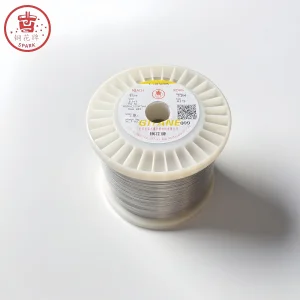
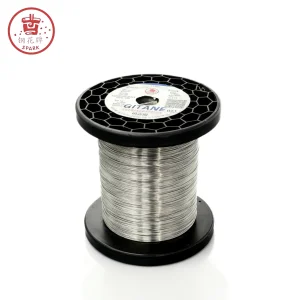
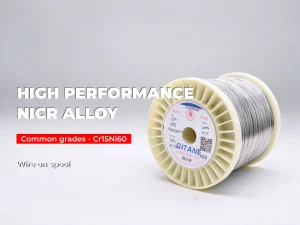
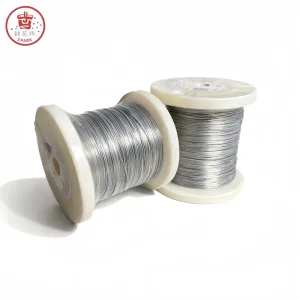
Round Wire & Fine Wire
Diameters: 0.05 mm to 12.0 mm (0.002" to 0.472").
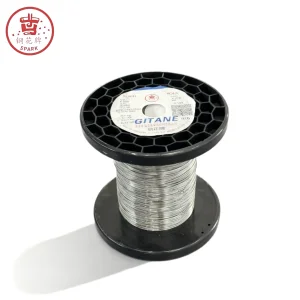
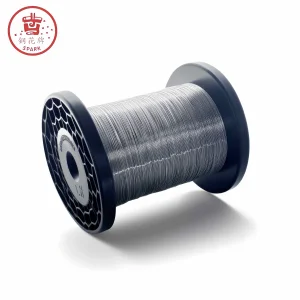
Delivery: Plastic spools (DIN 125, DIN 200, DIN 250), heavy wire carrier coils, or straight bars cut to length.
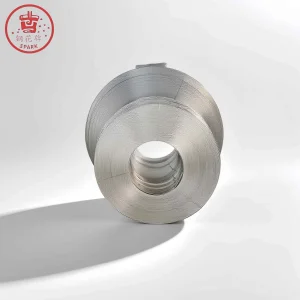
Flat Ribbon & Cold-Rolled Strip
Thickness: 0.10 mm to 4.0 mm.
Width: 0.5 mm to 120 mm.
Edge Options: Slit, rounded, or deburred smooth edges for automatic element coiling machinery.
Pre-Formed Heating Elements
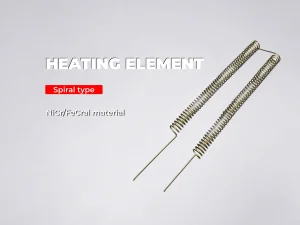
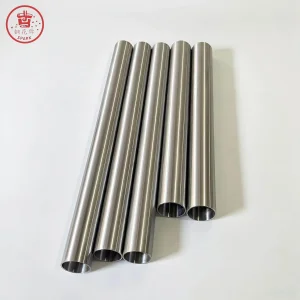
Ready-to-install spiral coils, meander/wave shapes, tubular elements, and heavy-gauge basket heaters manufactured precisely according to OEM technical drawings and terminal connections.
Customized Surface Treatments
Options include Bright Annealed finish, Acid-Pickled clean finish, Oxidized (Pre-oxidized alumina film), or Custom Coated surfaces tailored for specific furnace installation environments.
International Compliance & Dedicated Engineering Support
Comprehensive regulatory peace of mind coupled with direct metallurgical consultancy for thermal system optimization.
Certified Mill Test Reports (MTR)
Every shipment includes EN 10204 3.1 Certified Mill Test Certificates verifying actual chemical melt analysis, electrical resistivity at 20°C, physical dimensions, yield strength, and elongation performance.
RoHS, REACH & ISO Standards
Fully compliant with EU Directive RoHS (2011/65/EU and amendment 2015/863) and REACH hazardous substance regulations. Manufactured under certified ISO 9001 (Quality) and ISO 14001 (Environmental) systems.
Thermal System Engineering
Our staff of Senior Metallurgical Engineers provides complimentary element life estimation, surface load density calculations ($\text{W/cm}^2$), pitch-to-diameter optimization, and furnace retrofitting support.
Frequently Asked Questions by Industrial Buyers
Get expert answers regarding alloy selection, thermal behavior, and wholesale ordering procedures.
Why is FeCrAl preferred over NiCr alloys in carburizing and endothermic gas environments?
NiCr alloys are highly vulnerable to carbon absorption at temperatures between 800°C and 1050°C in carbonaceous gases with low oxygen partial pressure. This causes internal carburization and severe grain destruction known as "Green Rot". In contrast, our modified anti-carburization FeCrAl alloys rapidly grow a dense, self-healing Alpha-Alumina ($\alpha-\text{Al}_2\text{O}_3$) scale that serves as a impermeable structural ceramic barrier against carbon atom diffusion, dramatically increasing element working life.
What is the maximum surface load ($\text{W/cm}^2$) recommended for anti-carburization FeCrAl wire?
Recommended surface load depends heavily on furnace operating temperature and atmosphere. In a clean oxidizing atmosphere at 1100°C, surface loads of $2.5 - 4.0 \text{ W/cm}^2$ are standard. However, in heavily carburizing or endothermic atmospheres, reducing the design surface load to $1.2 - 2.0 \text{ W/cm}^2$ lowers element operating temperature relative to furnace ambient, reinforcing the oxide scale integrity and substantially extending life.
How should new anti-carburization FeCrAl heating elements be commissioned in a furnace?
Before introducing carburizing gas (such as methanol, natural gas, or endothermic gas), the newly installed elements MUST undergo a pre-oxidation cycle in clean air. Heat the furnace in atmospheric air to approximately 1050°C–1100°C, hold for 8 to 12 hours, and cool down naturally. This establishes a robust, uniform, protective alpha-alumina oxide layer across all wire surfaces.
What quality guarantees and tolerances are provided for wholesale wire orders?
All SPARK brand electrothermal alloys are manufactured strictly under ISO 9001 quality standards and GB/T 1234 standards. Wire diameter tolerance is guaranteed within ±0.002mm to ±0.01mm (depending on gauge), and electrical resistance per meter is maintained within ±3% (precision grade ±1.5%). Every batch is shipped with a full chemical analysis and physical testing Mill Test Report (MTR).
What are your typical lead times and minimum order quantities (MOQ)?
For standard wire sizes (0.5mm to 8.0mm in popular grades such as 0Cr25Al5, 0Cr23Al5, and HRE), we maintain significant safety stock with lead times of 3 to 7 working days. Custom vacuum-melted or specific non-standard ribbon dimensions carry a typical factory lead time of 15 to 25 days. Minimum order quantities start as low as 10 kg for sample validation up to full container wholesale loads.
Explore More Factory-Direct Heating Wire Solutions
Select from our comprehensive catalog of high-purity electrothermal alloys and custom furnace components.