Featured High-Performance Thermal Alloy Products
Explore our core catalog of precision resistance wires, FeCrAl/NiCr alloys, and high-temperature elements designed for demanding industrial furnaces and thermal applications.


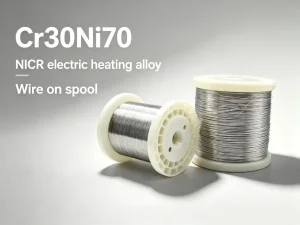



Metallurgical Foundations of Austenitic Nickel-Chromium Alloys
Austenitic nickel-chromium (Ni-Cr) electric heating alloys represent the metallurgical gold standard for mid-to-high end thermal applications worldwide. Characterized by a face-centered cubic (FCC) crystal structure, these alloys deliver exceptional structural integrity under severe thermal stress, defying the creep and embrittlement common to ferritic alternatives.
Protective Chromia Scale Dynamics
Upon initial thermal exposure, austenitic Ni-Cr alloys form an adherent, dense passivating surface scale primarily composed of chromium oxide ($\text{Cr}_2\text{O}_3$). This chromia layer acts as an ionic diffusion barrier, preventing rapid internal oxidation and guaranteeing thousands of hours of stable operational longevity without spalling during thermal cycling.
Ductility After Prolonged Heat
Unlike Ferritic Iron-Chromium-Aluminum (FeCrAl) alloys, which undergo severe grain growth and room-temperature embrittlement post-heating, Ni-Cr alloys retain high room-temperature ductility. Elements can be uncoiled, repaired, re-bent, or modified even after prolonged high-temperature exposure.
Exceptional Processability
The yield-to-tensile ratio and work-hardening coefficient of austenitic alloys permit extreme cold-forming capabilities. Wire-drawing factories can achieve micro-diameter tolerances ($\pm0.002 \text{ mm}$), tight winding pitch control, and flawless ribbon rolling for precision heating elements.
Technical Comparison Matrix: Ni-Cr vs. Alternative Alloys
| Alloy Grade / Parameter | Composition Nominal | Max Temp (°C) | Resistivity (μΩ·m, 20°C) | Post-Heat Ductility | Creep Resistance |
|---|---|---|---|---|---|
| Cr20Ni80 (Austenitic Benchmark) | 20% Cr, 80% Ni | 1200 | 1.09 | Excellent | High |
| Cr30Ni70 (High Cr Grade) | 30% Cr, 70% Ni | 1250 | 1.18 | Very Good | Superior |
| Cr15Ni60 (Standard Industrial) | 15% Cr, 60% Ni, Bal. Fe | 1150 | 1.11 | Good | Moderate |
| 0Cr25Al5 (Ferritic FeCrAl) | 25% Cr, 5% Al, Bal. Fe | 1250 | 1.42 | Poor (Brittle) | Low (Sags easily) |
| SPARK SGHT (PM FeCrAl) | Powder Metallurgy FeCrAl | 1425 | 1.45 | Moderate | High (Dispersion Strengthened) |
China Industry 4.0: Supply Chain Resilience & Manufacturing Precision
As a premier China manufacturer and global supplier under the Shougang Group legacy, our manufacturing modernizations bridge sixty years of metallurgical expertise with Industry 4.0 automated digital controls.
VIM + ESR Melting Precision
Every heat begins in Vacuum Induction Melting (VIM) furnaces, followed by Electroslag Remelting (ESR). This double-vacuum degassing process minimizes non-metallic inclusions, controlling dissolved gas content ($\text{O}_2, \text{N}_2, \text{H}_2 < 15\text{ ppm}$), guaranteeing ultra-homogeneous chemical distributions.
Continuous Closed-Loop Drawing
Utilizing high-speed multi-pass drawing machinery integrated with real-time laser micrometer feedback, our wires maintain dimensional tolerances down to $\pm 0.001\text{ mm}$. Continuous bright annealing in pure hydrogen atmospheres ensures bright oxide-free surfaces.
Supply Chain Security
Fully integrated vertical control—from raw nickel ore sourcing to final wire spooling or furnace tube assembly—eliminates raw material volatility and guarantees continuous lead-time predictability for international OEM order contracts.
Macro Industry Solutions & Thermal System Engineering
Modern industrial heat-processing equipment demands custom alloy selection tailored to atmospheric conditions, watt densities, and mechanical configurations.
Semiconductor & Photovoltaic Furnaces
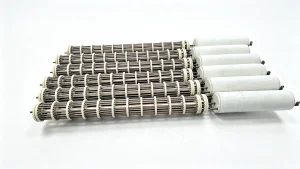
In high-purity diffusion, oxidation, and PECVD processing furnaces, non-magnetic Cr20Ni80 wires and high-temperature SGHT FeCrAl tubes prevent electromagnetic interference and micro-particle spallation, keeping cleanroom environments pristine.
Automotive Heat Treatment & Brazing
Continuous mesh-belt furnaces processing transmission gears, aluminum heat exchangers, and drive components require alloys with exceptionally high creep strength to prevent horizontal element sag under continuous power modulation.
Petrochemical & Process Heating
Direct-immersion tubular heaters and explosion-proof heat exchangers leverage our Cr15Ni60 and Cr20Ni40 alloy strip and wire, encased in corrosion-resistant sheath materials, delivering optimized surface watt loading ($W/\text{cm}^2$).
Global Procurement Requirements & Total Cost of Ownership (TCO)
Procurement directors and supply chain engineers evaluate thermal alloys beyond the upfront cost per kilogram. Our enterprise procurement frameworks are engineered to minimize lifetime operational downtime and reduce maintenance overhead.
1. Rare-Earth Element Optimization
By micro-alloying minute amounts of Yttrium (Y), Cerium (Ce), and Zirconium (Zr), SPARK alloys form a self-healing oxide barrier. This extends continuous life expectancy by up to 30% compared to standard commercial-grade NiCr wire, lowering the TCO dramatically.
2. Standardized Packaging & Spooling
To support high-speed automated element coiling machines, wire is shipped on precision plastic spools (DIN160, DIN200, DIN250) or in continuous pay-off coils up to 500 kg, eliminating snarls, uneven tension, or wire breakage during automated coiling.
3. Traceability & MTR Quality Proof
Every shipment is backed by a full EN 10204 3.1 Mill Test Report (MTR), detailing precise spectrographic chemical analysis, cold electrical resistance ($\Omega/\text{m}$), tensile strength, and elongation performance.
Technical Roadmap & Future Outlook (2025–2035)
The global industrial shift toward electrification, green hydrogen firing, and decarbonization demands next-generation thermal alloys capable of withstanding extreme environmental conditions.
Hydrogen Atmosphere Compatibility
As green hydrogen replaces natural gas in industrial kilns, heating elements must withstand dry hydrogen embrittlement and elevated reduction kinetics. Our R&D team is advancing grain-boundary engineered Ni-Cr-Al alloys optimized for $100\% \text{ H}_2$ atmospheres up to 1300°C.
Powder Metallurgy (PM) Dispersion
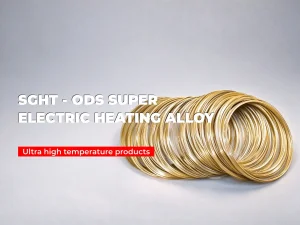
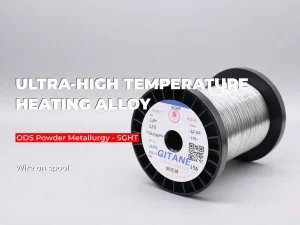
Extending beyond traditional ingot casting, oxide-dispersion-strengthened (ODS) powder metallurgy techniques create ultra-high temperature FeCrAl and NiCr matrices (such as SPARK SGHT), raising maximum continuous service thresholds up to 1425°C.
Additive Manufacturing Wires
Development of specialized alloy wire feedstock tailored for Wire Arc Additive Manufacturing (WAAM) and 3D plasma thermal spraying, enabling custom-printed radiant heating structures without manual bending or welding.
Localized Support, Global Compliance & Quality Assurance
Navigating international regulatory frameworks requires complete material safety compliance and rigorous quality systems. Shougang Gitane guarantees full adherence to international industrial standards.
ISO 9001 & ISO 14001 Certification
Our manufacturing processes operate under certified ISO 9001 Quality Management and ISO 14001 Environmental Management Systems, ensuring standardized quality from raw material melting through final dispatch.
REACH, RoHS & Conflict Minerals Compliant
All SPARK electric heating wires and ribbons strictly comply with EU REACH regulations and RoHS hazardous substance restrictions, backed by third-party SGS testing certificates for heavy metal safety.
Engineering Thermal Calculation Services
Our application engineers provide custom element design calculations, determining wire diameter, coil pitch, surface watt loading ($W/\text{cm}^2$), and voltage/power specs to optimize furnace life before procurement.
Technical Q&A: Intent Mining & Application Engineering
Comprehensive technical insights addressing key procurement, engineering, and metallurgical questions from industrial heating professionals.
Complete Heating Element & Industrial Alloy Selection
Explore additional high-grade electric heating tubes, specialized furnace wires, ceramic plates, and powder metallurgy FeCrAl alloys.