
Factory Direct Heating Elements & Wire Solutions (Part I)
Explore our flagship wholesale iron chromium aluminum and high-temperature nickel-chromium wire catalog, engineered for heavy-duty industrial furnaces and thermal systems.




1. Executive Metallurgical Overview & Fundamental Physics
Understanding the thermodynamics, crystallographic structure, and self-passivating alumina chemistry of wholesale Iron Chromium Aluminum (FeCrAl) resistance alloys.
In modern industrial electrothermal processing, Iron Chromium Aluminum (FeCrAl) resistance wire stands as the premier material class for converting electrical energy into high-temperature thermal energy. Characterized by a Body-Centered Cubic (BCC) ferritic crystal lattice, FeCrAl alloys exhibit exceptional electrical resistivity, high melting points, and an unequaled ability to resist high-temperature oxidation up to 1425°C (2597°F). When procuring wholesale resistance wire directly from leading manufacturing facilities, mechanical designers and furnace engineers must evaluate how chemical composition, grain growth kinetics, and passivating oxide dynamics govern long-term thermal performance.
The Thermodynamics of the Passivating Alpha-Alumina (α-Al₂O₃) Scale
The defining metallurgical advantage of FeCrAl resistance wire over conventional Nickel-Chromium (NiCr) alloys resides in its oxidation mechanism. When energized and heated in an oxygen-bearing atmosphere above 900°C, the aluminum content within the FeCrAl matrix selectively migrates to the surface, reacting with ambient oxygen to form a continuous, thermodynamically ultra-stable layer of alpha-alumina (α-Al₂O₃). In contrast, NiCr alloys form a chromia (Cr₂O₃) surface scale, which experiences volatility and rapid degradation when exposed to operating temperatures exceeding 1200°C.
Information Gain Insight: The passivating α-Al₂O₃ layer formed on FeCrAl wire acts as an exceptional electrical insulator and oxygen barrier. Because α-Al₂O₃ possesses a significantly lower growth rate constant compared to Cr₂O₃, element degradation via oxidation proceeds exponentially slower in FeCrAl, extending element service life in continuous high-temperature kilns by up to 200–300% compared to NiCr alternatives.
Furthermore, FeCrAl wire features a lower specific density ($7.10 \text{ g/cm}^3$) compared to NiCr ($8.40 \text{ g/cm}^3$). For industrial furnace builders purchasing wholesale resistance alloy wire by total mass, this density advantage delivers up to 15–18% more linear meters of wire per kilogram, yielding substantial raw material cost savings alongside superior thermal rating.
2. Technical Grade Matrix & Physical Property Comparison
Detailed chemical formulations, thermal capabilities, and electrical standards according to GB/T 1234-2012, ASTM, and DIN standardizations.
Selecting the correct wholesale iron chromium aluminum resistance wire grade requires matching furnace atmosphere, physical element mounting, operating cycle frequency, and surface load density ($W/cm^2$). The engineering table below outlines the core physical properties of leading industrial FeCrAl alloys produced across specialized Beijing Shougang Gitane manufacturing lines.
| Alloy Grade | Nominal Composition | Max Temp (°C) | Resistivity (μΩ·m @ 20°C) | Density (g/cm³) | Primary Industrial Application |
|---|---|---|---|---|---|
| SGHT (Powder Met) | Fe-Cr25-Al6 + Reactive Rare Earths (RE) | 1425°C | 1.45 | 7.10 | Semiconductor diffusion, crystal growth, ultra-high temp kilns |
| SGHYZ / HRE | Fe-Cr26-Al5.5 + Yttrium (Y) / RE Micro-alloying | 1400°C / 1350°C | 1.42 | 7.10 | Heavy industrial furnaces, ceramic sintering, radiant tubes |
| 0Cr21Al6Nb | Fe-Cr21-Al6-Nb0.5 (Niobium stabilized) | 1350°C | 1.45 | 7.10 | Industrial heat treating, high-power heating elements, furnaces |
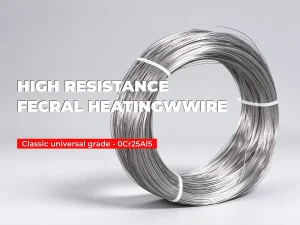
| 0Cr25Al5 | Fe-Cr25-Al5 (Standard High-Temp) | 1250°C | 1.42 | 7.10 | Kilns, industrial heat treating, domestic electric heating |
| 0Cr23Al5 / SG140 | Fe-Cr23-Al5 | 1250°C | 1.35 | 7.15 | Tempering furnaces, brake resistors, heating cassettes |
| Cr20Ni80 (NiCr) | Ni80-Cr20 (Austenitic) | 1200°C | 1.09 | 8.40 | Frequent thermal cycling appliances, medical equipment |
Micro-Alloying Breakthroughs: Rare Earth Element (RE) Additions
In high-grade FeCrAl resistance wire such as 0Cr21Al6Nb, HRE, and SGHYZ, precise fractions of Niobium (Nb), Yttrium (Y), Zirconium (Zr), and Lanthanide elements are added. This micro-alloying technique anchors the growing α-Al₂O₃ scale to the parent alloy matrix via "reactive element pegging." Consequently, thermal spallation—the flaking off of protective oxide during heating and cooling cycles—is virtually eliminated, dramatically improving element service life under variable power modulation.
3. Localized Application Scenarios & Engineering Integration
From solar photovoltaic crystal growth to automotive heat treatment, discover how industrial plants integrate wholesale FeCrAl wire into tailored heating elements.
Solar PV Silicon Crystal Growing
Monocrystalline silicon ingot furnaces require continuous, ripple-free thermal output at temperatures above 1350°C. High-purity FeCrAl wire (HRE and SGHYZ) maintains structural integrity without thermal sagging, enabling long crystal pull runs without heater failure.
Automotive & Electric Vehicle Supply Chains
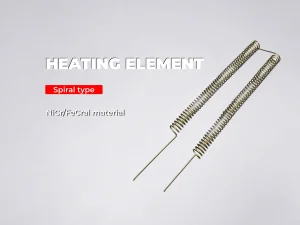
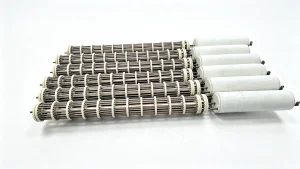
Automotive gears, bearings, and EV powertrain components undergo carburizing, nitriding, and tempering in large roller-hearth furnaces. Pre-coiled FeCrAl spiral elements housed in radiant ceramic tubes guarantee uniform case hardening across high-volume production batches.
Advanced Ceramic Sintering & Kilns
Dental zirconia, structural alumina, and technical ceramic components demand extreme thermal uniformity without contamination. FeCrAl's non-shedding, white alumina outer scale prevents metallic particle flaking that would otherwise stain high-purity ceramic workpieces.
Petrochemical & Process Heavy Industry
Large-scale gas cracking tubes, heat exchangers, and heavy industrial duct heaters rely on heavy-gauge FeCrAl strip and wire coils. High specific electrical resistance reduces space requirements while delivering multi-megawatt heating capacity.
4. Technical Roadmap & Future Metallurgical Outlook
Next-generation powder metallurgy, Dispersion-Strengthened Alloys (ODS), and sustainable green steelmaking processes.
Historically, the primary limitation of ferritic iron chromium aluminum resistance wire was its susceptibility to grain coarsening at temperatures exceeding 1100°C. As grain boundaries grow larger, the alloy loses hot tensile strength, becoming prone to thermal creep, deformation, and sagging under its own weight when hung horizontally or vertically without ceramic supports.
Powder Metallurgy (PM) & Oxide Dispersion Strengthened (ODS) FeCrAl Alloys
To overcome high-temperature creep, Beijing Shougang Gitane's metallurgical R&D team developed advanced Powder Metallurgy (PM) SGHT grade wire. Instead of conventional ingot melting, atomized metallic powders are blended with sub-micron yttrium oxide ($Y_2O_3$) particles and consolidated through Hot Isostatic Pressing (HIP) followed by hot extrusion and cold wire drawing.
Next-Gen Performance: The uniformly dispersed nanoscale oxide particles pin grain boundaries in place, preventing grain growth up to 1425°C. ODS FeCrAl wire achieves a 400% increase in high-temperature creep strength compared to standard 0Cr25Al5 wire, enabling furnace designers to construct un-supported hanging element configurations without danger of geometric deformation.
Green Metallurgy & Decarbonized Heating Solutions
As global industries transition away from fossil-fuel burner combustion toward zero-emission electric heating, the demand for large-capacity, high-voltage FeCrAl resistance bundles is accelerating. Future technical roadmaps focus on ultra-clean vacuum induction melting (VIM) to eliminate interstitial gas impurity levels (carbon, nitrogen, sulfur below 50 ppm), ensuring maximum cold ductility, seamless automated coil winding, and longer service life.
5. China Factory Supply Chain Resilience & Manufacturing Synergy
Inside Beijing Shougang Gitane's 88,000 m² state-of-the-art production complex—delivering uncompromised quality from raw ingot melt to finished wire coils.
For international buyers, OEM furnace manufacturers, and distributor networks searching for reliable wholesale iron chromium aluminum resistance wire factory direct supply, manufacturing consistency is paramount. As a key member of the state-owned Shougang Group, Beijing Shougang Gitane New Materials Co., Ltd. represents over 60 years of specialized metallurgical leadership.
Fully Integrated End-to-End Production Infrastructure
Spanning an 88,000 m² industrial facility with 39,268 m² of specialized workshops in Changping, Beijing, our factory operates a fully vertically integrated manufacturing supply chain:
- Raw Material Control & Melting: High-purity iron, electrolytic chromium, and virgin aluminum melted in Vacuum Induction Furnaces (VIM) and Electro-Slag Remelting (ESR) units to eliminate inclusions.
- Hot Forging & Rolling: Heavy hydraulic forging presses and precision continuous wire rod rolling mills transform ingots into uniform billets and master wire rods.
- Precision Cold Drawing: Multi-pass automated diamond die wire drawing machines pull wire down to micro-fine diameters (from Ø 10.0 mm down to Ø 0.05 mm) with micron-level dimensional tolerances.
- Continuous Hydrogen Bright Annealing: In-line protective atmosphere furnaces restore cold-work ductility, imparting a bright, silver-clean, oxide-free surface finish.
- Rigorous Testing Protocols: Every production batch undergoes full electrical resistance testing (μΩ·m), automated eddy-current defect inspection, metallographic grain structure analysis, and high-temperature accelerated oxidation life testing per GB/T 1234-2012 standards.
Operating under strict ISO 9001:2015 quality management systems (certified since 1996), Shougang Gitane maintains deep raw material reserves and optimized energy logistics. This structural efficiency guarantees fast lead-times, competitive wholesale direct-factory pricing, and complete mill test report (MTC 3.1) traceability for global engineering projects.
6. Localized Support, Regulatory Compliance & Quality Assurance
Global logistics, customized wire packaging, technical surface load calculation support, and international cross-referencing.
Procuring wholesale resistance heating alloy wire across international borders requires rigorous compliance with packaging, technical documentation, and electrical verification standards. Shougang Gitane provides end-to-end engineering support to simplify procurement for global clients.
Mill Test Certification (MTC 3.1)
Every shipment is accompanied by certified chemical heat analysis, room-temperature resistivity measurements, mechanical tensile values, and dimensional tolerance inspection logs compliant with EN 10204 3.1.
Export-Grade Protective Packaging
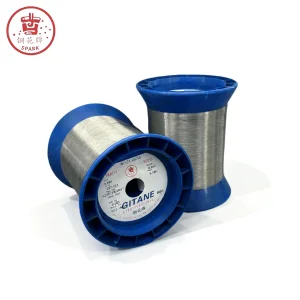
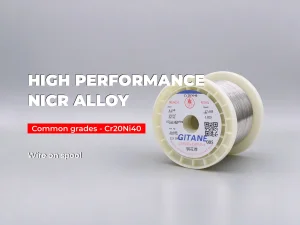
FeCrAl wire is supplied on precision plastic spools (DIN 160, DIN 200, DIN 250), wrapped in moisture-proof vacuum foil, and packed inside sturdy, ISPM-15 compliant fumigated wooden crates to prevent surface oxidation or physical distortion during sea transport.
Engineering Thermal Calculations
Our in-house technical staff provides complimentary surface power load calculations ($W/cm^2$), coil stretch ratio optimization, and cold-end connection sizing to prevent premature element burnout in custom furnace builds.
Factory Direct Heating Elements & Wire Solutions (Part II)
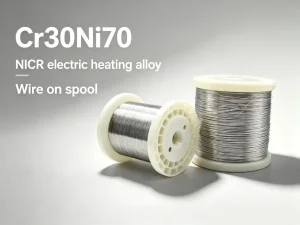
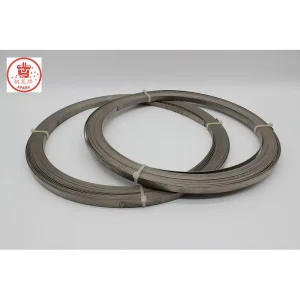
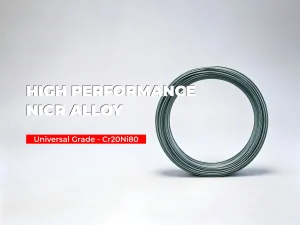
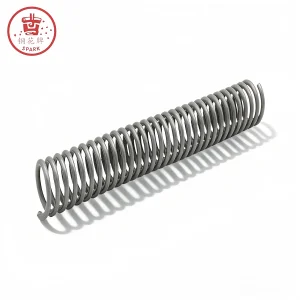
Explore additional high-grade FeCrAl strip, spiral heating cores, and nickel-chromium resistance wire variants engineered for demanding industrial environments.

7. Frequently Asked Questions (FAQ)
Comprehensive engineering and procurement answers regarding wholesale iron chromium aluminum resistance wire sourcing and performance.